KOKorean
 ENEnglish
 JP日本語
 CN中文(简体)
 TW中文(繁體)


Old Scar Treatment in Seoul: Can a 10-Year-Old Scar Still Improve?
Yes, an old scar can still improve. Scars settle within about a year, sometimes longer, so a ten-year-old scar can change with treatment, not with waiting: a wide scar can be cut out and closed again as a fine line, a depressed scar released and filled, and surface texture and thickness refined with laser. White color and lost hair follicles in the scar are the hardest to restore, so the realistic goal is a less noticeable scar rather than no scar. If you are considering treatment in Seoul, you can send photos of your scar to see which approach may fit your case.
Curious about your own case? Ask us online →
What makes a ten-year-old scar different from a new one?
A wound turns into a scar in three phases. In the first days, inflammation clears up the wound. Over the next few weeks, new tissue fills the gap and the surface closes. The last phase is remodeling, when the scar is rebuilt from the inside.
A review of scar research (a paper that gathers and summarizes earlier studies) describes remodeling as lasting from months to over a year. During this time, the collagen laid down in a hurry at first (collagen is the protein fiber that gives skin its strength) is replaced by a sturdier type, and the fibers gradually line up. The scar becomes thinner and softer. Many of the small blood vessels that formed early on disappear, so the redness fades too.1
One study followed this process for a full year. Researchers made small 1 cm incisions on the inner upper arms of 58 healthy men, photographed the scars every month and examined tissue samples under a microscope at set times. The scars matured through a series of defined stages over about one year. The pace varied: men over 55 matured quickly, while those under 30 stayed in an active, changing state for longer.2
Put simply, most of the change a scar makes on its own happens in roughly its first year, sometimes a little longer. A scar that is ten years old is long past that point; it is a mature scar. Rather than waiting for it to change further, treatment planning starts from what makes it noticeable today. If your scar is less than a year old, our guide to when to treat a surgical scar explains what can be done at each stage.
What happens inside a scar during its first year
How is a mature scar different from normal skin?
A settled scar may look quiet, but inside it is not the same as the skin around it. The review summarizes adult scar tissue like this:1
- The collagen bundles are not woven evenly as in normal skin.
- The outer layer of skin (the epidermis) is flattened.
- Skin appendages such as hair follicles, oil glands and sweat glands do not grow back.
- A healing wound regains about 20% of normal skin strength at three weeks and 70 to 80% at six weeks, but it never reaches the full strength of uninjured skin.
You can see these differences from the outside. The surface of the scar has no pores and looks smooth and different in texture from the surrounding skin. A scar that crosses an eyebrow or beard area has no hair.
That is why some features stay much the same even ten years later:
- Width: a scar that has spread wide does not narrow over time.
- Height: a scar whose floor is stuck to the tissue below does not rise by itself. Some scars, on the other hand, stay raised.
- Direction: a line that runs across the skin's natural tension lines (the direction of facial creases) stands out more when you make expressions.
- Color: skin that has turned white rarely returns to the surrounding color.
- Texture: a smooth surface without hair or pores looks different from the skin around it.
In many depressed scars, the floor of the scar is stuck to deeper tissue, and the layer of fat under the skin has thinned or disappeared. These are called adherent (tethered) scars. Because the gliding layer under the skin is missing, smoothing the surface alone does not bring the scar level.4
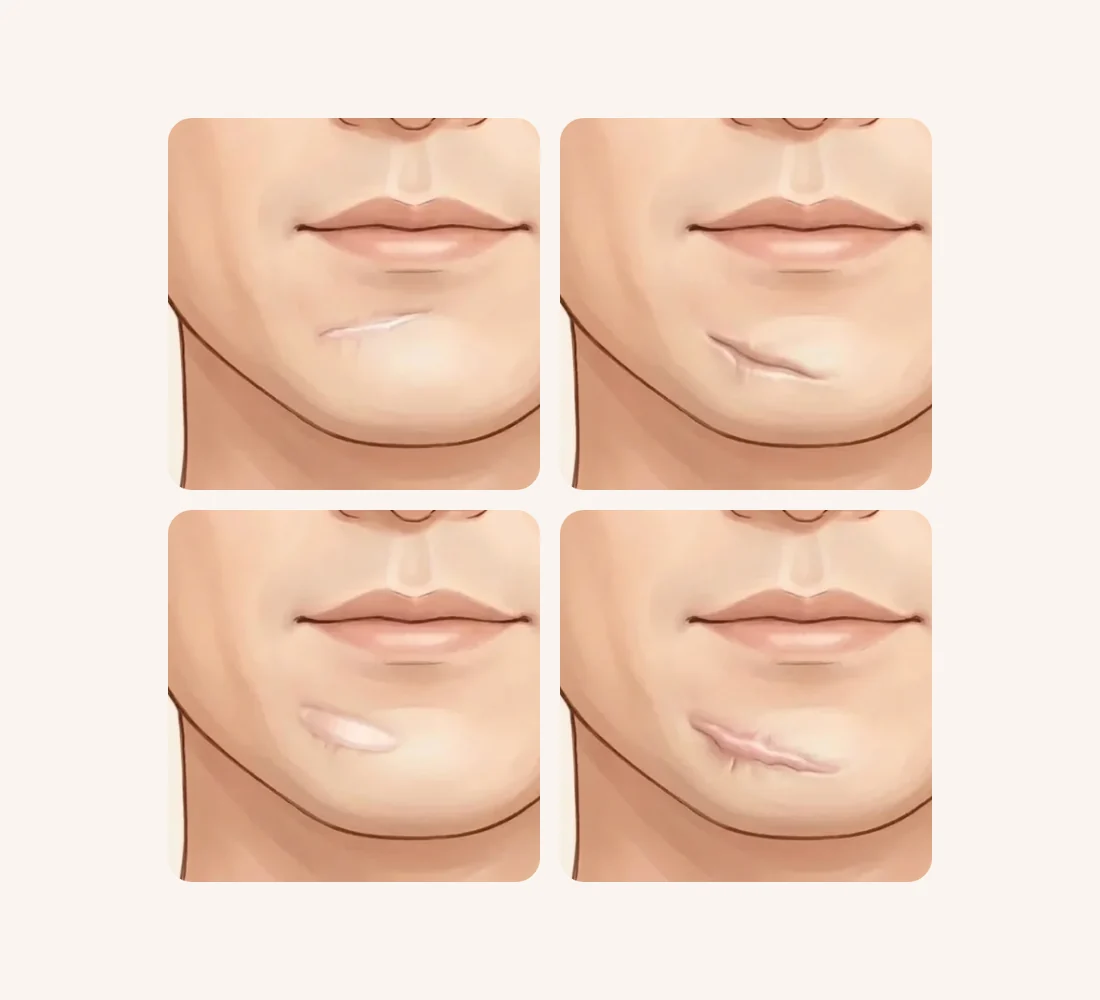
What an old scar can look like in the mirror
Even among old scars, the appearance points to different first steps.
A scar ten years on: if it looks like this
1A flat, white line
If the height is fine, texture and width are refined; the white color itself is the hardest part
Laser, re-closure
2Sunk below the surface, casting a shadow
The tethering under the floor is released and missing volume filled with your own fat
Release, fat grafting
3A wide, band-like scar
It can be cut out and closed again as a fine line, with the skin's tension lines in mind
Excision, re-closure
4Still raised after years
Whether it is a keloid is settled first, and the treatment order follows from that
Hypertrophic scar, keloid
It is common for one scar to combine two or more of these. A wide scar, for example, may be sunken in the middle and white in color. In that case the plan starts from whichever feature stands out most.
Can an old scar still change with treatment?
Yes, it can. Studies of scars that had already matured have reported changes. How much changes depends on the method and on the scar, though, and not every measure improved.
Laser: a study of mature burn scars
A fractional CO2 laser makes tiny columns of injury in the skin, close together, which the skin then fills in as it heals. A US burn center carried out a prospective study (one planned in advance and followed forward in time) of this laser on mature burn scars. In the same patients, 48 scars were treated and 32 scars were left untreated for comparison, and the treated scars received three laser sessions.3
All treated scars showed some improvement. Measured thickness, sensation, redness and pigmentation improved significantly compared with the untreated scars over the same period. On the Vancouver Scar Scale (VSS, where a higher score means a more noticeable scar), an independent observer's score fell from 8 to 6. Elasticity improved, but not to a statistically significant degree, and patients reported the same levels of pain and itch in both groups.3
Fat grafting: a study of scars twenty years old on average
A Dutch research group followed 46 people with adherent scars for one year. The scars were on average 20 years old (plus or minus 17 years), and most were burn scars. Twelve months after fat grafting, patients rated their scars as improved. The largest change was in pliability, which fell from 7.4 to 5.8 on the patient scale (lower scores are closer to normal skin), and the patients' scores for pain, itch and color also improved significantly.4
Clinicians also rated pliability as the most improved feature, but their change was not statistically significant. Pliability, redness and pigmentation measured with devices showed no significant difference at twelve months. The same group had earlier reported more than a 20% improvement in pliability using fat processed by a different method, so the way fat is prepared may affect results.4
In plain terms, a scar twenty years old can feel softer to the person who has it, even when machine measurements do not clearly change. Most scars in both studies were burn scars, so the findings cannot simply be carried over to small facial scars. Still, they run against the idea that a scar is simply too old to work on.
What can each method change, and where are its limits?
With an old scar, the first step is to separate what is making it noticeable. Width, height, surface and color are problems in different layers of the skin, so each needs a different method. Not every method is used on every scar; only what the scar needs is chosen and put in order.
Wide or misdirected scars: cutting out and closing again
The most basic method is to cut the scar out and close the wound again in a straight line. According to the 2018 review, this works when the surgeon can prevent whatever caused the original scar, such as excessive tension pulling the wound apart, or infection. If the scar runs across the skin's tension lines, a Z-plasty can change the direction of the line. Because a Z-plasty also adds length, it is especially useful for scars that have contracted. W-plasty and geometric broken-line closure change the direction of the line without adding length.1
There are trade-offs. The re-closed line is a new scar, and it goes through its own settling period. Keloids often come back after simple excision, so they need to be identified before surgery.1 If you are not sure whether a raised scar is a keloid, see our guide to telling keloids and hypertrophic scars apart.
Depressed scars: releasing what holds them down and filling the gap
When the floor of a scar is stuck to the tissue below, a shadow remains however much the surface is refined. The fibers holding the floor down (the tethering) are cut to free the skin, and the thinned or missing fat layer under the skin is rebuilt with your own fat. The 2024 Dutch study describes fat grafting, mostly combined with release, as the main way to rebuild this layer.4
Looking across many studies points the same way. A meta-analysis (a study that pools and recalculates the results of earlier studies) of 45 studies and 3,033 patients who had fat grafting for scars or fibrosis (tissue that has become stiff) found significant improvement in scar assessment scores, most clearly in stiffness and pliability. On average, 1.4 procedures were needed to reach the desired result, and minor complications occurred in 4.8% of procedures.7 An average above one means that a single session is not always enough.
As the Dutch results show, though, the change a patient feels and the change devices measure may differ, and how much of the fat settles varies from person to person. Our guide to depressed facial scars explains release (subcision) with illustrations.
Narrow, deep pits: lifting the floor
For narrow, deep scars that look as if they were made with an awl, filling a wide area is not the right fit. Instead, the floor of the pit alone can be cut free in a small round piece and lifted to the level of the surrounding skin (punch elevation). At Bonita Clinic, we do this without stitches.
Surface texture, thickness and redness: laser
Lasers work mainly within the skin layers (the epidermis and dermis), refining texture, thickness and redness. As in the burn scar study above, measures such as thickness and redness can improve even in mature scars.3 Lasers cannot, however, release tethering in the fat layer under the skin or replace lost volume, so they cannot lift a shadow caused by a floor pulled down from below. That is why they are mainly used to refine remaining texture and color after the height has been leveled. How many sessions and how far apart is covered in our guide to scar laser sessions and intervals.
What each method mainly changes, and what to know
| Method | Mainly changes | Good to know |
|---|---|---|
| Excision, re-closure | Width · direction of the line | Leaves a new line that needs time to settle |
| Release (subcision) | A floor pulled down from below | Large volume loss also needs filling |
| Fat grafting | Lost volume · stiff tethering | How it feels and what devices measure can differ · may need more than one session |
| Punch elevation | Narrow, deep pits | Suited to narrow scars |
| Laser | Surface texture · thickness · redness | Cannot lift a deep floor · several sessions apart |
Why are white color and lost hair the hardest to restore?
In an old scar, the most difficult thing to change is skin that has turned white. A systematic review of treatments for white (hypopigmented) scars describes them as challenging to treat, because effective treatments are lacking and improvements often do not last.5
The review gathered five studies (87 patients) in which a laser created tiny channels in the skin before applying a medicine that darkens skin color. Results were generally favorable, but the studies used different devices, numbers of sessions and follow-up times, and the authors concluded that larger randomized trials are needed.5 In other words, ways to bring white skin back to its original color are still being studied. The improvement in pigmentation in the burn scar laser study did not look at white scars separately either.3
Hair is similar. As described earlier, hair follicles do not grow back inside scar tissue.1 Treatment can make a scar crossing an eyebrow or beard narrower or more level, but it cannot make hair grow in the scar itself.
So the aim of treating an old scar is to make it less noticeable, not to make it disappear. Narrowing the width, leveling the height and refining the surface can make even a white line less conspicuous. How far to go is decided together at consultation, with the scar in front of us.
What if a scar that has been quiet for years starts to change?
A mature scar usually changes little. If a scar that has been quiet for years begins to change, an examination comes before any cosmetic treatment.
- It turns red again, grows, itches or hurts: it may be a keloid that is still growing. Whether it spreads beyond the edges of the original wound is checked.
- It breaks down into sores that keep coming back or do not heal: the cause needs to be found.
- A new firm lump appears on or beside it, it bleeds, or it grows quickly: whether a biopsy is needed is checked.
It is not common, but skin cancer can develop in old scars or long-standing wounds; this is called a Marjolin's ulcer. A systematic review of reports published between 2000 and 2019 found that, in long-standing scars and wounds, the cancer appeared after about 20.75 years on average. Squamous cell carcinoma (a cancer of the cells in the outer layer of skin) was the most common type, and the legs were the most common site. The authors recommended early coverage with skin grafts or flaps for chronic wounds and burn scars.6
In short, a decades-old scar that suddenly behaves differently should not be ignored. If you notice changes like these, see a dermatologist or plastic surgeon for an examination before seeking scar revision.
How we approach it at Bonita Clinic
Cell-based scar treatments such as stem cells, however, have not yet been clearly proven effective in people.1 Researchers also note that the added effect of stem cells or other supplements in fat grafting still needs to be measured.7
The order we follow
- 1AssessmentDepth, width, tethering, lost volume
- 2LevelingRelease, fat grafting or punch, as needed
- 3ReshapingWide or thick lines re-closed along skin creases
- 4Texture and colorTwo or three lasers suited to the scar type
- 5Follow-upMore only if marks remain
Surgical restoration is performed under local anesthesia or sedation, you go home the same day, and stitches are removed afterward. Right after treatment the area is protected, and we tell you when you can start washing your face and wearing makeup, depending on the treatment. During recovery, redness and swelling settle gradually, and sun protection becomes important from this point. How to look after a stitched scar is covered in our guide to silicone gel, tape and sunscreen after surgery. Recovery time and the number of follow-up visits depend on the extent of treatment and on each person, and side effects such as bleeding, infection or inflammation can occur. The actual plan is decided after an in-person examination.
Treatment options you can discuss in Seoul
Since opening in 1995, Bonita Clinic has been in the same place, and Dr. Kwang-Seop Jung, a board-certified plastic surgeon (Brazil), has led its care throughout. For an old facial scar, what you can discuss at consultation is the approach on our treatment page:
- Release of tethering under depressed scars (subcision)
- Fat grafting, with combined regenerative treatment using stem cells (cell-based scar treatments are still being studied1)
- Excision and re-closure of wide or thickened scars along skin creases
- Punch elevation for narrow, deep pits, done without stitches
- Combined laser treatment for remaining redness, pigment and texture
Which of these you need, and in what order, is decided only after an examination. Scars on the arms, legs or body are covered on our depressed and incision scars of the body page, and scars from accidents on our accident scars page.
Why do the plan and cost differ from scar to scar?
Two people who both say "my scar is ten years old" can need very different treatment. What shapes the plan, and therefore the cost, is which features make the scar noticeable and which methods are combined to address them.
- Which features stand out: width, depression, texture, color
- Size, number and location of the scars
- Methods combined: excision, release, fat grafting, laser
- Anesthesia: local or sedation
- Number of stages, which varies by scar
- Earlier treatments or surgery on the scar
Final plan and quote after an in-person exam
A final estimate is given only after an in-person examination, once the depth, tethering and lost volume are clear. Photos help narrow down the options; the extent of treatment is settled at an examination.
What can photos show, and what needs an in-person exam?
Photos are a good way to start, because much of what makes an old scar noticeable is visible. What lies under the surface, however, has to be felt and seen in person.
Photos can show
- Where the scar is and how long it is
- Rough width and direction
- Color: white, red or brown
- Shadows that hint at a depression
- Missing hair along the scar
Needs an in-person exam
- How deep it is and whether the floor is tethered
- How much volume is missing underneath
- Firmness, and how it moves with expression
- Whether a raised scar is a keloid
- Recent changes: sores, lumps, bleeding
Helpful photos: the scar from the front and at 45 degrees on both sides in daylight, plus one with light coming from the side so that any shadow shows. A close-up with a ruler or coin beside the scar helps with size. Tell us what caused the scar, roughly how old you were, and what treatments you have had. Our guide to taking photos for an online consultation shows how to set up the light and angles. You can send us a message with your photos and a short description of what bothers you most.
Planning your visit and recovery
What is confirmed in advance is the treatment information above: surgical restoration under local anesthesia or sedation, same-day discharge, and stitches. Laser care generally has a shorter recovery, while surgical restoration needs more time depending on the area and extent. Because old scars are often treated in stages, and the number varies from scar to scar, whether everything fits into one trip or needs return visits depends on your plan. How long to stay in Seoul, when stitches come out and when the next stage can follow are planned together with you at consultation.
Expect redness and swelling at first, settling gradually. After you return home, protect the area from the sun as advised, and contact a doctor promptly if pain, redness, swelling or discharge increases instead of settling. Dated photos taken in the same light make it easier to follow the result as the treated area matures, a process that takes months, as described above.1 Our guide to planning a scar-treatment visit to Seoul explains how photo consultation, examination, treatment and stitch removal usually fit into a trip.
Real treatment cases
These cases are from our facial depressed and incision scars page. How old each scar was and how it was treated differ from case to case, and results vary from person to person.
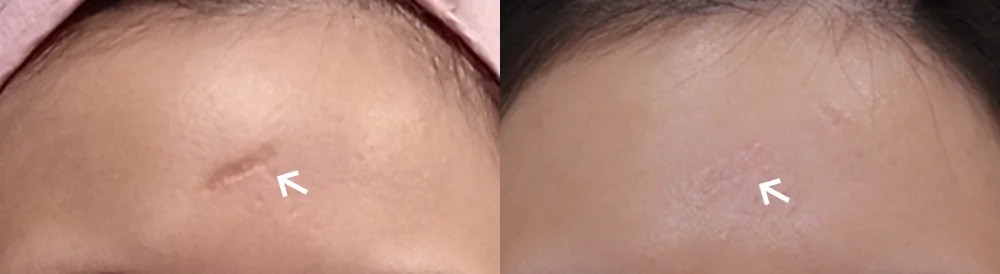
A short, depressed line scar on the forehead
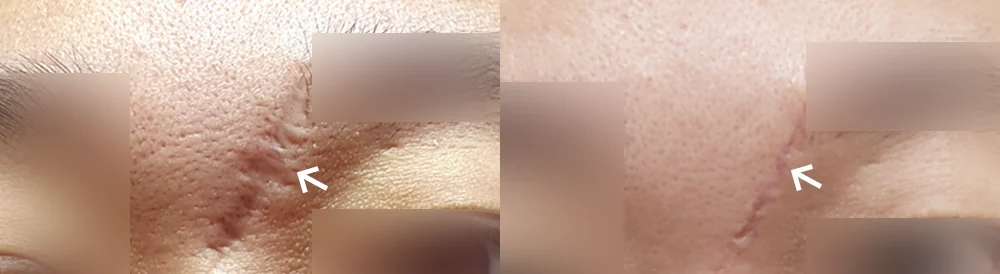
A jagged, depressed line scar near the area between the eyebrows
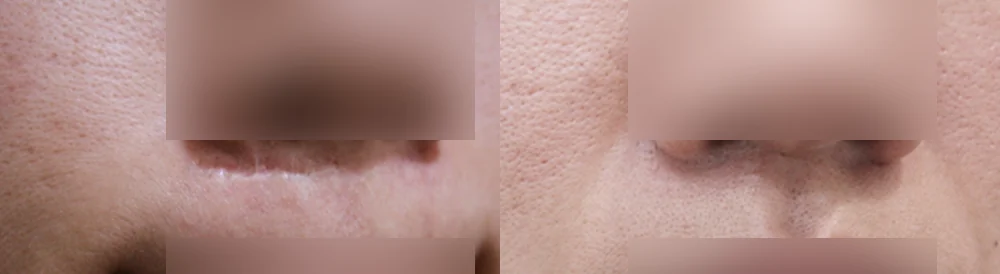
A white horizontal line scar under the nose
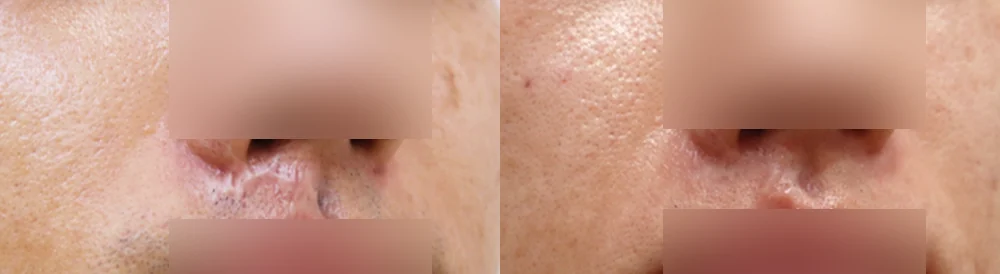
An uneven scar on the upper lip below the nostril
* Results vary from person to person. Side effects are possible, so please decide after a thorough consultation with a doctor.
Frequently asked questions
Does an old scar take longer to treat than a new one?
It can. Settled scars often have a firmly tethered floor or lost volume, so release and filling steps are often added. In a meta-analysis of fat grafting studies, an average of 1.4 procedures was needed to reach the desired result.7 Being old does not rule a scar out, though: even in a study of scars twenty years old on average, patients reported changes they could feel.4 The plan is based on the scar's current width, depth, tethering and color rather than its age.
Will treatment make my scar disappear?
Treatment makes a scar less noticeable; it does not erase it. When a scar is cut out and closed again, a new line remains, and hair follicles and sweat glands do not grow back in scar tissue.1 A realistic goal is to reduce the difference from the surrounding skin by refining width, height and surface.
How many treatments does an old scar need, and over how long?
It depends on the scar's depth, extent and your skin type. At Bonita Clinic, the number of surgical and procedural restoration stages is not fixed; it varies from scar to scar, and laser is added only if marks remain after we review your progress. When laser is used, it is often repeated several times with intervals in between. A re-closed line is a new scar, so it takes months to over a year to settle.1
No hair grows where a scar crosses my eyebrow. Will treatment bring it back?
Scar treatment alone will not, because hair follicles do not grow back in scar tissue.1 The line can be made narrower or more level so that it shows less, so the area of missing hair and the shape of the scar are checked together at consultation.
My old scar has recently started to itch and grow. What should I do?
A settled scar that turns red and grows again may be a keloid that is still active, so it is checked at an examination. If it has broken down and will not heal, or a new firm lump has appeared, another condition is possible, rarely, so finding the cause comes before any cosmetic treatment.6
Before your consultation
- What caused the scar (a fall, an accident, surgery, acne) and roughly how old you were
- Treatments you have had: re-closure, laser type and number of sessions, fillers or fat grafting, scar injections
- Photos in daylight from the front and at 45 degrees, plus one with side lighting that shows any shadow
- Whether the scar has grown, itched or broken down in recent years
- What bothers you most: width, depression, color, how well makeup covers it, or pulling when you make expressions
Bonita Clinic is on the 3rd floor of 565 Gangnam-daero, Seocho-gu, Seoul, about 100 m on foot from Exit 8 of Nonhyeon Station (Line 7). You can read more on our facial depressed and incision scars page. For scars from injuries, our accident scar treatment guide explains how timing changes the options.
References (7)
Sources that support the explanations in this article. Study findings describe general trends and do not guarantee individual results.
- Marshall CD, Hu MS, Leavitt T, et al. Cutaneous Scarring: Basic Science, Current Treatments, and Future Directions. Adv Wound Care (New Rochelle). 2018;7(2):29-45.doi:10.1089/wound.2016.0696Review (full text): remodeling lasts months to over a year, with type III collagen replaced by type I, more organized fibers and regressing vessels; wound strength rises from 20% at three weeks to 70–80% at six weeks but never reaches normal; adult scars have disorganized collagen, a flattened epidermis and no hair follicles, oil or sweat glands; excision works when the original cause can be prevented; Z-plasty reorients and lengthens, W-plasty and broken-line closure reorient without lengthening; keloids often recur after simple excision
- Bond JS, Duncan JAL, Sattar A, et al. Maturation of the human scar: an observational study. Plast Reconstr Surg. 2008;121(5):1650-1658.doi:10.1097/PRS.0b013e31816a9f6fObservational study (abstract): 1 cm incisional scars on the upper arms of 58 healthy men followed monthly for 12 months with photographs and histology; scars matured through defined stages over about one year, faster in men over 55 and more slowly in those under 30
- Blome-Eberwein S, Gogal C, Weiss MJ, et al. Prospective Evaluation of Fractional CO2 Laser Treatment of Mature Burn Scars. J Burn Care Res. 2016;37(6):379-387.doi:10.1097/BCR.0000000000000383Prospective study (abstract) of fractional CO2 laser on mature burn scars, 48 treated and 32 control scars in the same patients: all treated scars improved; thickness, sensation, erythema and pigmentation improved significantly versus controls; elasticity not significant; observer VSS 8 to 6; patient-reported pain and itch unchanged
- Rijpma DD, Jaspers ME, Pijpe A, et al. A one year follow-up on quality of adherent scars after autologous fat grafting processed by a filtration technique. Burns. 2024;50(9):107252.doi:10.1016/j.burns.2024.08.018Cohort study (abstract): fat grafting with release is the main way to rebuild the subcutaneous layer; 46 adherent scars with a mean age of 20 years, mostly burns, followed for 12 months; patient ratings improved (pliability 7.4 to 5.8; pain, itch and color also significant), clinician pliability not significant, device-measured pliability, erythema and melanin unchanged; an earlier study with a different fat processing method reported over 20% better pliability
- Rambhia PH, Pagan AD, Lal K, Goldberg D. Laser-Assisted Prostaglandin Analogs in the Treatment of Hypopigmented Scars: A Systematic Review. J Clin Aesthet Dermatol. 2023;16(9):28-32.Systematic review (full text): hypopigmented scars are challenging to treat because effective treatments are lacking and results are often transient; five studies (87 patients) of laser-assisted delivery of pigment-stimulating medicine reported favorable results, but methods varied and larger randomized trials are needed
- Burusapat C, Wanichjaroen N, Wongprakob N, Satayasoontorn K. Characteristics of Marjolin's Ulcers in 21st Century: A Retrospective Study, Systematic Review, and Surgical Guideline Recommendation. J Burn Care Res. 2021;42(2):152-166.doi:10.1093/jbcr/iraa196Retrospective study and systematic review (abstract) of Marjolin's ulcer, skin cancer arising in scars and chronic wounds, literature 2000–2019: mean latency about 20.75 years for the chronic type, squamous cell carcinoma most common, legs most often affected; early coverage of chronic ulcers and burn scars is recommended
- Krastev TK, Schop SJ, Hommes J, et al. Autologous fat transfer to treat fibrosis and scar-related conditions: A systematic review and meta-analysis. J Plast Reconstr Aesthet Surg. 2020;73(11):2033-2048.doi:10.1016/j.bjps.2020.08.023Systematic review and meta-analysis (abstract) of autologous fat transfer for fibrosis and scar-related conditions, 45 studies and 3,033 patients: patient and surgeon satisfaction and POSAS scar scores improved, most notably stiffness and pliability; on average 1.4 procedures were needed; minor complications in 4.8% of procedures; the effect of added supplements or stem cells still needs to be quantified
About this article
This article separates general medical information from Bonita Clinic's own approach. Because the right decision depends on each person's condition, it is not a substitute for a consultation.