KOKorean
 ENEnglish
 JP日本語
JP日本語 CN中文(简体)
 TW中文(繁體)

Scar Laser Treatment in Seoul: How Many Sessions, and How Far Apart?
Scar laser treatment usually takes several sessions spaced weeks to months apart, rather than a single session. The tiny wounds a laser makes heal on the surface in about a week, but the rebuilding of collagen underneath is known to continue over months. In studies, vascular lasers for red scars were given every 4 weeks over several sessions, and fractional laser for depressed scars gave similar improvement at 1-month and 3-month intervals. The number of sessions is not a preset figure; it is decided by checking progress at each session, and if change stalls or deep depressions are the main problem, another approach is considered instead of more of the same laser. If you are planning treatment in Seoul, you can send photos of your scar and your treatment history to see which plan may fit your case.

Why doesn't one scar laser session do the job?
The fractional lasers most often used for scars do not strip or burn the whole skin surface at once. They use very fine beams to make tiny, closely spaced columns of injury, and leave the skin between the columns untouched. "Fractional" means exactly that: only a fraction of the skin is treated in each session. Because the untouched skin acts as a base for healing, recovery is lighter than with lasers that remove the whole surface.5 The trade-off is that each session treats only part of the skin, which is why the studies described below spread treatment over several sessions.2
How these tiny wounds heal can be seen in a US study that examined forearm skin samples from 12 people under the microscope. Each person received a single session of non-ablative fractional laser (a laser that makes the columns with heat, without removing the skin surface), and samples were taken at several points over 3 months.1
- Within 24 hours, the bottom layer of the epidermis (the outer skin) had reconnected.
- By day 7, the epidermis had fully regenerated. Tiny crusts containing pigment were shed within a week.
- Proteins that respond to heat injury appeared from day 1, and by day 7 new collagen (the fibers that support the skin) had increased in the dermis (the deeper skin). The researchers read this as a sign of a wound-healing response.
- The researchers followed the skin for 3 months, and at that point no hardened scar tissue remained.1
The surface heals in about a week, but what happens underneath takes longer. After a wound has closed, the maturation phase in which collagen is rebuilt is known to continue for months.4 This is why scar lasers are given as a series with gaps in between. Each session's change is given time to settle, and the next session adds a little more.
How skin recovers after a laser session
Keep in mind that this study used a non-ablative laser once, on healthy forearm skin. Healing may differ with ablative lasers, which remove the skin surface, and in scar tissue. So the next session is not set by the calendar alone. It is set once the skin has visibly recovered.
Do different scars need different lasers?
Yes. Whether a scar stands out because of its color or because of its surface level decides which family of laser is used. Each family also has its own logic for how many sessions and how far apart.
- Red scars: small blood vessels inside the scar make it look red. Vascular lasers, most commonly the pulsed dye laser (PDL), use light that is absorbed by hemoglobin, the red pigment in blood. They are generally considered safer than ablative lasers, but their light does not reach as deep.4
- Brown marks: pigment left behind after inflammation or injury. In Asian skin, darkening after fractional laser (post-inflammatory hyperpigmentation) is the most common side effect, so strength and spacing are chosen with care.5 At Bonita Clinic, the picosecond laser on our device list (used for pigment and scar marks) is considered for these marks. This article does not cover studies that directly compare intervals for pigment lasers, so the interval is set by checking how your skin responds.
- Shallow depressions and rough texture: fractional lasers help rebuild collagen beneath the surface to smooth texture and level.
- Narrow, deep pits, or scars whose base is pulled down: the cause sits deeper than the laser reaches. Laser alone often leaves a shadow, so treatments that lift the base or release the tethering come first.
The laser depends on why the scar stands out
1If a line scar has stayed red
Vascular laser in sessions a few weeks apart, checking whether the redness fades
Vascular laser
2If brown marks remain
Strength and spacing are set carefully so the color does not darken, with sun protection
Picosecond laser
3If shallow, broad dips and rough texture
Fractional laser over several spaced sessions to smooth texture and level
Fractional laser
4If narrow, deep pits or a tethered base
Lifting the base or releasing tethering comes before adding more laser sessions
Punch · subcision
In real life, two or three of these often appear in the same scar. A surgical scar can be red and slightly depressed at the same time, for example. Then the order of treatment is planned first, and lasers from different families may be used in turn. Why acne scars sometimes look the same after many laser sessions is explained in our acne scar laser guide.
Red scars: how far apart, and how many vascular laser sessions?
Few studies have directly tested the number of sessions and the interval for vascular lasers. One frequently cited US comparison took 10 raised red scars from chest surgery through the breastbone (sternotomy) and divided each scar into four segments. Three segments were treated with a 585-nm pulsed dye laser at different strengths, and one was left untreated for comparison. The laser was used every 4 weeks for six sessions, and the scars were followed for 32 weeks.3
- All treated segments improved in height, redness and pliability (softness).
- Higher strength did not give better results. If anything, the lower strengths tended to do slightly better.
- Visible improvement was first seen around week 16, after more than two sessions.
- More than two sessions appeared to give a greater degree of improvement.3
Going by these results, it is too early to judge a vascular laser after one or two sessions. Change may only start to show after several sessions spaced about 4 weeks apart. Even so, the authors noted that the right strength, number of sessions and interval were still largely a matter of clinical experience.3
A meta-analysis (a study that pools and re-analyzes earlier studies) of 11 studies with 491 adults who had thick scars after burns also looked at intervals, grouped as under 4 weeks, 4 to 8 weeks, and over 8 weeks. For most outcomes, intervals shorter than 8 weeks did better than longer ones, and for overall scar scores, intervals under 4 weeks did better than 4 to 8 weeks. Among laser types, PDL produced the largest improvement in overall scar scores.4
However, for overall scar scores, the under-4-week group and the over-8-week group each contained only one study, and the single under-4-week study used PDL, so the effect of the interval cannot be separated from the effect of the laser type. Only two studies used PDL at all.4 The authors acknowledge that these comparisons are exploratory, with a low level of evidence, because they compare different studies with each other and some results rest on a single study. They also could not separate out the effect of the number of sessions.4
It helps to know how strong the evidence is overall. A Cochrane systematic review (a review that gathers every relevant trial using a set method) examined 15 randomized trials involving 604 people with thick (hypertrophic) scars or keloids. It found low-certainty evidence that scars treated with PDL may improve more than untreated scars.6
Depressed scars: fractional laser every month, or every three months?
For fractional laser on depressed scars, a Danish trial compared intervals head to head in 13 people with similar depressed acne scars on both cheeks. Each person received two sessions of ablative fractional CO2 laser: one cheek at 1-month intervals, the other at 3-month intervals. Evaluators who did not know which side was which assessed the scars 1 and 6 months after the last session.2
- Scar depth clearly improved on both sides.
- There was no difference in improvement between the 1-month and 3-month intervals.
- Satisfaction was similar on both sides, and side effects were minor and not affected by the interval.2
To sum up, for the same number of sessions, every month or every three months may give similar results. In this trial at least, the side treated at closer intervals did not improve more. Seen the other way, there is room to choose an interval that suits both your skin's recovery and your schedule, which can matter if you are traveling to Seoul for treatment. Still, this was a small study of only two sessions, so it is not known whether the same holds for longer series.
In the burn scar meta-analysis, ablative fractional CO2 lasers were used in 6 of the 11 studies, and they improved redness, pliability and height.4 The Cochrane review, on the other hand, judged the evidence on whether fractional CO2 or non-ablative fractional lasers reduce thick scars to be very uncertain.6 Studies are small and their methods vary. That is why it is more realistic to review progress at each session than to fix the number of sessions from the start.
Does a shorter gap mean faster results?
Not necessarily. Two things are weighed when the interval is set.
- Has the skin recovered? Treating again before redness, swelling and crusting have settled adds more heat to skin that is still healing.
- Does your skin darken easily? In Asian skin, the most common side effect of fractional laser is post-inflammatory hyperpigmentation (brown darkening after laser or injury). A review of fractional laser in Asian patients concluded that more sessions at lower density (fewer columns per session) and wider intervals typically carry the lowest risk of this darkening without compromising results.5
In plain terms, if your skin tends to darken, more sessions that are gentler and more widely spaced may carry less risk of darkening than fewer strong, frequent ones.
That does not mean that longer is always better. In the burn scar meta-analysis, the group with gaps longer than 8 weeks (a single study) generally showed smaller improvements.4 In the end, the interval is set for each person within a range: after the skin has recovered and any pigment reaction has calmed down, but without leaving needlessly long gaps.
Different schedules for different lasers
How is the number of sessions decided?
The number of scar laser sessions cannot be fixed as a single figure in advance. Researchers have noted that the right strength, number and interval still rely largely on experience,3 and the meta-analysis added that the number of sessions is an important factor it could not analyze separately.4 Our treatment pages likewise state that the number of sessions depends on the depth and extent of the scar and on skin type. What we look at:
- Type of scar: is the problem color only, or the surface level as well?
- Depth and extent: how deep the scar is and how far it spreads
- Mix: whether redness, brown marks and depressions are present together, needing different lasers in turn
- Skin type: skin that darkens easily may do better with lower strength and more sessions5
- Age of the scar: a new scar that is still changing, or a settled one
- Previous treatments and how your skin responded to them
At Bonita Clinic, we explain the recommended number of sessions and the interval in advance, and decide each next session based on how your skin has responded. The goal is not to complete a preset number of sessions. It is to decide the next step from what has changed, and by how much.
When should you stop and consider another approach?
Lasers work on the color and texture of the skin surface and the shallow layers just beneath it. If change has stopped even with further sessions, it is time to look again at what remains, rather than adding more of the same laser.
After several sessions, what is left?
- Redness or texture still improvingContinue the same planAdjust interval and strength to the response
- The shadow of a depression staysConsider lifting or releasing the baseSubcision · punch · fat grafting
- Skin turned brown after laserDelay and widen the intervalLower strength and density, sun protection
- Thick, raised or growingConsider injections, excision and moreCheck first whether it is a keloid
- If the shadow of a depression stays: the base of the scar may be tethered to the tissue below, or volume may have been lost. Releasing the tethering, lifting narrow deep pits, or filling the hollow is considered. The options are compared in our guide to depressed facial scars.
- If the scar is thick and raised, or keeps growing: it may be a keloid or a hypertrophic scar. The Cochrane review found the evidence for lasers in thick scars and keloids still insufficient.6 Other treatments such as injections or excision are considered as well; see our keloid and burn scar guide.
- If the skin turns brown after laser: the next session is not rushed. We wait until the color settles, then lower the strength and density and widen the interval.5
- If the scar line has widened or pulls: at Bonita Clinic, such scars are treated with surgical restoration first, and lasers are used afterwards to refine the remaining color and texture.
On the other hand, if redness or texture is improving a little at each session, the plan continues, with the interval and strength adjusted to your response.
Is the timing different for new and old scars?
For a recent surgical scar, it depends on how well the wound has healed. At Bonita Clinic, if it is too early, we monitor and care for the scar, then plan the order of treatment around the time it settles. When to begin treating a surgical scar is covered in our guide on surgical scar timing.
An old scar is not too late. In the burn scar meta-analysis, scars that started laser more than 12 months after the injury actually showed greater improvement in redness and height than scars that started within 12 months.4 This exploratory analysis of burn scars cannot simply be applied to every scar, but it does show that older scars can still respond to laser. We treat old scars too. Because a settled scar may need extra steps to release and fill the tissue, there can be more stages than with a new scar.
What should you do between sessions?
What happens between sessions can change the plan for the next one. This is the aftercare we advise after laser (based on our UltraClear page; it can vary with the device and settings):
- Sun protection: apply sunscreen thoroughly whenever you go outside.
- Less irritation: avoid harsh cosmetics and scrubs for one week.
- Moisture: use moisturizer generously to keep the skin hydrated.
- No temperature extremes: skip hot baths and saunas, and wash with lukewarm water.
Depending on the device, temporary redness, swelling or flaking can occur after laser, and pigment changes occasionally occur. After vascular lasers, bruise-like purple discoloration can appear, and depending on the laser, side effects such as peeling after blistering, lighter skin color and thinning of the skin have also been reported, although the certainty of this evidence is very low.6 Whether such reactions have settled is also considered when the next session is planned. Taking photos at each session in the same place, light and angle makes it easier to judge whether change has stalled. Before your next session, let us know about any new redness or brown marks, or time spent in strong sun.
How we approach it at Bonita Clinic
The order we follow
- 1Find the causeWhat surgery or injury, when, and past treatments
- 2Set the orderDepressions and pulling first, color and texture later
- 3Laser in spaced sessionsDevices combined for the purpose, with gaps between
- 4Check each sessionNext session and method decided by progress
Rather than repeating the same treatment, we start from the current state of the tissue
Scar laser sessions are done under topical or local anesthesia, and you go home the same day (as described on our acne and pore scar page). Recovery time and follow-up visits vary with the extent of treatment and your individual condition.
Scar laser options you can discuss in Seoul
Since Bonita Clinic opened in 1995, Dr. Kwang Sub Jung, a board-certified plastic surgeon (Brazil), has seen patients at the same location. When laser is part of a scar plan, the options you can discuss at consultation are those described on our treatment pages:
- Finding out what caused the scar, when, and which treatments you have already had
- Lifting deep scars with punch techniques and subcision, and filling broad hollows with fat grafting, before laser
- Combining lasers for different purposes (fractional, CO2, vascular, picosecond and radiofrequency microneedling) according to your skin
- Surgical restoration first for widened or pulling surgical scars, with lasers afterwards for color and texture
Which of these you need is decided only after an examination. See our Facial Surgical Scars and Acne & Pore Scars pages for details.
Why do the plan and cost differ from person to person?
Two people who both describe "acne scars" or "a surgical scar" may need very different plans. What shapes the plan, and therefore the cost, is what the scar is made of and how much needs to be done.
- Scar type and mix: color, texture, depressions
- Size and number of areas
- Which lasers are combined
- Likely number of sessions
- Whether release, fat grafting or surgery comes first
- Skin type and pigment response
Final plan and quote after an in-person exam
A final estimate is given only after an in-person examination, once the scar type, the order of treatment and the likely number of sessions are clear. Photos help narrow down the options before you plan a trip.
What can photos show, and what needs an in-person exam?
Photos are a good way to start, because color, shape and location are visible in them. What lies beneath the surface is not.
Photos can show
- Location, size and shape
- Redness or brown color
- Roughly how widespread
- Changes after past sessions
Needs an in-person exam
- How deep the depressions are
- Whether the base is tethered
- Firmness and thickness
- How your skin reacts with pigment
- Laser settings and interval
Helpful photos: the scar close up and from a little further away, in daylight and without makeup. Add photos from before any earlier treatment and after previous laser sessions if you have them, and note roughly when those sessions took place. You can send us a message with your photos and a short description of what caused the scar and which treatments you have had.
Planning visits when sessions are weeks apart
Because laser sessions are spaced weeks to months apart, a scar laser plan may span more than one visit to Seoul. How many visits make sense depends on the type of scar, on whether release, fat grafting or surgical restoration comes first, and on how your skin responds. So it is planned together with you at consultation, not fixed in advance. Points worth discussing:
- Whether any surgical step and the first laser session can be arranged around the same trip, and when the scar will be ready for laser afterwards
- Which interval suits both your skin's recovery and your travel; in the depressed acne scar trial, 1-month and 3-month intervals gave similar results,2 which leaves some room to plan
- Keeping up sun protection during your stay and after you return home
- Keeping dated photos after each session so progress can be compared at your next visit
After you return home, contact a doctor promptly if redness, swelling, pain or crusting increases instead of settling.
Real treatment cases
These cases are from our acne and pore scar treatment page. Because the treatments and number of sessions differed from person to person, only what is visible in the photos is described. Results vary from person to person.
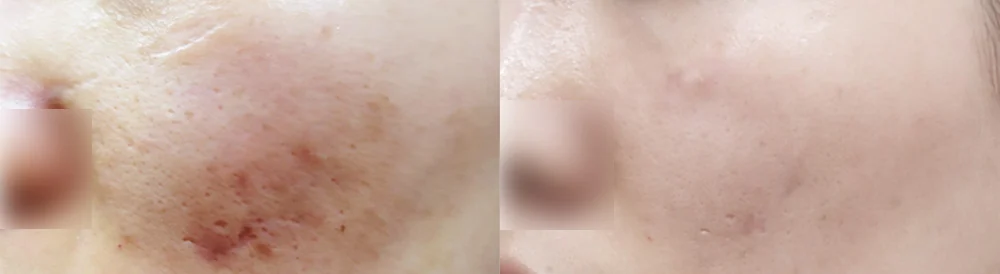
Red marks mixed with small depressions on the cheek
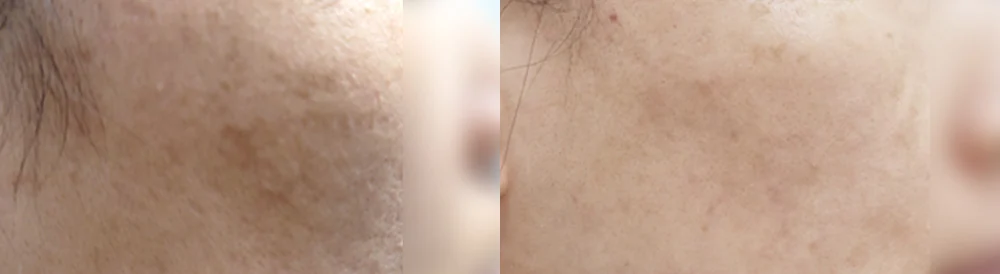
Brownish patches spread across the cheek
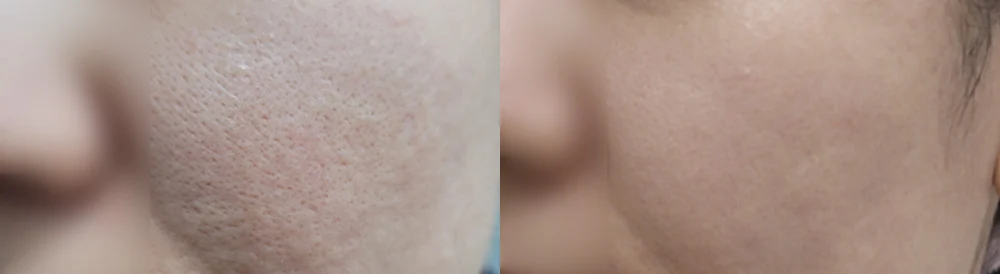
Prominent pores and rough texture on the cheek
* Results vary from person to person. Side effects are possible, so please decide after a thorough consultation with a doctor.
Frequently asked questions
Will two sessions a month finish the course faster?
It depends on the laser, but there is little evidence that shorter gaps finish the course sooner. For ablative fractional CO2 laser on depressed scars, 1-month and 3-month intervals gave similar results.2 In the burn scar meta-analysis, gaps under 4 weeks scored better, but that was an exploratory finding from a single study that used a pulsed dye laser.4 For Asian skin, more sessions spaced further apart are described as typically carrying the lowest risk of darkening,5 so the interval is set after checking that your skin has recovered.
The redness from my last session has not faded. Can I have the next one?
If redness, swelling or crusting remains, the skin's recovery is checked at an examination first, even if the planned date has come. If there are signs of brown darkening in particular, the plan is changed toward a wider interval or lower strength.5
After how many sessions will I see a change?
It depends on the scar and the laser. In the study that used a vascular laser every 4 weeks on raised red scars, visible change was confirmed around week 16, after more than two sessions.3 So rather than judging after one or two sessions, we compare photos taken under the same conditions across several sessions.
I started laser treatment elsewhere. Can I continue at your clinic?
Yes. Tell us which lasers you had, when and how many times, how long the redness lasted afterwards, and whether the skin ever darkened. This helps us plan. Whether to continue the same laser, or whether another approach should come first, is decided by looking at that history together.
If I keep having laser, will deep acne scars eventually lift?
Not necessarily. Lasers refine texture and color in the surface and shallow layers, so when the base of a scar is tethered to the tissue below or volume has been lost, a shadow can remain even after the texture improves. In that case, releasing or filling the scar comes first, and laser is used last to refine the remaining texture and color.
What to prepare before your consultation
- What caused the scar (acne, surgery, an accident or a burn) and when
- Lasers you have had so far: the type if you know it, the number of sessions and the date of the last one
- How many days the redness lasted after laser, and whether the skin ever turned brown
- Photos of the scar close up and from a little further away in the same light, plus any photos from before treatment
- Important events or plans for strong sun exposure in the coming months
Bonita Clinic is on the 3rd floor of 565 Gangnam-daero, Seocho-gu, Seoul, about 100 m on foot from Exit 8 of Nonhyeon Station (Line 7). Our treatment process is described on the Facial Surgical Scars and Acne & Pore Scars pages, and skin-renewal laser on the UltraClear page. Recovery after laser is also covered in our UltraClear laser guide.
References (6)
Sources that support the explanations in this article. Study findings describe general trends and do not guarantee individual results.
- Laubach HJ, Tannous Z, Anderson RR, Manstein D. Skin responses to fractional photothermolysis. Lasers Surg Med. 2006;38(2):142-149.doi:10.1002/lsm.20254Histology study (abstract) of 12 people after one non-ablative fractional laser session on the forearm: the base of the epidermis reconnected within 24 hours, the epidermis recovered by day 7, pigmented micro-crusts shed within 7 days, heat shock protein was expressed on day 1 and new (type III) collagen was increased at day 7, read by the authors as a wound-healing response, and no fibrosis remained at 3 months; the biological reason for spacing sessions
- Bjørn M, Stausbøl-Grøn B, Braae Olesen A, Hedelund L. Treatment of acne scars with fractional CO2 laser at 1-month versus 3-month intervals: an intra-individual randomized controlled trial. Lasers Surg Med. 2014;46(2):89-93.doi:10.1002/lsm.22165Split-face randomized trial (abstract) of 13 people with depressed acne scars: two sessions of ablative fractional CO2 laser at 1-month versus 3-month intervals; both sides improved, with no difference in improvement, satisfaction or side effects by interval
- Manuskiatti W, Fitzpatrick RE, Goldman MP. Energy density and numbers of treatment affect response of keloidal and hypertrophic sternotomy scars to the 585-nm flashlamp-pumped pulsed-dye laser. J Am Acad Dermatol. 2001;45(4):557-565.doi:10.1067/mjd.2001.116580Randomized split-scar study (abstract) of 10 raised red sternotomy scars: 585-nm pulsed dye laser every 4 weeks for six sessions; no difference by strength, change visible from about week 16 after more than two sessions, more than two sessions appeared to give greater improvement; strength, number and interval still based on experience
- Ma Y, Barnes SP, Chen YY, et al. Influence of scar age, laser type and laser treatment intervals on adult burn scars: A systematic review and meta-analysis. PLoS One. 2023;18(9):e0292097.doi:10.1371/journal.pone.0292097Meta-analysis (full text) of 11 studies, 491 adults with hypertrophic burn scars: intervals under 4 weeks and 4-8 weeks generally did better than over 8 weeks; PDL gave the largest scar-score gain; scars over 12 months old improved more in redness and height. Subgroups were exploratory and some were a single study: for overall scores the under-4-week group (a PDL study) and the over-8-week group were one study each, so interval and laser type cannot be separated; only two studies used PDL. Sessions not analyzed. Discussion: wound maturation typically lasts until about 12 months
- Wat H, Wu DC, Chan HH. Fractional resurfacing in the Asian patient: Current state of the art. Lasers Surg Med. 2017;49(1):45-59.doi:10.1002/lsm.22579Review (abstract) of fractional laser in Asian patients: fractional lasers treat depressed and thick scars with columns of heat injury; post-inflammatory hyperpigmentation is the most common complication, and more sessions at lower density with wider intervals typically carry the lowest risk without compromising results
- Leszczynski R, da Silva CA, Pinto ACPN, et al. Laser therapy for treating hypertrophic and keloid scars. Cochrane Database Syst Rev. 2022;9(9):CD011642.doi:10.1002/14651858.CD011642.pub2Cochrane systematic review (abstract) of 15 randomized trials with 604 people with hypertrophic scars or keloids: low-certainty evidence that 585-nm PDL may be better than no treatment, very uncertain evidence for non-ablative fractional and fractional CO2 lasers; overall evidence for laser is still limited; reported adverse effects (pain, purple discoloration, lighter skin, thinning, peeling after blistering) are also of very low certainty, with purple discoloration reported in pulsed dye laser studies (seen in the full-text tables)
About this article
This article separates general medical information from Bonita Clinic's own approach. Because the right decision depends on each person's condition, it is not a substitute for a consultation.