KOKorean
 ENEnglish
 JP日本語
 CN中文(简体)
 TW中文(繁體)


Silicone Gel, Tape and Sunscreen for Surgical Scars: How Long? (Seoul Clinic Guide)
Guidelines and reviews recommend silicone gel or sheets from the time the wound has fully closed (usually about two weeks after surgery), for at least 12 hours a day and for about 12 weeks; if the scar starts to thicken, use may continue for up to six months, with a medical check at that point. Sun protection is worth keeping up for as long as the scar is red, and paper tape is a supporting measure that reduces pull on the scar. Home care does not erase a scar but helps it settle less noticeably, so if a scar keeps getting thicker, itches or hurts, have it examined rather than relying on home care alone. If you are considering scar treatment in Seoul, you can send us photos of your scar to see which approach may fit.
Curious about your own case? Ask us online →
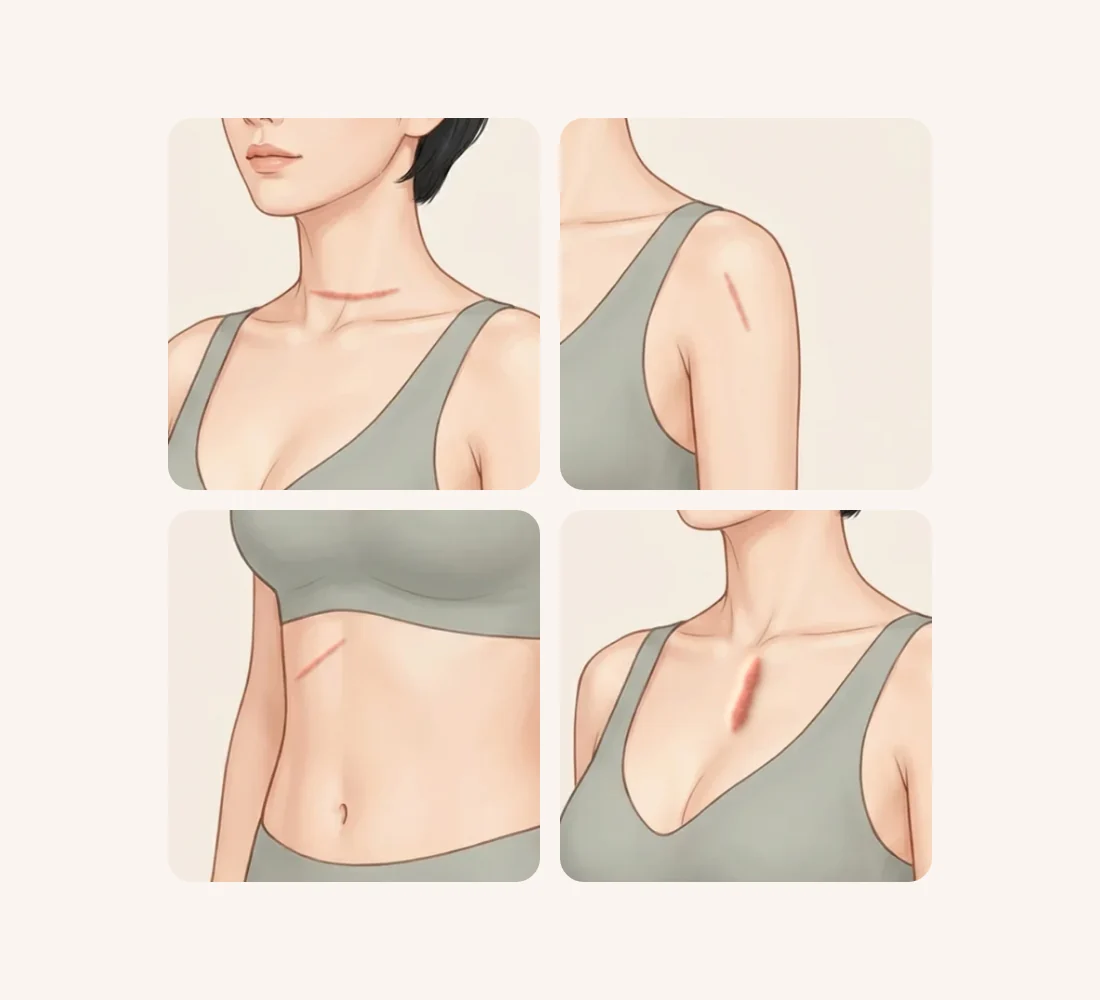
What can you do for a scar at home?
Once a surgical wound has healed and the stitches are out, the scar begins a long period of settling. During this time there are five main things you can do at home: use silicone gel or silicone sheets, reduce pull on the scar with tape, keep it out of the sun, keep it moisturized, and massage it.
Practical guidelines drawn up by an international group of 24 scar experts (a document setting out standards to follow in everyday care) name silicone sheets and gels as the first-line, non-surgical option for both preventing and treating scars. Other general preventive measures they list are avoiding sun exposure, compression, taping and moisturizers.1 They add that how much of this each person does depends on their risk of developing a problem scar and on how much the scar's appearance matters to them.1
What home care can do, and what it cannot
Home care does not erase a scar. Its job is to help the scar avoid turning red, thick and raised, and to give it calm conditions in which to settle. On the other hand, a scar that has already spread wide or sunk below the surface rarely changes shape with creams and tape alone. A scar like that needs an examination to find the cause.
When to consider treatment for a surgical scar is covered in a separate guide, when to treat a surgical scar. This guide is about the daily care you do at home in the meantime, whether you had surgery in Seoul or closer to home.
When should you start?
The first rule is simple: wait until the wound is fully closed. As long as stitches remain, a scab is still attached or the line is oozing, it is still a wound. During that time, follow the wound care your surgeon gave you.
A review (a paper that gathers and summarizes earlier studies) on preventing raised scars after surgery, published in the journal of the Brazilian Society of Plastic Surgery, recommends starting silicone as soon as the incision is fully epithelialized, which means completely covered by a new outer layer of skin. This usually happens about two weeks after surgery.2 Put simply, the starting point is when the stitches are out and the surface of the wound is smooth, closed and no longer weeping.
Sun protection can start earlier. While the wound is still open, do not put sunscreen on it; cover it from the sun with clothing, a hat or a dressing instead.
The calendar below puts home care in time order after surgery. Tap a step to see what is done at that stage.
Home scar care after surgery: when to start, how long
How does silicone work on a scar?
How silicone products help scars is not fully understood. The most widely accepted explanation is that they keep the scar hydrated. A consensus document from the Japan Scar Workshop (recommendations agreed by an expert panel) explains that silicone gels and creams moisturize the scar surface, which reduces inflammation and helps the scar mature, or settle.4 Conversely, the same document notes that a dry environment, as in winter, can feed inflammation in a scar.4
Sheets have one more role. The consensus notes that gel sheets have been shown to reduce local skin tension, the pulling force on keloids and hypertrophic scars (red, thick, raised scars).4
What silicone does for a scar
In short, silicone lays a thin film over a young scar so that moisture does not escape, and a sheet also takes up some of the pull. That is why nothing changes the moment you apply it. Its value comes from keeping it up, day after day, for months.
Moisturizing is part of home care too. Keeping the scar surface from drying out with a moisturizer is one of the general preventive measures listed in the practical guidelines.1 The Japan Scar Workshop consensus also explains that moisturizing preparations such as heparinoid ointment, like silicone gels and creams, help reduce inflammation and support scar maturation by keeping the scar surface moist.4
Silicone gel or silicone sheet: which should you choose?
The two forms appear to work about equally well. A 2020 meta-analysis (a study that pools the results of several studies and recalculates them) of six randomized controlled trials (studies that assign people to groups by chance, like drawing lots) with 375 patients reported that, after surgery, silicone gel lowered the scar's scores for pigmentation, height and pliability (stiffness) compared with a placebo or no treatment. Silicone gel and silicone gel sheets performed comparably.3 Put simply, choosing a form you can use every day matters more than choosing gel over sheet or the other way round.
It is worth knowing the limits of the evidence, too. The same analysis also found no clear difference between silicone gel and other non-silicone topical treatments.3 Not finding a difference, however, does not mean the two work equally well. The Japan Scar Workshop consensus notes that a pooled analysis of 20 randomized trials found silicone gel sheets may be useful, but because the trials were of poor quality, the finding should be read very cautiously.4 Silicone is widely recommended, but it is not a treatment with a predictable result for everyone.
Which form to use mostly comes down to fit and comfort. The review above says the choice depends mainly on how well the patient accepts it, and that gel may be preferable for exposed areas such as the face, or for areas that move a lot, such as joints.2
Silicone gel, silicone sheet and paper tape at a glance
| Method | Suits | How to use | Good to know |
|---|---|---|---|
| Silicone gel | Face, neck and other exposed areas; joints | Spread thinly and let it dry | Similar effect to sheets |
| Silicone sheet | Areas under clothing, such as the abdomen or chest | Use a piece larger than the scar | Remove and wash daily; avoid trapped sweat |
| Paper tape | Incisions under pull | Replace when it lifts off by itself | At least 12 weeks; limited evidence |
Here is what to think about first, depending on where your scar is.
What to think about first, by scar location
1If the scar is on the face or neck, where it is always visible
Spread silicone gel thinly and keep the scar out of the sun
Silicone gel · sun protection
2If it is on a shoulder or joint that moves a lot
Gel is easier to keep on; tape to reduce pull may be added
Silicone gel · tape
3If it is on the abdomen, under clothing
A silicone sheet is easy to wear for 12 or more hours a day
Silicone sheet
4If it turns red, raised and itchy
Do not rely on home care alone; have it examined
Get it examined
How many hours a day, and for how many months?
On the question of "how much," the review above sets out the following.2
- Hours a day: at least 12 hours, and 24 hours if possible
- How long: up to 12 weeks (about three months) after the wound closes
- If the scar starts to thicken: after a medical check, another 12 weeks together with pressure therapy, for up to six months in total. The evidence for pressure therapy itself on surgical scars is still weak.2
In other words, silicone is not something you dab on only when going out. It should be on the scar for more than half of each day. With gel, the time that counts is the time the dried film stays on the skin; with a sheet, it is the time the sheet stays in place. Follow the product instructions on how often and how much to apply.
These numbers are a standard that the review drew from international recommendations and clinical guidelines; they did not come from trials comparing different durations. Instructions may differ by product and by wound, so the advice of the clinic that did your surgery comes first.
Regular checks matter too. The guidelines mentioned earlier recommend that a clinician re-evaluate the scar every four to eight weeks to decide whether more treatment is needed.1 At home, taking photos in the same light at those intervals and showing them at your visit makes changes easier to see. It also helps to note whether the scar is turning red and raised, whether it itches or hurts, and whether a product is irritating the skin.
Tips for using silicone sheets
The Japan Scar Workshop consensus offers these practical points.4
- Sheets are generally removed and washed once a day. They can be reused after washing for as long as they stay sticky.
- Use a sheet large enough to cover the scar with a margin. That way it protects the scar from pull and keeps it hydrated.
- In summer, sweat can make the area under a sheet or tape too moist. If this lasts, a fungal infection can develop, so wash the scar every day in the shower during summer.
- In winter the skin around a scar dries out easily, so use the sheet even more consistently.
Why use tape, and for how long?
A scar under pull tends to thicken. The Japan Scar Workshop consensus explains that local tension stretching the skin makes keloids and hypertrophic scars worse, and that these scars tend to grow in the main direction of skin tension.4 Applying fixation tape or gel sheets reduces the pull on the scar and is thought to help it mature.4
How tape takes up the pull
The tape used is mostly made of paper or silicone.4 The review above suggests keeping paper tape on for at least 12 weeks, because shorter use appeared to be less effective. Its benefit has not been firmly proven, though, so it is described as an option for people at low risk of problem scars.2 The details of a randomized trial of tape in cesarean section patients are in our guide on when to treat a surgical scar.
How you apply tape matters as well. The consensus advises not to replace it every day, but to change it only when it comes off naturally. Peeling tape off often can irritate the skin, causing contact dermatitis or damage to the outer layer.4 On places where the skin stretches with every movement, such as the upper chest, shoulders and around joints, reducing pull becomes even more important.
How long should you protect the scar from the sun?
A scar that is still settling is vulnerable to sunlight. In a randomized controlled trial from Denmark, small round skin wounds (punch biopsy wounds) were made and then randomly assigned to solar UV exposure after surgery or to no UV exposure. At 12 weeks, among the wounds that healed on their own without stitches, the UV-exposed scars scored higher for color, firmness and scar area, and their pigmentation increased more. Assessors picked the UV-exposed scars as the most disfiguring.5 This suggests that a healing scar exposed to sun may end up darker and more noticeable.
This trial used small experimental wounds, and the clear difference was seen in wounds that healed without stitches. So it cannot be applied directly to every surgical scar. Even so, the guidelines list avoiding sun exposure as a basic measure in preventing scars.1
How long, and how to cover it
There are not yet studies comparing how many months of sun protection are needed. While a scar is still red it is still settling, so it is sensible to keep it covered throughout that time.
- Before the wound closes: cover it with clothing, a hat or a dressing.
- After it closes: on exposed areas, use sunscreen and reapply during long stays outdoors.
- Scars on the body: clothing is the easiest and most reliable cover.
- With silicone gel: follow each product's instructions on which to apply first.
Does scar massage help?
Scar massage is often recommended, but the evidence is weak. A literature review of 10 scar massage studies (144 patients) found that 65 people (45.7%) improved on measures such as scar scores, range of motion, itching or pain. Among surgical scars alone, 27 of 30 (90%) improved in appearance or score.6 In other words, massage seemed to do better on surgical scars than on scars from injuries or burns.
But the studies used very different methods. Massage started anywhere from after stitch removal to more than two years later; sessions ranged from 10 minutes twice a day to 30 minutes twice a week; and treatment lasted from a single session to six months. Outcomes were not measured in a standard, objective way, so the authors concluded that the evidence is weak.6 The review on postoperative scars likewise notes that regimens such as "start four weeks after surgery, two to three times a day for three to five minutes, for three to four months" have been suggested, but that the evidence is not strong enough to recommend massage.2
Ultimately, massage cannot replace silicone or sun protection. If you do massage, start only after the wound is fully closed and keep it gentle enough not to hurt. If the scar is turning red and raised, have it checked before you rub it.
What should you avoid?
Cutting down on things that irritate a scar matters as much as adding the things that help.
- Putting silicone on a wound that has not closed: silicone is used once the incision is fully covered by new skin.2
- Picking or scratching scabs: leave scabs until they fall off by themselves. If itching is strong, ask your doctor rather than scratching.
- Peeling tape off and re-applying it every day: the irritation adds up and can cause dermatitis. Change it when it comes off naturally.4
- Leaving a sweaty sheet on without washing: prolonged moisture can lead to a fungal infection.4
- Using steroid creams for a long time without supervision: steroid ointments and creams can cause acne-like eruptions and visible small blood vessels, so they should not be used long term without a doctor checking.4
- Rubbing vitamin E oil on a scar as a scar treatment: in a study of 15 patients with surgical scars, 90% saw no improvement with vitamin E, and about one in three (33%) developed contact dermatitis. Some studies have reported other results, but the review concludes that vitamin E should not be recommended until better evidence is available.2
- Repeating movements that strongly stretch the scar: the consensus advises cutting back on heavy physical work or excessive exercise that repeatedly pulls on the scar.4
- Leaving a settling scar exposed to strong sun: UV-exposed scars can become darker and more noticeable.5
Signs that home care is not enough
Home care is meant to support a scar that is healing normally. If you notice any of the following, have the scar examined rather than waiting.
- The scar is getting steadily thicker, or rises and hardens
- It spreads sideways beyond the original wound
- It itches or hurts
- It pulls and makes movement uncomfortable
- The wound reopens, or becomes red, swollen and oozing
The Japan Scar Workshop consensus notes that keloids and hypertrophic scars develop particularly often in people of Asian and African descent.4 Keloids, which grow beyond the edge of the wound, are managed differently. How to tell the two apart is covered in our guide Keloid or hypertrophic scar?, and keloid treatment in our guide to keloid and burn scar treatment.
What does your scar look like now?
- Stitches, scabs or oozing remainWound care firstCover from the sun with clothing
- Closed, a red lineSilicone, tape, sun protectionClinic recheck every 4–8 weeks
- Getting thicker, itchy or painfulHave it examinedDo not rely on home care alone
- Widened or sunkenDiscuss when to revise itCreams and tape rarely change this
How we approach it at Bonita Clinic
As a rule, home care should first follow the instructions of the clinic or hospital that did your surgery. When a scar does not settle as hoped, this is how we look at it.
Bonita Clinic has been at the same location since opening in 1995, where Dr. Kwang-Seop Jung, a plastic surgeon board-certified in Brazil, sees patients. For a surgical scar that has not settled well, the options you can discuss with us in Seoul are those on our treatment pages:
- Laser care for color and texture, chosen by scar type and repeated at intervals when needed
- Releasing tethered tissue and filling a sunken scar
- Surgical restoration of a widened or thickened scar, under local anesthesia or sedation, with same-day discharge and stitches
Recovery time and follow-up visits vary with the extent of treatment and your individual condition. Which steps you need is decided only after an examination.
Scars that home care rarely changes: treatment cases from our clinic
The shape of a scar that has already widened or sunk rarely changes with creams and tape. These cases are from our body surgical scar treatment page. Results vary from person to person.
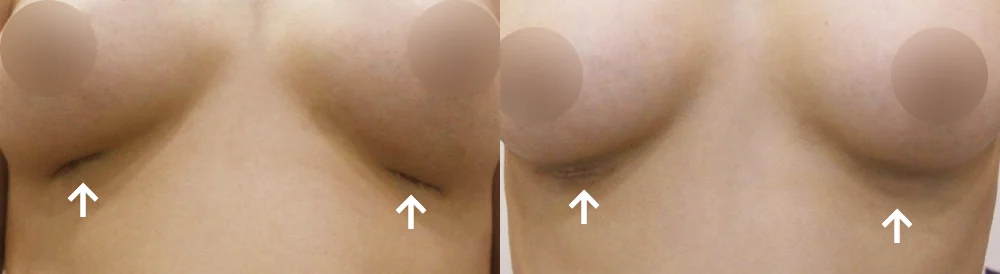
Line scars left in the creases under both breasts
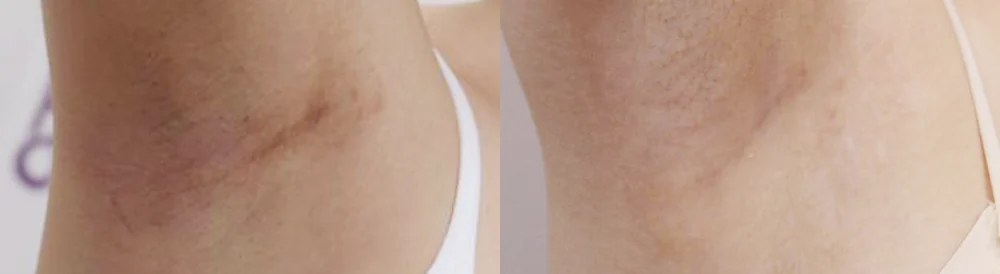
A line scar running diagonally near the armpit
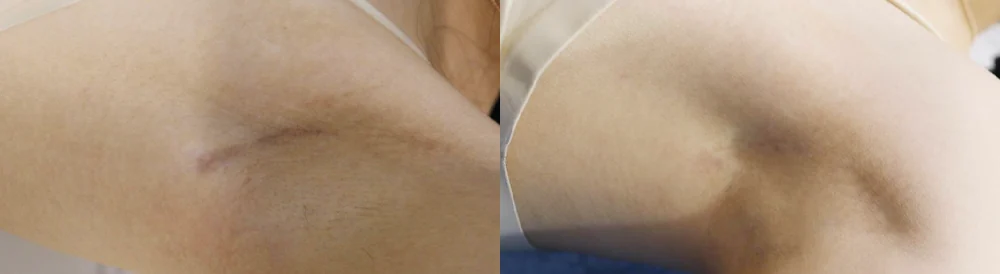
A curved scar in the armpit fold
* Results vary from person to person. Side effects are possible, so please decide after a thorough consultation with a doctor.
Why do treatment plans and costs differ?
Two scars that both look "red" or "wide" can need very different care. What shapes the plan, and therefore the cost, is the kind of scar and how much needs to be done.
- Scar type: red, raised, widened or sunken
- Size, length and location
- Method: laser, release and filling, or surgical revision
- Number of sessions
- Anesthesia: local or sedation
- Earlier surgery or treatment on the area
Final plan and quote after an in-person exam
A final estimate is given only after an in-person examination, once the type, depth and extent of the scar are clear. Photos help narrow down the options, and the plan is settled at the examination.
What can photos show, and what needs an in-person exam?
Photos are a good way to start, because how a scar looks and how it has changed over time say a great deal. What lies under the surface still needs to be felt and seen in person.
Photos can show
- Where the scar is and how long it is
- Color: red, brown or pale
- Whether it looks wide or raised
- How it has changed, from dated photos
- Which surgery you had and when
Needs an in-person exam
- Thickness and firmness
- Whether it is stuck to deeper tissue
- How much it pulls when you move
- Itch, pain and tenderness
- Whether it grows like a keloid
Helpful photos: the scar in good daylight from straight on and from an angle, with a ruler or coin beside it if possible, plus any photos taken at different times since surgery.
What to prepare before your consultation
- The name and date of your surgery, and where it was done (as far as you remember)
- The date your stitches came out, and photos taken at different times since then, ideally in the same light and from the same distance
- The products you have used, for how long, and for how many hours a day
- Any redness or itching caused by a product
- Any history of keloids or thick scars, in you or your family
You can send us a message with your photos and questions.
Planning your visit, and caring for the scar back home
Home care is the same wherever you are: silicone for 12 or more hours a day once the wound has closed, tape where the scar is pulled, and sun protection while it is red. Because the guidelines suggest re-evaluating every four to eight weeks,1 taking dated photos in the same light at those intervals makes it much easier for any doctor, at home or in Seoul, to follow the scar.
If you are planning treatment with us, how long to stay in Seoul, when stitches come out and how many follow-up visits you need all depend on the method and extent of treatment. These are planned together with you at consultation. After you return home, contact a local doctor promptly if the scar becomes red, swollen, painful or starts to ooze, or if it keeps getting thicker.
Bonita Clinic is on the 3rd floor of 565 Gangnam-daero, Seocho-gu, Seoul, about 100 m on foot from Exit 8 of Nonhyeon Station (Line 7). You can read more on our body surgical scars page and facial surgical scars page; care right after an injury is on our emergency wound care page. For more on scars, see our guides on when to treat a surgical scar, scars after body contouring and breast surgery, telling keloids from hypertrophic scars and keloid and burn scar treatment.
Frequently asked questions
My surgery was six months ago. Is it too late to start silicone?
The guidelines see silicone as the first non-surgical option not only for preventing scars but also for treating them.1 If the scar is still red and firm, starting now can still be worthwhile. A scar that has already settled pale and flat, however, rarely changes its width or depression with silicone, so that kind of scar is better examined.
Do scar creams without silicone work?
In the meta-analysis, silicone gel and other non-silicone topical treatments performed similarly.3 As important as the ingredient is using a product consistently, for long enough, once the wound has closed. If the skin turns red or itchy where you apply it, stop and ask your doctor.
My silicone sheet makes the area sweaty and itchy. Should I keep wearing it?
In summer the area under a sheet or tape can become too moist, and if this lasts, a fungal infection can develop. Wash the scar in the shower every day and wash the sheet as well.4 If a rash appears or the itching is strong, take a short break and ask whether you can switch to another form, such as gel.
How often should I change the tape?
There is no need to change it every day. Frequent peeling can irritate the skin and damage its outer layer, so changing it when it comes off naturally is recommended.4 If it lifts because of sweat or water, simply apply a new piece.
How long should I keep using sunscreen on the scar?
There are not yet studies that compare different durations. Because a randomized trial found that scars exposed to UV after surgery became darker and more noticeable,5 it is sensible to keep the scar covered for as long as it stays red. Scars on the body are easiest to protect with clothing.
References (6)
Sources that support the explanations in this article. Study findings describe general trends and do not guarantee individual results.
- Meaume S, Le Pillouer-Prost A, Richert B, et al. Management of scars: updated practical guidelines and use of silicones. Eur J Dermatol. 2014;24(4):435-443.doi:10.1684/ejd.2014.2356Practical guidelines from an international group of 24 experts (abstract): silicone sheets and gels as the first-line non-invasive option for preventing and treating scars; avoiding sun exposure, compression, taping and moisturizers as general measures; re-evaluation by the clinician every 4–8 weeks; the amount of care depends on scar risk and the patient's concern
- Faveret PLS, Cunha KSG. Current management for the prevention of postoperative scar hypertrophy. Rev Bras Cir Plást. 2015;30(4):638-648.doi:10.5935/2177-1235.2015RBCP0205Review in the Brazilian Journal of Plastic Surgery (full text): silicone from epithelialization (about 2 weeks), at least 12 hours a day (24 if possible), up to 12 weeks, plus 12 weeks with pressure if hypertrophy appears (6 months in total), figures drawn from international recommendations and guidelines, not duration trials; gel for exposed areas and joints; paper tape for at least 12 weeks in low-risk patients (limited evidence); massage, local pressure, onion extract, 5% imiquimod and vitamin E not recommended (vitamin E: no improvement in 90% of 15 patients, contact dermatitis in 33%)
- Wang F, Li X, Wang X, Jiang X. Efficacy of topical silicone gel in scar management: A systematic review and meta-analysis of randomised controlled trials. Int Wound J. 2020;17(3):765-773.doi:10.1111/iwj.13337Meta-analysis of 6 randomized trials with 375 patients (abstract): silicone gel lowered pigmentation, height and pliability scores after surgery versus placebo or no treatment; no difference between gel and gel sheets, and no clear difference from non-silicone topical treatments (which does not prove equal effect)
- Ogawa R, Akita S, Akaishi S, et al. Diagnosis and Treatment of Keloids and Hypertrophic Scars-Japan Scar Workshop Consensus Document 2018. Burns Trauma. 2019;7:39.doi:10.1186/s41038-019-0175-yJapan Scar Workshop consensus (full text): local tension worsens keloids and hypertrophic scars, which grow in the direction of tension; fixation tape and gel sheets reduce tension and aid maturation by moisturizing; silicone gels and creams and heparinoid ointment calm inflammation by moisturizing the scar surface; dryness promotes inflammation; change tape only when it detaches, wash and reuse sheets daily, beware summer fungal infection; avoid long-term unsupervised steroid creams; more common in Asian and African patients; the pooled analysis of 20 trials is low quality
- Due E, Rossen K, Sorensen LT, et al. Effect of UV irradiation on cutaneous cicatrices: a randomized, controlled trial with clinical, skin reflectance, histological, immunohistochemical and biochemical evaluations. Acta Derm Venereol. 2007;87(1):27-32.doi:10.2340/00015555-0154Randomized controlled trial with punch biopsy wounds (abstract): scars exposed to UV after surgery (healing by second intention) had higher color, infiltration and area scores and more pigmentation at 12 weeks and were rated most disfiguring; no histological differences
- Shin TM, Bordeaux JS. The role of massage in scar management: a literature review. Dermatol Surg. 2012;38(3):414-423.doi:10.1111/j.1524-4725.2011.02201.xLiterature review of scar massage, 10 studies and 144 patients (abstract): 45.7% improved, 27 of 30 surgical scars (90%) improved; timing, methods and duration varied and outcomes were not objective, so the evidence is weak
About this article
This article separates general medical information from Bonita Clinic's own approach. Because the right decision depends on each person's condition, it is not a substitute for a consultation.