KOKorean
 ENEnglish
 JP日本語
 CN中文(简体)
 TW中文(繁體)


Scar Treatment in Seoul: How Long Should You Stay, and How Many Visits?
A scar treatment trip is planned in stages rather than as a fixed number of days: a photo consultation from home, an in-person examination in Seoul, treatment, then stitch removal and a wound check. If a scar is cut out and re-stitched, treatment and stitch removal belong together; stitches usually come out after a few days on the face and after one to two weeks on the body. Laser treatment is often split into several sessions a few weeks apart, and raised scars are treated repeatedly at intervals and watched over a long time. So how many visits you need depends on the type, depth and site of the scar and on the method, and your actual schedule is planned with you after the examination, around the extent of treatment and your recovery. Wondering how your scar might fit into a trip? Send us your photos and the dates you are considering before you plan your visit to Seoul.
Curious about your own case? Ask us online →
Why can't a scar treatment trip be planned as "a set number of days"?
The first question most people ask before coming to Seoul for scar treatment is simple: "How many days should I stay?" It is a fair question, because travel, time off work and accommodation all have to be arranged in advance. The honest answer is that scar treatment schedules vary a great deal, even between two scars that look alike in a photo. There are three main reasons.
- Scars are not all the same kind. A scar that is still red and new, a scar that has spread wide, a scar that has been pulled down into a dent and a scar that has risen above the skin each start with a different first step.
- Each method works on a different time scale. If a scar is cut out and the skin is stitched closed again (excision and closure), your stay has to include the day the stitches come out. Laser treatment is often split into several sessions a few weeks apart. Raised scars are usually treated repeatedly and watched over months.
- Stitch removal timing differs by body site. Stitches on the face usually come out earlier than on the body: typically after a few days on the face and after one to two weeks on the body, depending on the site.1
Bonita Clinic's own treatment pages state that recovery time and follow-up visits depend on the extent of treatment and on each person's condition. So this guide does not give you a fixed number of days. Instead, it explains the order in which a schedule is built, and what is checked at each stage. The numbers we quote are general medical information backed by the sources in the footnotes. Your actual schedule is planned together with you after an examination, around the extent of treatment and your recovery.
How does the whole process run, from first contact to after you return home?
In one line: you consult with photos from home first, come to Seoul for an in-person examination, and are treated. The stitches and wound are checked, you travel home, and then you watch how the scar settles before deciding whether another visit is needed.
Visiting Seoul for scar treatment
- Before you travelPhotos and scar history first
- First visit in SeoulIn-person exam to set the method and order
- TreatmentExcision, laser or injections, to fit the scar
- Stitches and checkIf excised, stitches out and wound checked
- Back homeLess tension, sun protection, dated photos
- Next visitOnly if color, texture or height still need it
Each stage answers a question:
- Before you travel: what kind of scar is this, and what still needs to be checked in person?
- The first in-person examination: how does the scar feel and move? Which methods are used, and in what order?
- Treatment and stitches: how much is done on this visit, and when do the stitches come out?
- Back home: what do you look after yourself, and when is it decided whether more treatment is needed?
What can a photo consultation show before you travel?
A photo consultation is where planning starts. Photos show the site, length, color, shape and number of scars quite well. That is often enough to narrow down the direction, for example whether a scar looks like one to start with laser or one where excision may be considered.
Some things, however, do not show up in a photo. Whether a scar is firm or thick, and whether it pulls on the skin around it when you smile or open your mouth, can only be judged by touching it and watching it move. When the base of a scar is stuck to the tissue underneath and pulled inward, this is called tethering (adhesion). Whether a scar is tethered, and how deep it goes, is also checked at the examination. The same scar can look deeper or shallower depending on where the light comes from, so shadows in a photo are not a reliable measure of depth.
Photos can show
- Where the scar is and how long it is
- Color: red, brown or pale
- Shape: line, wide band, dent, raised
- How many scars there are
- How it looks from different angles
Needs an in-person exam
- Firmness and thickness, by touch
- Pull on nearby skin when you move
- Tethering to deeper tissue
- True depth and lost volume
- Whether it is still active or has settled
Some information makes a photo consultation more accurate. Bonita Clinic's treatment pages ask patients to tell us what caused the scar (acne, surgery or an accident), when it happened and what treatment they have had so far. It also helps to tell us:
- The cause and date of the scar (for a surgical scar, the name and date of the operation and where it was done)
- Treatments so far: laser, injections, silicone products, tape, revision surgery
- Whether the scar has grown larger than the original wound or risen above the skin, and whether it itches or hurts
- Any history of keloids, in you or in your family
- How long you can stay in Seoul, and when you could come back
The last point matters more than people expect. For the same scar, how long you can stay changes what can be done on this visit and what is better split into a later one.
Helpful photos: the whole area and a close-up, in daylight or bright even light, without makeup, from the front and from the side. If the scar pulls when you smile or talk, add one photo with that expression. You can send us a message with your photos, the scar's history and the dates you are considering.
Why is an in-person examination in Seoul still needed?
Even when photos have narrowed down the options, the actual plan is made at the in-person examination. This is what is assessed:
- Firmness and thickness: a scar that feels hard and thick may still be "active", with inflammation continuing inside it.
- Pull: whether the scar drags on the surrounding skin when you open your mouth or smile.
- Tethering and volume: gently pushing the scar shows whether it is stuck to the layer below and whether volume has been lost, leaving a dent.
- Color and texture: whether the color is redness or brown pigment, and whether the surface is uneven.
- How the scar came about: knowing which operation you had and when helps us judge the direction of the incision and the cause of the scar.
Rarely, something that looks like a scar turns out to be a different skin growth. The Japan Scar Workshop consensus document (recommendations agreed by experts after reviewing the evidence) advises considering a biopsy, a small tissue sample examined under a microscope, before treatment when a lesion looks unlike a typical scar and a tumor is suspected.2
Whether treatment can follow on the same day as the examination depends on the scar and on what needs to be prepared. Asking about this during the photo consultation makes the trip easier to plan.
If the scar is cut out and re-stitched, when do the stitches come out?
Scars that have spread wide or sunk, or that run in an awkward direction, may be treated by cutting out the scar band and stitching the skin closed again (excision and closure). According to Bonita Clinic's treatment information, surgical restoration of facial surgical scars is done under local anesthesia or sedation, you go home the same day, and there are stitches. The anesthesia and recovery depend on the extent of treatment and on each person.
Excision does not make a scar disappear. It replaces a wide or sunken scar with a new, finer closure line. Because the scar band is removed as a spindle (pointed at both ends), the new line can end up slightly longer than the original scar. Where the skin is under strong tension, a scar can become thick or raised again.2 For this reason, deep stitches are used to take tension off the wound, and the area is supported with tape after surgery as well.23 As Bonita Clinic's treatment pages note, side effects such as bleeding, infection or inflammation can occur after surgery.
With excision, the day the stitches come out becomes the anchor of your schedule. A wound repair review in American Family Physician lists typical timing for stitch removal by body site, shown below. The authors note that this timing is based on expert opinion and experience rather than trials.1
| Body site | Typical time to remove stitches |
|---|---|
| Face | 3–5 days |
| Scalp and arms | 7–10 days |
| Trunk, legs, hands and feet | 10–14 days |
| Palms and soles | 14–21 days |
Put simply, stitches on the face often come out within a few days, and stitches on the body after one to two weeks. These are general examples for wound repair as a whole. The actual date is set by looking at the site, the way the wound was closed and how it is healing.
Is the wound fully healed once the stitches are out?
No. The Japan Scar Workshop consensus explains that the dermis (the thick layer under the skin surface) only regains about 80% of its original strength by around three months after surgery. For this reason, when keloids or hypertrophic scars are excised, it recommends deep stitches made of thread that keeps its strength for at least three months.2 In plain terms, even after the stitches are out and you have gone home, the wound needs protecting from tension for several months.
International scar management guidelines point the same way. For early scars after surgery they recommend reducing tension, taping, keeping the scar hydrated and protecting it from ultraviolet light, and they name silicone sheets or gel as the first-line option for preventing and treating raised scars.3 So if you are having an excision, it helps to plan not only "until the stitches are out" but also the few months of care that follow at home.
Why are laser sessions spaced several weeks apart?
For scars where redness, color or surface texture is the main problem, laser is usually at the center of treatment. A 2020 international consensus of 26 dermatologists and plastic surgeons from 13 countries concluded that lasers are a first-line therapy, meaning one of the treatments considered first, for traumatic scars and contractures (scars that tighten and restrict movement).5
Laser treatment is usually split into sessions rather than done all at once. A systematic review (a study that collects all relevant research by a set method) looked at 25 studies in which laser treatment began within three months of the injury. In 18 of them, lasers were given two to four times, at intervals of two to eight weeks.4 The Japan Scar Workshop consensus also notes that vascular lasers for red scars were traditionally given two to four times, about four to eight weeks apart.2 Put simply, in these studies laser treatment followed a cycle of "treat, wait a few weeks, treat again". These figures come from studies of recent scars and from older vascular laser protocols, so for older scars or other types of laser the interval and number of sessions can differ. Even so, laser treatment is usually split into sessions, which is why it often cannot all fit into one short stay.
There are good reasons for the gaps:
- Treated skin needs time to recover, and new tissue needs time to settle.
- Different lasers are often used for different problems: a vascular laser for redness, and a fractional laser (one that heats the skin in tiny columns) for texture and unevenness. For keloids and hypertrophic scars, combining the two has been described as more effective than either alone.2
- In Asian skin, temporary darkening after laser, called post-inflammatory hyperpigmentation, is a well-known side effect. In a study of 119 fractional laser sessions in 37 Chinese patients, widespread hyperpigmentation occurred after 7.1% and 12.4% of sessions with two different settings (the difference was not statistically significant).6 So before the next session, the skin is checked to make sure the color has settled.
At Bonita Clinic, we combine fractional laser, CO2 laser, picosecond laser, vascular laser and radiofrequency microneedling according to the condition of each scar. Research on each individual device is limited, so please read the figures above as general evidence for these types of laser. How many sessions are usually needed, and how far apart, by type of scar and laser is covered in our guide Scar Laser Treatment in Seoul: How Many Sessions, and How Far Apart?.
Why does the number of visits differ from scar to scar?
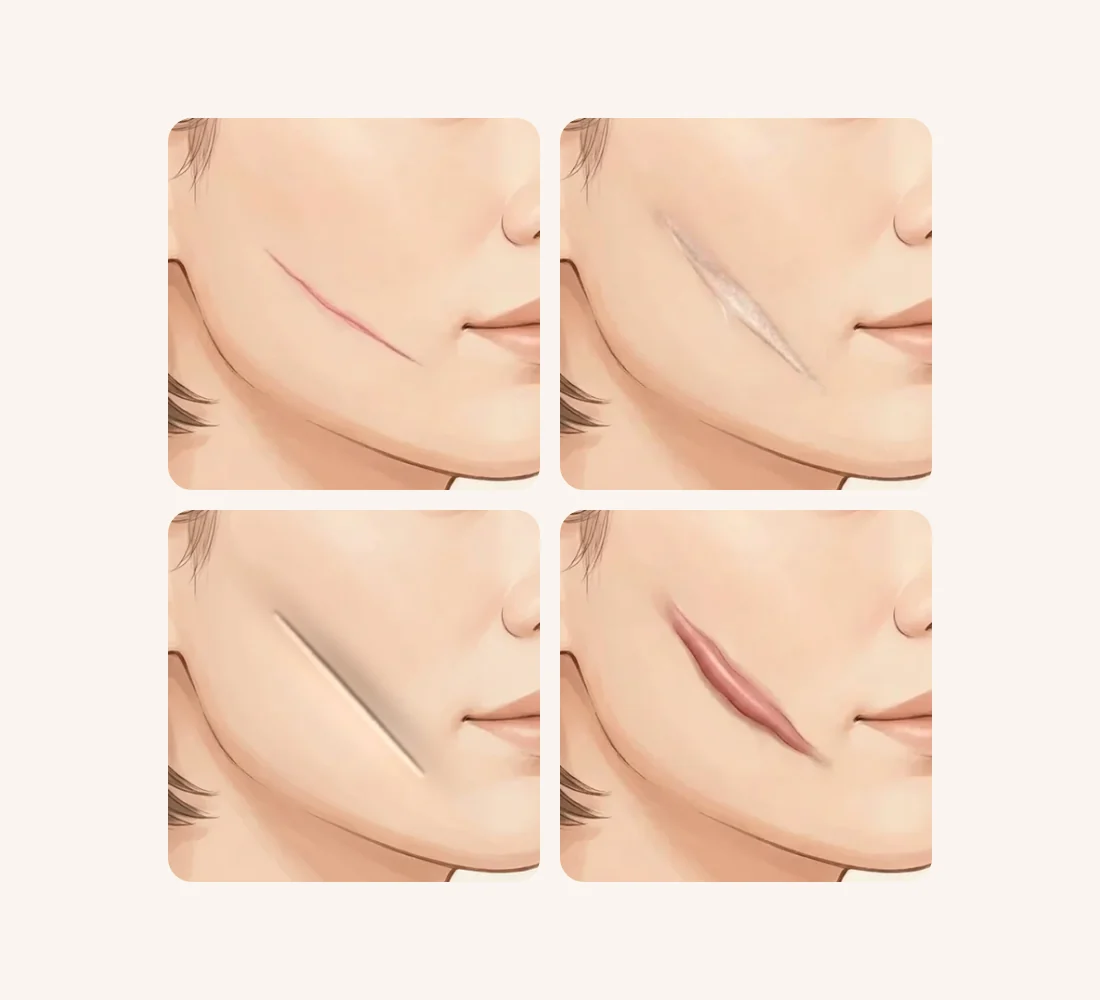
Even on the same cheek, the shape of a scar changes the first method and the rhythm of visits. The four drawings below show the same person with a scar in the same place; only its condition differs.
How the rhythm of visits changes with the scar
1A thin scar that is still red
Laser refines redness and texture, often in sessions a few weeks apart
Laser
2A scar that has spread wide and sunk
Cutting out the scar band and re-stitching may be considered; plan to stay until the stitches come out
Excision and closure
3A scar pulled down into a dent
The tethered tissue is released and filled; the next step is decided once it settles
Release and fill
4A thick scar raised above the skin
Injections and laser are repeated at intervals and recurrence is watched over time
Keloid or hypertrophic
Laying the visits out along a timeline makes the differences clearer.
- A new red scar: laser sessions are often spaced a few weeks apart, so treatment is split across several visits.4 Spacing sessions out is more usual than treating very strongly at once.
- A widened scar: after excision and closure, your stay runs until the stitches come out: usually a few days on the face, one to two weeks on the body.1 Any remaining color or texture is assessed separately once the scar has settled.
- A sunken scar: the tissue holding the scar down is released (adhesion release) and lost volume is filled, and the next step is decided once this settles. The methods are explained in our guide to depressed facial scars.
- A raised scar: treated repeatedly at intervals and watched over a long period, as explained below.
Why do raised scars take longer to plan?
Among red, firm scars that rise above the skin, those that stay within the borders of the original wound are called hypertrophic scars, and those that grow sideways beyond the wound borders are called keloids.2 The Japan Scar Workshop consensus notes that keloids come back in 50–80% of cases when they are only cut out surgically.2 For this reason it recommends that treatment for every patient starts with the least invasive option.2
In Bonita Clinic's burn and keloid treatment, we do not rely on excision alone for keloids; we combine it with laser and injection treatment. Because this is not a treatment that ends in a single session, we review progress at intervals and adjust the approach. If you are traveling from abroad, a realistic plan is often to confirm the type of scar and start the first treatment on your first visit, then decide the timing of the next visit according to how the scar responds. Photos taken from the same angle and dated each time make it easier to compare changes at the next examination.
Treatment for keloids and burn scars is covered in detail in our keloid and raised burn scar guide.
Treatment options you can discuss in Seoul
Bonita Clinic has treated patients at the same location since opening in 1995, and Dr. Kwang-Seop Jung, a plastic surgeon board-certified in Brazil, has seen patients here ever since; his career in plastic surgery and scar restoration spans 31 years. The options below are those described on our scar treatment pages; which of them you need is decided only after an examination.
- Surgical restoration of facial surgical scars: for scars left after procedures such as alar reduction, face lift or double-eyelid surgery, starting from where and how the original incisions were made. See Facial Surgical Scars.
- Depressed and incision scars: releasing tissue that pulls the scar down, filling lost volume, including fat grafting, and refining the surface. See Facial Depressed & Incision Scars.
- Accident scars: surgical scar removal combined with cosmetic scar treatment. See Accident Scars.
- Keloids and raised scars: surgery, laser and injections used together, reviewed at intervals. See Burn & Keloid Treatment.
- Combined lasers: chosen according to whether redness, pigment or texture is the main problem.
Why do the plan and cost differ from person to person?
Two people who both describe "a scar on the cheek" can need very different treatment. What shapes the plan, and therefore the cost, is the type of scar and how much needs to be done.
- Type of scar: red, wide, sunken or raised
- Size, number and site of the scars
- Method: excision, release and fill, laser, injections
- Anesthesia: local or sedation
- How many sessions and visits are needed
- Previous surgery or treatment on the area
Final plan and quote after an in-person exam
A final estimate is given only after an in-person examination, once the type of scar and the extent of treatment are clear. Photos help to narrow down the options; the extent of treatment is settled at the examination.
What should you look after once you are back home?
A scar does not stop changing on the day it is treated. Its color and firmness keep changing over months. International scar management guidelines recommend the following for early scars:3
- Reducing tension and taping: support the wound with tape for the period you are advised, so the edges are not pulled apart.
- Silicone sheets or gel: widely used as a first-line option for preventing and treating hypertrophic scars and keloids.
- Hydration and sun protection: the guidelines advise keeping early scar tissue moisturized and protected from ultraviolet light. If you have had laser treatment, take extra care, because hyperpigmentation can occur.6
A few other habits help too:
- Take dated photos in the same place, in the same light and from the same angle. This makes it easier to compare changes at your next examination.
- Write down the type and date of each treatment you have received. This helps any doctor you see plan the next step.
- If redness, pain, swelling or discharge around the wound gets steadily worse, or the wound opens, see a local doctor promptly rather than waiting.
- If the scar keeps getting thicker or itchier, it is worth discussing whether to bring your next visit forward.
How scars change over time is explained in our guide to the timing of surgical scar treatment.
How we approach it at Bonita Clinic
Real treatment cases
These cases appear on Bonita Clinic's facial scar treatment pages. The photos alone do not show the method or the time since treatment, so we describe only what can be seen. Results vary from person to person.
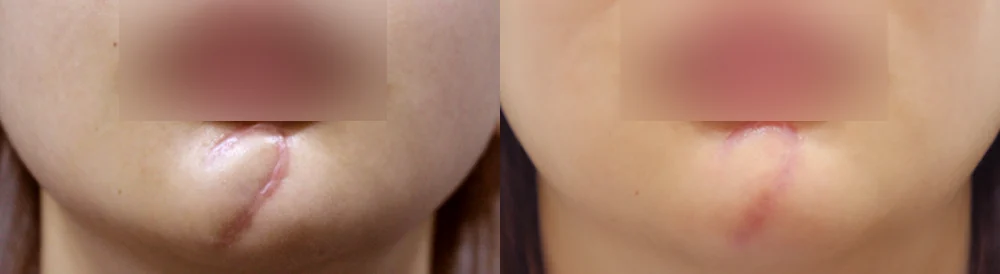
A line scar running diagonally from below the lower lip toward the chin
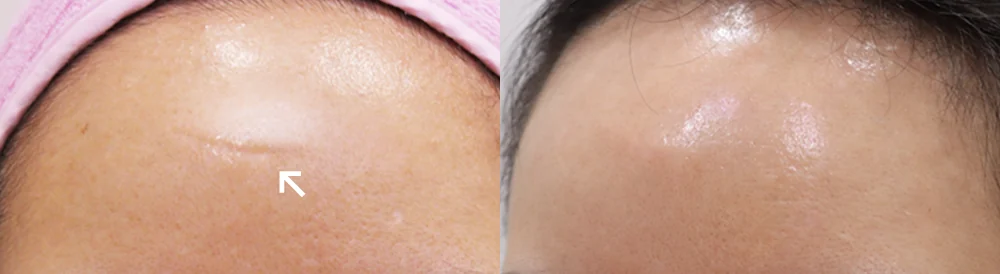
A short horizontal depressed line scar on the forehead
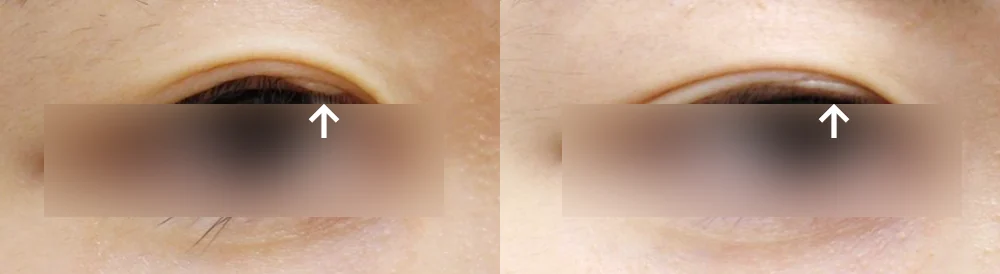
A scar along the upper eyelid crease
* Results vary from person to person. Side effects are possible, so please decide after a thorough consultation with a doctor.
Frequently asked questions
Can scar treatment be finished in a single trip?
It depends on the scar and the method, and treatment is often split across more than one visit. With excision and closure, treatment and stitch removal belong together; stitches usually come out after a few days on the face and after one to two weeks on the body.1 Laser treatment and treatment for raised scars, on the other hand, are often spread over weeks or months,24 so for those scars it is more realistic to expect more than one visit. At the first examination, we decide together what to do on this visit and what to leave for later.
Can I return home before the stitches come out?
If you have an excision, we recommend planning your stay in Seoul so that it lasts until the stitches are out and the wound has been checked. On the day the stitches come out, the wound is also checked to see that it has closed well. The timing differs by body site,1 so if your return date is already fixed, please tell us during the consultation.
Can I continue laser sessions near home after I return?
You may be able to, but first check that it is the same type of laser and that the color has settled since the last session, because Asian skin can darken temporarily after laser.6 Wherever you continue, a record of the treatments you have had, with dates, and dated photos will help whoever plans the next step.
My scar is still recent. Is it too early to come to Seoul?
It depends on how far the wound has healed. In studies where laser began within three months of the injury, laser generally helped the scar, but the difference was not always statistically clear, and the reviewers call for better-quality studies.4 Excision, which means cutting out and re-stitching the scar, is usually considered once the scar has settled to some degree. For more on timing, see our guide to the timing of surgical scar treatment.
Can you decide the method and number of sessions from photos alone?
Photos show the site, length, color and shape, which helps narrow down the direction. Firmness, thickness, pull, tethering and depth, however, have to be checked in person. That is why the method and number of sessions are decided after the examination.
What to prepare before your consultation
- A photo of the whole area and a close-up (in bright light, without makeup, from the front and the side)
- If the scar pulls when you make an expression, a photo with that expression
- The cause and date of the scar, and any surgical records you have
- The types and dates of treatments you have had
- The dates you can stay in Seoul, and when you could come back
- Medicines you take and any medical conditions
Bonita Clinic is on the 3rd floor of 565 Gangnam-daero, Seocho-gu, Seoul, about 100 m on foot from Exit 8 of Nonhyeon Station (Line 7). The treatment process is described on our Facial Surgical Scars, Facial Depressed & Incision Scars, Accident Scars and Burn & Keloid Treatment pages. Treatment by type of scar is covered separately in our guide to depressed facial scars, accident scar guide and keloid and raised burn scar guide; laser sessions and intervals are covered in Scar Laser Treatment in Seoul: How Many Sessions, and How Far Apart?.
References (6)
Sources that support the explanations in this article. Study findings describe general trends and do not guarantee individual results.
- Forsch RT, Little SH, Williams C. Laceration Repair: A Practical Approach. Am Fam Physician. 2017;95(10):628-636.Wound repair review (full text): typical stitch removal timing by site (face 3–5 days, scalp and arms 7–10, trunk, legs, hands and feet 10–14, palms and soles 14–21), stated to be based on expert opinion and experience rather than trials
- Ogawa R, Akita S, Akaishi S, et al. Diagnosis and Treatment of Keloids and Hypertrophic Scars-Japan Scar Workshop Consensus Document 2018. Burns Trauma. 2019;7:39.doi:10.1186/s41038-019-0175-yJapan Scar Workshop consensus (full text): the dermis regains about 80% of its strength by about 3 months, so long-lasting deep sutures are advised; keloids grow beyond the wound and recur in 50–80% after surgery alone; start with the least invasive option; vascular laser 2–4 sessions about 4–8 weeks apart (older protocols); vascular plus fractional laser combined; biopsy if a tumor is suspected
- Monstrey S, Middelkoop E, Vranckx JJ, et al. Updated scar management practical guidelines: non-invasive and invasive measures. J Plast Reconstr Aesthet Surg. 2014;67(8):1017-1025.doi:10.1016/j.bjps.2014.04.011International scar management guideline from 24 experts (abstract): reduce tension, tape, hydrate and protect early scars from UV light; silicone sheets or gel as first-line prevention and treatment for hypertrophic scars and keloids; invasive correction at a later stage
- Karmisholt KE, Haerskjold A, Karlsmark T, et al. Early laser intervention to reduce scar formation - a systematic review. J Eur Acad Dermatol Venereol. 2018;32(7):1099-1110.doi:10.1111/jdv.14856Systematic review of 25 studies starting laser within 3 months of injury (abstract): 18 used 2–4 sessions at 2–8 week intervals; laser generally helped but not always significantly, and higher-quality studies are needed
- Seago M, Shumaker PR, Spring LK, et al. Laser Treatment of Traumatic Scars and Contractures: 2020 International Consensus Recommendations. Lasers Surg Med. 2020;52(2):96-116.doi:10.1002/lsm.23201Modified Delphi consensus of 26 experts from 13 countries (abstract): lasers are a first-line therapy for traumatic scars and contractures; 25 recommendations covering vascular and fractional lasers and skin of color
- Chan HH, Manstein D, Yu CS, et al. The prevalence and risk factors of post-inflammatory hyperpigmentation after fractional resurfacing in Asians. Lasers Surg Med. 2007;39(5):381-385.doi:10.1002/lsm.20512Retrospective study of 119 fractional laser sessions in 37 Chinese patients (abstract): post-inflammatory hyperpigmentation is common after laser resurfacing in Asians; widespread hyperpigmentation after 7.1% and 12.4% of sessions with two settings, difference not significant
About this article
This article separates general medical information from Bonita Clinic's own approach. Because the right decision depends on each person's condition, it is not a substitute for a consultation.