KOKorean
 ENEnglish
 JP日本語
 CN中文(简体)
 TW中文(繁體)

Your First Plastic Surgery Consultation in Seoul: What Is Checked and What to Bring
A first in-person plastic surgery or scar consultation in Seoul is where the direction suggested by your photos is checked by looking and touching, and where the method, risks and recovery schedule are agreed. The doctor checks what photos cannot show: how your face looks at rest and when you smile, how firm a scar is and whether it is tethered, the support and skin thickness of the nasal tip, the inside of the nose and your breathing, and how far the facial skin has loosened. Bringing records of past surgery, a list of your medicines, earlier photos and questions written in advance makes the consultation more accurate. If you tell us your return date at consultation, we decide together what to do on this visit and what to leave for a later one, based on the extent of treatment and your recovery.
Curious about your own case? Ask us online →

What is the first in-person consultation in Seoul for?
Most people who travel to Seoul for a cosmetic or scar consultation go through two stages. First, they consult from home with photos and a written description. Then they come to Seoul and meet the doctor in person. The photo consultation narrows down the direction. The first in-person consultation checks whether that direction is right, by looking and touching, and turns it into an actual plan.
At this first visit, four things are usually settled:
- Your current condition: whether what the photos suggested matches what the doctor sees and feels in person.
- The method: which approach fits, how it compares with other options, and whether not having treatment now is also reasonable.
- Risks and recovery: anesthesia, stitches, swelling and bruising, possible side effects, and whether you have really understood them.
- The schedule: within the dates you are in Seoul, what is done on this visit and what is better left for a later one.
Bonita Clinic's treatment pages also state that what is possible, the method and the recovery schedule are explained at consultation. How to take good photos before you travel is covered in our guide to photos for online consultation. This article is about the next step: what actually happens in the consultation room in Seoul.
In what order does the consultation run in Seoul?
A first in-person consultation usually starts with listening. The doctor then looks and examines by touch, explains the options and risks, and finally fits the plan to your dates. Knowing this order in advance makes it easier to prepare what to say and what to ask at each stage.
How a first in-person consultation unfolds
- 1Listeningyour concern, the change you want and do not want, past surgery and medicines
- 2Looking and touchingat rest and smiling, by hand, inside the nose and breathing
- 3Optionshow methods differ, including waiting or not having treatment
- 4Risks and recoveryanesthesia, stitches, swelling, possible side effects
- 5Fitting your dateswhat to do this visit and what to leave for later
Not every consultation follows this order exactly. How long each part takes depends on the area: a scar, a nose or facial sagging each needs a different kind of attention, and a revision case spends more time on the previous surgery. Even so, before you leave the room it is worth checking that all five parts have been covered.
What can only be checked in person, not in photos?
Photos show position, size, color and shape well. But a photo is one moment from one angle. It cannot show what changes when you smile, how firm something feels when pressed, or what the inside of your nose looks like while you breathe. In the clinic, these are checked one after another.
What is checked in person, step by step
What is checked by hand differs by area. The four cards below show what is looked at first, depending on what you have come to discuss.
What is checked first, by area
1If you are consulting about a scar
Firmness, thickness and tethering to deeper tissue are felt by hand, and we ask what surgery you had and when
Facial surgical scars
2If you are consulting about your nose
Tip support, skin thickness, the septum and breathing are checked, and we ask about any previous nose surgery
Rhinoplasty
3If your jawline, cheeks or neck sag
How far it has sagged, which layer is involved and where volume is lost, plus earlier lifting or fat grafting
Facelift
4If you have had surgery or take medicines
Surgical records, earlier photos and a list of medicines help explain how the current state came about
Health history
If you are consulting about a scar
Beyond the color and shape you can see, much about a scar is only learned by touch. The examination points themselves (firmness, thickness, tethering to the tissue underneath, and pulling when you smile) are covered in our guide to planning scar treatment in Seoul; here we focus on what you can tell the doctor in the room.
Your own experience of the scar is a key part of that. The team that developed the Patient and Observer Scar Assessment Scale (POSAS), a tool in which the clinician and the patient each score a scar, tested it on 49 burn scar areas in 20 patients. The clinicians' overall opinion was influenced by redness, thickness, pigmentation and surface relief, whereas the patients' opinion was mainly influenced by itching and thickness.1 What a doctor notices by eye and what bothers you day to day can differ. So please mention whether the scar itches or hurts, whether it pulls, and when it feels worse.
At Bonita Clinic, for scars left after cosmetic surgery, we start by asking what surgery you had. Scars such as alar reduction marks, a pixie ear after a facelift or a double-eyelid incision line only make sense once we know where and how the incisions were made.
If you are consulting about your nose
At Bonita Clinic, we do not judge a nose by its height alone. We look at the bridge, tip and nostrils from the front and the side, together with the angle where the nose meets the upper lip (the nasolabial angle) and the proportions of the whole face. Gently pressing the tip shows how firm its support is and how thick the skin is. Skin thickness matters because, even for the same tip shape, it can change the direction of the design.
Breathing is the clearest example of something a photo cannot show. When the entrance through which air enters the inside of the nose is narrowed, this is called nasal valve compromise. According to a consensus statement by US ear, nose and throat and facial plastic surgery specialists, it is most effectively evaluated through the patient's history and a physical examination. Endoscopy and photography were considered useful but not routinely needed, and imaging was not considered useful for this assessment.2 Put simply, breathing problems are assessed first by asking and examining in the room.
At Bonita Clinic, when the septum (the wall dividing the inside of the nose) may also be bent, as is often the case with a crooked nose, function such as nasal blockage and rhinitis is checked along with appearance. Because some people's nasal tip drops further when they smile, our drooping-tip consultations compare the nose at rest and when smiling before planning. More on this is in our drooping nasal tip guide.
If you are consulting about facial sagging
At Bonita Clinic, we first ask which area bothers you most: the jawline, the cheeks or the neck. In our view, the same kind of sagging can call for different approaches depending on how far it has gone and which layer is involved. So we look at whether only the skin has loosened or whether the SMAS (a thin layer covering the facial muscles beneath the skin) has descended as well. Hollow areas, such as the cheeks or forehead, are checked too, because lifting sagging tissue and filling lost volume are different goals. Any earlier thread lifting or fat grafting also affects the plan.
What can a photo consultation settle before you travel, and what must wait?
Sending photos before you book a flight is worthwhile. It lets you know whether your concern is something that can be discussed in Seoul, which options are likely to come up, and roughly what the recovery involves. It also helps you plan your dates more realistically.
What photos cannot do is replace the examination. The final method, extent, schedule and quote are decided after the doctor has seen you in person.
Settled before you travel
- Whether your concern suits a consultation
- The range of methods likely to come up
- The rough course of recovery
- Candidate dates for your stay
Decided after the exam in Seoul
- The final method and extent
- What to do now and what to leave for later
- The final quote
- Dates for stitch removal and check-ups
Which details photos can show, which need an examination, and what to write alongside your photos are covered in our guide to photos for online consultation. Planning a first visit? Send us your photos, your surgical history and the dates you are considering before you book your trip to Seoul.
Why are previous surgery and health details asked in such detail?
You may be surprised by how many questions you are asked. There are two reasons. One is to understand why the area looks the way it does now. The other is to plan surgery or a procedure safely.
Previous surgery is the starting point for what is there now. In a revision rhinoplasty, the implant that was used and the cartilage that remains change the plan. For a scar, the position of the incision and the timing of the surgery matter. For facial sagging, earlier lifting and fat grafting do. Bonita Clinic's treatment pages likewise ask about previous nose surgery for the nose; earlier lifting or fat grafting for facial sagging; and the cause and timing of a scar and the treatments so far.
Health details are about safety. Some medicines and supplements affect how blood clots. Smoking can get in the way of wound healing. Medical conditions, allergies and how you reacted to anesthesia in the past also matter, and so does any history of keloids (scars that grow beyond the original wound). What to pause before surgery, and when, is covered with its evidence in our guide to medicines, supplements and smoking before surgery. Please do not stop prescribed medicines on your own; tell us about them at consultation first.
Not having records does not stop you from being seen. You can consult us about surgery done at another clinic. Telling us what surgery you had, and roughly when, as far as you remember, already helps.
What should you bring to make the consultation more accurate?
A consultation has limited time and a lot to decide, so a little preparation goes a long way.
Worth bringing
For medicines, a photo of the box or prescription is more useful than a name alone, because it shows the ingredient and dose. Please note the date on any earlier photos. If you can obtain surgical records, the most helpful ones state the name of the operation, the date, the area treated and the type of any implant.
Writing questions down beforehand also helps. A Cochrane systematic review of 33 randomized trials (8,244 patients) looked at interventions given before consultations, such as question checklists and coaching on how to ask. A systematic review collects every relevant study by a set method and reviews them together. These interventions slightly increased the number of questions patients asked and slightly raised satisfaction, and the authors judged the benefits to be limited.3 A list of questions will not transform a consultation, but it does help you not to forget what you meant to ask.
How to describe the change you want
"Please make it look natural" means different things to different people. To get the change you want across clearly, separate what you would like to change from what you would like to keep. For example: "I'd like to change the direction of my nasal tip, but keep its length," or "I'd like a cleaner jawline, but I don't want my expression to look stiff."
Photos of other people can help explain a direction, but the result cannot simply be copied: facial proportions, skin thickness and the shape of bone and cartilage differ from person to person. If you show such a photo, say which aspect of it you like.
The doctor may also ask how much the concern affects your daily life. When worry about appearance becomes overwhelming, other kinds of help may be needed before surgery. Australia's medical board, for example, requires cosmetic surgeons to assess patients for underlying psychological conditions such as body dysmorphic disorder (a preoccupation with small or unnoticeable flaws that causes real distress), using a validated screening tool.4 Questions like these are not meant to stop you; they help decide together whether surgery is likely to help.
Which questions are worth asking?
Good questions draw out answers about your own case. Use the list below as a starting point and adapt it to your situation.
- Diagnosis: Is anything different from what you saw in my photos? How would you describe my condition?
- Method: What do you recommend, and why? What about other options, or not having treatment now?
- Anesthesia and the day itself: What kind of anesthesia is used? Do I go home the same day or stay overnight?
- Risks: What commonly happens after this, and which less common side effects should I know about?
- Recovery: When are swelling and bruising at their worst? When do the stitches come out? When can I return to daily activities and travel home?
- After I return home: What should I do if something worries me? What records can I take with me?
These questions overlap with what Australia's medical board, for example, requires to be discussed. Its guidelines for cosmetic surgery, in force since July 2023, require the surgeon to discuss the short- and long-term risks and complications, recovery time and care needs, the total cost, and other options, including not having the surgery.4 These are Australian rules and do not apply to clinics in Korea, but they make a useful checklist of what a consultation should cover.
When it is reasonable to travel home depends on the operation and on your recovery. Nose surgery is covered in our guide to air travel after rhinoplasty, and facelifts in our guide to returning home after a facelift.
You felt well informed, but how much did you actually understand?
In a consultation you hear many unfamiliar terms in a short time. So you can feel well informed and still agree to treatment without having fully understood it, and studies suggest this is not rare. A 2009 systematic review of studies on what patients understood during surgical consent brings this out.5
How much of the surgical explanation was understood?
In that review, adequate overall understanding of the information given was found in 6 of the 21 studies with relevant data (29%). Adequate understanding of surgical risks was found in 5 of 14 (36%). Satisfaction with the amount of information, by contrast, was found in 7 of 12 (58%).5 The three figures come from different sets of studies, so they cannot be compared directly. Put simply, though, there can be a gap between feeling that you were told enough and actually having understood it.
One simple habit narrows that gap: repeating back what you heard in your own words. In a randomized trial by Fink and colleagues (2010) at 7 US Veterans Affairs medical centers, 575 patients scheduled for surgery were split into two groups. Those asked to repeat back the information after the consent discussion had a mean comprehension score of 71.4%, compared with 68.2% in the standard-consent group, and the discussion took 2.6 minutes longer on average.6 The difference is modest, but it costs only a few minutes.
A more recent systematic review points the same way. It gathered 52 studies published between 2008 and 2018, testing 60 ways of improving understanding. Compared with standard consent, comprehension improved significantly with 6 of 14 written interventions (43%), 15 of 27 audiovisual ones (56%) and 11 of 13 interactive digital ones (85%). It also improved with all 3 interventions that combined a spoken explanation with checking understanding, either by testing and giving feedback or by teach-back, where you explain it back in your own words. The authors concluded that interactive approaches, particularly those with test/feedback or teach-back, appear superior. Because the interventions and measures varied so much, the results could not be pooled in a meta-analysis, and 44% of the studies had a high risk of bias.7
Things you can do in the consultation room:
- Say, "Let me repeat what I understood, to check," and summarize what you were told.
- Write down dates, medicine names, and what to do and avoid, while you are still there.
- If you are given written information, read it again back at your accommodation and ask about anything unclear.
- If the explanation is not in your first language, do not let unclear points pass; ask again.
Do you have to decide on surgery the same day?
When your stay is short, it is easy to feel you must decide right after the consultation. But the bigger the decision, the more it deserves time to think.
The Australian guidelines mentioned above require at least two consultations before cosmetic surgery, at least one of them in person with the surgeon who will operate. After those two consultations and consent, at least seven days must pass before the surgery can be booked or a deposit taken.4 Again, these are Australian rules. Still, the idea behind them, leaving time to think before deciding, is worth keeping wherever you have surgery.
If you are traveling from abroad, it can help to divide things like this:
- Before you travel: hear about the likely options, the rough course of recovery and the risks during the photo consultation, and think them over. The in-person consultation in Seoul then becomes a chance to confirm rather than to hear everything for the first time.
- In Seoul: if the plan changes after the examination, make sure you understand what changed and why.
- If you are not ready: using this visit for consultation and examination only, and leaving surgery for a later trip, is also a valid choice.
Whether surgery or a procedure can take place on the same day as the consultation depends on your condition and on what needs to be prepared. If that is what you would like, ask about it during the photo consultation, before you book your trip.
How is the schedule built after the consultation?
It is more realistic to plan a trip as a sequence of steps than as a set number of days. Start with the dates you cannot move, then fit in the consultation, the surgery or procedure, stitch removal and a follow-up check, in that order.
Planning the days after your consultation
The basic information on Bonita Clinic's treatment pages is below. The actual anesthesia, recovery and follow-up visits depend on the extent of treatment and your individual condition.
| Treatment | Anesthesia | Hospital stay | Stitches |
|---|---|---|---|
| Facial surgical scar restoration | Local or sedation | Same-day discharge | Yes |
| Rhinoplasty | Sedation + local | Same-day discharge | Yes |
| Facelift | General or sedation | 1 night (same day if stable) | Yes |
All three involve stitches. So a key question for your schedule is whether stitch removal and the check-up after it fit before your departure. If they do not, we decide together at consultation whether to extend your stay or to split what is done on this visit. For scar treatment, which often comes in several stages, visit planning is covered in our guide to planning scar treatment in Seoul.
Recovery continues after you return home. At consultation, ask in advance what to look after at home and which symptoms mean you should see a doctor near you. Care at home is covered in detail in our guide to aftercare after returning home.
Why do the plan and cost differ from person to person?
Two people who both say "I'd like to fix my nose" can need very different things. What shapes the plan, and therefore the cost, is the area involved and how much needs to be done.
- The area: scar, nose or facial sagging
- The extent: how much needs to be done
- Method and any combination of treatments
- Anesthesia: local, sedation or general
- Whether it revises earlier surgery
- Number of visits and check-ups
Final plan and quote after an in-person exam
A final estimate is given only after the in-person examination, once the extent of treatment is clear. Photos help narrow the options; the extent is settled when the doctor examines you.
How we approach it at Bonita Clinic
Bonita Clinic has treated patients at the same location since opening in 1995, and Dr. Kwang-Seop Jung, a plastic surgeon board-certified in Brazil, has seen patients here ever since. The treatments below are those described on our treatment pages; which of them, if any, fits you is decided only after an examination.
- Facial surgical scars: scars left after procedures such as alar reduction, facelift or double-eyelid surgery, starting from where and how the original incisions were made; after surgical restoration, combined lasers can refine color and texture if needed. See Facial Surgical Scars.
- Rhinoplasty and revision rhinoplasty: hump, crooked nose, nasal tip, drooping tip, alar reduction and nasal bone narrowing, as well as implant, tip and contracted-nose revisions and implant removal. See Rhinoplasty.
- Endoscopic facelift: the SMAS layer is lifted and fixed through incisions in front of the ear and inside the hairline behind the ear, with jaw liposuction, stem cell fat grafting or dissolvable threads added only when needed. See Face Lift.
Real treatment cases: scars along earlier incisions
These cases appear on Bonita Clinic's facial surgical scar page. For scars that follow the incision lines of earlier surgery, as around the eyes, knowing what surgery was done and when helps identify the cause. Because the treatment method and time elapsed cannot be confirmed from the photos alone, only what can be seen is described. Results vary from person to person.
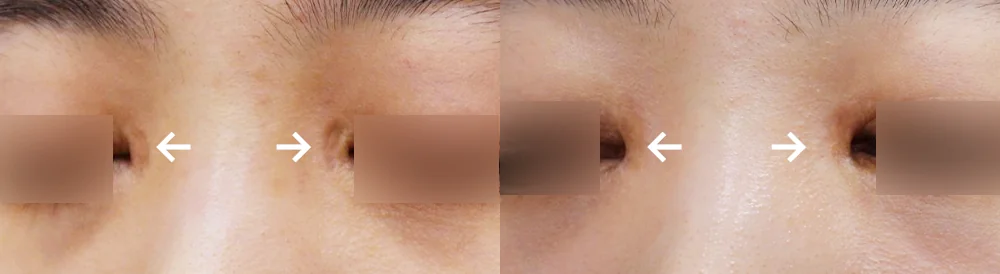
Scars around the inner corners of both eyes
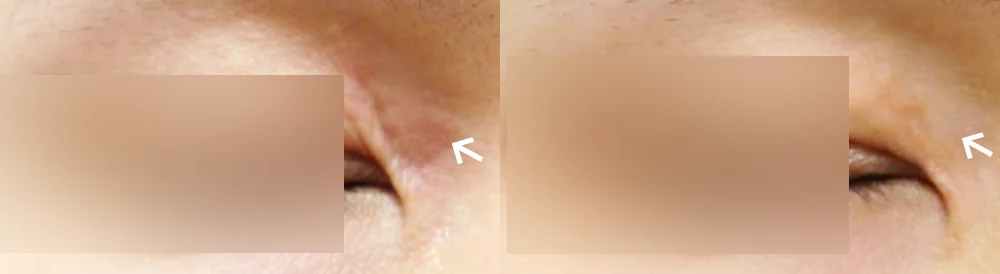
A red scar beside the eye
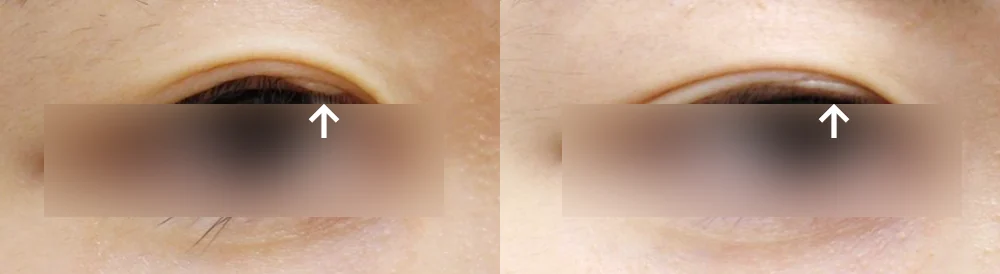
A scar along the upper eyelid crease
* Results vary from person to person. Side effects are possible, so please decide after a thorough consultation with a doctor.
Frequently asked questions
Can a family member or friend come with me, and can I take notes or record?
Having someone hear the same explanation makes it easier to go over dates and instructions together back at your accommodation. Whether a companion can join you in the consultation room, and whether recording is allowed, may depend on the clinic's policy, so please ask at the start of the consultation. Taking notes on the spot is a good idea, because feeling well informed and actually understanding can differ.5 If the consultation is not in your first language, ask again on the spot about anything that is unclear.
Can I have surgery or a procedure on the same day as my consultation?
It depends on your condition and what needs to be prepared. Some medicines need to be paused in advance, and sometimes the plan changes after the examination and you need time to think again. If you would like this, please mention it during the photo consultation, before you travel. Australia's medical board, for instance, requires a period to think before cosmetic surgery is booked, an idea also worth keeping in mind.4
Can I be seen without records from the clinic that did my earlier surgery?
Yes. Tell us what surgery you had and roughly when, as far as you remember; this already helps in judging where the incisions were and why problems arose. If you have photos from before surgery or from different stages, please bring them. If an implant was used, knowing its type also helps in planning a revision.
Should I come without makeup?
If the consultation is about a scar or your skin, it helps to remove makeup at least from that area. Makeup hides the color, edges and texture of a scar and makes it harder to assess accurately. For the nose or facial sagging too, a bare face makes it easier to see contours and skin condition.
What if a problem develops after I return home?
If the area becomes increasingly red, hot and painful, if the wound opens, or if bleeding does not stop, see a doctor near you first. Sudden shortness of breath, chest pain, or one swollen, painful leg can signal a blood clot; seek emergency care straight away. Then let the clinic that operated on you know, with photos. It is a good idea to confirm at consultation how to reach the clinic and which records you can take home. More detail, including blood clot warning signs, is in our aftercare guide.
Related treatment pages and guides
Bonita Clinic is on the 3rd floor of 565 Gangnam-daero, Seocho-gu, Seoul, about 100 m on foot from Exit 8 of Nonhyeon Station (Line 7). The treatment process is described on our Facial Surgical Scars, Rhinoplasty and Face Lift pages. Photos to send before your visit are covered in our guide to photos for online consultation, visit planning for scar treatment in our guide to planning scar treatment in Seoul, and care after you return home in our aftercare guide.
References (7)
Sources that support the explanations in this article. Study findings describe general trends and do not guarantee individual results.
- Draaijers LJ, Tempelman FR, Botman YA, et al. The patient and observer scar assessment scale: a reliable and feasible tool for scar evaluation. Plast Reconstr Surg. 2004;113(7):1960-1965.doi:10.1097/01.PRS.0000122207.28773.56Scale validation study, assessed at one point in time (abstract): development of the POSAS scar scale; in 49 burn scar areas from 20 patients, clinicians' overall opinion was influenced by vascularity, thickness, pigmentation and relief, while patients' opinion was mainly influenced by itching and thickness; supports asking about symptoms as well as examining
- Rhee JS, Weaver EM, Park SS, et al. Clinical consensus statement: Diagnosis and management of nasal valve compromise. Otolaryngol Head Neck Surg. 2010;143(1):48-59.doi:10.1016/j.otohns.2010.04.019US clinical consensus statement on nasal valve compromise (abstract; systematic review plus modified Delphi): most effectively evaluated by history and physical examination; endoscopy and photography useful but not routinely indicated; imaging not useful; supports checking breathing in person rather than by photo
- Kinnersley P, Edwards A, Hood K, et al. Interventions before consultations for helping patients address their information needs. Cochrane Database Syst Rev. 2007;(3):CD004565.doi:10.1002/14651858.CD004565.pub2Cochrane systematic review of 33 randomized trials, 8,244 patients (abstract): interventions before consultations, such as question checklists and coaching, produced small but significant increases in question asking (SMD 0.27) and satisfaction (SMD 0.09); the authors judged the benefits limited
- Medical Board of Australia. Guidelines for registered medical practitioners who perform cosmetic surgery and procedures. . 2023.Medical Board of Australia guidelines for cosmetic surgery, in force from 1 July 2023 (official page): at least two pre-operative consultations, one in person with the operating surgeon; a cooling-off period of at least seven days after consent before booking or a deposit; screening for conditions such as body dysmorphic disorder with a validated tool; discussion of risks, recovery, total cost and alternatives including not having surgery. Australian rules, not a standard that applies in Korea
- Falagas ME, Korbila IP, Giannopoulou KP, et al. Informed consent: how much and what do patients understand?. Am J Surg. 2009;198(3):420-435.doi:10.1016/j.amjsurg.2009.02.010Systematic review of understanding in informed consent (abstract; 23 surgical studies): adequate overall understanding was found in 6 of 21 studies (29%), understanding of surgical risks in 5 of 14 (36%) and satisfaction with the amount of information in 7 of 12 (58%); figures are shares of studies, not of patients
- Fink AS, Prochazka AV, Henderson WG, et al. Enhancement of surgical informed consent by addition of repeat back: a multicenter, randomized controlled clinical trial. Ann Surg. 2010;252(1):27-36.doi:10.1097/SLA.0b013e3181e3ec61Multicenter randomized trial at 7 US Veterans Affairs centers, 575 patients scheduled for surgery (abstract): adding repeat-back to the consent discussion raised the mean comprehension score to 71.4% versus 68.2% (P = 0.03), with 2.6 more minutes spent
- Glaser J, Nouri S, Fernandez A, et al. Interventions to Improve Patient Comprehension in Informed Consent for Medical and Surgical Procedures: An Updated Systematic Review. Med Decis Making. 2020;40(2):119-143.doi:10.1177/0272989X19896348Updated systematic review of interventions to improve comprehension in informed consent (abstract; 52 studies from 2008 to 2018, 60 interventions): compared with standard consent, comprehension improved significantly with 6 of 14 written (43%), 15 of 27 audiovisual (56%) and 11 of 13 interactive digital interventions (85%), and with all 3 verbal discussions using test/feedback or teach-back; the authors judged interactive approaches, especially with teach-back, to appear superior. No meta-analysis was possible, and 44% of studies had a high risk of bias
About this article
This article separates general medical information from Bonita Clinic's own approach. Because the right decision depends on each person's condition, it is not a substitute for a consultation.