KOKorean
 ENEnglish
 JP日本語
 CN中文(简体)
 TW中文(繁體)


How Soon Can You Fly After a Facelift in Seoul? Stitches, Swelling and Clot Risk
There is no single day after a facelift that is right for everyone; when you can fly depends on the extent of surgery and how your recovery is going. Hematoma (blood pooling under the skin), the most common complication after a facelift, is often found within the first 24 hours, so it is wise to spend the early period recovering near the clinic, with stitch removal and a wound check before you leave. Long-haul flights raise the risk of blood clots in the leg veins because you sit for hours, so if your journey after surgery is longer than about 4 hours, walking, fluids and compression stockings or other prevention should be agreed with your medical team in advance. At Bonita Clinic, your return date is set with you at consultation based on the extent of surgery and your recovery — send us your photos and travel dates to start planning.
Curious about your own case? Ask us online →
Why is there no single flight date after a facelift?
"How many days after my facelift can I get on a plane?" is usually the first question from patients who will fly home from Seoul. The trouble is that "facelift" covers operations of quite different sizes. A lift of the lower face alone and a lift that also tightens the neck differ in incision length to begin with, and adding jaw liposuction or fat grafting means more areas have to heal. Rather than starting from a date, it is more useful to know what your face and body need to be protected from at each stage of recovery; the date then follows from that.
Four things shape your flight home after a facelift:
- Hematoma: blood pooling and clotting under the lifted skin. It is the most common complication of a facelift,1 and most appear soon after surgery, so the first day is the critical one.
- Stitches and wounds: the stitches along the crease in front of the ear and the hairline behind it still have to come out, and the wounds need a check.
- Swelling and bruising: swelling and bruising spread over the lower cheeks, jawline and neck and settle gradually over many days.
- Hours in a seat: sitting in a plane seat for hours raises the risk of a blood clot (blood that has set into a lump inside a vein) in the leg veins.
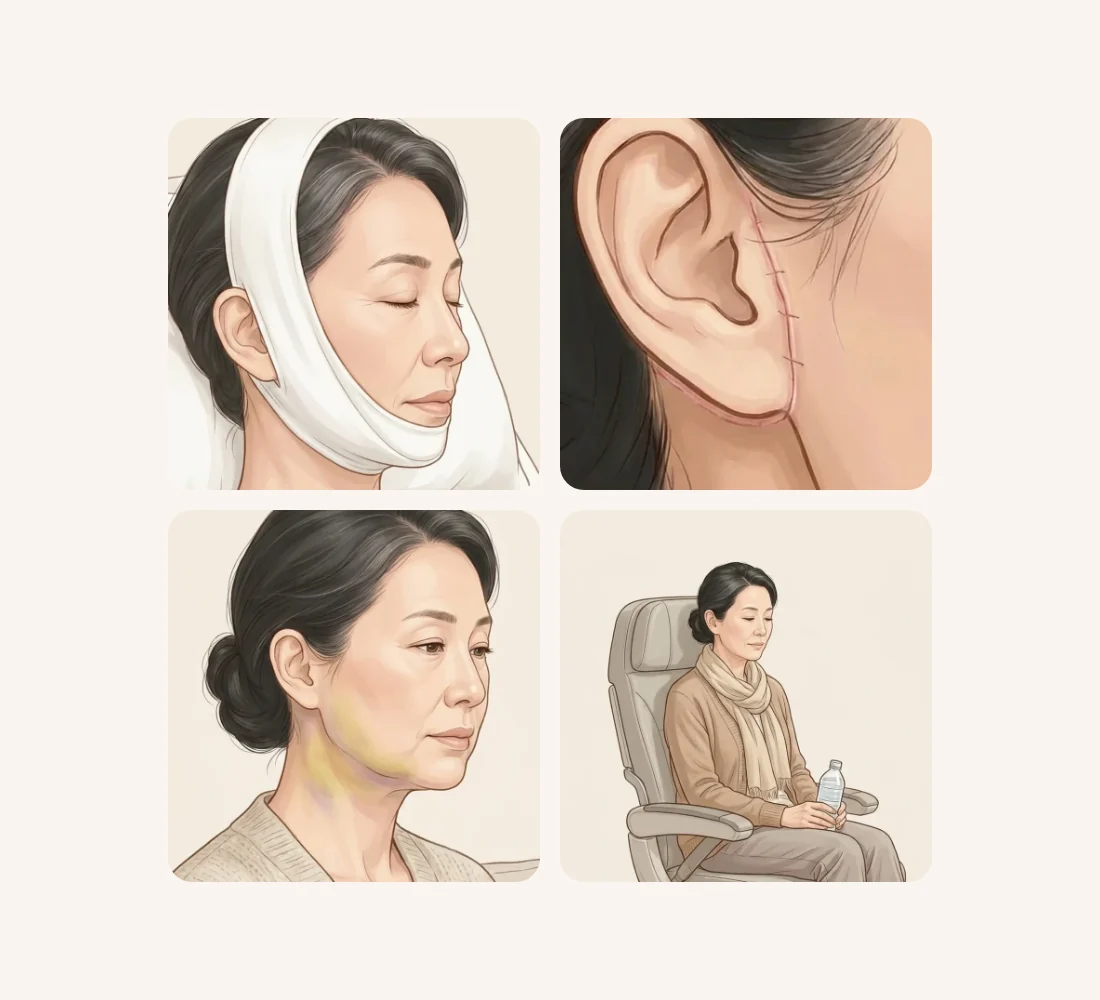
After rhinoplasty, nosebleeds and ear pressure were the main travel worries (see flying after rhinoplasty). A facelift shifts the focus: the first-day hematoma watch, the stitches around your ears and the long hours in a seat become the center of the plan. The cards below picture four moments you are likely to meet before and after the flight.
If this is you around your flight home
1The night of surgery or the next day
This is when we watch most closely for a hematoma, so you recover near the clinic
Hematoma check
2Your stitches around the ear are still in
Stitch removal and a wound check are built into your return date
Recovery schedule
3Swelling or bruising remains on the jaw and neck
We check that both sides are settling, not one side getting worse
Progress check
4Your journey is longer than 4 hours
Plan an aisle seat, water, moving often, and discuss stockings or other prevention
Clot prevention
How does facelift recovery unfold, from incision to stitch removal?
At Bonita Clinic, a facelift is done through incisions in the crease in front of the ear and inside the hairline behind the ear. Through these, the SMAS (a thin but tough layer under the skin that connects to the facial muscles) is lifted and fixed in place. An endoscope (a thin tube with a small camera at its tip) keeps the incisions short, and when the neck is lifted too, the incision behind the ear is extended. Surgery is under general anesthesia or sedation. You stay one night, or go home the same day if your condition allows. Stitches are used, and the recovery period and number of follow-up visits vary with the extent of surgery and with your own healing. The operation itself is covered in detail in our facelift guide.
Recovery passes through three main stretches. The first is the watch right after surgery, making sure no blood is collecting under the lifted layer. The second is the period when swelling and bruising rise on the lower cheeks, jawline and neck and then gradually subside. In the last, the stitches come out on a set day and the wounds are checked, and the result of that check decides when you fly. The drawing below shows these stretches one scene at a time.
How recovery unfolds after a facelift
The pace at which swelling and bruising fade differs a good deal between people. Bonita Clinic's own treatment information says only that it depends on the extent of surgery and that swelling needs time to go down, and it asks you to mention any important dates at consultation. We could not find reliable evidence that pins facelift swelling to a single number of days, so this guide does not give one either. Flying home with some swelling and bruising still visible is not unusual, which is why it helps to decide in advance how you will keep an eye on it at home.
Why should the first 24 hours after a facelift be spent near the clinic?
Hematoma is the most common complication after a facelift. Lifting the skin leaves a space beneath it, and a hematoma is blood that collects and clots in that space. It can lead to swelling that lasts longer, or to part of the skin being damaged because too little blood reaches it (skin necrosis).1
A UK study reviewed the records of 1,078 facelifts performed between 1994 and 1999 by two high-volume surgeons. A hematoma developed in 45 of them, about 4.2%.1 Put simply, that is roughly 1 in every 24 patients. How often hematoma is reported, though, varies widely with the period studied, how a hematoma was defined and who did the surgery. More recent, larger US data reported a lower rate of hematomas that needed urgent treatment (see our facelift guide).
When do hematomas tend to appear? In a review of 605 patients who had a facelift from one surgeon without drains (thin tubes that carry blood and fluid out of a wound), all 7 hematomas were recognized within the first 24 hours after surgery.2 Because this is one surgeon's series, it cannot prove that hematomas only ever appear on the first day. It does show clearly that the first day deserves the closest watch.
Hematoma after a facelift: how often, when, in whom
For a patient who has flown in, this matters for a practical reason: a hematoma should be found and treated early, and that cannot happen quickly on board a plane or in an airport queue. At Bonita Clinic, a facelift usually includes a one-night stay (same-day discharge if your condition allows), so those first hours can be watched closely at the clinic.
What makes a hematoma after a facelift more likely?
The 1,078-facelift study used statistics to see which conditions made a hematoma more likely. Systolic blood pressure (the higher number, measured as the heart contracts), gender, taking aspirin or anti-inflammatory painkillers, and smoking were all significantly linked to hematoma.1 Gender was among these factors, and in the 605-patient study men had more hematomas than women.2 An anterior platysmaplasty, which draws the thin muscle at the front of the neck (the platysma) together in the midline, was also linked to hematoma.1
Several of these can be prepared for in advance:
- Blood pressure: if yours is high, get it under control before surgery and keep taking your medicine as prescribed afterwards.
- Medicines: list every medicine you take at consultation, especially aspirin, anti-inflammatory painkillers and blood thinners. When to stop and restart them is decided by the medical team.
- Smoking: smoking was also linked to hematoma.1 A plan to stop around the time of surgery is made together at consultation.
- Nausea and vomiting: in the 605-patient study, 2 of the 7 patients with a hematoma vomited in the recovery room despite medication. The authors concluded that preventing nausea after surgery, and treating it promptly, may also help prevent hematoma.2 If you feel sick after surgery, tell the staff straight away rather than putting up with it.
Does a facelift drain prevent hematoma?
A drain is a thin tube that carries blood and fluid away from the operated area. Whether one is placed after a facelift depends on the surgeon and the technique. If you will have a drain, the day it comes out can affect your travel dates, so ask about it when your surgical plan is explained.
One randomized controlled trial (a study that assigns patients, or sides of the face, at random so they can be compared fairly) tested drains head to head. In 50 facelift patients, a drain was placed on one side of the face only and that side was compared with the other. Hematoma and swelling did not differ between the sides, and neither did the swelling and discomfort the patients themselves reported. Bruising was the one exception: it was clearly less on the drain side.3
The 605-patient study did not use drains either. It relied on careful control of bleeding and a pressure dressing for 24 hours, and the later 459 patients also had fibrin glue (a tissue glue made from the protein that forms when blood clots) sprayed under the lifted skin. Hematoma occurred in 3.4% of the 146 patients without glue and 0.4% of the 459 with it, and neither group had a large hematoma that needed a return to the operating room. The 5 hematomas in the group without glue were all small and were drained with a needle.2
Side with a drain vs side without
Going by these studies, a drain is more accurately seen as an option that may reduce bruising than as a device that prevents hematoma. Having one does not make the first-day watch any less important.
Before you fly: how are the ear incisions and jawline swelling checked?
The facelift incisions follow the crease in front of the ear and the hairline behind it. The day your stitches come out is set after surgery and may move a little depending on how quickly the wounds heal.
The British Association of Aesthetic Plastic Surgeons (BAAPS) guidance for patients having surgery abroad makes two points about this stage. Appointments such as stitch and drain removal should be booked before you leave the surgical facility, and the operating surgeon should see you at least once after surgery before you travel home.6 At Bonita Clinic, the recovery schedule is explained at consultation, and the stitch removal and wound check are built into it.
At the check-up before departure, we look at the following together:
- Whether the wounds in front of the ear, under the earlobe and behind the ear have closed well, with no gaping or oozing
- Whether one side of the face or neck is becoming more swollen and firm than the other
- Whether pain and swelling are on their way down
- How to care for the wounds at home, and whom to contact if something changes
Swelling of the jawline and neck usually goes down slowly and at a similar pace on both sides. If one side instead keeps swelling, turns firm and hurts, it may be a hematoma and needs to be seen at once. A daily photo of your face from the front and both sides, in the same light and at the same angle, makes left-right differences easy to spot and is useful when we review your progress after you return.
Helping the incision lines become less noticeable over time is part of recovery as well. At Bonita Clinic, care of the incision marks can continue at our Scar Clinic, so if you plan to come back to Seoul after returning home, please mention it at consultation.
Does a face-only operation still raise clot risk on a long flight?
In the days after a facelift you naturally move less than usual while you rest. If a long flight follows straight away, the time your calf muscles spend working shrinks even further. Each step you take squeezes the calf muscles, which act like a pump pushing blood in the leg veins back toward the heart; when that pumping slows, blood lingers in the veins and is more likely to clot. A clot in a deep leg vein is called deep vein thrombosis; when a fragment breaks away and lodges in a lung vessel it becomes a pulmonary embolism, and doctors group the two together as venous thromboembolism (VTE).
So how high is the clot risk after face surgery alone? A study of 129,007 patients in a US cosmetic surgery database (2008–2013), broken down by body area, gives a useful answer. VTE was confirmed within 30 days of surgery in 116 of them, about 0.09%.4 Face surgery alone came to 0.01%, the lowest rate along with breast surgery (0.01%). By contrast, face and body surgery together came to 0.16%, body surgery to 0.21%, and body and breast surgery together to 0.28%.4 In everyday numbers, a clot after face surgery alone affected about 1 in 10,000 people, but adding body surgery made it more than ten times as common.
The number of procedures mattered too. Patients who had several operations at once had a clot rate of 0.20%, against 0.04% for those who had only one. A combined analysis of the risk factors singled out four: body procedures, combining procedures, a higher body mass index (weight relative to height) and older age.4 This is why, if liposuction or another procedure is added to your facelift, clot risk is judged on the whole plan rather than on the facelift alone.
Blood clots after face surgery: body area and travel time
Then comes the length of the journey. The British association's guidance notes that "long-haul" usually means more than 6 hours, but says there is evidence that a total journey of around 4 hours already affects risk, and gives separate advice for those patients.6 A second source, the American Society of Hematology's 2018 guideline (practice recommendations from a specialist society that has reviewed the evidence), has a separate section on journeys longer than 4 hours. For people at substantially higher risk, recent surgery being one example, it suggests graduated compression stockings or a preventive dose of low-molecular-weight heparin (an injection that helps prevent clots), with the caveat that this is a conditional recommendation resting on very low certainty evidence.5
Why clot prevention and hematoma risk pull in opposite directions after a facelift
Medicines that prevent clots work by making blood clot less readily, which can increase bleeding. In the 1,078-facelift study, aspirin or anti-inflammatory painkillers were linked to hematoma.1 The guideline does suggest aspirin when stockings or injections are not feasible,5 but taking aspirin on your own soon after a facelift can work against the effort to prevent hematoma. Whether you need clot prevention at all, and in what form, is decided with the team that operated on you, based on the extent of surgery, the flight time and your own clot risk.
How long do surgeons' societies suggest staying in Seoul after a facelift?
We could not find research that sets a day when it becomes fine to fly after a facelift. For a facelift, the nearest thing to a benchmark is the BAAPS guidance written for patients who travel abroad for surgery. For patients traveling around 4 hours or more, it sorts operations into three groups by anesthesia and length of surgery and suggests, for each group, how long to stay in the country where you had surgery. The table below reproduces it (British society guidance · level of evidence: expert opinion · not a standard set by Bonita Clinic).6
| Group | Operations in this BAAPS group | BAAPS suggested stay (expert opinion) |
|---|---|---|
| 1 | Local anesthetic, typically 90 minutes or less | No set stay |
| 2 | General anesthesia of up to 3 hours with no movement restriction, or a local anesthetic operation longer than 90 minutes | 1–2 weeks |
| 3 | General anesthesia over 3 hours, several sites operated on, restricted movement, or a higher clot risk | 2–4 weeks |
Keep three things in mind when you apply this table to a facelift. First, BAAPS grades the evidence behind these figures as expert opinion.6 Second, whether a facelift falls into group 2 or group 3 depends on the anesthesia, how long the operation took and whatever was done alongside it, such as a neck lift or liposuction. Third, this is a British society's guidance and not Bonita Clinic's rule for how long you stay. The weeks in the table should be read not as "after this, all is well" but as a reminder to allow more time in Seoul the bigger the operation.
Your actual return date comes from several conditions taken together:
- Extent of surgery: lower face only or the neck as well, and whether jaw liposuction, fat grafting or dissolvable threads are added
- Anesthesia and stay: general anesthesia or sedation, and a one-night stay or same-day discharge
- How recovery is going: whether the wounds have healed without a hematoma, whether swelling and pain are easing, and whether the stitches are out
- The journey: a flight longer than 4 hours, or connections that stretch the total time from Seoul to your front door
- Your personal risk: a previous clot, age, body mass index, hormone medicines, blood pressure and the medicines you take145
At your pre-departure check-up, how are you doing?
- No hematoma, wounds stable, swelling easingFly home as planned, once confirmed at the check-up
- One side getting more swollen or painful, or a wound openingAnother check before departure · review the travel date
- Previous clot · combined procedures · journey over 4 hoursAgree on walking, stockings and other prevention in advance
At Bonita Clinic, we go through these conditions one by one at consultation, set aside room for the stitch removal and follow-up check first, and then fix the return date.
On the plane after a facelift: protecting ear incisions and leg veins
For patients flying after surgery, the same guidance suggests four things: an aisle seat, plenty of fluids, moving regularly during the flight and anti-embolism stockings.6 After a facelift, those four steps for your legs need to be paired with ways to protect the wounds on your face:
- Aisle seat: you can stand up and walk without climbing past other passengers.
- Ankle exercises: while seated, pull your toes up toward you and point them down again, over and over, so the calf muscles keep working. When the seatbelt sign is off, walk the aisle.
- Fluids: sip water little and often throughout the flight.
- Compression stockings: ask your surgical team first whether to wear them and which kind.56
- Neck pillow and glasses: make sure a neck pillow, the arms of your glasses or mask straps do not press on the incisions in front of and behind your ears for long. The wound behind the ear cannot be seen without a mirror and is easy to forget.
- Luggage: if you were told not to lift heavy things, that holds on board too; leave the overhead bin to a companion or the cabin crew.
- Medicines: keep prescribed medicines in your cabin bag, and before you leave, ask how to time them as you cross time zones. Do not add aspirin or anti-inflammatory painkillers on your own.1
Back home after a facelift: hematoma, infection and clot warning signs
Healing carries on after you land. Different symptoms point to different problems, and any of the following is a reason to see a doctor near you without delay:
- Possible hematoma: one side of the face or neck keeps swelling, turns firm and hurts.
- Possible infection: a wound becomes red and warm, pus appears, or you develop a fever. A wound that opens up also needs to be seen promptly.
- Facial movement: one side of the face does not move as it normally does.
- Possible clot: one leg becomes swollen and painful, or you suddenly feel short of breath with chest pain. This needs emergency care.
The British guidance also covers follow-up once you are home, by phone or video: a first check 1 to 2 weeks after surgery and a later one between 6 weeks and 6 months. It adds that you should find out before you travel how to get emergency care in your home country.6
If you see a local doctor, tell them the date of surgery, whether the neck was included, any procedures done at the same time and the medicines you take. Bring your operation notes if the clinic gave you a copy. Letting Bonita Clinic know how you are doing also helps us follow your recovery. Swelling that remains along the jawline and neck fades with time, so there is no need to judge your result by how your face looks in the first days back.
Facelift or a less invasive lift: what can be discussed at a Seoul consultation?
Bonita Clinic has been at the same address since it opened in 1995, and throughout that time its patients have been seen by Dr. Kwang-Seop Jung, who is board-certified in plastic surgery in Brazil. At consultation you can discuss the approaches described on our treatment pages:
- Endoscopic face lift: incisions in the crease in front of the ear and inside the hairline behind the ear, with the SMAS lifted and fixed; the incision behind the ear is extended when the neck is lifted as well. See Face Lift.
- Treatments added when needed: jaw liposuction when there is a lot of fat under the jawline, stem cell fat grafting (fat grafted with adipose-derived stem cells) for hollows in places such as the forehead or cheeks, and dissolvable threads where there are fine lines. The choice depends on how much sagging there is and where the face has lost volume.
- Multi-lifting: for early to moderate sagging, a non-incisional combination chosen from jaw liposuction, dissolvable threads, stem cell fat grafting and combined laser, under sedation with local anesthesia and usually with same-day discharge. See Multi-Lifting and our multi-lifting guide.
- Brow lift (above the brow): when a low brow makes the eyelids look heavy, skin just above the brow is removed to raise it. See Brow Lift.
Which approach suits you, and how much recovery time to plan for, can only be decided after an examination.
Why do facelift plans, stays and costs differ?
Two patients who both ask for a facelift may need very different operations: one may need only the lower face lifted, another the neck as well plus fat grafting. That difference carries through to the length of stay in Seoul and to the cost, which follow from how much is done and with which methods.
- Extent: face only, or the neck as well
- Added treatments: jaw liposuction, fat grafting, threads
- Anesthesia: general or sedation
- Overnight stay or same-day discharge
- Earlier lifting, threads or fillers
- Follow-up visits needed before flying home
Final plan and quote after an in-person exam
We can give a final estimate only once an in-person examination has settled how much surgery you need. Photos let us narrow the choices; the exact extent of surgery, and so how long you should plan to stay, is fixed at that examination.
What can facelift photos show, and what needs an in-person exam?
Photos are useful for a first conversation about a facelift. They show where the jawline, cheeks and neck sag and which of those areas bothers you most. What they cannot show is how thick and elastic your skin is, which layer is sagging, or whether earlier lifts or threads have left scar tissue underneath.
Photos can show
- Where sagging shows: jawline, cheeks, neck
- Neck lines and jowls from several angles
- Hollows in the forehead or cheeks
- Visible scars from earlier surgery
- Overall facial balance
Needs an in-person exam
- Skin thickness and elasticity
- Which layer sags: skin, SMAS or fat
- Scar tissue from earlier lifts or threads
- Blood pressure, medicines and clot history
- Fitness for anesthesia and travel
Helpful photos: front, both sides and both 45-degree views, taken in good light without heavy makeup, with your hair tied back so your ears and jawline are visible. Photos from a few years ago help too. With them, please tell us which area bothers you most (jawline, cheeks or neck), any earlier lifting, threads, fat grafting or fillers, your rough travel dates and flight length, and whether you have ever had a blood clot. Our guide on how to take photos for an online consultation shows the angles in more detail. When your photos are ready, send them to us by message with your questions, before you book anything for Seoul.
How we plan a facelift for patients flying in
How we plan your return date
- 1ConsultationWe hear which areas bother you, past treatments and flight plans, then set the extent and recovery schedule
- 2SurgeryGeneral anesthesia or sedation · one-night stay (same day if stable)
- 3Follow-upStitches out, wounds and swelling checked
- 4Flying homeAfter hematoma, wounds and swelling have been checked
Real treatment cases: facelift
The photos below show facelift patients treated at Bonita Clinic; the facelift is the treatment this guide is built around. We could not confirm how long after surgery each photo was taken, so no time frame is given. Results vary from person to person.
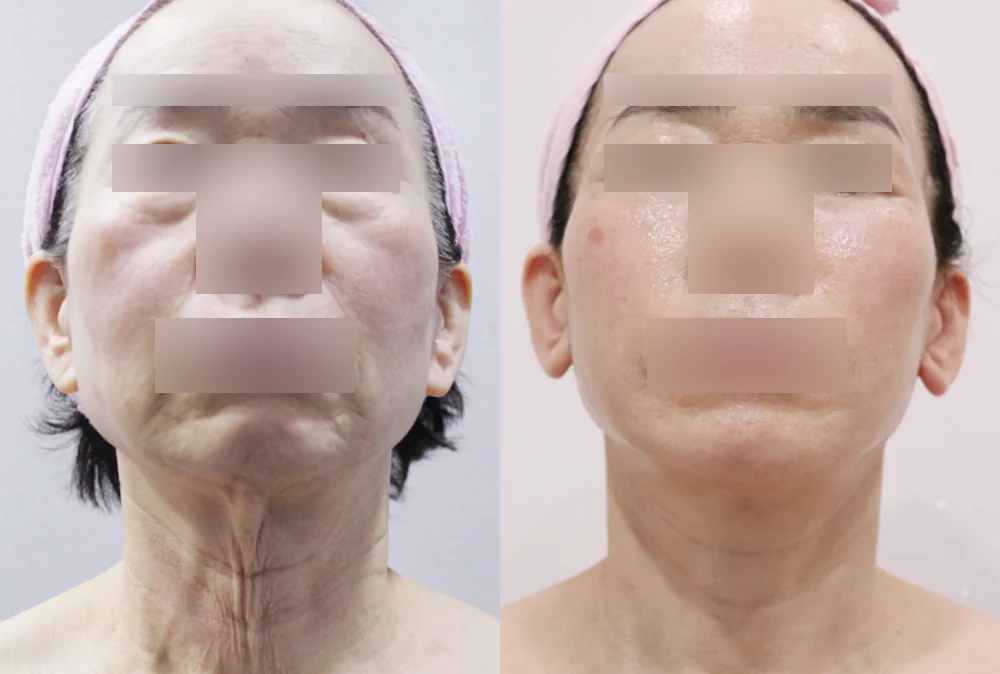
The jawline and neck lines from the front
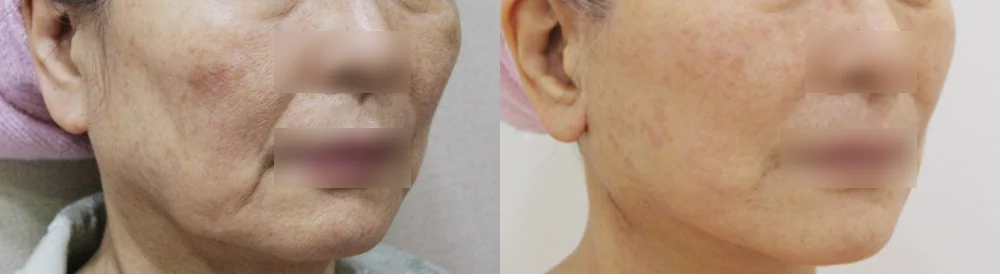
The lower cheek and mouth area from an angle
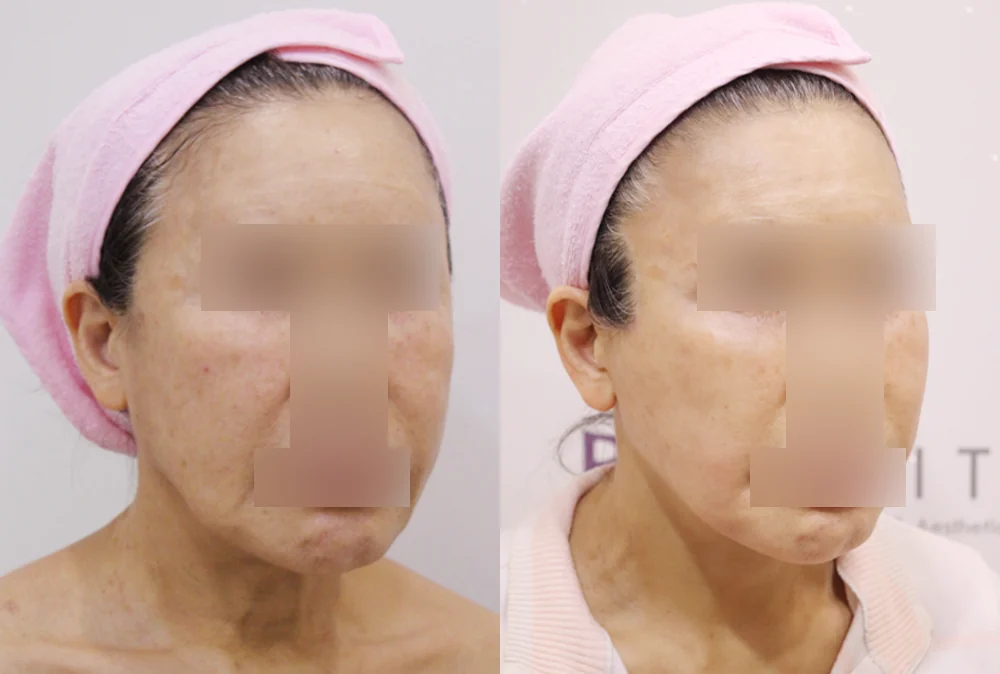
The jawline from an angle
* Results vary from person to person. Side effects are possible, so please decide after a thorough consultation with a doctor.
Frequently asked questions
Can I fly the day after my facelift?
It is hard to recommend. Hematoma, the most common complication after a facelift, usually appears soon after surgery; in a 605-patient series without drains, all 7 hematomas were recognized within the first 24 hours.2 Your stitch removal and wound check are also still ahead, and the British guidance asks that the operating surgeon see you at least once before you travel home.6 When to fly is decided with you at consultation, according to the extent of surgery and how you recover.
Can I fly home before my stitches are removed?
As a rule, the return flight is planned for after the stitches are out and the wounds have been checked. The BAAPS guidance likewise asks for stitch and drain removal to be booked before discharge and for at least one review by the operating surgeon before you travel.6 If your travel dates are already fixed, tell us at consultation and we will plan the extent of surgery and the recovery with those dates in view.
Will flying make the swelling along my jaw and neck worse?
No study we found has measured whether, or by how much, a flight increases facial swelling after a facelift. Because swelling settles bit by bit over many days, small differences in the days right after a flight do not show whether the flight caused them. If one side, rather than both, keeps getting more swollen, firm and painful, see a doctor straight away, whether or not you have just flown.
Do I need a clot-prevention injection or aspirin for the flight after a facelift?
Not necessarily. Clots were rare after face surgery alone, but the risk rose with combined procedures, a higher body mass index and older age.4 For people at clearly higher risk, such as after recent surgery, the guideline suggests compression stockings or a preventive injection for travel over 4 hours, though the certainty of this evidence is very low.5 Aspirin and similar medicines are also linked to hematoma,1 so rather than taking them on your own, decide with the team that operated on you.
What should I do if one side of my face swells and hurts after I get home?
If one side of your face or neck keeps swelling, turns firm and hurts, it may be a hematoma, so see a doctor near you straight away. The same goes for a fever or a wound that turns red or starts to ooze. Tell the doctor when you had surgery, what was done and which medicines you take, and please let Bonita Clinic know as well.
What to prepare before a facelift consultation from abroad
- Your planned flight home: rough date, flight time and connections
- Whether you have ever had a blood clot, your blood pressure, the medicines you take (including aspirin, anti-inflammatory painkillers, blood thinners and hormone medicines), any medical conditions, and whether you smoke
- Any earlier lifting, threads, fat grafting, fillers or facelift, with approximate dates
- Front, side and 45-degree photos, and the area that bothers you most (jawline, cheeks or neck)
- How many days you can spend in Seoul, and whether a companion is traveling with you
You will find Bonita Clinic on the 3rd floor of 565 Gangnam-daero, Seocho-gu, Seoul, a walk of about 100 m from Exit 8 of Nonhyeon Station (Line 7). The operation itself is described on our Face Lift page and in the facelift guide. For lifting without incisions, see Multi-Lifting and the multi-lifting guide; for heavy eyelids caused by a low brow, see Brow Lift.
References (6)
Sources that support the explanations in this article. Study findings describe general trends and do not guarantee individual results.
- Grover R, Jones BM, Waterhouse N. The prevention of haematoma following rhytidectomy: a review of 1078 consecutive facelifts. Br J Plast Surg. 2001;54(6):481-486.doi:10.1054/bjps.2001.3623Review of 1,078 consecutive facelifts by two high-volume surgeons, 1994–1999 (abstract): 45 hematomas (4.2%), the most common complication, which can lead to prolonged swelling or skin necrosis. In multivariate analysis, anterior platysmaplasty, systolic blood pressure, gender (the abstract does not state the direction; higher in men per the Zoumalan 2008 abstract), aspirin or anti-inflammatory painkiller intake and smoking were significantly linked to hematoma
- Zoumalan R, Rizk SS. Hematoma rates in drainless deep-plane face-lift surgery with and without the use of fibrin glue. Arch Facial Plast Surg. 2008;10(2):103-107.doi:10.1001/archfaci.10.2.103Retrospective review of 605 drainless deep-plane facelifts by one surgeon, the first 146 without and the next 459 with fibrin glue (abstract): pressure dressings for 24 hours in all patients; no major or expanding hematoma needing surgery in either group; hematomas fell from 5 (3.4%, all small and needle-aspirated) without glue to 2 (0.4%) with it; all 7 were recognized within the first 24 hours; men had more hematomas; 2 of the 7 patients vomited in the recovery room, and the authors suggest preventing and promptly treating postoperative nausea
- Jones BM, Grover R, Hamilton S. The efficacy of surgical drainage in cervicofacial rhytidectomy: a prospective, randomized, controlled trial. Plast Reconstr Surg. 2007;120(1):263-270.doi:10.1097/01.prs.0000264395.38684.5aRandomized controlled trial in 50 facelift patients with a drain on one side of the face only (abstract): hematoma and swelling did not differ with or without the drain, nor did patient-reported swelling and discomfort, but bruising was significantly lower on the drain side
- Winocour J, Gupta V, Kaoutzanis C, et al. Venous Thromboembolism in the Cosmetic Patient: Analysis of 129,007 Patients. Aesthet Surg J. 2017;37(3):337-349.doi:10.1093/asj/sjw173Prospective US cohort from the CosmetAssure database, 2008–2013, 129,007 patients (abstract): confirmed VTE within 30 days in 116 (0.09%); face 0.01%, breast 0.01%, face and body 0.16%, body 0.21%, body and breast 0.28%; combined 0.20% vs single 0.04%; risk factors: body procedures (RR 13.47), combined procedures (RR 2.4), BMI and age
- Schünemann HJ, Cushman M, Burnett AE, et al. American Society of Hematology 2018 guidelines for management of venous thromboembolism: prophylaxis for hospitalized and nonhospitalized medical patients. Blood Adv. 2018;2(22):3198-3225.doi:10.1182/bloodadvances.2018022954American Society of Hematology guideline (recommendations 17–19 read in the PMC full text): for travel over 4 hours, no stockings, heparin or aspirin for people without risk factors; for people at substantially increased risk such as recent surgery or a previous clot, compression stockings or preventive low-molecular-weight heparin, and aspirin if those are not feasible (all conditional recommendations, very low certainty evidence)
- British Association of Aesthetic Plastic Surgeons (BAAPS). BAAPS Cosmetic Tourism Guidelines. . 2023;September 2023 v1.British Association of Aesthetic Plastic Surgeons guidance for cosmetic surgery abroad (full document read; level of evidence: expert opinion): aisle seat, hydration, moving during the flight and anti-embolism stockings; total travel of about 4 hours affects risk; three surgery groups with suggested stays after surgery (group 2: 1–2 weeks, group 3: 2–4 weeks); stitch and drain removal booked before discharge and at least one review by the operating surgeon before travel; phone or video follow-up at home, early review at 1–2 weeks and further review at 6 weeks to 6 months
About this article
This article separates general medical information from Bonita Clinic's own approach. Because the right decision depends on each person's condition, it is not a substitute for a consultation.