KOKorean
 ENEnglish
 JP日本語
 CN中文(简体)
 TW中文(繁體)


Ice Pick, Boxcar or Rolling Acne Scars? Why Each Needs Different Treatment in Seoul
Ice pick, boxcar and rolling acne scars need different treatments because each shape is caused by something different under the skin and reaches a different depth. Narrow ice pick scars often run deeper than conventional lasers reach, so punch techniques that treat the scar itself are considered first; boxcar scars are refined with laser when shallow, while deep ones may also need punch elevation to lift the floor. Rolling scars are tied down by fibrous bands, so subcision to release those bands comes first and lost volume is filled afterwards. Most faces have a mix of shapes, so the plan depends on which shapes sit where, and photos sent before a visit to Seoul can help narrow down the options.
Curious about your own case? Ask us online →
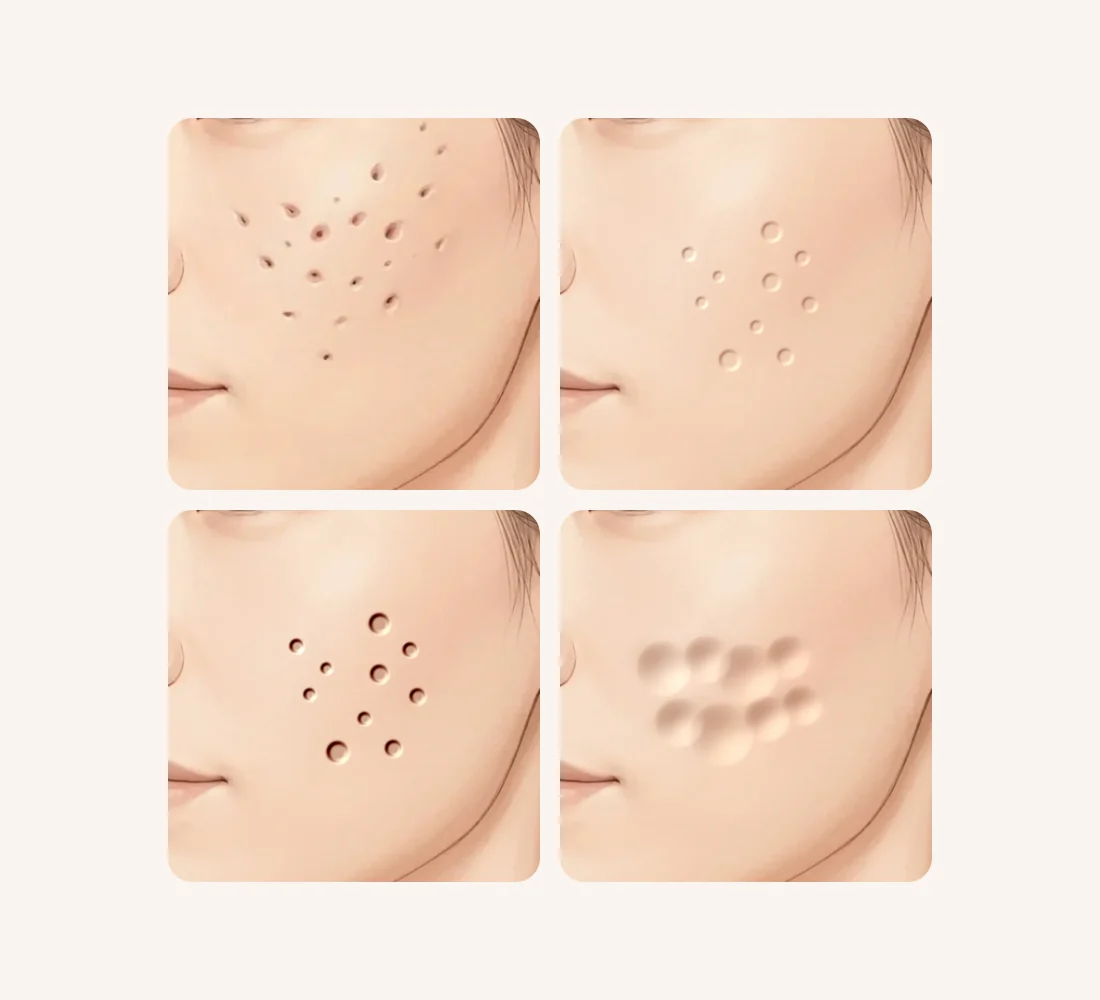
Why do acne scars come in different shapes?
Acne starts inside a hair follicle, where oil builds up and bacteria and inflammation join in. When the inflammation is strong, the follicle wall can break and the inflammation spreads into the surrounding skin. As that area heals, a scar can be left behind.2
Healing skin makes new collagen, the protein fibers that hold the skin up. If too little collagen fills the wound, the skin sinks; if too much builds up, the scar is raised. Among people with acne scars, 80–90% have the sunken kind, called atrophic scars, caused by a net loss of collagen.2
How strong and how long-lasting the inflammation was also matters. One study compared acne lesions from people who scarred and people who did not: in those who scarred, the inflammatory reaction was stronger and lasted longer.2 So if new acne is still appearing, calming it down is the first step in limiting new scars.
Sunken acne scars are usually sorted into three shapes: ice pick, boxcar and rolling.1 These names are not just labels for how a scar looks. They are clues to what is missing under the skin and what is pulling it down. That is why sorting the shapes comes first when choosing treatment.3
Different shapes, different things under the skin
| Shape | What happened under the skin | Considered first |
|---|---|---|
| Ice pick (opening under 2 mm) | A narrow V-shaped tract runs straight down to the deep dermis (the middle layer of skin) or into the fat below; the opening is wider than the bottom2 | Surface treatments reach it poorly,3 so punch excision removes the scar itself7 |
| Boxcar (1.5–4 mm across) | A U-shape with vertical walls; 0.1–0.5 mm deep is a shallow boxcar, 0.5 mm or deeper a deep boxcar2 | Surface treatment such as laser if shallow;3 punch elevation to lift the floor if deep47 |
| Rolling (4–5 mm or wider) | The dermis is tied to the tissue below by fibrous bands, pulling the surface down into an M-shape2 | Subcision to cut the bands below the dermis, then filling of lost volume3 |
Among sunken acne scars, ice pick scars are estimated to make up 60–70%, boxcar scars 20–30% and rolling scars 15–25%.2 The exact share of each type is hard to calculate, so these are rough estimates given as ranges;3 that is also why the upper ends of the ranges add up to more than the whole. When several shapes sit on one face, they can also be hard to tell apart.2
How can you tell the shapes apart in the mirror?
You can get a rough idea at home. Look at three things in turn.
- The opening: is it pinhole-narrow, is it a round dip you can clearly see, or does a broad area feel sunken when you run a fingertip over it?
- The edges: sharp, as if cut with a blade, suggests boxcar; so gentle you can hardly find the edge suggests rolling.
- The floor: narrowing to a point suggests ice pick; broad and flat suggests boxcar.
Watch the direction of the light as well. Sunken scars can be hard to see in light from the front, but they show up as shadows when light comes from the side. Turning your face slowly by a window in daylight makes it easier to see which shapes sit where.
Doctors also stretch the skin by hand when grading how severe scars are. In a widely used grading system, scars that flatten when the skin is stretched are graded moderate, and scars that do not flatten are graded severe.2 The stretch test is shown step by step in Acne Scar Treatment in Seoul: What to Consider When Laser Results Are Limited. It is only a guide; the shapes are confirmed at an examination.
Flat red or brown marks without any dip are a problem of color, not of height, and are looked at separately.2 Raised scars also need a different approach from sunken ones. Both are covered further down.
Why does the same laser give different results for different shapes?
In one study, the same laser given the same number of times improved scars to very different degrees depending on their shape. Thirty-five people with darker skin had six sessions of a 1,540 nm non-ablative fractional laser, a laser that leaves the surface intact and delivers heat in very fine columns. Six months after the last session, the researchers counted each scar by shape and compared them.5
Scar reduction efficiency was highest for boxcar scars at 52.9%. Rolling scars came next at 43.1%, and ice pick scars were lowest at 25.9%. The researchers treated 51% or more as a meaningful improvement, and only boxcar scars passed that line; their improvement was statistically significant after four sessions.5 Put simply, the same laser worked fairly well on boxcar scars but achieved less than half as much on ice pick scars.
A systematic review (a study that gathers every study on a question by a set method and re-examines them) shows a similar pattern. Across fractional CO2 laser studies, rolling and boxcar scars responded most and ice pick scars least. Ice pick scars run straight down into the deep dermis or below, which is likely deeper than conventional lasers reach.4 Because most faces carry a mix of all three shapes, the same review concludes that the final effect of a fractional laser probably depends more on which shape is predominant than on which fractional laser is used.4
None of this means lasers are not useful. Lasers are good at refining surface texture and the edges of shallow dips. How far a laser reaches into the skin, and why deeper causes remain, is explained in detail in Acne Scar Treatment in Seoul: What to Consider When Laser Results Are Limited. This article focuses on which methods are considered first for each shape.
Which treatment is considered first for each shape?
The idea of sorting scars by shape before choosing a method goes back to a 2001 classification paper,1 and later systematic reviews agree that classification helps guide treatment.3 The cards below pair each shape with the method usually considered first.
If your scars look like this, these methods come first
1If the openings are narrow and deep like an awl mark
Punch excision, which removes the scar whole, is considered first
Punch excision
2If the edges are sharp but the dips are shallow
Surface treatment such as fractional laser refines the edges and texture
Fractional laser
3If the walls are steep and the floor is deep
Punch elevation, which lifts the floor, is considered alongside laser
Punch elevation
4If broad areas sink gently like waves
Subcision to cut the bands comes first, then lost volume is filled
Subcision · filling
Ice pick scars: treating the scar itself
Ice pick scars are narrow tracts that reach deep into the dermis, so they respond poorly to treatments that work on the skin surface.3 That is why punch excision is considered first: a round blade (a punch) matched to the size of the scar removes it whole, and the skin is stitched closed.7 In effect, a deep hole becomes a short, fine line. The mark does not disappear; it changes into a shape that is less noticeable than a shadowed pit.
Dermatologists also use a method called TCA CROSS, in which a strong solution of TCA (trichloroacetic acid, an acid that peels skin) is dabbed only inside each scar. In a systematic review, ice pick scars seemed especially responsive to this method, and in one study 73.3% of patients improved by more than 70%.3 Another review found that overall results of TCA CROSS and fractional laser were similar, but TCA CROSS did better on ice pick scars while fractional laser did better on rolling scars.4 In darker skin, though, TCA carries a high risk of hyperpigmentation, so caution is needed.2 We describe this method as general medical information; at Bonita Clinic, narrow deep scars are treated with punch techniques.
Boxcar scars: shallow or deep is the turning point
Boxcar scars of the same shape take different routes depending on their depth. Shallow boxcar scars tend to respond to surface treatments such as laser, while deep boxcar scars respond less to surface treatment alone.3 The line between shallow and deep is 0.5 mm.2 That is about the thickness of a few sheets of paper stacked together, too small to judge by eye, so it is assessed by the direction of light and at an examination.
For deep boxcar scars, punch elevation is considered: a punch is passed around the edge of the scar to free its floor, which is then lifted to the level of the surrounding skin. The raised floor is set slightly high at first and settles level as it heals.7 A review of fractional CO2 laser studies also notes that adding punch elevation helped with deeper scars that respond less to laser alone.4 The idea is to level the floor first and refine the remaining edges and texture with laser afterwards.
Rolling scars: untie the bands first
Rolling scars are caused not by the surface but by fibrous bands underneath that pull the skin down. They therefore need treatment below the level of the dermis.3 Picture a sheet of fabric tied down from underneath with a thread: only the tied spot sinks.
Subcision is a method in which a needle is passed under the skin and moved in a fan-like motion to cut those bands. The tethered spots are released, and new connective tissue forms there, which helps lift the sunken floor.3 How much a rolling scar will lift is hard to predict, though. A review of 36 studies from the previous ten years found that improvement after subcision varied widely: as low as about 10% in some reports, while in other studies every participant improved. The same review noted that, by shape, rolling scars had the highest rates of treatment failure; in one subcision study, 10–15% of patients did not improve.3 Other studies, on the other hand, reported marked improvement in rolling scars, particularly after subcision.3 Put simply, releasing the bands is the starting point for rolling scars, but whether that alone is enough differs from person to person.
When a lot of volume has been lost, filling is added. Injected fat can even out the contour, except where scar attachments remain and keep the skin from rising evenly.2 That is why, for rolling scars, the order matters: release first, fill afterwards.
Fat grafting has limits of its own. In a systematic review of 23 studies of fat grafting for scars, several studies needed more than one session to fill the area fully, and complications such as hematoma (a collection of blood), infection and the need for further procedures were reported. Most of the studies were small, so the level of evidence was low.8 Bruising, swelling and the chance of an uneven surface are also discussed at consultation. For injectable fillers, a review of randomized controlled trials (studies that compare treatments in randomly assigned groups) found moderate-quality evidence that they improved scars more than placebo injections, but no study had looked at long-term effects.6
What do punch techniques, subcision and laser do under the skin?
The names may be unfamiliar, but what each method does under the skin is simple. Step through the four panels below to see why each shape is paired with its method.
- Punch excision: the skin around the scar is cut out as a small round column and stitched. A short line remains where the deep pit was, and there are stitches to remove.
- Punch elevation: the floor of the scar is freed along its edge as a small round column and raised to the height of the surrounding skin. Nothing is cut away; the aim is to level the floor.7
- Subcision: only a tiny needle entry is made, and the bands are cut beneath the skin. Because nothing is cut out, there is no incision line, but bruising and swelling can follow.3
- Fractional laser: very fine columns of tiny wounds are made close together. The untouched skin between them fills in quickly as it heals, and collagen is remodelled in the process.2
Lasers differ among themselves too. Ablative lasers (CO2 and erbium, including fractional types), which remove the surface layer, tend to be the most effective, but they bring more pain, longer downtime and a risk of long-lasting pigment changes. Non-ablative fractional lasers have a safer profile but achieve less. Radiofrequency microneedling (fine needles that deliver radiofrequency heat into the skin) is slightly less effective than fractional laser but tends to cause fewer side effects, and seems to work better on rolling and boxcar scars.4 For skin that pigments easily, these differences become part of how a method is chosen.4
How is a plan made when shapes are mixed?
Most faces have more than one shape. Rather than treating the whole face with one method at one strength, the first step is to see which shapes sit where, and which one is most common. As shown above, results depend more on the predominant shape.4
Which shape do you see most on your face?
- Many narrow, deep pitsPunch techniques for the scars themselves firstRemaining texture with laser
- Many round dips with sharp edgesPunch elevation if deep, laser if shallowDepth confirmed at an examination
- Broad, gentle depressionsRelease with subcision firstFill lost volume; surface last
Combined plans in stages have also been reported. In one combination approach, acid dabbed into individual scars, together with subcision, was done twice, two to three months apart, and fractional laser followed every three to four weeks, for 12 months in all. The authors reported that the combination could be used across a range of sunken acne scars without significant complications.2 There is no fixed formula, but a common thread is to deal with the deeper problems first and refine the surface later. Why this order matters is explained in Acne Scar Treatment in Seoul: What to Consider When Laser Results Are Limited, and how far apart laser sessions are spaced in Scar Laser Treatment in Seoul: How Many Sessions, and How Far Apart?.
Is there one treatment that works for every acne scar?
To be honest, no single method has been shown to suit every acne scar. A Cochrane review (a systematic review from an international organization that grades medical evidence) gathered 24 randomized controlled trials with 789 participants. It concluded that high-quality evidence is lacking because of weak study methods, small numbers of participants and differing ways of measuring improvement, and that its results do not support using any one treatment as the first-line choice.6 Reviews of non-energy and energy-based treatments likewise conclude that there is no easy, definitive solution and that larger studies are needed.34
Put simply, each method has shapes it suits and limits of its own, which is why methods are chosen and combined according to shape. The aim of treatment is to make scars less noticeable, not to erase them. How much they improve depends on the depth and extent of the scars and on your skin type.
Any method can cause side effects such as bruising, swelling, redness, infection and pigment changes. Darker skin types are known to carry a higher risk of darkening (post-inflammatory hyperpigmentation) after ablative laser.2 If your skin has darkened after laser before, please mention it, as it affects the choice of method and strength. If you are taking, or have recently taken, acne medication (especially oral isotretinoin), please tell us as well; it helps in deciding the timing.
Are raised scars and red or brown marks treated the same way?
No. Raised scars, where too much collagen has built up, are the opposite problem from sunken scars. They divide into hypertrophic scars, which stay within the original wound, and keloids, which grow beyond it. With acne, they appear more often on the trunk, such as the chest and back, than on the face, and they are more common in people with darker skin.2 They are treated with other approaches, such as silicone gel or steroid injections into the scar.2 For how to tell them apart, see Keloid or Hypertrophic Scar? How to Tell Them Apart Before Treatment in Seoul.
Flat red or brown marks without a dip are the mildest grade of acne scarring, a problem of color rather than height.2 They are treated with lasers that target color, not with methods that lift the floor; the lasers and intervals used for red and brown marks are covered in Scar Laser Treatment in Seoul: How Many Sessions, and How Far Apart?.
How we approach it at Bonita Clinic
How treatment proceeds at Bonita Clinic
- 1Sort the shapeswhere ice pick, boxcar and rolling scars are, and how many
- 2Raise the floorpunch techniques and subcision for deep scars
- 3Fillyour own fat for broad hollows
- 4Refine the surfacetexture and pores with laser, last
- 5Check progressthe next session is set after spacing
The actual plan is decided after an in-person examination.
Acne scar treatment options you can discuss in Seoul
Since Bonita Clinic opened in 1995, Dr. Kwang-Seop Jung, a board-certified plastic surgeon (Brazil), has seen patients at the same location, near Nonhyeon Station (Line 7, Exit 8). For sunken acne scars, the options you can discuss at consultation are those described on our Acne & Pore Scars page:
- Sorting your scars by shape and depth, and checking how much each shape contributes
- Raising deep scars from the floor with punch techniques and adhesion release (subcision)
- Filling broad hollows with fat grafting, after tethered spots are released
- Laser and energy devices last (fractional, CO2, picosecond and vascular lasers, and radiofrequency microneedling), combined to refine the surface and pores
Which of these you need, and in what order, is decided only after an examination.
Why do the plan and cost differ from person to person?
Two people who both say they have "acne scars" may need very different plans. What shapes the plan, and therefore the cost, is which shapes you have, where they are and how much needs to be done.
- Mix of shapes: ice pick, boxcar, rolling
- Depth of the scars
- Size of the treated areas
- Punch, subcision or fat grafting needed
- Lasers combined and likely sessions
- Skin type and pigment response
Final plan and quote after an in-person exam
A final estimate is given only after an in-person examination, once the shapes, the depth and the order of treatment are clear. Photos help narrow down the options before you plan a trip.
What can photos show, and what needs an in-person exam?
Photos are a good place to start: the rough shape of the scars, where they are and how widely they are spread can be seen in them. What lies beneath the surface cannot.
Photos can show
- Rough shape of the scars
- Where they are and how widespread
- Redness or brown marks
- Changes after past treatments
Needs an in-person exam
- How deep each scar is
- Whether the floor is tethered
- Whether scars flatten when stretched
- Skin thickness and pigment response
- Which methods to combine, in what order
Helpful photos: the front and both sides at 45 degrees, taken in daylight without makeup, plus one with light coming from the side so the dips cast shadows. Add photos from before and after earlier treatments if you have them, and note roughly when those treatments took place. Tips are collected in How to Take Photos for an Online Consultation in Seoul: Scars, Nose, Sagging, Body. You can send us a message with your photos and a short note on your acne history and past treatments.
Planning a visit when treatment comes in stages
Because acne scar treatment is usually divided into sessions spaced apart, a plan may span more than one visit to Seoul. How many visits make sense depends on your mix of shapes, on whether punch techniques, subcision or fat grafting come first, and on how your skin responds, so it is planned together with you at consultation, not fixed in advance. Points worth discussing:
- Which steps can be arranged around the same trip, and when the skin will be ready for the next step
- Stitch removal if any excision is done, and how that fits your stay
- Bruising and swelling, which can follow subcision and are usually temporary,3 and how that fits your plans
- Keeping up sun protection during your stay and after you return home
- Keeping dated photos so progress can be compared at your next visit
After you return home, contact a doctor promptly if redness, swelling, pain or crusting increases instead of settling.
Real treatment cases
These cases appear on our Acne & Pore Scars page. The methods, number of sessions and time since treatment for each case are not given in this article, and results vary by individual.
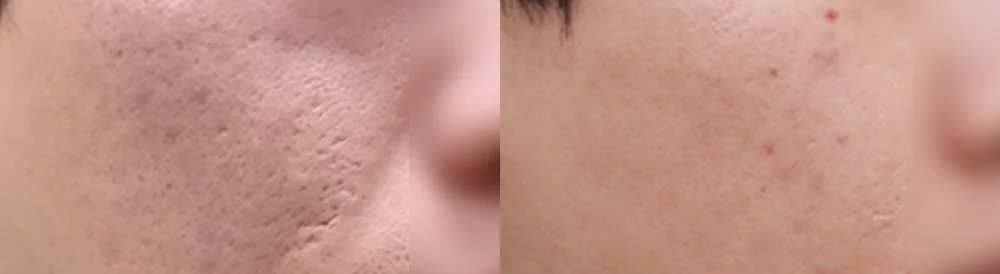
Small, narrow pinpoint pits clustered on the cheek
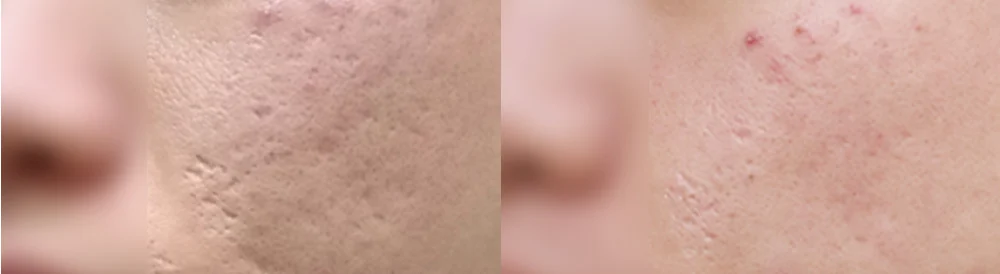
Small dips scattered over the middle of the cheek, some with sharp edges
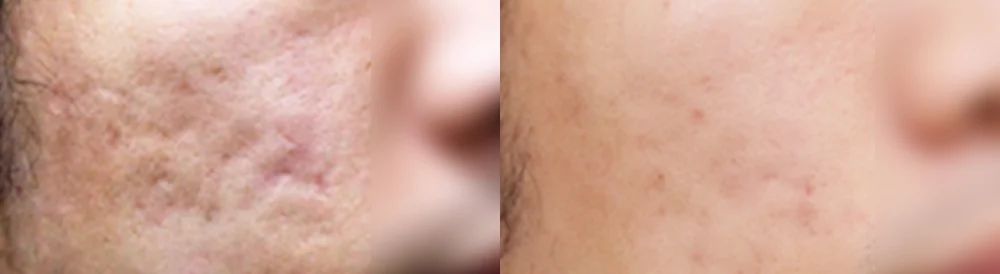
Broad sunken areas mixed with several dips on the cheek
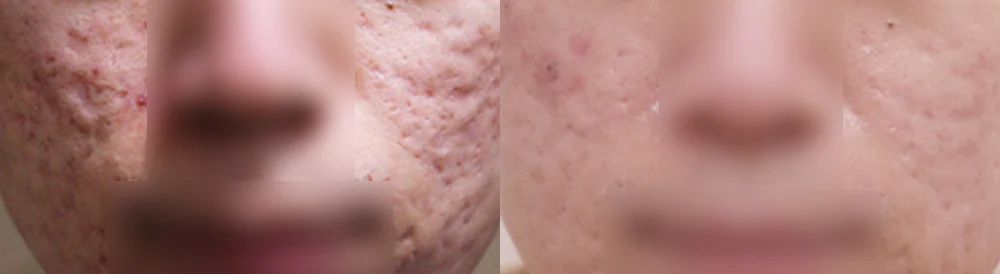
Large, deep dips of mixed shapes on both cheeks
* Results vary from person to person. Side effects are possible, so please decide after a thorough consultation with a doctor.
Frequently asked questions
Will ice pick scars rise if I have enough laser sessions?
In the study where everyone had six sessions of the same non-ablative fractional laser, ice pick scars had the lowest scar reduction efficiency of the three shapes, at 25.9%.5 This is explained by their floor often lying deeper than conventional lasers reach.4 So if ice pick scars are the main problem, methods that treat the scar itself are considered alongside laser, rather than simply adding more sessions of the same laser.
Can't rolling scars just be filled with filler?
Fillers can help replace lost volume.6 But in rolling scars, fibrous bands hold the floor down, so filling without releasing them may leave the tied spots uneven.2 Fillers range from temporary to longer-lasting types,3 and studies of long-term effects are still lacking.6 That is why we first check whether the tethered spots need to be released.
Does punch excision leave a new scar?
Yes. A short, fine line remains where the skin was stitched. The method turns a shadowed pit into a less noticeable line; it does not erase the mark, and the line can widen somewhat over time.7 Combining punch excision with laser resurfacing has been reported to improve acne scarring,2 so the remaining line and the surrounding texture are sometimes refined with laser later.
How can I tell whether a boxcar scar is shallow or deep?
The cutoff used in the literature is a depth of 0.5 mm.2 The difference is too small to measure by eye. It is judged at an examination by how dark the shadow is under side lighting, how the scar changes when the skin is stretched and how the edge feels to the touch. The shallower the scar, the more it tends to respond to surface treatment; the deeper, the less.3
Can the scar shape be judged from photos alone?
The rough shape and how widely the scars are spread can be seen in photos. But depth, how firmly the floor is tethered and whether the scars flatten when the skin is stretched can only be judged accurately by seeing and feeling the skin in person. A photo with light from the side, in addition to the front and 45-degree views, shows dips much more clearly.
What to prepare before your consultation
- Whether new acne is still appearing, and any acne medication you take or apply
- Scar treatments you have had (laser types and number of sessions, fillers or fat grafting, and when the last one was)
- Whether your skin has darkened after laser before
- Photos of the front and both 45-degree sides in good light, plus one with light from the side
- The area that bothers you most, and how much recovery time you can set aside
You can read more on our Acne & Pore Scars page. Lasers for skin texture and pores are described on our UltraClear and Sculpio pages. Why scars can stay after many laser sessions is explained in Acne Scar Treatment in Seoul: What to Consider When Laser Results Are Limited, and treatment of long-standing scars in Old Scar Treatment in Seoul: Can a 10-Year-Old Scar Still Improve?.
References (8)
Sources that support the explanations in this article. Study findings describe general trends and do not guarantee individual results.
- Jacob CI, Dover JS, Kaminer MS. Acne scarring: a classification system and review of treatment options. J Am Acad Dermatol. 2001;45(1):109-117.doi:10.1067/mjd.2001.113451Classification paper (abstract only): sorts sunken acne scars into ice pick, rolling and boxcar types and proposes choosing treatment (punch excision, punch elevation, subcision, laser resurfacing and others) once the type is defined; the abstract does not say which method suits which shape, so it is cited here only as the origin of shape-based planning
- Fabbrocini G, Annunziata MC, D'Arco V, et al. Acne scars: pathogenesis, classification and treatment. Dermatol Res Pract. 2010;2010:893080.doi:10.1155/2010/893080Review (full text): scars form as inflamed follicles heal; 80–90% are atrophic; stronger, longer inflammation in those who scar; dimensions of each type (ice pick under 2 mm reaching the deep dermis or below; boxcar 1.5–4 mm, shallow 0.1–0.5 mm, deep 0.5 mm or more; rolling 4–5 mm or wider, tethered to the subcutis); estimated shares; grading by stretching; fat cannot even out tethered spots; punch excision with laser; a 12-month combination plan; higher pigment risk after laser in darker skin; raised scars on the trunk treated with silicone gel or steroid injection
- Kravvas G, Al-Niaimi F. A systematic review of treatments for acne scarring. Part 1: Non-energy-based techniques. Scars Burn Heal. 2017;3:2059513117695312.doi:10.1177/2059513117695312Systematic review (full text) of 36 studies from the past ten years: exact shares of each type are hard to calculate and are estimates; classification guides treatment (ice pick resists surface treatment, rolling needs treatment below the dermis, shallow boxcar responds, deep boxcar less); subcision, mainly for rolling scars, with widely varying improvement; rolling scars had the highest failure rates (10–15% in one subcision study), though others improved markedly after subcision; TCA CROSS suits ice pick scars (73.3% improved by over 70% in one study); no easy definitive solution
- Kravvas G, Al-Niaimi F. A systematic review of treatments for acne scarring. Part 2: Energy-based techniques. Scars Burn Heal. 2018;4:2059513118793420.doi:10.1177/2059513118793420Systematic review (full text) of 59 studies since 2008: with fractional CO2 laser, rolling and boxcar scars responded most and ice pick least, likely lying deeper than conventional lasers reach; adding punch elevation helped deeper scars; results depend more on the predominant shape; TCA CROSS did better on ice pick, fractional laser on rolling; ablative lasers most effective but with pain, downtime and pigment risk; non-ablative safer but less effective; radiofrequency microneedling slightly less effective with fewer side effects
- Sardana K, Manjhi M, Garg VK, Sagar V. Which type of atrophic acne scar (ice-pick, boxcar, or rolling) responds to nonablative fractional laser therapy?. Dermatol Surg. 2014;40(3):288-300.doi:10.1111/dsu.12428Prospective single-group study (abstract only) of 35 people with darker skin given six sessions of a 1,540 nm non-ablative fractional laser, with scars counted by shape six months after the last session: scar reduction efficiency 52.9% for boxcar, 43.1% for rolling and 25.9% for ice pick scars; 51% or more counted as meaningful improvement; boxcar scars improved significantly from the fourth session
- Abdel Hay R, Shalaby K, Zaher H, et al. Interventions for acne scars. Cochrane Database Syst Rev. 2016;2016(4):CD011946.doi:10.1002/14651858.CD011946.pub2Cochrane systematic review (abstract only) of 24 randomized trials with 789 participants: high-quality evidence is lacking because of weak methods, small samples and differing outcome measures; moderate-quality evidence that injectable filler improved scars more than placebo (longest follow-up 48 weeks, no long-term studies); no support for any treatment as first-line
- Attia E. Atrophic Postacne Scar Treatment: Narrative Review. JMIR Dermatol. 2024;7:e49954.doi:10.2196/49954Narrative review (full text) of surgical methods for individual scars: punch excision may be effective for ice pick scars and small (under 3 mm) boxcar scars, with the risk that the resulting scar widens; punch elevation is best suited to boxcar scars, the raised floor settling level as it heals; punch elevation combined with fractional CO2 laser; side effects of subcision
- Riyat H, Touil LL, Briggs M, et al. Autologous fat grafting for scars, healing and pain: a review. Scars Burn Heal. 2017;3:2059513117728200.doi:10.1177/2059513117728200Systematic review (full text) of 23 studies (1,158 patients) on fat grafting for scars: improvements in volume and contour were reported, but some studies needed several sessions to fill fully, complications included haematoma, infection and further procedures, and most studies were small with low levels of evidence (mainly burn, traumatic and surgical scars; one acne scar study)
About this article
This article separates general medical information from Bonita Clinic's own approach. Because the right decision depends on each person's condition, it is not a substitute for a consultation.