KOKorean
 ENEnglish
 JP日本語
 CN中文(简体)
 TW中文(繁體)


Subcision and Fillers for Deep Acne Scars in Seoul: What Each Can and Cannot Lift
Subcision (adhesion release) is a procedure in which a needle or a blunt-tipped cannula is passed under the skin to cut the fibrous bands holding the floor of an acne scar down. Because the tethered floor is freed and rises, it is used mainly for broad, wave-like rolling scars, and any volume still missing afterwards is replaced with filler or fat grafting. Neither, however, changes narrow, deep ice pick scars or surface texture; filling a scar that is still tethered may leave that spot sunken; and released areas can reattach, so treatment is often done in stages. At Bonita Clinic in Seoul, depth, width, tethering and lost volume are checked first and the plan follows a release, fill, then refine order. Wondering which applies to you? Send us photos taken in daylight and with side lighting before planning your visit.
Curious about your own case? Ask us online →
What does subcision actually do under the skin?
Subcision is short for "subcutaneous incisionless surgery": the skin surface is not cut open, but tissue underneath it is. The 1995 report that coined the term described inserting a sharp needle through a tiny puncture in the skin and moving it under the depressed spot to make cuts beneath the surface.1 It is also called adhesion release, because that is what it does.
Why cut under the skin at all? Rolling acne scars form when the dermis (the middle layer of the skin) is tied down to the fat beneath it by abnormal fibrous tissue. Those fibres hold the floor of the scar down, so from the outside you see broad, soft shadows that run together like waves.2 Subcision is the procedure that cuts those fibrous bands.
The floor is thought to rise for two reasons. First, once the bands are cut, the tethered floor is released. Second, the small wound made by the procedure heals, and new connective tissue (the fibrous tissue that supports the skin) forms and fills the space.1 A recent review puts it the same way: the controlled injury sets off a healing response, and connective tissue grows into the released pocket.3
Several instruments are used: sharp needles, blunt-tipped cannulas (thin tubes), fine wires and blunt blade-like tools. The choice depends on how deep the scars are and on what else will be combined with the release.3 Sharp needles are known to cause hematomas (small collections of blood) quite often, while blunt tools are described as a way of separating tissue with less injury to the structures around it.3 There are not yet enough comparative studies to say that any one tool is the right choice for everyone.
In plain terms: subcision unhooks the floor from below and lets the body lay down new support tissue in the gap. It is a release procedure, not a filling procedure and not a resurfacing procedure.
What can subcision change, and what can't it change?
Subcision does one job: it releases a floor that is tethered from below. The scars it suits most are therefore broad, gently sloping rolling scars that run together in waves.
There are also clear limits to what subcision alone can change.
- Narrow, deep ice pick scars: the problem is a narrow channel running deep, not a band pulling the floor down, so punch techniques that treat the scar itself are usually considered first.
- Broad hollows from lost volume: cutting the bands does not bring back volume that is missing. Replacing that volume is a separate step.
- Surface texture, enlarged pores, and red or brown marks: subcision works under the skin, so the surface stays as it was. Those are the job of laser and other surface treatments.
Which method is considered first for each scar shape is covered in Ice Pick, Boxcar or Rolling Acne Scars? Why Each Needs Different Treatment in Seoul, and how deep lasers reach is explained in Acne Scar Treatment in Seoul: What to Consider When Laser Results Are Limited. This guide focuses on the two steps in between: releasing and filling.
If a scar is sunken, isn't filler enough?
It is natural to think "it's sunken, so fill it." But a scar whose floor is still tied down may not rise evenly when it is filled. A review of acne scar treatment explains that injected fat evens out the contour except where remaining scar attachments hold the skin down.2
Think of a sheet of cloth tied down in the middle with a thread. If you push padding underneath, the area around the thread puffs up, but the tied spot stays sunken. Because the surrounding area has risen, the tied spot can even look deeper than before.
So when tethering and volume loss come together, the usual order is to release first and fill afterwards. Patient guidance from the American Academy of Dermatology also describes lifting some sunken scars surgically and then injecting a filler.6 On the other hand, where volume is missing but nothing is tethered, a plan may involve filling alone, because filler is a treatment that adds volume to depressed scars.6
How do you tell whether a scar needs subcision, filling, or both?
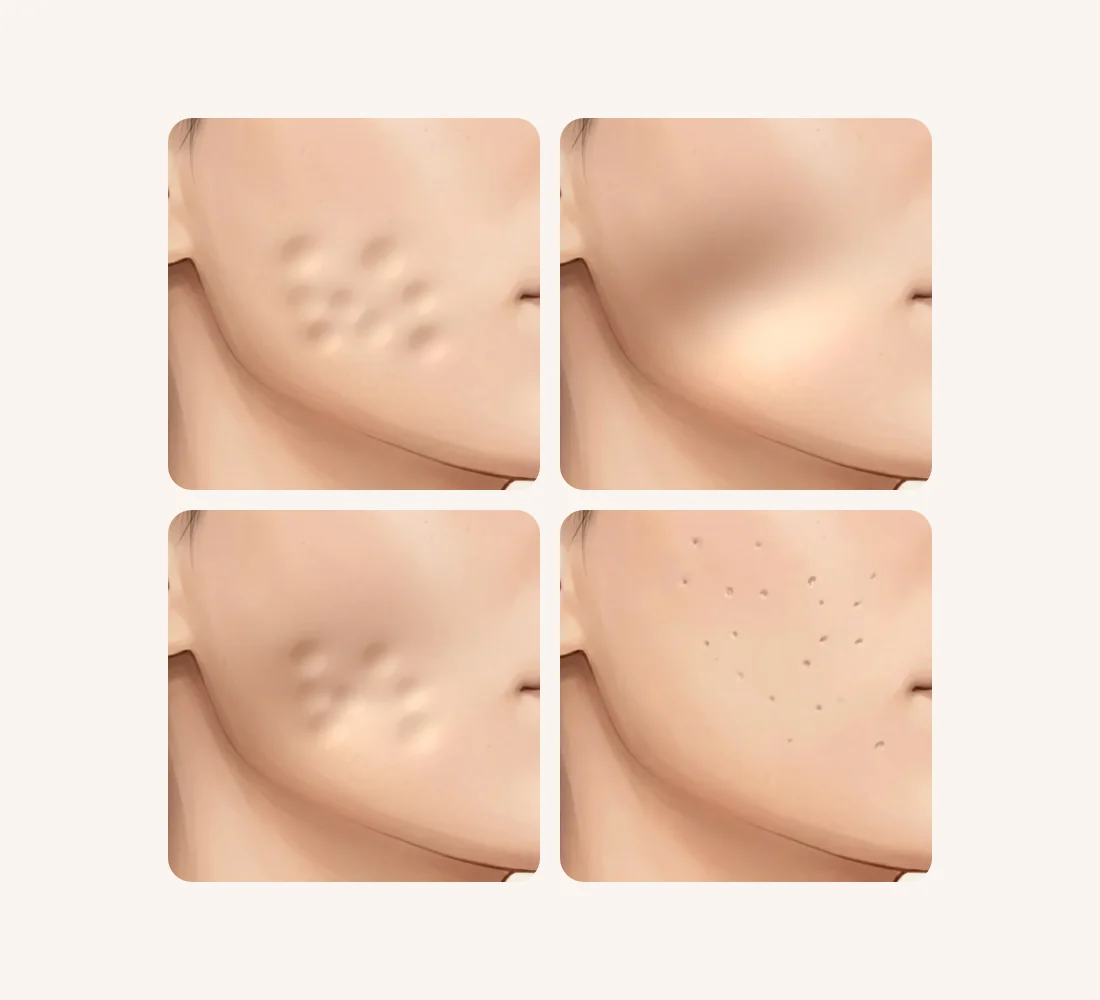
Two questions decide it: is the floor tied down, and is volume missing? Depending on which is larger, subcision comes first, filling comes first, or both are needed. The cards below show four common situations drawn on the same cheek.
What to look at first, by the kind of dip
1If soft dips run together in waves
Bands often hold the floor down, so subcision comes first
Subcision
2If the cheek is broadly hollow
Lost volume is replaced with fat or filler
Filling
3If wave-like dips sit in a hollow
Release first, then fill what is still missing
Subcision → filling
4If the pits are narrow and deep
Punch techniques for the scar itself come before subcision
Punch
You can get a rough idea at home. Look at your cheek under light coming from the side, and notice whether small dips run together in waves or whether the whole cheek is hollow and casts a broad shadow. A simple stretch test, gently spreading the skin beside a scar with two fingers, is illustrated in Acne Scar Treatment in Seoul: What to Consider When Laser Results Are Limited.
How firmly the floor is tethered and how much volume is actually missing are hard to judge in a mirror, though. Most faces have more than one shape of scar, so the final judgement is made at an examination, where the skin can be seen and felt directly.
How do filler and fat grafting differ?
The materials used to replace lost volume fall into two groups: fillers, which are injected, and your own fat, which is moved from another part of your body.
Materials used to replace lost volume
| Material | Mainly used for | Good to know |
|---|---|---|
| Hyaluronic acid filler | Small areas, without surgery | Absorbed by the body, so it fades over time |
| Non-absorbable filler (PMMA) | When a longer-lasting result is wanted | Stays long, so decide carefully · little long-term data |
| Your own fat | Broad hollows such as the cheek | Needs a harvesting step · how much stays varies |
Hyaluronic acid filler
Hyaluronic acid is similar to a substance found naturally in the skin, and fillers made from it are gradually absorbed by the body. In a review of acne scar treatment it is described as the recommended material among fillers.2 The American Academy of Dermatology notes that most fillers are temporary and last roughly 3 months to 2 years, depending on the type.6 In practical terms, if you like the result, it may need topping up as time passes.
Non-absorbable filler
Some fillers are not absorbed and last much longer.6 One randomized controlled trial (a study in which participants are assigned to treatments at random) tested a filler made of tiny plastic beads (PMMA) suspended in collagen in rolling acne scars. Among 147 people followed for 6 months, 64% of those who received the filler and 33% of those who received saline were rated as treatment successes.5 The follow-up lasted only 6 months, and the authors themselves called for longer-term data; the first author worked for the manufacturer.5 Because the material stays for a long time, it is worth hearing the pros and cons in full before deciding.
Your own fat
Fat grafting means removing a small amount of fat from an area such as the abdomen or thighs, purifying it and placing it where volume is missing. It suits broad hollows such as the cheek, and as your own tissue it is easy to obtain and described as having a low rate of side effects.2 A review of subcision summarizes reports in which fat injected after subcision gave better results than subcision combined with platelet-rich plasma (PRP, a concentrate made from your own blood). In another series, the only cases of overcorrection (too much fullness) were in patients who had wire subcision combined with fat transfer.3 How much grafted fat settles in varies from person to person, so any touch-up is decided after watching the progress.
Does adding filling to subcision change the results?
Studies suggest combinations can do better than release alone. In one randomized study, subcision with a blunt cannula was followed by hyaluronic acid filler on one side, fractional CO2 laser on another, or nothing further in a third group (20 people each). Six months after the last session, the average scar grading score had fallen by 44.3%, 62.3% and 68.6% respectively.4
There are three ways to read this. Subcision alone gave some improvement. Adding filler or laser gave more. And the difference between the filler side and the laser side was not statistically significant.4 The conditions were not identical, though: the subcision-only group was treated once, while the combined sides were treated monthly for up to three sessions. The study was also small.4
A review also summarizes a study in which 94.1% of patients improved after wire subcision followed by hyaluronic acid filler, and 82.4% after poly-L-lactic acid (PLLA, an injectable that gradually stimulates collagen).3 The same review concludes, however, that because procedures are not standardized, firm clinical guidelines cannot yet be written.3 Put simply, evidence that combining release and filling can help is building up, but which combination fits whom is still something to decide at an examination.
Can a released scar sink back again?
Yes. This is the limit of subcision mentioned most often. After subcision with sharp needles, many patients were reported to regress noticeably within a few weeks.3 With blunt cannulas, satisfaction was higher at three months but similar at six months, which suggests that some of the gain faded over time.3
The usual explanation is that the cut ends heal and stick together again. Ways to reduce this are being studied. In one study, suction was applied to the treated area at least every other day for two weeks starting on day three; the average improvement was 71.73%, compared with 43.75% when suction was limited or not done.3 This is, however, the only published study of suction after subcision.
For these reasons subcision often needs more than one session, and any remaining hollow may be completed with filling.3 How far the floor rises and how long it holds differs with the depth of the scar, how tightly it is tethered and how thick the skin is.
What can happen after the procedure?
Subcision leaves no incision line, but because tissue is cut under the skin, bruising and swelling can follow. Hematomas are known to be quite frequent with sharp needles.3 With blunt tools, fluid is used to separate the tissue planes, which can cause temporary swelling.3
Adding filler can make swelling more noticeable. In the randomized study above, swelling was more visible on the filler side than on the laser side, and the subcision-only group had the least pain, redness, swelling and downtime; no serious side effects were reported.4 In the trial of the non-absorbable filler, adverse events were generally mild and reversible.5 With fat, overcorrection has been reported.3
Timing matters too. While acne is still active, new scars can form, so scar treatment usually begins once acne is under control.6 If you have an important event coming up, mention it at consultation so that time for bruising and swelling to settle can be built into the plan.
How we approach it at Bonita Clinic
At Bonita Clinic, the filling method described on our treatment page is your own fat (fat-derived stem cells). Filler is covered in this guide as general medical information. The actual plan is set after an in-person examination.
Subcision and filling options you can discuss in Seoul
Since Bonita Clinic opened in 1995, Dr. Kwang-Seop Jung, a board-certified plastic surgeon (Brazil), has seen patients at the same location, near Nonhyeon Station (Line 7, Exit 8). For sunken acne scars, the options you can discuss at consultation are those described on our Acne & Pore Scars page:
- Checking depth, width, tethering and lost volume, and how each shape contributes
- Releasing tethered scars from below (adhesion release) and raising deep, narrow scars with punch techniques
- Filling broad hollows with your own fat, together with fat-derived stem cells
- Laser and energy devices last, to refine the surface, pores and redness
Which of these you need, and in what order, is decided only after an examination.
Why do the plan and cost differ from person to person?
Two people who both describe "deep acne scars" can need very different plans. What shapes the plan, and therefore the cost, is how much of the problem is tethering and how much is lost volume, how large the areas are, and how many stages are likely.
- How much is tethered vs lost volume
- Size of the areas to release and fill
- Subcision alone or with fat grafting
- Other methods needed: punch, laser
- Likely number of stages
- Skin type and pigment response
Final plan and quote after an in-person exam
A final estimate is given only after an in-person examination, once the depth, the tethering and the order of treatment are clear. Photos help narrow down the options before you plan a trip.
What can photos show, and what needs an in-person exam?
Photos are a good place to start. Where the dips are, how widely they are spread, and whether they look like waves or a broad hollow can often be seen in them, especially with light from the side. What lies under the surface cannot.
Photos can show
- Where the dips are and how widespread
- Wave-like dips vs a broad hollow (with side lighting)
- Ice pick pits mixed in
- Changes after past treatments
Needs an in-person exam
- How firmly each floor is tethered
- How much volume is actually missing
- Skin thickness and how it moves
- Past filler or fat and where it sits
- Which steps to combine, in what order
Helpful photos: the front and both sides at 45 degrees in daylight without makeup, plus one with light coming from the side so the dips cast shadows. If you have had filler or fat grafting before, note roughly when and where. Tips are collected in How to Take Photos for an Online Consultation in Seoul: Scars, Nose, Sagging, Body. You can send us a message with your photos and a short note on your acne history and past treatments.
Planning a visit when release and filling come in stages
Because subcision may need more than one session and filling is often decided after watching how the floor settles, a plan may span more than one visit to Seoul. How many visits make sense depends on your scars, on whether release, filling or punch techniques come first, and on how your skin responds, so it is planned together with you at consultation rather than fixed in advance. Points worth discussing:
- Which steps can be arranged around the same trip, and when the next step makes sense
- Bruising and swelling after subcision, which are usually temporary,3 and how that fits your plans
- Whether fat will be harvested, and how the donor area is cared for during your stay
- Keeping up sun protection during your stay and after you return home
- Keeping dated photos so progress can be compared at your next visit
After you return home, contact a doctor promptly if redness, swelling, pain or firmness increases instead of settling.
Real treatment cases
These cases appear on Bonita Clinic's Acne & Pore Scars page. The methods, number of sessions and time since treatment are not stated here, and results vary from person to person.
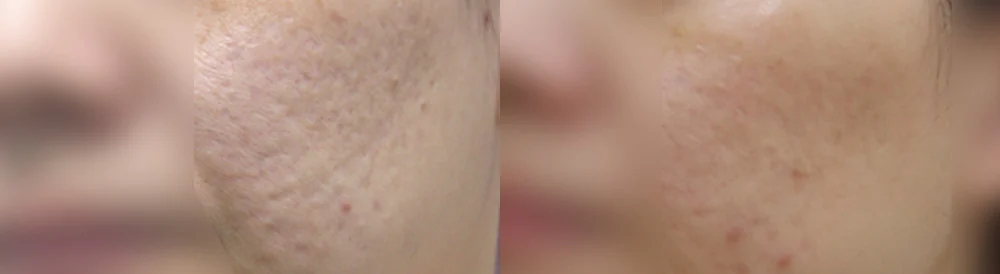
Broad, gentle dips running together like waves on the lower cheek
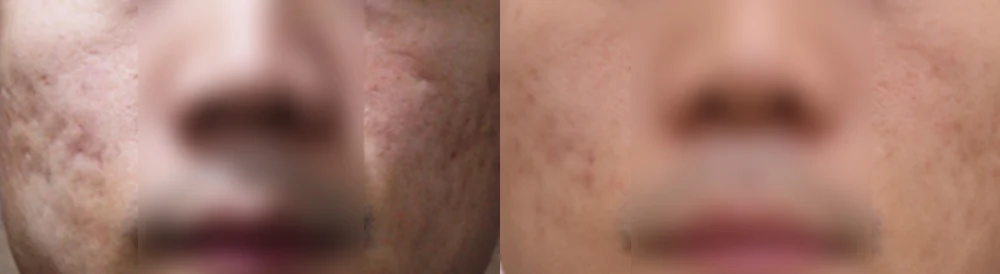
Broad hollows mixed with larger and smaller dips on both cheeks
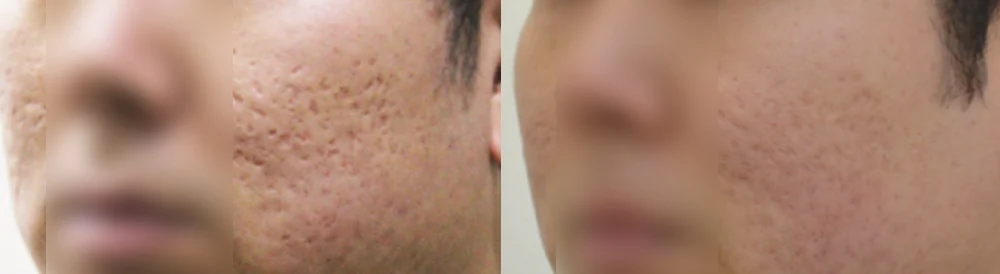
Larger and smaller dips spread closely across the whole cheek
* Results vary from person to person. Side effects are possible, so please decide after a thorough consultation with a doctor.
Frequently asked questions
Is one session of subcision enough?
Sometimes, but more than one session is often needed. Needle and cannula subcision are described as frequently requiring several sessions to reach the result people want.3 At Bonita Clinic, how many sessions surgical restoration of the floor takes also varies from scar to scar, and the next step is decided after checking progress.
Exactly how long does filler in an acne scar last?
The exact time cannot be promised, because it depends on the material and the person. Most fillers are temporary and last roughly 3 months to 2 years.6 Non-absorbable filler lasts longer, but the acne scar trial followed people for only 6 months.5 And if the floor is still tethered, the spot may not rise evenly no matter how long the filler lasts.2
Will I definitely bruise after subcision?
Not definitely, but because tissue is cut under the skin, it is sensible to expect some bruising and swelling. Hematomas are known to be quite frequent with sharp needles.3 How long bruising takes to fade depends on the extent of treatment and on you, so let us know about important dates.
Can I have this while I still get breakouts?
Scar treatment usually begins once acne is under control,6 because new breakouts can leave new scars. If you take or apply acne medication, tell us at consultation so we can take it into account when choosing the timing.
Can areas where I had filler before be released or filled again?
The plan depends on the type of material and when it was placed. Bonita Clinic also treats sunken scars that remain after filler or implant removal. Telling us what was injected, when and where, as far as you remember, helps with planning.
What to prepare before your consultation
- Whether you still get breakouts, and any acne medication you take or apply
- Past scar treatments: subcision, laser, filler or fat grafting, and roughly when
- Daylight photos from the front and both sides at 45 degrees, plus one with side lighting so broad hollows show
- The area that bothers you most, and how much time you have for bruising and swelling to settle
The treatment process is described on our Acne & Pore Scars page. Releasing and filling depressed facial scars from injuries or surgery is covered on our Facial Depressed & Incision Scars page and in Depressed Facial Scars After Surgery or Injury in Seoul: Release, Fill or Revise?, and treatment of long-standing scars in Old Scar Treatment in Seoul: Can a 10-Year-Old Scar Still Improve?.
References (6)
Sources that support the explanations in this article. Study findings describe general trends and do not guarantee individual results.
- Orentreich DS, Orentreich N. Subcutaneous incisionless (subcision) surgery for the correction of depressed scars and wrinkles. Dermatol Surg. 1995;21(6):543-549.doi:10.1111/j.1524-4725.1995.tb00259.xReport that first defined subcision (abstract only): a needle inserted through a skin puncture is moved under the depression to make cuts beneath it; the depression is lifted both by the release and by connective tissue that forms as the wound heals
- Fabbrocini G, Annunziata MC, D'Arco V, et al. Acne scars: pathogenesis, classification and treatment. Dermatol Res Pract. 2010;2010:893080.doi:10.1155/2010/893080Review (full text): rolling scars are caused by abnormal fibrous anchoring of the dermis to the subcutis; injected fat normalizes the contour except where residual scar attachments impede it; fat is easily available with a low rate of side effects; hyaluronic acid is described as the recommended filler
- Vempati A, Zhou C, Tam C, et al. Subcision for Atrophic Acne Scarring: A Comprehensive Review of Surgical Instruments and Combinatorial Treatments. Clin Cosmet Investig Dermatol. 2023;16:125-134.doi:10.2147/CCID.S397888Review of subcision instruments and combinations (full text): controlled injury promotes connective tissue that fills the released pocket; hematomas frequent with sharp needles; several sessions often needed; many regress within weeks (earlier report); cannula satisfaction higher at 3 months but similar at 6; suction from day 3 for 2 weeks gave 71.73% vs 43.75% mean improvement (only study of suction); HA 94.1% and PLLA 82.4% improved after wire subcision (one study); fat after subcision better than PRP; overcorrection only in wire subcision plus fat; no firm guidelines yet
- Abdelwahab AA, Omar GAB, Hamdino M. A combined subcision approach with either fractional CO2 laser (10,600 nm) or cross-linked hyaluronic acid versus subcision alone in atrophic post-acne scar treatment. Lasers Med Sci. 2022;38(1):20.doi:10.1007/s10103-022-03677-yRandomized study (full text, 20 per group, 18G blunt cannula): Goodman-Baron quantitative score fell on average 44.29% with subcision alone, 62.29% with HA filler and 68.58% with fractional CO2 laser at 6 months; filler vs laser not significant; subcision-only group treated once vs monthly up to three sessions; more swelling on the filler side; least pain, redness, swelling and downtime with subcision alone; no serious side effects; small study
- Karnik J, Baumann L, Bruce S, et al. A double-blind, randomized, multicenter, controlled trial of suspended polymethylmethacrylate microspheres for the correction of atrophic facial acne scars. J Am Acad Dermatol. 2014;71(1):77-83.doi:10.1016/j.jaad.2014.02.034Double-blind randomized trial in 147 people with moderate to severe rolling atrophic scars (abstract only): PMMA-collagen filler 64% vs saline 33% success; up to two injection sessions; adverse events generally mild and reversible; only 6 months of follow-up; first author employed by the manufacturer
- Acne scars: Consultation and treatmentAmerican Academy of Dermatology patient guidance: scar treatment usually begins once acne is under control; fillers add volume to depressed scars; most are temporary, lasting about 3 months to 2 years, and some last much longer; some sunken scars are lifted surgically and then filled
About this article
This article separates general medical information from Bonita Clinic's own approach. Because the right decision depends on each person's condition, it is not a substitute for a consultation.