KOKorean
 ENEnglish
 JP日本語
 CN中文(简体)
 TW中文(繁體)


Thyroid Surgery Scar Treatment in Seoul: Laser or Scar Revision for a Neck Scar?
It depends on why the scar stands out. A thin scar that is red or slightly raised is usually treated first with non-surgical options such as vascular or fractional laser and injections, while a widened scar calls for scar revision, cutting it out and re-closing it from the deep layer up, because laser does not narrow it. A scar that pulls in when you swallow needs the attachment underneath released first, and because many scars mix these problems, revision or release often comes first and laser then refines the remaining color and texture. If you are planning treatment in Seoul, you can send photos of your scar and your treatment history to see which approach may fit your case.
Curious about your own case? Ask us online →
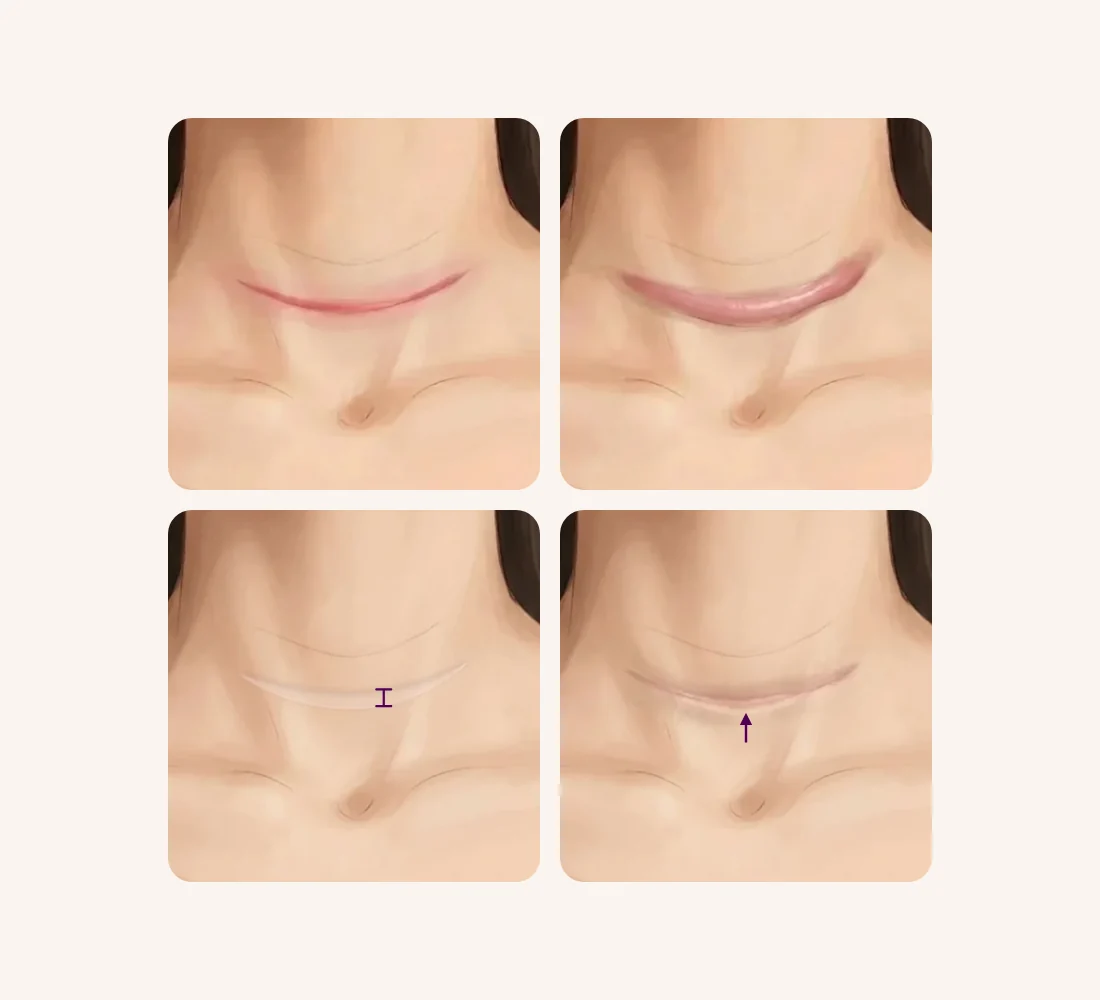
Why does a thyroid surgery scar sit low across the neck?
The thyroid is a butterfly-shaped gland at the lower front of the neck, wrapped around the windpipe (trachea). Open thyroid surgery is usually done through a horizontal incision low on the neck. The incision runs sideways so that it lies along the neck's natural horizontal creases. The scar revision literature describes a less noticeable scar as a fine line that runs parallel to skin creases and folds and matches the surrounding skin in color and height.1
The neck is also a place where scars are easy to see. Clothing rarely covers it, and the skin stretches and relaxes every time you raise your head, turn it or swallow. The same review explains that in areas prone to stretching and frequent movement, scars tend to widen, and that careful stitch placement and delaying stitch removal help prevent this.1
Under the skin of the front of the neck lie a thin layer of fat and the platysma (a thin sheet of muscle covering the front of the neck). Beneath them, under a set of narrow strap-like muscles, the thyroid wraps around the front of the windpipe. The thyroid cartilage (the cartilage that forms the Adam's apple) sits just above the thyroid. Surgery passes through the fat and muscle layers to reach the thyroid. As the wound heals, the scar does not always stay in the skin; it can stick to the muscle layer or toward the thyroid cartilage. A scar stuck this deeply can be pulled inward when you swallow.6
Forces on a neck scar
Put simply, a neck scar has one advantage, because it lies along a natural crease, and one disadvantage, because it sits on a part of the body that is always moving. How the scar settled between these two forces is the starting point for choosing treatment.
Which type is your neck scar?
Before deciding between laser and re-stitching, it helps to sort out why the scar stands out. This review groups less-than-ideal scars into those that are wide, red or pigmented, raised or depressed, or that cut across natural creases.1 In thyroid surgery scars, four patterns come up again and again.
What makes your neck scar noticeable?
1Thin, but still red
Vascular or fractional laser is considered first for redness and texture
Laser
2Thick, raised and firm
Injections and laser to flatten it, while checking it is not a keloid
Injection · laser
3Flat, but spread wide
Laser does not narrow it, so excision and re-closure are considered
Scar revision
4Pulls inward when you swallow
The attachment underneath is released, then filled or re-closed if needed
Adhesion release
- Red scar: the line is thin and flat, but redness lingers. This comes from the fine new blood vessels that formed while the wound healed.
- Thick, raised scar: a hypertrophic scar, meaning a scar that becomes thick, firm and raised along the line of the wound. It is often itchy or feels tight. If it grows sideways beyond the edge of the original wound, a keloid is suspected.
- Widened scar: not raised, but the line has spread because the skin on both sides was pulled apart while it healed. It looks like a pale or shiny band and may sit slightly sunken, casting a shadow.
- Tethered scar: the scar is stuck to the tissue underneath. It looks like a groove, and when you swallow it moves up with the throat or the neck feels tight.
In practice, many scars combine two or three of these. A scar may be red and raised, or widened and tethered at the same time. So the question "laser or re-stitching?" is often less about choosing one and more about deciding what to do first. How to tell a keloid from a hypertrophic scar is explained in our guide Keloid vs hypertrophic scar.
Who is more likely to get a thick scar after thyroid surgery?
How often a hypertrophic scar develops after thyroid surgery varies between studies. In one Korean hospital's review of 1,141 patients' records, it was 13.9%, or roughly one person in seven.3 In another study of 4,238 people who visited a dermatology clinic after thyroid surgery, it was 35.3%.2 Because that study included only people who came to a dermatology clinic, its figure cannot be read as the rate for everyone who has the surgery.
In the 1,141-patient study, hypertrophic scars were more common in younger patients and in those with a higher body mass index (weight relative to height). They were also more common when the scar was itchy, tight, hard or adhered to the tissue beneath. In contrast, patients who had early scar treatment, such as steroid injections or non-ablative fractional laser, or who used a preventive topical product, developed hypertrophic scars less often.3
The 4,238-patient study used statistics that weigh several factors at once. Hypertrophic scars were more common in these situations:2
- younger age
- male sex
- higher body mass index
- prominent sternocleidomastoid muscles (the thick muscles running diagonally from behind the ear toward the collarbone)
- a scar located within 1 cm of the sternal notch (the dip at the base of the neck between the collarbones)
- a history of keloids
In numbers, a scar within 1 cm of the sternal notch had about 4.3 times the odds (a statistical measure related to, but not the same as, the chance) of becoming hypertrophic compared with a scar placed higher. A history of keloids came with about 2.8 times the odds, and prominent neck muscles with about 2.5 times. A scar near the sternal notch and a keloid history were also linked to needing more steroid injection to treat the scar once it had become hypertrophic. The finding that men were more affected differed from earlier studies; the authors suggested that the skin of the male neck may be under more tension.2
Both studies looked back at existing records, so they do not prove that these conditions cause thick scars. The position of a scar that has already formed cannot be changed either. Still, when several of these conditions overlap, such as younger age, a keloid history and a scar close to the sternal notch, it is a reason to have the scar checked early rather than simply waiting once it starts to redden or rise.
Red scar: should you wait, or start laser?
A scar that stays red for several months after surgery is common. The fine blood vessels that formed during healing show through the skin. A scar usually takes 12 to 18 months to fully mature.1 It keeps changing during that time, and redness sometimes fades on its own. So if the scar is only red, and is flat, soft and gradually fading, it can be watched while you protect it from the sun and use scar care products. For home care, see Scar care after surgery: silicone, tape and sun protection.
When redness persists or deepens, laser is considered. A vascular laser (pulsed dye laser) targets the red pigment in blood and shrinks the fine vessels, which reduces redness. The literature also describes starting around the time the stitches are removed.1
A Korean study compared two lasers side by side on thyroid surgery scars. In 30 people, each scar was divided in half: one half received a 595 nm vascular laser, and the other a 1,550 nm non-ablative fractional laser (a laser that leaves the skin surface intact and makes very fine columns of heat to stimulate new tissue). Treatment started 2 to 3 weeks after surgery, with three sessions 4 weeks apart.4
The Vancouver Scar Scale (a score for color, blood vessels, softness and height, where a higher score means a more noticeable scar) fell from 8.2 to 4.7 on the vascular laser side and from 8.0 to 4.6 on the fractional laser side. There was no clear difference between the two lasers. Patients reported that the vascular laser side looked a little better, while the fractional laser side felt a little softer and less thick.4 In other words, with both lasers started early, the scar score fell by close to half.
This was a study of only 30 people, and it did not include an untreated side for comparison, so how much of the change would have happened on its own is unknown. Three months after the last session, 3 of the 30 people developed a mild hypertrophic scar.4 How intervals and the number of sessions are planned is covered in Scar laser: how many sessions, and how far apart?
Thick, raised scar: how are injections and lasers used?
A scar that is rising and getting firm calls for a more active approach than a scar that is only red. Steroid injections (medicine placed inside the scar to calm inflammation and the overgrowth of scar tissue) are commonly used for raised scars. Injections help flatten a raised scar, but they do not reduce its width. Side effects such as thinning or lightening of the skin and visible fine blood vessels are reported fairly often, so the dose and interval are adjusted.1 Silicone gel or sheets are also used to even out a scar's height, texture and color.1
Different lasers suit "red" and "raised" a little differently. A Korean study compared the records of 55 patients who had four laser sessions, 3 to 4 weeks apart, starting 1 to 2 months after thyroid surgery. Thirty-four received ablative fractional laser (a 10,600 nm CO2 laser that makes very fine, closely spaced holes in the skin), and 21 received non-ablative fractional laser (1,550 nm). Both groups improved, with no difference in overall scores. But raised, uneven contour improved more with the ablative laser, and redness improved more with the non-ablative laser.5
In that study, the non-ablative laser was chosen when redness was more severe, and the ablative laser when contour was more uneven. Because patients were not randomly assigned, the results cannot simply be generalized.5 Still, the study shows the principle clearly: the laser is chosen according to which feature of the scar needs to change.
In the 1,141-patient study as well, patients who had early injections or non-ablative fractional laser developed hypertrophic scars less often.3 If your scar has started to rise, it is better to discuss treatment suited to that stage early than to wait a full year for the scar to mature.
If the scar is growing sideways beyond the original wound edge, a keloid is suspected. A keloid tends to grow back if it is only cut out, so its plan differs from that of a hypertrophic scar. At Bonita Clinic, we treat keloids with laser and injections together and follow their progress over time; our approach is described on the Burn & Keloid Treatment page.
Widened scar: why is re-excision considered before more laser?
A widened scar is neither raised nor red, but the line has spread. While it healed, the skin on both sides pulled apart and the scar tissue stretched out. What stands out in such a scar is its width rather than its color. Lasers work on the color and texture of the skin surface and shallow layers, and injections lower a scar's height without narrowing it.1 That is why, for a widened scar, re-excision with re-closure (scar revision) is considered first, because it rebuilds the width itself.
In scar revision, the scar is cut out in a spindle shape (a leaf shape with pointed ends) and the wound is stitched again. The same review describes this as the most suitable technique for a mature widened or depressed scar that lies along the skin creases. The length of the spindle is kept at about three times its width, and its ends are tapered to 30 degrees or less and aligned with the creases. This keeps the ends from bunching up and helps the new line blend with the surrounding skin.1 Thyroid surgery scars usually run along the horizontal creases of the neck, so they fit this description well.
How the wound is closed has a big influence on the result.
- The deep layer is stitched first. Bringing the deep dermis (the thick lower layer of the skin) together with dissolving stitches lets this layer take the force that pulls the wound apart.1
- The surface is closed with fine stitches. Because the deep layer carries the tension, the surface stitches do not need to stay in for long, which reduces the ladder-like stitch marks that can form along a scar.1
- Areas that stretch get extra protection. On a mobile, stretchy area like the neck, stitch removal is delayed so the wound does not open, and tape is used to support the wound after the stitches come out.1
There are limits to keep in mind. Scar revision does not erase a scar; it turns a wide scar into a finer, less noticeable line.1 The new line also goes through a period of a few months when it may redden or thicken slightly. Aftercare therefore follows, along with laser if needed to refine any remaining color and texture.
Does your scar pull in when you swallow? What a tethered scar needs
If the scar is drawn inward and upward every time you swallow, and the neck feels tight or as if something is catching, the scar may be stuck to deeper layers. A Korean study called this a "post-thyroidectomy swallowing deformity". The scar tissue runs continuously from the skin through the fat and muscle layers down to the thyroid cartilage, so when the cartilage moves during swallowing, it drags the skin with it.6
A scar like this does not correct well when only the surface line is cut out and re-stitched, because the band stuck deep under the skin stays in place. Of the 18 patients in this study, 3 had previously had a skin-only scar revision and the pulling had come back.6
The surgeons removed the scar tissue from the skin down to the fatty layer and cut the band that pulled on swallowing. They then lifted flaps of the platysma to create a barrier between the skin and the deeper layers. The platysma flaps were sutured in a Z pattern (Z-plasty) to prevent a band forming in the midline of the neck; the skin itself was closed in a straight line.6 Over an average follow-up of 11.4 months, the inward pull on swallowing disappeared in all 18 patients, throat or neck discomfort was reduced in all of them, and scar scores (Vancouver Scar Scale) went down. Two patients developed hypertrophic scars and one a keloid, which needed further treatment.6 With only 18 patients, the authors themselves said more cases are needed.
The key point: with a tethered scar, the problem is less the line on the surface and more "the cord pulling from underneath". In the 1,141-patient study, scars with adhesion or tightness were also more likely to become hypertrophic.3 For this reason, if your scar sits in a groove or moves when you swallow, how far it is stuck to the deeper tissue is checked before any more laser. Releasing adhesions and filling hollow areas are also covered in our guide Depressed facial scars after injury or surgery.
Laser or scar revision: a side-by-side view
Here is the same information arranged by scar type.
What is considered first, by scar type
| Scar type | Usually considered first | Worth knowing |
|---|---|---|
| Red scar | Vascular laser · non-ablative fractional laser | May fade on its own, so progress is followed too |
| Thick, raised scar | Injections · fractional laser · silicone | Injections flatten a scar but do not narrow it |
| Keloid | Injections and laser together; excision with caution | Tends to regrow if only cut out |
| Widened scar | Excision and re-closure, then laser for color and texture | Often done once the scar has matured |
| Tethered scar | Release the attachment and separate the layers | Re-closing the skin alone may let it pull again |
In short, problems of color and texture are mainly addressed with laser, and problems of width and pulling mainly with surgical correction. For scars that mix both, width and pulling are usually corrected first, and the remaining color and texture are refined with laser afterwards.
When should treatment start?
The timing depends on what is being done. Treatments that aim to change how a scar grows, such as laser and injections, have often been started early in studies. The two laser studies above began 2 to 3 weeks after surgery and 1 to 2 months after surgery.45
Cutting a scar out and re-stitching it, on the other hand, usually waits for the scar to mature. A scar firms up over 12 to 18 months and regains about 70 to 80% of the strength of normal skin. An immature scar is prone to thickening, and revising it at that stage can give a poor result. The literature advises that if early revision is truly needed in adults, it is better done after 8 to 12 weeks.1
What to look at, and when, after surgery
- Stitch removalProtect the wound · tape · sun protection
- 2 wk–2 moIf it turns red or raised, discuss laser or injections early
- After 8–12 wkEarly revision only if really needed
- 12–18 moScar matures · decide on revision or release for widened or tethered scars
- After thatRefine remaining redness and texture with laser
For timing across surgical scars in general, see Surgical scars: when should you consider treatment?
Recovery and limits of revision and laser
At Bonita Clinic, we perform surgical scar restoration under local anesthesia or sedation, and you go home the same day. We remove the stitches on the date we give you. Recovery time and follow-up visits vary with the extent of treatment and your individual condition.
After laser, there may be temporary redness, swelling or flaking depending on the device and settings, and rarely a change in pigmentation. Overly aggressive ablative laser treatment can also alter pigment or make a scar worse.1 At Bonita Clinic, we choose the device and settings to suit your skin and explain aftercare.
Limits to keep in mind
- No method erases a scar. The aim is a less noticeable scar.1
- After revision, the new scar can redden or thicken again. If you have conditions linked to hypertrophic scars, such as younger age, a keloid history or a scar near the sternal notch, aftercare is planned more carefully.2
- A deeply tethered scar can pull again if only the skin is re-stitched.6
- The laser studies were small (30 to 55 people) and neither had an untreated comparison group; in the 30-person study, 3 people developed a mild hypertrophic scar after treatment. Their results should not be read as what every patient can expect.45
- Any surgery or procedure can cause side effects such as bleeding, infection and inflammation, and results vary from person to person.
If your thyroid treatment is still ongoing (follow-up tests, medication adjustments and so on), it makes sense to plan scar treatment around the schedule of the doctors managing your thyroid.
How we approach it at Bonita Clinic
An actual treatment plan is decided after an in-person consultation.
Neck scar treatment options you can discuss in Seoul
Since Bonita Clinic opened in 1995, Dr. Kwang-Seop Jung, a board-certified plastic surgeon (Brazil), has seen patients at the same location, a short walk (about 100 m) from Exit 8 of Nonhyeon Station on Seoul Subway Line 7. For a scar left after thyroid surgery, the options you can discuss at consultation are those described on our treatment pages:
- Reviewing which surgery you had, when, and the scar treatments you have already tried, even if the surgery was done elsewhere
- Surgical restoration: cutting out a widened or uneven scar and re-closing it in layers
- Releasing a scar stuck to deeper tissue and, where a hollow remains, filling it with fat grafting
- Lasers combined for the purpose (fractional, CO2, vascular, picosecond, radiofrequency microneedling) for remaining redness and texture
- For keloids, laser and injection treatment together, with follow-up
Which of these you need is decided only after an examination. See our Facial Surgical Scars and Facial Depressed & Incision Scars pages for details.
Why do the plan and cost differ from person to person?
Two people who both say "my thyroid scar bothers me" may need very different plans. What shapes the plan, and therefore the cost, is what the scar is like and how much needs to be done.
- Scar type: red, raised, widened, tethered or keloid
- Length and width of the scar
- Laser only, or excision and re-closure first
- Whether adhesion release or fat grafting is needed
- Local anesthesia or sedation
- Likely number of laser or injection sessions
Final plan and quote after an in-person exam
A final estimate is given only after an in-person examination, once the scar type, the order of treatment and the likely number of sessions are clear. Photos help narrow down the options before you plan your visit.
What can photos show, and what needs an in-person exam?
Photos are a good way to start, because location, length and color show up in them. What lies beneath the surface does not.
Photos and video can show
- Where the scar sits and how long it is
- Redness and roughly how wide it is
- Whether it looks raised
- A short video: whether it pulls in when you swallow
Needs an in-person exam
- How firm and thick it is
- How deep the attachment goes
- Keloid or hypertrophic scar in unclear cases
- Whether your skin tends to darken after treatment
- Whether excision and re-closure suit your skin
Helpful photos: the front of the neck in daylight without makeup, one with your head tilted slightly back, and, if the scar pulls in when you swallow, a few seconds of video while you swallow. Please also tell us when your thyroid surgery was done and which scar treatments you have had. You can send us a message with your photos and these details.
Planning a visit to Seoul for neck scar treatment
How many visits make sense depends on the plan. Laser sessions in studies were spaced several weeks apart,45 and scar revision involves stitches and a follow-up for their removal. So the schedule is not fixed in advance; it is planned together with you at consultation, around the treatment and your recovery. Points worth discussing:
- Whether the scar is ready for revision yet, or whether earlier laser or injections make more sense at its current stage
- If revision is planned, when the stitches come out and how the wound will be protected with tape afterwards1
- Whether laser sessions can be continued near home after a revision in Seoul, or whether follow-up visits are planned
- Keeping your thyroid follow-up with the doctors who manage it, and fitting scar treatment around those appointments
- Keeping dated photos of the scar so progress can be compared at your next visit
After you return home, protect the scar from the sun, and contact a doctor promptly if redness, swelling, pain or discharge increases instead of settling.
Real treatment cases: linear surgical scars elsewhere on the body
The cases below are from our scar treatment pages. They are not thyroid scars but two vertical surgical scars on the abdomen that were red and raised or left as a wide band, so they show how similar line-shaped scars are approached. Because the treatments and their timing differed between patients, only what is visible in the photos is described. Results vary from person to person.
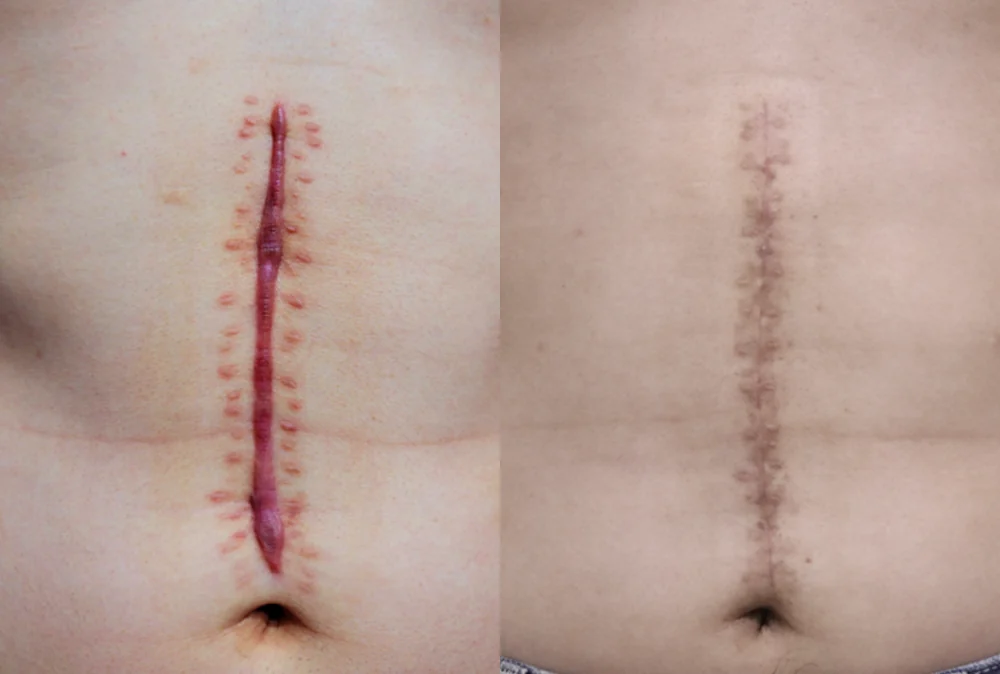
A vertical surgical scar in the middle of the abdomen, red, thick and raised, with stitch marks along both sides
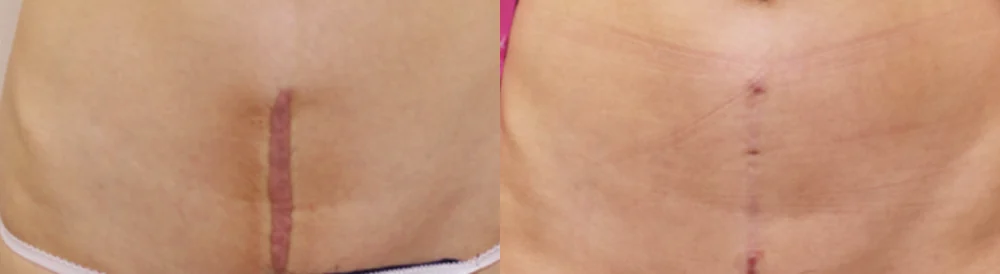
A vertical surgical scar on the lower abdomen left as a wide, red, slightly raised band
* Results vary from person to person. Side effects are possible, so please decide after a thorough consultation with a doctor.
Frequently asked questions
My surgery was two months ago and the scar is getting red and thick. Do I have to wait a year?
Not necessarily. Cutting out and re-stitching a scar often waits for the scar to mature, but several studies started laser a few weeks after surgery on scars that were turning red or raised.45 In the 1,141-patient study, patients who had early injections or laser developed hypertrophic scars less often.3 It is also worth checking whether the scar is growing beyond its edges, which would suggest a keloid.
Will more laser sessions narrow a widened scar?
Laser helps even out a scar's color, texture and height, but it cannot bring the spread edges back together. Injections lower a scar's height without narrowing it either.1 If width is the problem, the usual order is scar revision, cutting the scar out and re-closing it from the deep layer up, followed by laser for any remaining color and texture.
Will scar revision make my scar longer?
When a scar is cut out in a spindle shape, the length is kept at about three times the width and the ends are tapered to 30 degrees or less, so that they do not bunch up.1 As a result, the wider the scar, the more the new line may end up slightly longer than the original. The length and position are decided at consultation, looking at the neck creases and the width of the scar together.
My scar pulls in when I swallow. Can that be corrected?
When a scar is attached to deep layers such as the muscle layer or the thyroid cartilage, it is pulled in when you swallow. Because re-stitching the skin alone may let it pull again, a correction that releases the stuck band and separates the skin from the deeper layers has been described in research.6 The extent and depth of the attachment are checked at an examination first.
I have a keloid on my neck. Can it just be cut out?
A keloid can grow back if it is only cut out. At Bonita Clinic, even when excision is part of the plan, we plan laser and injection treatment together and follow progress over time. If you are prone to keloids, the literature also stresses keeping tension on the wound as low as possible when it is closed.1 To tell a keloid from a hypertrophic scar, see Keloid vs hypertrophic scar.
What to prepare before your consultation
- When and how your thyroid surgery was done, and whether the same area has been operated on again
- Scar treatments so far (silicone products, injections, the type and number of laser sessions, and when the last one was)
- Whether you have ever had a keloid, and how your other surgical scars healed
- Photos: the front of the neck, your head tilted slightly back, and the moment you swallow (a few seconds of video helps if the scar pulls in)
- Symptoms photos cannot show, such as itching, tightness or discomfort when swallowing
- If your thyroid treatment is ongoing, the dates of your next tests or treatment
You can find more about our approach on the Facial Surgical Scars and Facial Depressed & Incision Scars pages. Keloids and hypertrophic scars that formed after surgery are covered on our Burn & Keloid Treatment page.
References (6)
Sources that support the explanations in this article. Study findings describe general trends and do not guarantee individual results.
- Garg S, Dahiya N, Gupta S. Surgical scar revision: an overview. J Cutan Aesthet Surg. 2014;7(1):3-13.doi:10.4103/0974-2077.129959Scar revision review (full text): features of a less noticeable scar (fine, parallel to creases); preventing widening in stretchy, mobile areas (stitch placement, delayed stitch removal, tape); maturation over 12–18 months, early revision only after 8–12 weeks in adults; vascular laser for redness; steroid injections flatten but do not narrow a scar and often cause side effects; silicone; fusiform excision (3:1, ends ≤30°) for mature widened or depressed scars; deep dermal sutures ease tension; overly aggressive ablative laser can alter pigment or worsen a scar; revision does not erase a scar
- Cho MY, Lee SG, Kim JE, et al. Analysis of Risk Factors to Predict Occurrence and Prognosis of Postsurgical Hypertrophic Scar Development: A Review of 4238 Cases. Yonsei Med J. 2023;64(11):687-691.doi:10.3349/ymj.2023.0003Retrospective analysis (full text) of 4,238 patients seen in dermatology after thyroidectomy: hypertrophic scars in 35.3%. In multivariable regression, younger age, male sex (female OR 0.562 vs male), higher BMI, prominent sternocleidomastoid muscles (OR 2.522), a scar within 1 cm of the sternal notch (OR 4.345) and a keloid history (OR 2.789) were linked to hypertrophic scars; the notch location and keloid history were linked to more triamcinolone injected (about 4.3 mg and 23 mg more). The authors put the male-sex finding down to greater tension on male neck skin
- Shin JU, Park JH, Oh SH, et al. Early intervention in thyroidectomy scars: demographics, symptoms, and prevention. J Wound Care. 2015;24(4):163-171.doi:10.12968/jowc.2015.24.4.163Chart review (abstract) of 1,141 thyroid surgery patients: hypertrophic scars in 13.9%, associated with younger age, higher BMI, itching, tightness, induration and adhesion; early intervention (steroid injection or non-ablative fractional laser) and preventive topical agents were associated with fewer hypertrophic scars
- Ha JM, Kim HS, Cho EB, et al. Comparison of the Effectiveness of Nonablative Fractional Laser versus Pulsed-Dye Laser in Thyroidectomy Scar Prevention. Ann Dermatol. 2014;26(5):615-620.doi:10.5021/ad.2014.26.5.615Split-scar comparison (full text) in 30 patients: from 2–3 weeks after surgery, three sessions 4 weeks apart; Vancouver Scar Scale 8.2→4.7 with 595 nm pulsed dye laser and 8.0→4.6 with 1,550 nm non-ablative fractional laser, no significant difference; patients reported better appearance with PDL and better feel with fractional laser; 3 patients developed a mild hypertrophic scar 3 months after the last session; no untreated control
- Jang JU, Kim SY, Yoon ES, et al. Comparison of the Effectiveness of Ablative and Non-Ablative Fractional Laser Treatments for Early Stage Thyroidectomy Scars. Arch Plast Surg. 2016;43(6):575-581.doi:10.5999/aps.2016.43.6.575Retrospective comparison (full text) of 55 patients treated from 1–2 months after surgery, four sessions 3–4 weeks apart: ablative CO2 fractional (34) vs non-ablative 1,550 nm fractional (21); both improved with no overall difference, contour improved more with ablative and color more with non-ablative; lasers were chosen by scar features, not randomized; no untreated control group
- Jeon MK, Kang SJ, Sun H. Platysma Flap with Z-Plasty for Correction of Post-Thyroidectomy Swallowing Deformity. Arch Plast Surg. 2013;40(4):425-432.doi:10.5999/aps.2013.40.4.425Case series (full text), 18 patients with post-thyroidectomy swallowing deformity: scar adhesion runs from skin through subcutaneous and muscle layers to the thyroid cartilage, pulling the scar in and up on swallowing; skin-only revision is insufficient (3 had relapsed after it). After excising scar tissue and cutting the scar band, a platysma flap served as a barrier, with Z-plasty on the flap to prevent midline platysma banding and a straight skin closure; retraction removed in all 18, discomfort alleviated, lower Vancouver scores; 2 hypertrophic scars, 1 keloid; mean follow-up 11.4 months
About this article
This article separates general medical information from Bonita Clinic's own approach. Because the right decision depends on each person's condition, it is not a substitute for a consultation.