KOKorean
 ENEnglish
 JP日本語
 CN中文(简体)
 TW中文(繁體)

Revision Rhinoplasty in Seoul: How Do You Plan the Trip, from Records to Recovery?
A revision rhinoplasty trip is planned as a sequence rather than a set number of days. You consult first from home with your earlier surgical records and photos; in Seoul, an in-person examination checks the remaining cartilage, the skin and the scar tissue before the extent of surgery is decided. A major revision is usually done at least a year after the last operation, once swelling and scar tissue have settled, but redness, pus or an implant pushing through the skin should be examined without waiting. After an infection, or with a contracted nose, surgery may be split into two visits, so your length of stay and return date are planned with you after the examination. Wondering how your revision might fit into a trip? Send us your photos and surgical history before you plan your visit to Seoul.
Curious about your own case? Ask us online →

How is planning revision rhinoplasty from abroad different from a first nose surgery?
If you are thinking about coming to Seoul for revision rhinoplasty, the first practical question is usually "How many days do I need to stay?" Flights, time off work and accommodation all have to be booked in advance, so it is a fair question. A revision, however, depends on more things than a first operation does, and several of them affect the schedule. There are four differences worth knowing before you plan anything.
- Your earlier surgery becomes part of the plan. Which implant was used, and which cartilage has already been taken, changes what material is left for this operation.
- Timing matters. Until the scar tissue from the last operation has settled, it is hard to judge the shape your nose will actually keep.
- Much has to be checked in person. Skin thickness, scar tissue, remaining cartilage and breathing cannot be judged from photos alone.
- It may not be finished in one trip. After an infection, or when the nose has shrunk and shortened (a contracted nose), surgery is sometimes split into two stages.
A review of revision rhinoplasty (a paper that brings together published studies and clinical experience) notes that up to about 15% of people who have rhinoplasty go on to have revision surgery.1 The same review stresses that a good revision depends on careful patient selection, a thorough examination and detailed planning before surgery.1 This guide walks through that preparation in the order an international patient meets it, from gathering records at home to the months after you fly back. The figures we quote are general medical information backed by the footnotes. How revision surgery itself is done is covered separately in our revision rhinoplasty guide.
Why do your previous surgical records and photos matter so much?
A revision starts from a nose that has already been changed once, so knowing what was done before is the starting point. The review above advises obtaining the operative notes and the before-and-after photos from any previous rhinoplasty whenever they are available.1
These details are the most useful:
- Dates, number of operations and where they were done: how long it has been since your last operation is the first thing used to judge timing.
- Implant details: whether it is silicone or another material, its size and shape, and when it was placed. When we revise an implant at Bonita Clinic, the type, size and age of the existing implant are among the first things we check.
- Cartilage already used: whether septal cartilage (from the wall that divides the inside of the nose), ear cartilage or rib cartilage was taken, and where it was placed.
- The approach: whether the surgeon made a small cut across the columella (the strip of skin between the nostrils) for an open approach, or worked only through the nostrils.
- Any infection or inflammation: when it happened, how it was treated, and whether an implant was removed.
- Photos from before your first surgery, and photos from now: seeing your original nose makes it easier to separate what surgery changed from what was always there.
The drawing below shows, on the same nose, what photos, records and an examination each tell us.
If I have my records, is a full examination still needed?
Yes. The same review points out that operative notes can contain inaccuracies, so a revision plan should not rely on them alone.1 Think of the records as a map that shows where to look more closely; the actual condition is confirmed at the examination.
Missing records are not a reason to delay a consultation: what you remember, such as approximate dates and any scars behind the ear or on the chest, is enough to start (see the FAQ in our revision rhinoplasty guide). If you plan to request records from your previous clinic, ask early, because it can take time and may need to be done well before you travel.
When is the right time for revision after your last nose surgery?
If you are unhappy soon after surgery, it is natural to want it corrected as quickly as possible. A nose that has been operated on, however, keeps changing for months, for two reasons.
The first is swelling, which settles slowly. A curve estimated from 3D measurements of 40 people after a first (primary) open rhinoplasty suggests that, counted from the first check-up 1–2 weeks after surgery, about two-thirds of the swelling goes in the first month and 95% by six months.3 Revision patients were left out of that study, and swelling has been reported to settle slightly more slowly after a revision,7 so for several months what you see in the mirror is not yet the final shape (how swelling settles is covered in the recovery section of our revision rhinoplasty guide).
The second is scar tissue under the skin, which takes time to mature. The review explains that this can take up to a year, and recommends that in most cases revision should not be attempted until at least a year after the previous operation.1 Smaller corrections, such as redoing the cuts in the nasal bones or trimming a hump that was left behind, can sometimes be done earlier, but larger revisions are better left until the full year has passed.1 The American Academy of Otolaryngology–Head and Neck Surgery clinical practice guideline on rhinoplasty (recommendations a specialist society builds from the evidence) likewise advises documenting patients' satisfaction with both appearance and breathing at least 12 months after surgery.2
In practice, during the first year after your last operation, the focus is on following your progress through photos. The surgery date is usually set once swelling and scar tissue have settled. For someone traveling from abroad, that waiting period is valuable: it is the time to collect records and take dated photos, which makes the eventual trip much more efficient.
When should you see a doctor without waiting?
Some situations should not wait for the scar tissue to mature:
- Redness, swelling, pain or discharge of pus from the nose, which can signal inflammation or infection
- An implant outline that is becoming steadily more visible while the skin over it thins, or an implant that seems to be pushing through the skin
If you notice changes like these, do not wait for your trip to Seoul; see a doctor near home first. The diagnosis, the treatment you receive and photos from that time will become important records when a revision is planned later. Signs that an existing silicone implant may need to be replaced or removed are covered in Replacing an Old Silicone Nose Implant in Seoul: Is There a Set Time, or Do Signs Decide?
How is your nose now, after the last surgery?
- Redness, pain or pus, or an implant pushing throughDo not wait: see a doctor near home first
- Less than a year since surgery and the shape bothers youFollow progress with photos and set the timing together
- More than a year, and the shape has settledConsult with records and photos, then plan your visit to Seoul
What can a photo consultation show before you travel?
A photo consultation from home is the first step in planning. Photos show the outer shape of the nose quite well: the height and line of the bridge, the direction and length of the tip, asymmetry, the shape of the nostrils and whether an implant outline shows through. Placing a photo from before your first surgery next to a current one also shows what has changed.
Take photos from the front, from both sides, at a 45-degree angle on both sides and from below, all in the same light. Hold the phone a little way from your face, because a phone held very close makes the nose look larger than it is. Our guide to taking photos for an online consultation explains how to set this up.
Much of what a revision plan depends on, however, does not show up in a photo:
- How thick and supple the skin is, and whether earlier surgery has thinned or hardened it in places
- Whether the implant moves, and whether the tissue around it has become firm
- How much septal cartilage is left inside the nose
- Whether the inside of the nose narrows or collapses when you breathe in
These are checked at an in-person examination by feeling the nose, looking inside it and watching it as you breathe. A photo consultation therefore narrows down the likely direction and what needs to be checked; the extent of surgery is decided after the examination.
Photos can show
- Height and line of the bridge
- Direction and length of the tip
- Asymmetry and nostril shape
- An implant outline showing through
- What changed since your first surgery
Needs an in-person exam
- Skin thickness, thinning or firmness
- Whether the implant moves
- Septal cartilage left inside
- Airflow as you breathe in
- Ear or rib cartilage available
You can send us a message with your photos, the history of your previous surgery and the dates you are considering.
What is checked at the in-person examination in Seoul?
At the examination, what was seen in your records and photos is checked directly. The revision review lists these examination points, explained here in plain terms:1
| What is checked | How | Why it matters |
|---|---|---|
| Skin thickness and condition | By touch, looking for areas thinned or damaged by earlier surgery | It limits how much the nose can be raised or reshaped |
| Septal cartilage left | Feeling inside the nose, or shining a light through it | It decides what material is available this time |
| The airway | Looking at the nostril entrance, the septum and the turbinates (the soft ridges on the inner side walls), comparing normal and forceful breathing in | Breathing is planned together with shape |
| Ear and rib cartilage | Looking at the ears and chest to see whether cartilage can be taken | The alternatives if septal cartilage has run short |
Your physical and emotional health are part of the picture too. The guideline advises asking every patient why they want surgery and what they expect, and telling them whether those expectations are realistic. It also advises checking for conditions that can change or rule out surgery, such as obstructive sleep apnea (breathing that stops during sleep), bleeding disorders, long-term use of decongestant nasal sprays, and worry about appearance that takes over daily life (body dysmorphic disorder).2 The revision review adds that people seeking revision have often already been through a disappointing result, so it recommends paying attention to how the patient feels and what they hope for at the first consultation, and keeping the conversation open.1
Please tell us about every medicine and supplement you take; which ones are usually paused before surgery is explained in Medicines, Supplements, Smoking and Alcohol Before Surgery in Seoul.
At Bonita Clinic, a revision plan is built on an analysis of how the previous surgery was done, the condition of any implant, how much cartilage remains and how much the tissues have stuck together (adhesions), skin thickness and blood supply, and symmetry and proportions. The final surgical plan is only set once you have been examined in person. Whether surgery can follow on the same trip as the examination, or even the same day, depends on your condition and what has to be prepared, so it is worth asking about this during the photo consultation. The overall flow of a first in-person consultation is described in Your First Plastic Surgery Consultation in Seoul: What Is Checked and What to Bring.
How satisfied are people after revision, compared with a first rhinoplasty?
At a single hospital in Turkey, 54 people who had revision rhinoplasty and 54 who had a first rhinoplasty completed the same satisfaction questionnaire, scored from 0 to 100, where higher means more satisfied. In the revision group the average score rose from 32.8 to 62.4; in the first-surgery group it rose from 40.5 to 80.5.4
Both groups improved clearly, but the improvement was larger after a first surgery. Revisions that corrected both appearance and breathing improved less than revisions for appearance alone, and younger patients and men also showed smaller gains. Patients who were satisfied with the information they received before surgery improved more.4
For your own planning, this means satisfaction can improve after a revision, but the change is usually not as large as after a first operation, and understanding the plan well beforehand goes hand in hand with being satisfied afterwards. Keep the limits in mind: the 'before' scores were given after surgery while looking at preoperative photos, all patients were operated on by one surgeon, and people having revision for breathing problems alone were not included, so the numbers should not be generalized too far.4 The guideline also asks surgeons to explain, before surgery, what recovery involves, how breathing may change, the possible complications and the possibility that further nasal surgery may be needed in the future.2 When you are traveling from abroad, it helps to start this conversation during the photo consultation, well before you book a flight.
How does the extent of revision change the number of trips?
"Revision rhinoplasty" covers very different situations, and the problem being corrected changes both the order of surgery and the number of visits. The four drawings below show the same person; only the situation differs.
How the extent of revision changes your visits
1If an implant shows through or has shifted
The implant, its capsule and the covering tissue are assessed to decide whether to replace it or rebuild with your own tissue
Implant revision
2If you have had red, swollen inflammation
Whether to rebuild on the day the implant comes out, or let it settle and split the work, is decided at the exam
May need two visits
3If the nose looks shorter and upturned
Reconstruction waits until the tight skin has softened, and may be done in stages
Contracted nose revision
4If too little cartilage is left
If rib cartilage is used, healing of the chest wound is built into the schedule too
Your own cartilage
- An implant that shows through or has shifted: Bonita Clinic's treatment page explains that an implant that can be seen or felt often means its size or material does not suit the nose, or that the tissue covering it has thinned. We therefore consider both reselecting the implant while reinforcing the supporting tissue, and removing it to rebuild with your own tissue. If the capsule, the layer of tissue that forms around an implant, is simply left behind, the tissue can tighten again, so how to handle the capsule is decided at the same time. More detail is in Nasal Implant Revision in Seoul.
- After inflammation or infection: infected implants have traditionally been managed in two stages: the implant is removed and the infection controlled first, and the nose is rebuilt later.5 Because scarring and tissue contraction during the wait can make that later reconstruction difficult, a case series reported eight patients whose noses were rebuilt with their own cartilage on the same day the infected implant was removed. Over an average follow-up of about seven years there were no major complications; six of the eight were very satisfied with the appearance, and two asked for further surgery for aesthetic reasons.5 With so few patients, this cannot be applied to every case. At Bonita Clinic, if there has been inflammation or infection, we plan the timing of removal and revision carefully, and with a history of infection we may consider reconstruction centered on your own tissue first. For these patients, whether the treatment takes one trip or two is decided after the examination.
- A shortened, upturned nose (contracted nose): Bonita Clinic's treatment page describes this as skin and soft tissue that have shrunk and hardened after a long-standing implant or repeated inflammation. Reconstruction waits until the skin has become as soft as it will get, and depending on the condition it may be done in a first and a second stage. That can mean a gap between two trips to Seoul, with its length set by how the skin responds. See Contracted Nose Revision in Seoul for details.
- Too little cartilage left: explained in the next section.
What does using rib cartilage add to your schedule?
Revision often runs short of building material. The review explains that septal cartilage is often already harvested during the first operation, which limits its use in a revision. Rib (costal) cartilage gives strong support but has a tendency to warp, or bend over time.1 Taking cartilage from the ear or rib also means an additional harvest site and a longer operation.1
Rib cartilage in particular leaves a second wound on the chest, so the chest has to heal along with the nose. When chest pain was tracked on a 0–10 scale for 45 days in 19 people who had rib cartilage harvested for rhinoplasty, pain at rest fell considerably after the first week, but pain on movement eased more slowly, over several weeks.6 With a muscle-sparing technique (the muscle is spread apart along its fibers rather than cut) the average was 1.6 at day 7 and 0.7 at day 15; with a muscle-cutting technique it was 3.1 at day 7, 1.8 at day 15 and 1.3 at day 30.6
Chest pain on movement after rib harvest
In practical terms, if rib cartilage is used, lifting heavy bags or twisting your upper body can be uncomfortable for a few weeks. This was a small single-center study, and the amount of pain depended on how the cartilage was taken.6 What this means for the journey home is covered in the FAQ below, and the differences between cartilage sources are compared in Ear, Septal or Rib Cartilage for Rhinoplasty in Seoul: How Do They Differ?
Revision options you can discuss in Seoul
Bonita Clinic has been at the same location since opening in 1995, and Dr. Kwang-Seop Jung, a plastic surgeon board-certified in Brazil, has seen patients here throughout. The options below are those described on our nose revision pages. Which of them applies to you is decided only after an examination.
- Full revision rhinoplasty: for a nose that looks different after earlier surgery, with problems involving the bridge, tip and symmetry together. Adhered scar tissue is released and, where needed, the structure is rebuilt with your own ear, septal or rib cartilage. More on our Full Revision Rhinoplasty page.
- Implant revision: for an implant that shows through, has shifted or has been associated with repeated redness or inflammation, including decisions about the capsule and the supporting tissue. More on our Implant Revision page.
- Contracted nose revision: for a nose that has become short and upturned with hardened skin, with timing chosen around how soft the skin has become and stages planned where needed. More on our Contracted Nose Revision page.
Why do the plan and cost differ from person to person?
Two people who both say "I need a nose revision" can need very different operations. What shapes the plan, and therefore the cost, is what has to be corrected and what material is available.
- What needs correcting: bridge, tip, implant, airway
- Implant removal and how the capsule is handled
- Cartilage source: septal, ear or rib
- Number of previous surgeries and any infection
- Anesthesia and the extent of surgery
- One stage or two stages
Final plan and quote after an in-person exam
A final estimate is given only after an in-person examination, once the extent of surgery and the material needed are clear. Photos and records help narrow down the options; the plan itself is settled at the examination.
What happens while you recover in Seoul?
Our treatment page lists general anesthesia or sedation, going home the same day without a hospital stay, and stitches as the usual details of full revision rhinoplasty at Bonita Clinic. The type of anesthesia and whether you go home the same day are also decided at consultation, depending on the extent of surgery (for example, rib cartilage harvest) and your condition. Recovery time and follow-up visits depend on the extent of surgery and on each person's condition. Because a revised nose may have a reduced blood supply from earlier scarring, we pay close attention to blood flow, tissue condition and swelling during recovery, and follow progress to catch complications early.
In general, after nose surgery a splint is placed to hold the shape, and on a set day the splint and stitches are removed while the wound, any bleeding and the swelling are checked. Many people also worry about packing, the gauze or sponge material sometimes placed inside the nose. The guideline recommends that surgeons should not routinely place packing inside the nose after rhinoplasty, including when the septum is operated on as well.2 Any care needed for bleeding or other situations is discussed at your consultation, together with the extent of surgery.
The chart below shows how the visits of an international patient can run in two situations: a revision rebuilt in one stage, and one split into two.
When to book your flight home depends on bleeding, the splint and stitches, cabin pressure and the risk of blood clots from sitting for a long time. All of this is explained with its evidence in Flying After Rhinoplasty in Seoul: How Soon Can You Fly Home?, which also covers research suggesting that rib cartilage harvest adds to blood clot risk.
What should you watch for after you return home?
Your nose keeps changing after you are home. Swelling settles over months,3 and scar tissue continues to mature for up to a year.1 So the result is not judged from how the nose looks in the first weeks after your return. The guideline likewise recommends assessing satisfaction with appearance and breathing no earlier than 12 months after surgery.2
At home, it helps to keep the following:
- Dated photos: take front, side and 45-degree photos in the same place, light and angle. They let you see the swelling settle for yourself, and they are useful whenever you share your progress.
- A record of this surgery: write down what you were told about which implant or cartilage was used and where. In effect, you are collecting the records a future doctor might need. If you need any documents, ask before you fly home.
- Signs that need prompt care: bleeding that does not stop; redness, pain or swelling that keeps getting worse; fever; or pus from a wound. In any of these cases, see a doctor near home. Tell them the date and extent of your surgery and the medicines you take, and please also let Bonita Clinic know what care you received.
Aftercare in general is covered in Back Home After Plastic Surgery in Korea: What Aftercare Do You Need?
How we approach it at Bonita Clinic
Real treatment cases
These cases appear on Bonita Clinic's full revision rhinoplasty page. The photos alone do not show what the earlier surgery involved or how long after surgery they were taken, so we describe only what can be seen. Results vary from person to person.
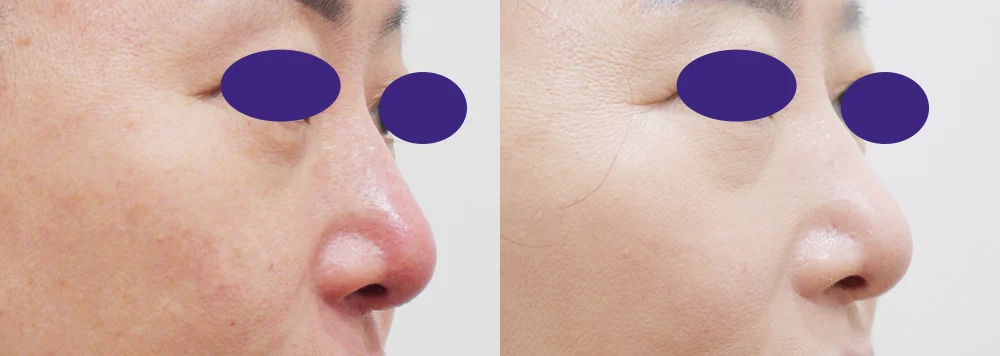
Near-side view in which the tip and bridge looked red
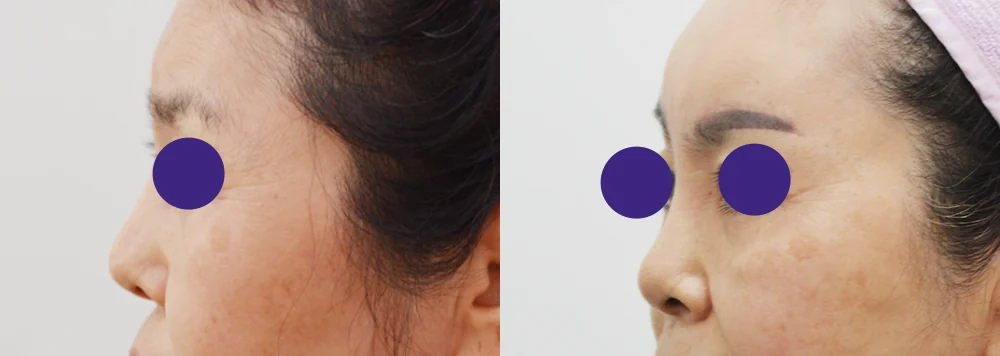
The bridge and tip line, seen in profile and at an angle
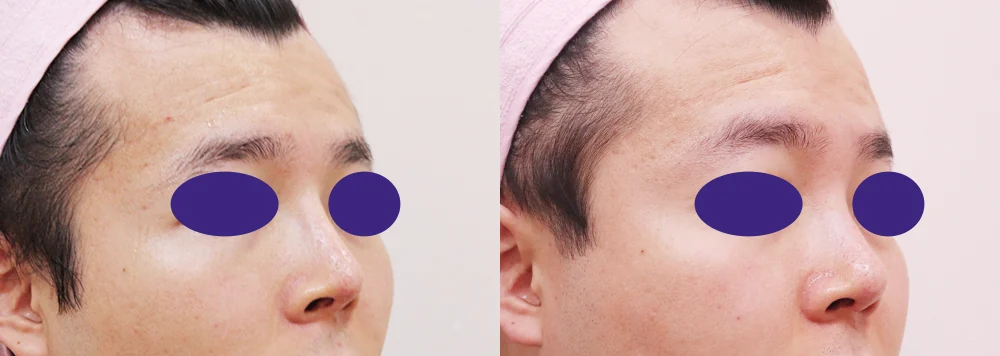
The bridge and tip seen at an angle
* Results vary from person to person. Side effects are possible, so please decide after a thorough consultation with a doctor.
Frequently asked questions
It has been less than a year since my last surgery. When should I book flights?
You can start a photo consultation now, but it is better to book flights and time off once the likely timing of surgery is clear, because a major revision usually waits about a year after the previous operation for the scar tissue to settle.1 In the meantime, dated photos taken in the same conditions and any records you can collect from your previous clinic will make the eventual plan quicker. If redness or pus appears, or an implant seems to be pushing through the skin, do not wait for the trip: see a doctor near home first.
Can the whole revision be done in one trip?
It depends on the extent of the revision. Infected implants have traditionally been managed in two stages: the implant is removed and the area allowed to settle, and the nose is rebuilt later.5 For a contracted nose, Bonita Clinic may divide treatment into a first and a second stage, once the skin has become soft enough and depending on its condition. In every case there is a follow-up visit after surgery to remove the splint and stitches and check how you are healing. If your return date is already fixed, please tell us during the photo consultation.
If treatment is split into two stages, how is the time in between spent?
The two stages are separated so that the skin can soften after the first operation. The length of that wait is not a fixed number; it is set by the condition of the skin and tissue, so whether you stay in Seoul or go home in between is also decided together after the first operation. Dated photos taken in the same conditions during this period make it easier to see how the skin is changing when you discuss the timing of the next visit. If redness, pain or pus comes back, see a doctor near home first and let Bonita Clinic know what was found.
Does swelling last longer after a revision than after a first rhinoplasty?
In 36 people who had both a first and a revision open rhinoplasty, the thickness of the nasal skin and the soft tissue beneath it was measured by ultrasound at 1, 3, 6 and 12 months after each operation. After the revision it was thicker in most areas and at most time points, and swelling went down slightly more slowly.7 This was a small study from one private clinic. The study that tracked swelling over a year left out revision patients, so its figures do not transfer directly to a revision.3 Scar tissue can also take up to a year to mature,1 so it is better to judge the result over about a year rather than a few months.2
What is harder on the journey home if rib cartilage is used?
Pain on movement from the chest wound can last for several weeks,6 so lifting a heavy suitcase or twisting your upper body may be uncomfortable. Pack light and plan how your luggage will be handled at the airport. In the pain study above, patients went home on the third day after surgery, once the chest drain (a thin tube that removes fluid) had been taken out.6 Whether a hospital stay is needed when rib cartilage is used is decided at consultation. Preparing for the flight itself, including the risk of blood clots from sitting for long periods, is covered in Flying After Rhinoplasty in Seoul.
What to prepare before your consultation
- The dates, number and place of your previous operations, and any surgical records
- The type and size of any implant, and where cartilage was taken (septum, ear, chest)
- When any inflammation or infection occurred, how it was treated, and whether an implant was removed
- Photos from before your first surgery and from now (front, both sides, both 45-degree angles, from below)
- Any breathing problems such as nasal blockage, sleep apnea, a tendency to bleed, and the medicines and supplements you take
- How long you can stay in Seoul, and when you could come back
- What you would like to change and what you would like to keep
Bonita Clinic is on the 3rd floor of 565 Gangnam-daero, Seocho-gu, Seoul, about 100 m on foot from Exit 8 of Nonhyeon Station (Line 7). The treatment process is described on our Full Revision Rhinoplasty, Implant Revision and Contracted Nose Revision pages. Revision techniques are covered in our revision rhinoplasty guide, and the flight home in Flying After Rhinoplasty in Seoul.
References (7)
Sources that support the explanations in this article. Study findings describe general trends and do not guarantee individual results.
- Jiang A, Chamata ES, Bressler FJ. Revision Rhinoplasty: With Introduction of a Novel Preoperative Assessment Classification System. Semin Plast Surg. 2021;35(2):78-87.doi:10.1055/s-0041-1727271Review of revision rhinoplasty (full text): revision follows up to 15% of rhinoplasties; in most cases wait at least 1 year (scar tissue can take up to a year to mature), with small corrections such as revision osteotomies earlier; obtain earlier operative notes and photos but do not rely on them, as they can be inaccurate; exam points: skin, palpation, septal palpation or transillumination, valves and turbinates, collapse on inspiration, ear and rib cartilage; psychological assessment at first consultation; septal cartilage often already used; rib cartilage strong but prone to warping
- Ishii LE, Tollefson TT, Basura GJ, et al. Clinical Practice Guideline: Improving Nasal Form and Function after Rhinoplasty. Otolaryngol Head Neck Surg. 2017;156(2 Suppl):S1-S30.doi:10.1177/0194599816683153AAO-HNS clinical practice guideline on rhinoplasty (abstract): ask about motivations and expectations and say whether they are realistic; check for sleep apnea, body dysmorphic disorder, bleeding disorders and long-term decongestant spray use; assess nasal obstruction; explain recovery, breathing changes, complications and possible future surgery; do not routinely place nasal packing; document satisfaction with appearance and function at least 12 months after surgery
- Pavri S, Zhu VZ, Steinbacher DM. Postoperative Edema Resolution following Rhinoplasty: A Three-Dimensional Morphometric Assessment. Plast Reconstr Surg. 2016;138(6):973e-979e.doi:10.1097/PRS.0000000000002760Retrospective 3D imaging study of 40 primary open rhinoplasty patients (abstract): about two-thirds of swelling resolved at 1 month, 95% at 6 months and 97.5% at 1 year; closed, secondary (revision) and cleft cases were excluded, so the figures do not transfer directly to revision noses
- Calvert JW, Kruayatidee A, Shakoori P, Rovelo M. Immediate Nasal Reconstruction in Management of Infected Nasal Alloplast and Allografts: A Case Series. Aesthetic Plast Surg. 2024;48(4):689-701.doi:10.1007/s00266-023-03397-wCase series of 8 patients with infected nasal implants or allografts (abstract, level IV): traditionally managed in two stages (removal and infection control, then delayed reconstruction), which scarring and contracture make difficult; immediate reconstruction with autologous cartilage at removal; follow-up 12–156 months (mean 84.4); no major complications needing revision or reconstruction; 6 of 8 reported excellent aesthetics, 2 requested aesthetic revision
- Abbas OL. Revision rhinoplasty: measurement of patient-reported outcomes and analysis of predictive factors. SpringerPlus. 2016;5(1):1472.doi:10.1186/s40064-016-3166-5Single-center study in Turkey comparing 54 revision and 54 primary rhinoplasty patients on the ROE questionnaire, 0–100 (full text, level III): revision 32.81 to 62.40, primary 40.51 to 80.53; both improved, more after primary surgery; smaller gains in younger and male patients and in combined aesthetic and functional revisions; larger gains in patients satisfied with preoperative information
- Özücer B, Dinç ME, Paltura C, et al. Association of Autologous Costal Cartilage Harvesting Technique With Donor-Site Pain in Patients Undergoing Rhinoplasty. JAMA Facial Plast Surg. 2018;20(2):136-140.doi:10.1001/jamafacial.2017.1363Prospective non-randomized comparison in 19 rhinoplasty patients after right sixth rib cartilage harvest (full text): pain (0–10) measured from 6 hours to day 45 with muscle-sparing (11) or muscle-cutting (8) technique; movement pain 1.6 and 3.1 at day 7, 0.7 and 1.8 at day 15, 0.3 and 1.3 at day 30; resting pain eased after the first week; the authors note movement pain persists for several weeks; patients in this study were discharged on day 3
- Rasti M, Rasti S, Behshadnia F. Evaluation of Skin-Soft Tissue Envelope Thickness by Ultrasonography after Primary and Revision Rhinoplasty. Aesthetic Plast Surg. 2023;47(2):738-745.doi:10.1007/s00266-022-03053-9Single private clinic in Iran; 36 patients who had both a primary and a revision open rhinoplasty, with nasal skin–soft tissue envelope thickness measured by ultrasound at 1, 3, 6 and 12 months after each operation (abstract, level III): thicker after revision in most regions and time points (except the nasion at 1 month and the rhinion at 12 months), and swelling subsided slightly more slowly; a small single-clinic study
About this article
This article separates general medical information from Bonita Clinic's own approach. Because the right decision depends on each person's condition, it is not a substitute for a consultation.