KOKorean
 ENEnglish
 JP日本語
 CN中文(简体)
 TW中文(繁體)


Ear, Septal or Rib Cartilage for Rhinoplasty in Seoul: How Do They Differ?
The three cartilages differ in where they come from, how much is available, how firm they are and what they leave behind, so the choice depends on how much support is needed, how much septum remains and any previous surgery. Septal cartilage comes from the same operative field and is straight and firm, which suits tip support, but in a Korean study the piece that could be taken averaged only about 5.2 cm² in area, with its bridge-side edge under 2 cm. Ear cartilage is usually plentiful and naturally curved, which suits shaping the tip, but it is soft and has limits as a firm support. Rib cartilage provides the most material and strength for a large bridge lift, a revision or a contracted nose, but carved pieces can warp and the harvest leaves a chest scar. If you are planning surgery in Seoul, sending photos and details of any previous nose surgery helps us see which options may fit your case.
Curious about your own case? Ask us online →
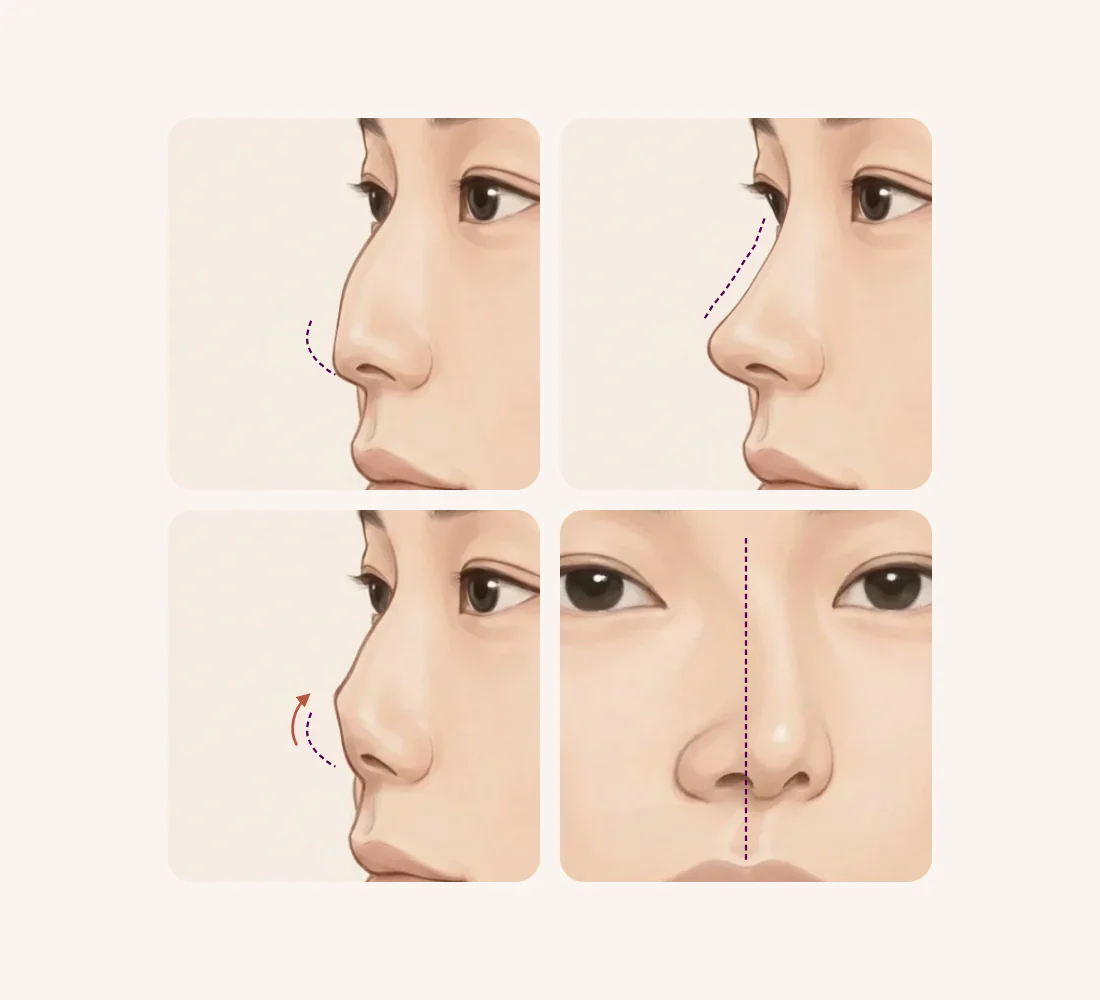
What does cartilage actually do in a rhinoplasty?
The shape of your nose comes from a framework of bone at the top and cartilage lower down, covered by skin and soft tissue (the soft layers under the skin). To raise a low tip, turn a drooping tip, or build up the bridge, a surgeon needs a material that can hold the new shape in place. When that material is cartilage taken from your own body, it is called an autologous cartilage graft, or simply "your own cartilage".
Your own cartilage usually comes from one of three places: the septum (the wall that divides the inside of the nose), the hollow bowl inside the ear, and the cartilage at the front ends of the ribs.1 All three are cartilage, but they differ in how much can be taken, how firm they are, what shape they have, and what is left behind where they were taken. A review of graft options puts it plainly: an ideal material does not exist yet.1 So rather than asking which cartilage is "better", the more useful question is what job the cartilage has to do in your particular nose.
At Bonita Clinic, when a tip is low or drooping we graft your own cartilage, such as ear or septal cartilage, to reinforce its support and plan its angle. In tip revision, support is rebuilt with your own cartilage from the ear, septum or rib, and in contracted nose revision the support of the bridge and tip is reconstructed with your own tissue such as rib cartilage. Which cartilage we use depends on how much is needed and on the condition of your nose. The operations themselves are explained in our nose tip surgery guide and contracted nose revision guide; this guide compares the cartilage that goes into them.
Where in the body do the three cartilages come from?
A different donor site means a different extent of surgery, and a different place that has to heal. Here are the three sites.
Three places cartilage comes from
- Septal cartilage: the front part of the wall that separates the two sides of the nose. It is taken through the same operative field as the rhinoplasty itself, which cuts down on extra surgery and operating time.1
- Ear cartilage: taken from the bowl-shaped hollow inside the ear, called the concha. The surgeon can reach it from the front or the back of the ear.1
- Rib cartilage: the cartilage that joins the front ends of the ribs. It can be taken from the 5th to the 11th ribs, and the 7th rib is used most often.1 In a Korean series of 83 Asian patients who received rib cartilage, the chest incision used to take it averaged 2.4 cm.6
How do amount, firmness and shape compare?
It helps to think about three questions: how much can be taken, how well it holds up, and what shape it has.
Septal cartilage is firm and flat, so it is easy to carve into the shape a surgeon needs. When enough of it is available, it is often the first choice.1 Ear cartilage is naturally curved, which makes it hard to carve into a straight piece. That same curve, however, can suit grafts on the nasal tip. Ear cartilage is also more fragile, more elastic and less rigid, so it has limits as a structural support, the "pillar" that holds the nose up.1 Rib cartilage offers the largest amount. Even when sliced thin it keeps much of its strength, and it resists resorption (being gradually absorbed by the body). Its biggest weakness is a tendency to warp after it has been carved.1
In plain terms: septal cartilage is a firm but small plate, ear cartilage is a plentiful but curved and soft piece, and rib cartilage is a large, strong block that can bend after carving.
The three cartilages at a glance
| Feature | Septal | Ear | Rib |
|---|---|---|---|
| Donor site | Septum, same operative field | Hollow bowl inside the ear | Front ends of the ribs |
| Amount | Small | Usually plenty (both ears) | The largest |
| Firmness and shape | Firm, straight plate | Soft and curved | Strong; can warp after carving |
| Typical use | Tip support, small bridge lift | Tip shaping, nostril rims | Major support, bridge, septum rebuild |
| Donor-site burden | No extra skin incision | Ear incision; keloid or hematoma (rare) | Chest incision; scar may thicken |
Why is septal cartilage usually considered first, and why does it often run short?
Septal cartilage can be taken right where the surgery is happening, and because it is straight and firm it works well as a tip support or for a modest lift of the bridge.1 The problem is the amount.
Taking too much of the septum can weaken the structure that holds the nose up.1 For this reason, surgeons leave an L-shaped strip of cartilage along the bridge edge and the tip edge and take only the part inside it. The strip that is left behind is called the L-strut.
One study measured the septal cartilage taken during 55 rhinoplasties in Korean patients, with a 10 mm wide L-strut left in place. The harvested piece averaged 520.9 mm² in area, with an average length of 18.2 mm along the bridge side and 15.1 mm along the lower side. Only 5 patients (9.1%) had a piece long enough to cover the whole length of the bridge. In 10 patients (18.2%) the piece was longer than 25 mm, long enough for a spreader graft, a thin strip placed alongside the bridge.2
That means the septal cartilage available is, on average, a single piece of about 5.2 cm², and even its bridge-side edge is shorter than 2 cm. That is often not enough to support the tip and raise the bridge at the same time.2
The same study found that the outside size of the nose did not predict how much septal cartilage was inside.2 People whose nose is small and who want it built up may also have less septal cartilage to begin with.1 If you have had nose surgery or a nose injury before, cartilage may already have been used or damaged, and a severely deviated septum can make harvesting difficult.1 This is why the surgical plan considers, in advance, whether additional cartilage from another site might be needed.2
What is ear cartilage good for?
Ear cartilage is almost always available in sufficient quantity, especially if both ears are used. Its width is similar to that of the nasal bridge, and it has been reported to raise the bridge by about 3 to 6 mm.1 Its natural curve can make it a good fit for grafts on the tip.1 In a chart review of 372 rhinoplasty patients whose ear cartilage was harvested, it was used for tip grafts, bridge grafts, reinforcing the septum and correcting uneven nostrils.3
Because ear cartilage is soft and elastic, it has limits as a firm support. Over time its surface can become uneven, and it can give way to the pull of scar tissue as the nose heals.1 One approach that has been reported is to fold the ear cartilage and use it as a support.4
As an example, surgeons in Korea folded cartilage from the upper part of the ear's hollow (the cymba concha) to use as a caudal septal extension graft, a graft joined to the lower end of the septum to fix the position of the tip. They did this because Asian patients often have too little septal cartilage, and in revision cases the septum has often been used already. The folded grafts averaged 24.2 mm long and 7.8 mm wide in men, and 22.4 mm long and 7.2 mm wide in women. In 220 patients followed for more than 12 months, tip projection increased by 28.9% and the angle between the columella and the lip by 9.7%. When compared with patients who received septal cartilage, there was no clear difference in tip projection or in that angle.4
This was a retrospective study from a single hospital, so the same outcome cannot be expected in every nose. In short, even when the septum is short of cartilage, folded ear cartilage can sometimes be used to build tip support.
When is rib cartilage needed, and why can it warp?
The greatest advantage of rib cartilage is quantity.1 In the Korean series of 83 Asian patients, rib cartilage was used on the bridge in all 83, on the tip in 66, for the septum in 58 and for the nostril wings (alae) in 23. Thirty-nine of the 83 operations were revisions.6 In other words, a single harvest can provide support for the bridge, tip and septum together. That is why rib cartilage is mainly considered for revisions where septal cartilage has run out, when the bridge needs a large lift, or when firm support is needed to resist tight, stiff skin.16
Its main drawback is warping. When rib cartilage is carved, forces held in balance inside the cartilage are released, and the piece can bend. Most warping happens within the first 30 minutes after carving, but some authors report that it can happen weeks or months later, and some believe it cannot be fully prevented. Many others believe that, with experience and specialised carving techniques, warping can be adequately managed.1
A meta-analysis (a study that pools the results of several studies) looked at complications of rib cartilage in rhinoplasty. This updated analysis, published in 2023, combined 20 studies and 1,648 patients.5
- In the nose: warping 3.05%, resorption 1.2%, infection 1.45%, uneven contour 1.53%
- At the chest: thickened (hypertrophic) scar 2.08%, pneumothorax (air collecting around the lung) 0%
- Revision surgery: 2.25%
The authors concluded that warping was the most common complication, and that problems at the chest donor site push the overall complication rate higher. All complications combined came to 15.13%.5 In numbers, about 3 in 100 people had warping and about 2 in 100 had a thickened chest scar. These are averages across many studies, not the risk for any one person.
In the Korean series, graft-related complications occurred in 12%: five grafts warped and five became infected, and all infections settled with intravenous antibiotics. There was no pneumothorax and no significant pain at the donor site, and two patients developed a thickened chest scar.6 The authors added that warping of rib grafts placed on the bridge, and infection in revision surgery, need particular attention.6
What is left at the donor site?
Choosing a cartilage is not only about the nose. It also means thinking about how the place it came from will heal.1
- Septum: taken through the same operative field as the nose surgery, so no extra skin incision is added. Because taking too much can weaken the nose, an L-strut is left behind.12
- Ear: in the chart review of 372 patients, 2.4% had a problem at the ear donor site: keloids (scars that grow beyond the original wound) in 1.1% and hematomas (collections of blood) in 1.3%.3 Taking too much cartilage can make the ear stick out less or look different from the other ear.1
- Rib: this adds an incision on the chest. The scar can thicken or darken, the contour of the chest wall can become uneven, and there is a small risk of pneumothorax.15
Which cartilage might suit my nose?
The same "rhinoplasty" can ask very different things of the cartilage, and that job decides which cartilage is considered. Here are four common situations.
Which cartilage is considered first
1A low tip with weak support
Septal cartilage is considered first; ear cartilage is added if it runs short
Nasal tip
2You want the whole bridge raised
Septal or ear cartilage for a small lift; for the full length, rib cartilage, also compared with implants
Bridge
3A nose that has become short and upturned, with stiff skin
Firm support is needed to resist the skin, so rib cartilage is considered
Contracted nose
4A badly deviated or already-used septum
Septal cartilage may be hard to obtain, so ear or rib cartilage is considered
Revision, crooked nose
In practice, four questions are usually worked through in order:
- What needs to change, and by how much: a little tip support, raising the full length of the bridge, or rebuilding a contracted nose?
- Is there enough septum: any previous surgery, injury or deviation, and how much is left?
- How firm must the support be: how strongly do the skin and any scar tissue press down?
- What is the burden at the donor site: previous ear surgery, a tendency to keloids, your feelings about a chest scar?
When one cartilage is not enough, another can be added: for example, septal cartilage to build the support and ear cartilage to refine the tip. That is why the possibility of needing extra cartilage is built into the plan from the start.2
The bridge can also be raised with an implant such as silicone instead of your own cartilage.1 How implants and your own tissue compare is covered in our full rhinoplasty guide and on our Full Rhinoplasty page.
How we approach it at Bonita Clinic
The order we follow
- 1AnalysisSkin thickness, cartilage, tip height and angle
- 2History checkPrevious surgery, grafts or implants, remaining cartilage
- 3Choosing cartilageMatched to the amount needed and your nose
- 4Recovery and follow-upTissue stabilization, swelling and bruising care
Our treatment pages list sedation combined with local anesthesia for nasal tip rhinoplasty and tip revision, and general anesthesia or sedation for contracted nose revision, with same-day discharge and stitches for all three. This is the usual approach; anesthesia and same-day discharge can differ with the extent of surgery and each person's condition, for example when rib or ear cartilage is also taken, and are confirmed at consultation. Recovery time and follow-up visits also depend on the extent of surgery and on each person, and the actual plan is set after an in-person consultation. Any surgery can cause swelling, bleeding, inflammation, infection or nerve injury, and the donor site needs to heal as well as the nose.
Treatment options you can discuss in Seoul
Bonita Clinic has been at the same location since 1995, and Dr. Kwang-Seop Jung, a board-certified plastic surgeon (Brazil), sees patients there. For questions about cartilage, these are the treatments described on our pages:
- Nasal Tip Rhinoplasty: for a low or drooping tip, support and angle design with your own cartilage, such as ear or septal cartilage
- Nasal Tip Revision: rebuilding tip support with your own cartilage from the ear, septum or rib after previous surgery
- Contracted Nose Revision: releasing tightened tissue and rebuilding bridge and tip support with your own tissue such as rib cartilage, with skin grafts or staged surgery where needed
Which of these applies to you, and which cartilage would be used, is decided only after an examination.
Why do the plan and cost differ from person to person?
Two people who both say "I want a higher tip" may need quite different operations. What shapes the plan, and therefore the cost, is how much needs to be built and where the cartilage has to come from.
- Which cartilage, and how many donor sites (septum, ear, rib)
- Tip only, or bridge and septum as well
- First surgery or revision (old grafts, implants, scar tissue)
- Anesthesia: sedation with local, or general for some revisions
- Whether surgery is planned in stages
- Skin thickness and how stiff the tissues are
Final plan and quote after an in-person exam
A final estimate is given only after an in-person examination, once it is clear how much support is needed and which cartilage can provide it. Photos help narrow down the options, but the amount of septal cartilage and the condition of the tissues can only be judged in person.
What can photos show, and what needs an in-person exam?
Photos are a useful starting point because the shape of the tip and bridge shows clearly in profile. What they cannot show is what is inside the nose.
Photos can show
- Tip height and rotation in profile
- Bridge height and line
- A short or upturned nose
- Deviation seen from the front
- Nostril shape from below
Needs an in-person exam
- How much septal cartilage remains
- Cartilage strength and skin thickness
- How firm scar tissue has become
- The septum and breathing inside
- Old grafts or implants in place
Helpful photos are a front view, both profiles, both 45-degree views and a view from below looking up at the nostrils, taken in good light without heavy makeup. If you have had nose surgery before, photos from before that operation and any records you have, such as operation notes mentioning which cartilage or implant was used, are very helpful. It also helps to tell us whether you have had septal or ear surgery and whether you tend to form keloids. You can send us a message with your photos and a short note about what you would like to change and what you would like to keep.
Planning your visit and recovery
Our treatment pages list sedation with local anesthesia (general anesthesia or sedation for contracted nose revision), same-day discharge and stitches as the usual approach; anesthesia and same-day discharge may differ when rib or ear cartilage is also taken, and are confirmed at consultation. How long you should stay in Seoul, when the stitches come out and how many follow-up visits you need all depend on the extent of surgery, including whether ear or rib cartilage is taken in addition to the nose. These are planned together with you at consultation.
Using cartilage from the ear or rib adds a second wound to look after during your stay. Swelling and bruising of the nose are expected at first. After you return home, contact a doctor promptly if pain, redness, swelling or bleeding gets worse instead of settling, at the nose or at a donor site. The donor-site problems reported were keloids and hematomas at the ear and thickened scars at the chest,35 so it is worth keeping an eye on these sites as well as on your nose. Dated photos of your nose and of any donor site make it easier for any doctor to follow your progress.
Real treatment cases
These cases appear on our Nasal Tip Rhinoplasty and Contracted Nose Revision pages. The photos do not show which cartilage was used, and results vary from person to person.
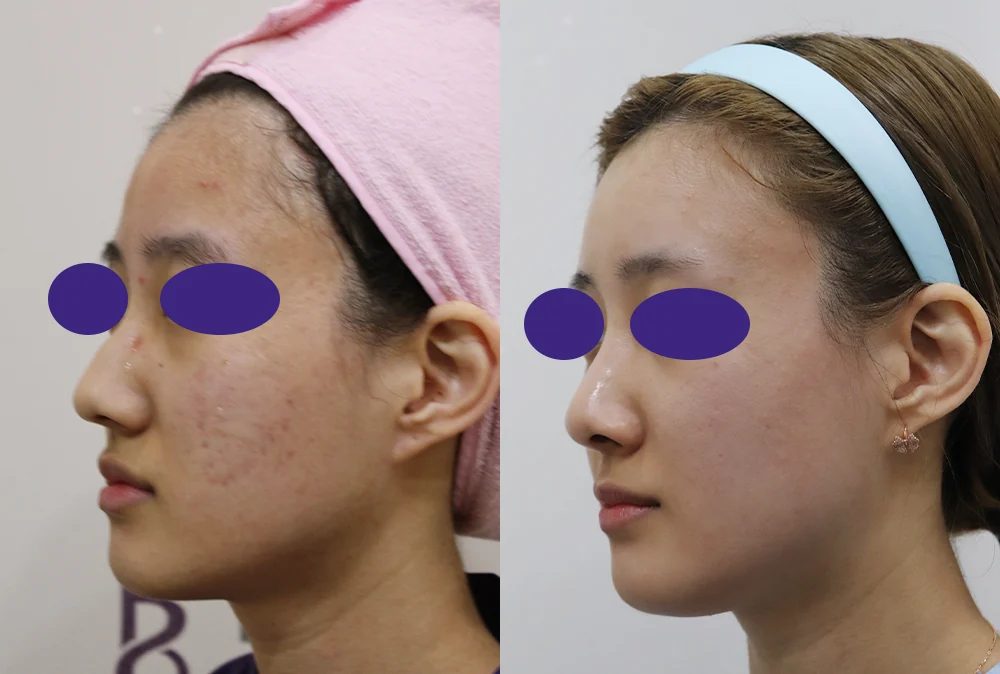
In an angled profile, the tip looked low and rounded
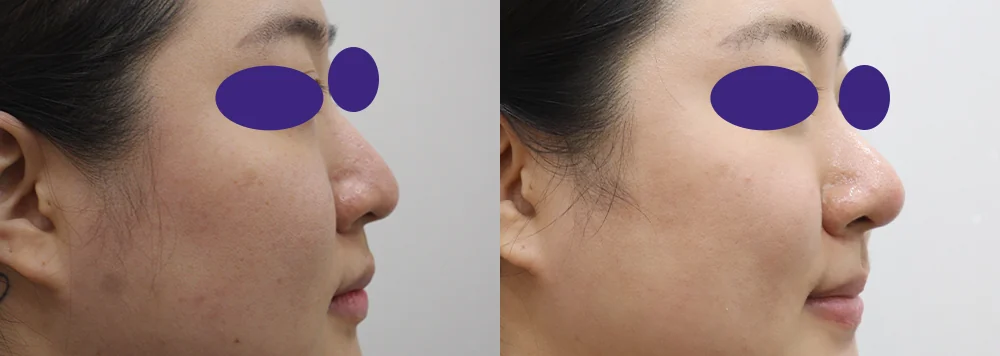
In profile, the tip looked round and blunt
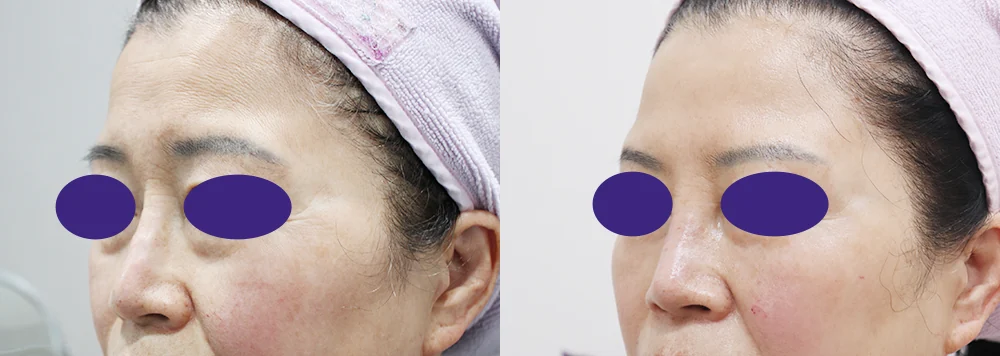
Contracted nose revision case: in an angled view, the nose looked short with an upturned tip
* Results vary from person to person. Side effects are possible, so please decide after a thorough consultation with a doctor.
Frequently asked questions
Will taking septal cartilage weaken my nose?
Taking too much of the septum can weaken the support of the nose.1 That is why an L-shaped strip is left along the bridge and tip edges and only the inner part is taken. In the study of 55 Korean patients, this L-strut was kept 10 mm wide.2 If you have had septal surgery for a blocked nose before, the remaining cartilage and the strength of the support are checked first.
Will taking ear cartilage change the shape of my ear?
The cartilage is usually taken from the hollow bowl inside the ear.1 Taking too much can make the ear stick out less or look different from the other side, so the amount needed is planned in advance.1 In the chart review of 372 patients, problems at the ear occurred in 2.4%, all keloids or hematomas.3 If you have ever had a keloid, for example at an earlobe piercing, please tell us at consultation.
Where is rib cartilage taken from, and how big is the scar?
It can be taken from the front ends of the 5th to 11th ribs, most often the 7th.1 In the series of 83 Asian patients, the chest incision averaged 2.4 cm, and two patients developed a thickened scar.6 In a meta-analysis pooling 20 studies, a thickened chest scar was reported in 2.08%.5 If you have had thick scars before, please mention it.
What happens if rib cartilage warps?
Warping is considered a particular concern when rib cartilage is placed on the bridge.6 In a meta-analysis pooling 20 studies, warping was the most common complication reported, at 3.05%.5 Most warping happens within 30 minutes of carving, but some authors report it weeks or months later.1 If a visible bend develops, it may be corrected with further surgery; in the same meta-analysis, revision surgery was reported in 2.25%.5
Is rib cartilage ever used in a first rhinoplasty?
It can be. In the series of 83 Asian patients, 44 were having their first operation.6 Septal cartilage is often too short to cover the whole bridge,2 so rib cartilage may be considered when the full length of the bridge needs raising or support is needed in several places. For tip support alone, septal or ear cartilage may be enough. Which cartilage you need is decided together, based on the size of the change you want and the findings at examination.
What to prepare before your consultation
- When and how often you have had nose surgery, and which cartilage (septal, ear, rib) or implant was used
- Whether you have had septal surgery for a blocked nose, or any ear surgery
- Whether you have ever formed a keloid or a thick scar
- The size of the change you want: tip support only, or a higher bridge as well
- Front, profile, 45-degree and from-below photos of your nose
Bonita Clinic is on the 3rd floor of 565 Gangnam-daero, Seocho-gu, Seoul, about 100 m on foot from Exit 8 of Nonhyeon Station (Line 7). How the cartilage is chosen in revision is covered in our nose tip revision guide, and rebuilding a nose after several operations in our revision rhinoplasty guide.
References (6)
Sources that support the explanations in this article. Study findings describe general trends and do not guarantee individual results.
- Wright JM, Halsey JN, Rottgers SA. Dorsal Augmentation: A Review of Current Graft Options. Eplasty. 2023;23:e4.Review of graft options (full text): septal cartilage is taken from the same field, firm and flat but limited (worse in revision, trauma or severe deviation), and over-resection weakens support; ear cartilage is plentiful, lifts the bridge about 3–6 mm and suits tip grafts but is soft and can yield to scar contraction; rib cartilage (5th–11th ribs, usually the 7th) gives the most material and strength and resists resorption, but warps (mostly within 30 minutes, sometimes later) and can leave chest scars or contour change, with a small pneumothorax risk; no ideal material exists
- Kim JS, Khan NA, Song HM, Jang YJ. Intraoperative measurements of harvestable septal cartilage in rhinoplasty. Ann Plast Surg. 2010;65(6):519-523.doi:10.1097/SAP.0b013e3181d59f95Prospective study of 55 Korean rhinoplasties (abstract): with a 10 mm L-strut kept, harvested septal cartilage averaged 520.9 mm² (18.2 mm dorsal, 15.1 mm caudal); only 9.1% had enough for a full-length dorsal graft and 18.2% had pieces over 25 mm; external nose size did not predict the amount
- Lan MY, Park JP, Jang YJ. Donor site morbidities resulting from conchal cartilage harvesting in rhinoplasty. J Laryngol Otol. 2017;131(6):529-533.doi:10.1017/S0022215117000639Chart review of 372 rhinoplasty patients with ear cartilage harvest (abstract): the cartilage was used for tip and dorsal grafts, septal reinforcement and nostril asymmetry; donor-site problems in 2.4% (keloid 1.1%, hematoma 1.3%)
- Namgoong S, Kim S, Kim HR, et al. Folded Cymba Concha: Is It Large and Stable Enough for Caudal Septal Extension Graft in Asian Rhinoplasty?. Aesthet Surg J. 2021;41(7):NP737-NP747.doi:10.1093/asj/sjab079Retrospective study (abstract) of folded cymba concha as a caudal septal extension graft in Asian rhinoplasty: graft size 24.2 × 7.8 mm in men and 22.4 × 7.2 mm in women; in 220 patients followed over 12 months, tip projection rose 28.9% and the columella–lip angle 9.7%, with no clear difference from septal cartilage; single-centre data
- Chen H, Wang X, Deng Y. Complications Associated with Autologous Costal Cartilage Used in Rhinoplasty: An Updated Meta-Analysis. Aesthetic Plast Surg. 2023;47(1):304-312.doi:10.1007/s00266-022-03075-3Updated meta-analysis of 20 studies and 1,648 patients with autologous rib cartilage in rhinoplasty (abstract): warping 3.05%, resorption 1.2%, infection 1.45%, contour irregularity 1.53%, revision 2.25%, hypertrophic chest scar 2.08%, pneumothorax 0%, all complications 15.13%; warping was the most common complication, and donor-site problems raised the overall rate
- Park JH, Jin HR. Use of autologous costal cartilage in Asian rhinoplasty. Plast Reconstr Surg. 2012;130(6):1338-1348.doi:10.1097/PRS.0b013e31826d9f03Retrospective series of 83 Asian patients with rib cartilage (abstract; 39 revisions): used on the bridge in 83, tip 66, septum 58 and alae 23; graft complications 12% (5 warping, 5 infections controlled with IV antibiotics); chest incision averaged 2.4 cm; no pneumothorax or significant donor-site pain; 2 hypertrophic chest scars
About this article
This article separates general medical information from Bonita Clinic's own approach. Because the right decision depends on each person's condition, it is not a substitute for a consultation.