KOKorean
 ENEnglish
 JP日本語
 CN中文(简体)
 TW中文(繁體)


Replacing an Old Silicone Nose Implant in Seoul: Is There a Set Time, or Do Signs Decide?
No, not simply because it is old. Silicone nose implants have no set lifespan or fixed replacement interval, and many people go for years without needing another operation. Replacement or removal is considered when signs appear, not when a certain number of years has passed: an implant edge that becomes more and more visible, a bridge that shifts to one side, redness or swelling that keeps coming back, or a nose that becomes shorter and more upturned. If you are noticing one of these changes and would like it assessed in Seoul, front, profile and 45-degree photos are a useful place to start.
Curious about your own case? Ask us online →
How long does a silicone nose implant last, and is there a set time to replace it?
Ten or fifteen years after a nose augmentation, many people start to wonder whether the implant is "due" for replacement. A silicone nose implant has no set lifespan and no fixed replacement interval. An implant is not a part with an expiry date; whether it needs attention is decided by what is happening to your nose now, not by the calendar.
The research explains why. A meta-analysis (a study that pools the results of many studies by a set method) gathered 27 studies and 3,803 cases of nasal bridge augmentation with synthetic implants, meaning factory-made materials such as silicone, Gore-Tex (ePTFE) and Medpor (porous polyethylene). Pooling the 451 patients whose studies reported revisions, the revision rate was 6.40%, and 7.64% for silicone. Yet the average follow-up in these studies was only 30 months, ranging from 3 months to 15 years.1 On average, that is about two and a half years of follow-up. There is simply not enough long-term data to draw a line at a particular year and say an implant must be replaced then.
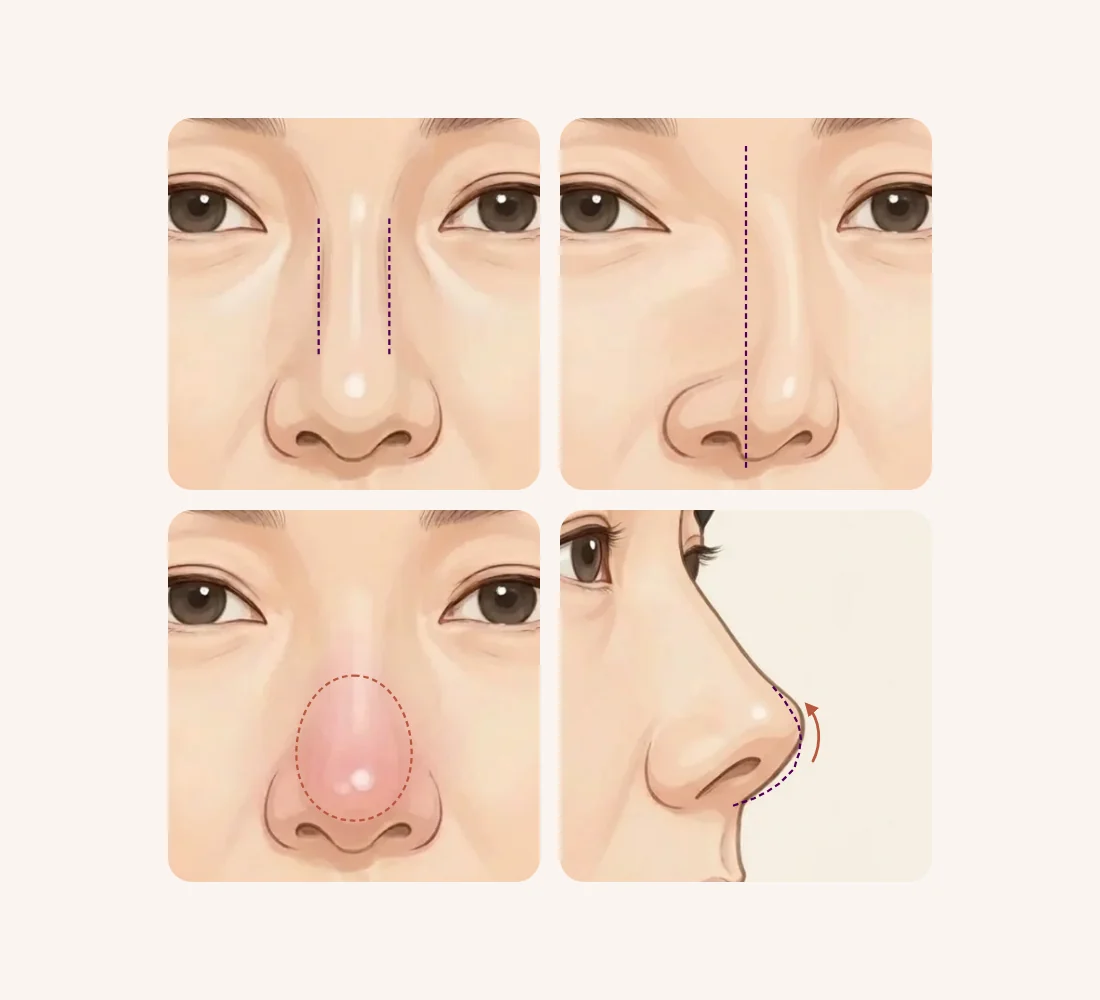
As the drawing shows, the changes that can happen around an implant do not follow one timetable. Some noses change within a few years of surgery; some very old implants stay quiet. That is why the question to ask is not "How many years has it been?" but "Is my nose showing a sign?"
How often are silicone nose implants removed over the years?
One study reviewed 422 people who had silicone augmentation at one Australian hospital over a 10-year period (1985–1995). The 10 years describe when the operations took place, not how long each person was followed. How long each person was followed is not stated in the abstract (the published summary), and because the study appeared in 1998, people operated on near the end had only a few years of follow-up. Of the 422, 98% were of South-East Asian origin.2
- 23 people (5.5%) had the implant removed within 30 days of surgery, for early problems such as displacement, prominence, bleeding or excess pressure.
- On longer follow-up, a further 18 (4.3%) had it removed. The most common reasons were displacement or a nose that looked over-prominent, and this was more often the surgeon's judgment than the patient's.
- Only 2 people (0.5%) had an implant push out through the skin (extrusion).
- Of the 266 patients reached by telephone, 84.2% were satisfied with the shape of their nose.
- The remaining 15.8% (42 people) were not satisfied with the shape, and 21 of them wanted their nose raised further.
Put simply, in the records available, about nine in ten people did not have their implant taken out again. Not being removed is not the same as being problem-free: as the list shows, some people were unhappy with the shape. The study also has clear limits: long-term follow-up was by telephone and reached only 63% of patients, so some problems may have been missed, and it comes from one hospital. Still, it paints a different picture from the idea that an implant must be swapped simply because it has been there a long time.
What changes around an implant over time?
Even when everything looks fine on the outside, quiet changes can take place around an implant. Three of them help explain the signs described further down.
The capsule: a thin layer the body builds
Silicone has no pores on its surface, so tissue cannot grow into it. Instead, the body wraps the implant in a thin fibrous layer called a capsule.1 Forming a capsule is a normal response. Problems begin when the capsule thickens and tightens. How a tight capsule can push the implant or pull the nose is covered in our nose implant revision guide.
Calcification: hard deposits that can build up with time
Calcification means calcium building up in tissue so that it hardens. One study examined 221 silicone nasal implants removed during revision surgery. They had been in place for 1 month to 25 years, 6 years and 7 months on average.3
- Calcium debris could be seen under the microscope from 4 years.
- Calcification visible to the naked eye first appeared after 5 years and 8 months.
- After more than 9 years, half of the implants showed focal calcification.
- The capsule around the calcified areas contained more inflammatory cells.
The authors concluded that calcification can cause the shape of the nose to change over the long term.3 Read these numbers with care, though. Only implants removed at revision surgery were studied, so the study cannot tell us how common calcification is in implants that never needed revision. Nor did it suggest that calcification alone is a reason to remove an implant. The fair takeaway is that the older an implant is, the more attention its signs deserve.
Shape changes can appear within a few years
Changes in shape are not limited to very old implants. A study from Thailand looked at 33 people who had corrective surgery after silicone augmentation, either because the shape changed over time or for aesthetic revision. To leave out problems caused by surgical technique, it excluded any deformity that appeared within 6 months of the last operation. Even so, symptoms appeared on average 26 months after the implant was placed, with a range of 10 to 48 months.4 So, among people who came for revision, the change appeared anywhere from under a year to about four years after surgery (about two years on average). Because only people having revision were included, this does not show when changes happen in implants in general.
The same study found bacterial biofilm more often as the deformity became more severe. A biofilm is a thin film of bacteria clumped together and stuck to a surface.4 This helps explain why a nose can change shape even without any obvious redness or pus. The topic is covered in more detail in our contracted nose revision guide.
Which signs mean an implant should be checked?
There are four main signs that an implant needs a closer look:
- Visible edge: the outline of the implant shows or its border can be felt clearly
- Shifting: the implant moves out of place and the bridge looks crooked
- Inflammation: redness, swelling, warmth or pus
- Contracture: the capsule tightens and the nose becomes shorter and upturned
They do not all carry the same urgency. The cards below show how each sign looks on the same nose, and what to do about it.
How urgent is each sign?
1The implant edge shows along the bridge
If it is not changing, keep comparing photos; see a doctor if it sharpens, and without delay if the skin thins or changes colour
Implant revision
2The bridge has shifted to one side
Where the implant sits and the capsule are checked, and revision is considered
Implant revision
3The tip turns red or swelling keeps returning
This may be inflammation around the implant, so see a doctor without delay
4The nose looks shorter and upturned
Capsular contracture is checked, and rebuilding the structure is considered
Contracted nose revision
Not every change leads to surgery. One study sorted 695 people with silicone nose implants into four grades based on how the nose looked after surgery.5
- Grades I (natural, as if no implant were there) and II (the edge is detectable by a surgeon, with some capsule tightening and slight firmness, but generally acceptable) made up 86.2%, and revision was not indicated for them.
- Grades III (the implant is deviated and firm) and IV (a short, upturned nose) made up 13.8%, and revision was needed.
Note that patients were followed for only 3–18 months (11.4 months on average), so later changes are not captured in these figures. The study also excluded people with infection, skin problems or extrusion from the start.5 So inflammation and thinning skin should be treated as separate signs that call for quicker action.
Visible edge: does it need replacing straight away?
A visible edge means the border of the implant shows as a line along the sides of the bridge, or can be felt clearly when you touch it. It happens when the skin and soft tissue over the implant have thinned, or when the size or material of the implant does not suit that nose. Soft tissue is the soft layer under the skin, such as fat and muscle. The meta-analysis also considered synthetic implants better suited to people with thicker skin than to those with thinner skin.1
A faint edge on its own does not have to mean surgery. In the grading study above, grade II, where the edge can be detected, was not an indication for revision (follow-up of about a year).5 It is worth having it examined, though, if:
- the edge becomes sharper over a few months;
- the skin over the implant looks shiny, thin or discoloured;
- the edge comes with redness or swelling.
If the skin over the implant or at the tip becomes noticeably thin or changes colour, it may be heading toward extrusion (the implant pushing out through the skin), so see a doctor without delay.6
How a visible edge is corrected, for example by choosing a different size or material, or by adding your own cartilage, is explained in the nose implant revision guide.
Shifting: what is checked when the bridge looks crooked?
Shifting here means a change that appears after the nose has settled following surgery: the bridge seems to curve to one side when you look straight on, or the implant has slid sideways out of its place. It can happen when the capsule pulls harder on one side; the grading study above describes the implant deviating when capsular contracture reaches a moderate degree.5
Displacement is a common reason for removing an implant later on. In the 422-patient study above, the most common reasons for removal after the first 30 days were displacement or over-prominence.2 In another study, 100 people had silicone on the bridge and ear cartilage at the tip and were followed for up to 5 years; 5 of them needed further surgery because the bridge implant was misaligned.6 The grading study treated grade III, where the implant has deviated and lost its original softness, as an indication for revision.5
When the bridge looks crooked, the examination checks:
- where the implant is sitting now;
- whether the capsule is pulling on one side, or has thickened;
- how thick the skin and soft tissue over the implant are.
If the shape of your nose changed after a hard knock, have it checked then as well, rather than waiting.
Inflammation: can redness, swelling or pus wait?
Signs of inflammation deserve quicker attention than the others. See a doctor without delay if:
- the tip or bridge turns red and feels warm;
- swelling and pain appear, or swelling settles and then keeps coming back;
- pus comes from inside the nose or through the skin.
There is a reason for not waiting. The meta-analysis notes that, unlike infections in grafts of your own tissue, infections around synthetic implants usually cannot be resolved with conservative treatment such as medication alone, and mostly need revision surgery. It adds that removing an infected implant, followed by immediate or delayed reconstruction, gives a better chance of resolution.1 In the 100-patient study, one person needed the implant removed because of recurring swelling over the bridge.6
Why does the tip skin turn red?
Pressure also plays a part in a red tip. When a silicone implant runs all the way into the tip, it presses on the tip skin from the inside. One team describes how increased mechanical pressure at the tip can lead to skin discoloration and possible extrusion of the implant.6
The same team placed silicone on the bridge only and supported the tip with ear cartilage in 100 patients, and over up to 5 years of follow-up no implant pushed out.6 It is one team's experience and cannot be applied to every case. Even so, it shows why a red, thin tip calls for a decision about what supports the tip, rather than simply putting in another implant of the same shape.
Contracture: when the nose looks shorter and upturned
Contracture is when the capsule thickens and tightens, pulling the nose upward. The nose gets shorter, the tip turns up, and more of the nostrils show. In the grading study, this grade IV appearance was seen in 3.0% and was an indication for revision.5 As the Thai study showed, it can develop within a few years of the implant being placed.4
If contracture is suspected, the examination looks at the length of the nose and the position of the tip, how firm and how thin the skin is, and the state of the capsule. The timing and method of revision are decided from there. Causes and correction are covered separately in the contracted nose revision guide.
No signs? How to keep an eye on it
If there are no signs, there is no reason to replace an implant early just because of its age. Revision is surgery too, and any surgery, whatever the method, can cause swelling, bleeding, inflammation, infection or nerve injury. A simple watching habit helps you notice change early:
- Now and then, take front, profile and 45-degree photos in the same light and at the same angles. Slow changes become much easier to compare.
- Look for a bridge that curves, an edge that sharpens, a change in tip colour, or a nose that gets shorter.
- After a hard knock to the nose, if redness or swelling appears, or if the skin over the implant thins or changes colour, see a doctor rather than waiting for the next photo.
- Before any other nose treatment, such as fillers, tell the practitioner that you have an implant.
Depending on how your nose looks now, the next step can be summed up like this.
How does your nose look now?
- No noticeable changeNo replacement based on age aloneKeep photos and compare now and then
- A faint edge, not changingWatch for changeSee a doctor if it sharpens
- The bridge shifts or the nose shortensRevision considered after an examImplant position, capsule, skin thickness
- Redness, swelling, pus, or thinning, discoloured skinSee a doctor without delayTiming of removal and rebuilding planned together
Replace or remove: how is it decided?
Once a sign has led to a decision to operate, the remaining question is whether to replace the implant or to remove it and support the nose another way. Either way, the operation rarely ends with the implant alone, because the capsule and the stretched or thinned skin and soft tissue around it can recreate the same problem. Depending on the situation, the usual direction is:
| Current situation | Usual direction | Read more |
|---|---|---|
| Visible or shifted, no inflammation | Choose a new size or material and reinforce the supporting tissue | Nose implant revision guide |
| Past infection or markedly thin skin | Consider rebuilding mainly with your own tissue first | Nose implant revision guide |
| You would rather live without an implant | Remove it, planning for the capsule and tip support | Nose implant removal guide |
| A shorter, upturned nose | Release the capsule and rebuild the structure with cartilage | Contracted nose revision guide |
| Several problems at once | Rebuild the whole structure based on the remaining tissue | Full revision rhinoplasty guide |
Which combination suits you can only be decided after the tissue has been examined.
How we approach it at Bonita Clinic
The order we follow
- 1Existing implantType, size, how long it has been in
- 2Tissue analysisCapsule, inflammation or infection history, visibility, skin thickness, symmetry
- 3Structural workImplant and capsule dealt with; new size or material, or your own cartilage
- 4Recovery careWatching for recurring inflammation, swelling, follow-up
At Bonita Clinic, implant revision is performed under sedation or general anesthesia, and implant removal under local anesthesia or sedation. In both cases you go home the same day, and there are stitches. Recovery time and follow-up visits depend on the extent of surgery and your condition, and the actual surgical plan is decided after an in-person consultation. Scars are mostly inside the nostrils or on the columella (the strip between the nostrils) and are cared for so that they fade over time.
Treatment options you can discuss in Seoul
Bonita Clinic has treated patients at the same location since opening in 1995, and Dr. Kwang-Seop Jung, a board-certified plastic surgeon (Brazil), sees patients there. For an older silicone implant, what you can discuss at consultation follows our treatment pages:
- Implant Revision: dealing with the existing implant and capsule, reselecting size and material or adding your own cartilage (ear, septum and others), and repositioning for balance and symmetry
- Nasal Implant Removal: removing the implant and contracted capsule, reinforcing support with your own tissue such as ear cartilage when needed, and clearing inflamed tissue
- Full Revision Rhinoplasty: when several problems overlap, rebuilding the structure with your own cartilage (ear, septum or rib) where needed
Which of these fits your nose is decided only after an examination.
Why do the plan and cost differ from person to person?
Two people who both say "my implant is old" can need very different operations. What shapes the plan, and therefore the cost, is which signs are present and how much needs to be done.
- Which signs are present: edge, shift, inflammation, contracture
- Replacing the implant or removing it
- How much of the capsule needs attention
- Whether your own cartilage is needed for support
- Active inflammation or past infection, which can mean staged surgery
- Anesthesia: sedation or general for revision, local or sedation for removal
Final plan and quote after an in-person exam
A final estimate is given only after an in-person examination, once the condition of the implant, capsule and skin is clear. Photos help narrow down the options; the extent of surgery is settled at the examination.
What can photos show, and what needs an in-person exam?
Photos are a good first step, because most signs of an implant problem can be seen from the outside. What photos cannot show is how thick the covering tissue is, or how the capsule and implant feel.
Photos can show
- An implant edge showing along the bridge
- A bridge that has shifted to one side
- Redness on the tip or bridge
- A shorter, upturned nose and nostril show
- Change compared with older photos
Needs an in-person exam
- Thickness of the skin and soft tissue over the implant
- How firm the capsule is and whether the implant moves
- Warmth, tenderness or discharge
- Where the implant sits and what kind it is
- Breathing and the inside of the nose
Helpful photos: front view, both profiles and both 45-degree views in good light without heavy makeup, plus a close-up of any red or swollen area. Older photos from before the change began make comparison much easier. If you have records of the original surgery, such as the date, the clinic and the implant type or size, include them. You can send us a message with your photos and a short description of what has changed and when.
Planning your visit and recovery
What is confirmed in advance is the treatment information above: surgery under the anesthesia described, same-day discharge, and stitches. How long you should stay in Seoul, when the stitches come out and how many follow-up visits you need depend on what the examination finds and on the extent of surgery, so these are planned together with you at consultation.
If there is active inflammation or a past infection, removal and reconstruction may be planned as separate steps. Because that changes how many visits are needed, it is worth raising before you book travel. After you return home, contact a doctor promptly if redness, swelling, pain, warmth or discharge appears or increases instead of settling. Taking dated photos from the same angles makes it easier for any doctor to follow your progress.
Real treatment cases
These cases are from our implant revision page. Results vary from person to person.
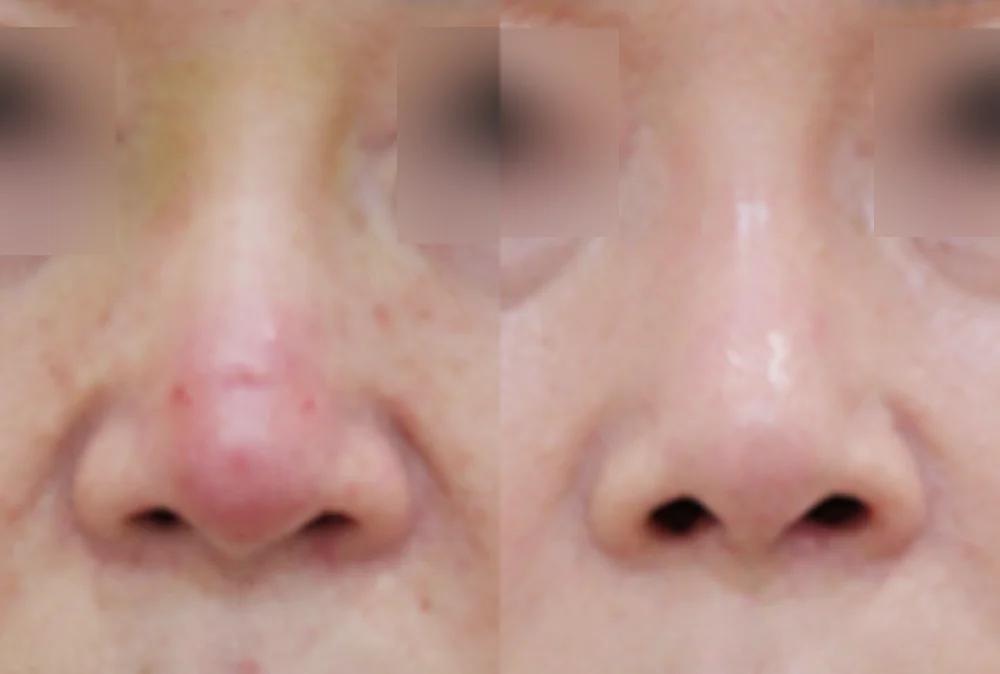
The skin of the nose tip had turned red (front close-up)
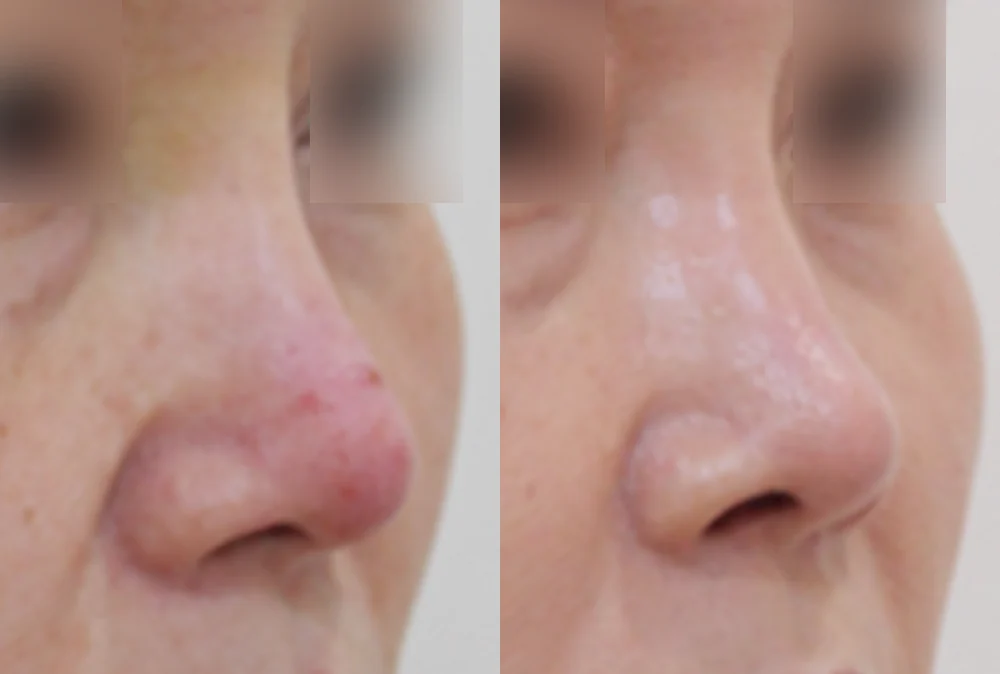
The same case, close-up from an angle
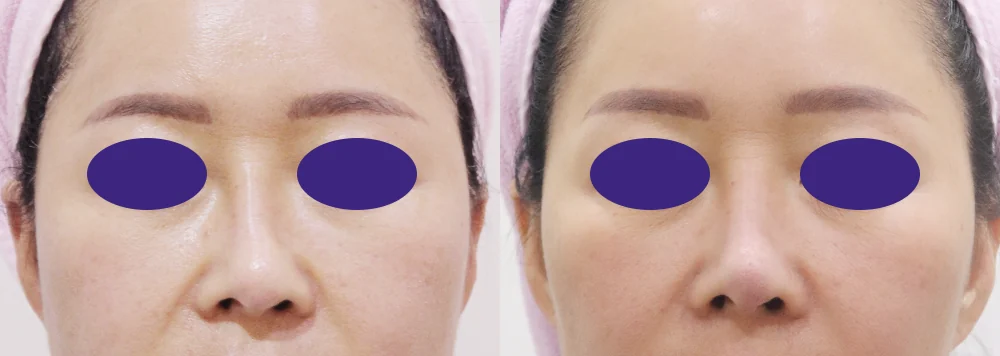
The bridge line seen from the front, from between the eyes to the tip
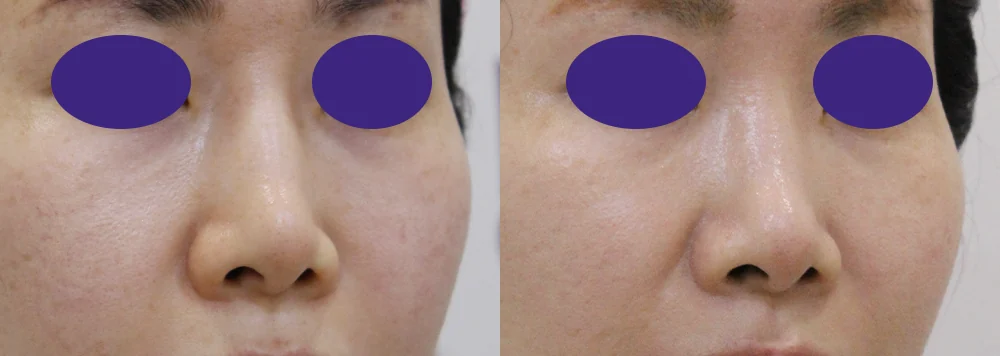
The bridge and tip in a front close-up
* Results vary from person to person. Side effects are possible, so please decide after a thorough consultation with a doctor.
Frequently asked questions
My implant has been fine for over ten years. Should I replace it before something happens?
There is no rule that an implant must be replaced because of its age. Calcification has been reported in long-term silicone implants, but those findings come from implants removed at revision surgery.3 Revision carries its own risks of swelling, bleeding, inflammation and infection. If nothing is changing, a realistic approach is to keep comparing photos and have it examined when a sign appears.
I can feel my implant when I touch my nose. Is that a problem?
A dorsal implant lies beneath the skin and a thin layer of soft tissue, so it can often be felt when pressed. But if the edge has become sharper than before, or the implant seems to slide sideways easily, the covering tissue may have thinned or the implant's size or material may not suit your nose. A study has classed a faintly visible edge as a grade that does not call for revision (follow-up of about a year).5 Watch whether it changes, and have it examined without delay if the skin thins or changes colour.
My nose keeps turning red and then settling down. Are antibiotics enough?
A meta-analysis notes that infections around synthetic implants usually cannot be resolved with medication alone and often need revision surgery.1 Even if it settles, redness that keeps coming back may be inflammation around the implant, so have it examined. The examination checks for redness, warmth and pus, when it started and how many times it has happened, and plans the timing of removal and rebuilding together.
If I have an old implant removed, will my nose go back to how it was?
Often not exactly. A long-standing implant usually stretches the skin and soft tissue, so removing it alone can leave the tip looking sunken or droopy. That is why the plan covers how much of the capsule to remove and whether the tip needs support. See the nose implant removal guide for details.
I do not know what kind of implant I have. Can I still have a consultation?
Yes. The examination starts by checking the type and size of the implant and how long it has been in place. If you have the date and clinic of the original surgery, any records or old photos, bring them, as they help the assessment.
What to prepare before your consultation
- When and where you had the original surgery, and the implant type and size if you know them (records if available)
- Any revisions, fillers or thread procedures since then
- When redness, swelling or pus occurred, how often, and how it was treated (for example, antibiotics)
- Front, profile and 45-degree photos from before the change and now
- What you want to change and what you do not (keeping an implant or living without one)
Bonita Clinic is on the 3rd floor of 565 Gangnam-daero, Seocho-gu, Seoul, about 100 m on foot from Exit 8 of Nonhyeon Station (Line 7). You can read more on our Implant Revision page. The surgical methods are explained in the nose implant revision guide and the nose implant removal guide, and a shortened, upturned nose in the contracted nose revision guide.
References (6)
Sources that support the explanations in this article. Study findings describe general trends and do not guarantee individual results.
- Keyhan SO, Ramezanzade S, Yazdi RG, et al. Prevalence of complications associated with polymer-based alloplastic materials in nasal dorsal augmentation: a systematic review and meta-analysis. Maxillofac Plast Reconstr Surg. 2022;44(1):17.doi:10.1186/s40902-022-00344-8Systematic review and meta-analysis (full text) of 27 studies and 3,803 cases of synthetic dorsal implants: revision 6.40% (pooled from the 451 patients with reported revisions; silicone 7.64%), mean follow-up 30 months (3 months to 15 years), fibrous capsule around non-porous silicone, synthetic implants considered better suited to thicker than thinner skin, and infections of synthetic implants usually needing revision surgery rather than conservative treatment (offered in the discussion as an explanation)
- Deva AK, Merten S, Chang L. Silicone in nasal augmentation rhinoplasty: a decade of clinical experience. Plast Reconstr Surg. 1998;102(4):1230-1237.doi:10.1097/00006534-199809040-00052Case series (abstract) of 422 silicone rhinoplasties performed at one Australian hospital, 1985–1995 (individual follow-up not stated): removal within 30 days 5.5%, later removal 4.3% (mainly displacement or over-prominence, more often judged by the surgeon), extrusion 0.5%; of 266 (63%) reached by phone, 84.2% satisfied and 15.8% (42) not satisfied, 21 of whom wanted further augmentation
- Jung DH, Kim BR, Choi JY, et al. Gross and pathologic analysis of long-term silicone implants inserted into the human body for augmentation rhinoplasty: 221 revision cases. Plast Reconstr Surg. 2007;120(7):1997-2003.doi:10.1097/01.prs.0000287323.71630.e6Analysis (abstract) of 221 silicone nasal implants removed at revision (in place 1 month to 25 years, mean 6 years 7 months): microscopic calcification from 4 years, visible calcification from 5 years 8 months, focal calcification in 50% after 9 years, inflammatory cells in the surrounding capsule; only implants removed at revision surgery were studied
- Jirawatnotai S, Mahachitsattaya B. Analysis of subclinical infections and biofilm formation in cases of capsular contracture after silicone augmentation rhinoplasty: Prevalence and microbiological study. Arch Plast Surg. 2019;46(2):160-166.doi:10.5999/aps.2018.00864Prospective study (full text) of 33 patients revised for delayed contour deformity or aesthetic revision after silicone augmentation (2014–2016; deformities within 6 months excluded): symptoms on average 26.06 months after implantation (10–48 months); biofilm more frequent with more severe deformity (10%, 50%, 71.4%, 80%); only patients having revision were included
- Kim YK, Shin S, Kang NH, Kim JH. Contracted Nose after Silicone Implantation: A New Classification System and Treatment Algorithm. Arch Plast Surg. 2017;44(1):59-64.doi:10.5999/aps.2017.44.1.59Classification study (full text) of 695 silicone rhinoplasties followed 3–18 months (mean 11.4 months): grade I 71.7%, II 14.5%, III 10.8%, IV 3.0%; revision not indicated for grades I–II (86.2%) and indicated for III–IV (13.8%); grade II = edge detectable with some capsule contraction and slight firmness, grade III = moderate contracture with implant deviation; infection, skin problems and extrusion were excluded
- Ahn J, Honrado C, Horn C. Combined silicone and cartilage implants: augmentation rhinoplasty in Asian patients. Arch Facial Plast Surg. 2004;6(2):120-123.doi:10.1001/archfaci.6.2.120Case series (abstract): silicone problems often involve the tip, with skin discoloration and possible extrusion from pressure; 100 patients with silicone on the bridge and ear cartilage at the tip followed up to 5 years had no extrusions, 5 revisions for dorsal misalignment and 1 removal for recurrent dorsal swelling
About this article
This article separates general medical information from Bonita Clinic's own approach. Because the right decision depends on each person's condition, it is not a substitute for a consultation.