KOKorean
 ENEnglish
 JP日本語
 CN中文(简体)
 TW中文(繁體)


Eyelid Surgery in Seoul: Planning Your Trip from Consult to Flight Home
Plan an eye surgery trip to Seoul as a sequence, not a set number of days: a photo consultation from home narrows the options, and an in-person exam in Seoul checks what photos cannot, such as eye-opening strength and eyelid skin and fat, before the method is decided. Spend the first 24 hours near the clinic, because orbital hemorrhage, a rare but serious complication, mostly starts within the first few hours after surgery. Stitch removal and a check before you fly are part of your stay, and the length of stay and your return date are planned with you at consultation, around the extent of surgery and your recovery. Wondering how eye surgery might fit into a trip to Seoul? Send us your photos and any previous eye surgery history before you plan your visit.
Curious about your own case? Ask us online →
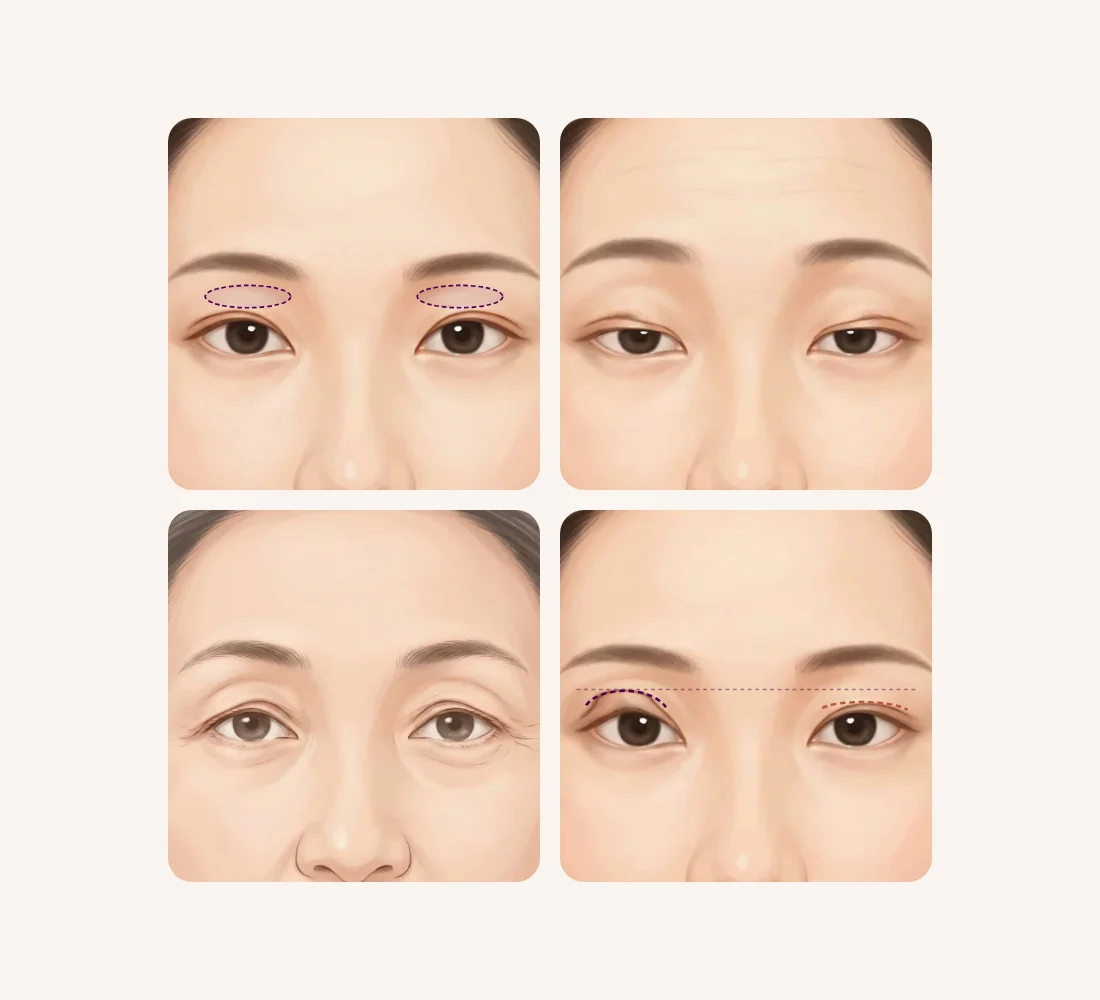
Planning eye surgery in Seoul from abroad: where do you start?
The first question most people ask when they consider eye surgery in Seoul is "How many days do I need to stay?" It is a fair question, because flights and time off have to be booked in advance. Yet an eye surgery trip is easier to plan as a sequence than as a number of days. "Eye surgery" covers quite different operations. A double eyelid procedure creates a crease. Ptosis correction fixes weak eye-opening strength, meaning the muscle that lifts the upper lid. An upper blepharoplasty removes loose upper eyelid skin, and a revision corrects an earlier operation. Each one needs different checks in Seoul and recovers in a different way.
The sequence usually looks like this:
- Photo consultation before you travel: your current eyes and concerns are reviewed, to narrow down the options and what needs checking in Seoul.
- In-person examination in Seoul: eye-opening strength, the thickness of the eyelid skin and fat, and differences between the two sides are checked directly, and the method and extent are decided.
- Surgery and the first day: the first hours after surgery are spent resting close to the clinic.
- Stitches and a check: if your operation has stitches, they are removed and the eyes are checked before you fly.
- Back home: dated photos help you share progress while swelling settles.
How an eye surgery trip runs
The British Association of Aesthetic Plastic Surgeons (BAAPS) has published advice for patients who have cosmetic surgery in another country. It recommends two consultations before surgery, at least one of them in person, with time to think in between; the society suggests two weeks. It also advises that the in-person consultation take place at least 48 hours before surgery.1 This advice is based on expert opinion rather than trials. Still, its message is clear: do not rush the order of photo consultation, in-person examination and surgery.
This guide walks through each step: what is checked, and where the schedule can change. Numbers are general medical information backed by the studies in the footnotes. Your length of stay and the date you fly home are not fixed in advance as numbers. They are planned with you at consultation, around the extent of surgery and your recovery.
Which kind of consultation fits your eyes?
The right operation depends less on the crease you would like and more on what is shaping your eyes now. Our eye surgery page starts from the same idea: "Know the cause, and the method follows." If you are coming from abroad, the cause also decides what must be checked in Seoul and what gets added to your schedule. The four cards below show the most common situations.
How your concern changes the consultation
1No crease yet, creating one for the first time
The method is chosen by eyelid thickness and fat. Whether there are stitches, and when they come out, depends on the method
Diamond Double Eyelid
2Lids cover the iris and you look sleepy
Eye-opening strength cannot be measured from photos, so it is measured in Seoul before the method is chosen
Ptosis correction
3Loose skin hangs over the lash line
Skin, fat and eye-opening strength are assessed together to set how much to remove. There are stitches
Upper blepharoplasty
4An earlier crease is uneven or has come undone
Earlier surgical records and photos from before the first surgery are reviewed, and timing is set once the tissue has settled
Eye revision
- Creating a crease for the first time: the method depends on whether your eyelids are thin or thick and how much fat sits above the eye. Bonita Clinic's Diamond Double Eyelid forms the crease with sutures and small beads, without an incision. It is designed to make up for the tendency of buried-suture methods to loosen, and it refines thick upper-lid fat at the same time. Which method suits you is decided at consultation, based on eyelid thickness and fat. The differences between methods are explained in our guide to double eyelid, canthoplasty and ptosis surgery.
- Lids covering the iris: this may be ptosis, where the eye-opening muscle has weakened. A crease alone may not be enough. At Bonita Clinic, ptosis is corrected with either the non-incisional natural adhesion method or the incisional method, depending on the case. Eye-opening strength has to be measured in person, as described in the examination section below.
- Loose skin over the lash line: with age, upper eyelid skin stretches. Removing a lot of skin can look unnatural, so skin, fat, muscle and eye-opening strength are assessed together. See our upper blepharoplasty guide for more.
- Revising an earlier operation: the records and timing of your previous surgery are the starting point. This is covered in its own section below.
If your concern is puffiness under the eyes with a hollow below it, the consultation will be about lower eyelid fat repositioning. At Bonita Clinic this is done through the conjunctiva, the thin lining on the inside of the eyelid, and the bulging fat is moved into the hollow. Because the skin is not cut, there is no visible incision line on the skin and no stitches to remove. However, our lower eyelid page also notes that when the skin under the eyes is loose, lower eyelid skin excision is considered as well. That involves a skin incision and may mean stitches, so the schedule is then planned again at consultation. Our lower eyelid fat repositioning guide explains it in detail. Canthoplasty, which opens the inner or outer corner of the eye, involves an incision, so the schedule also allows for the scar to settle.
Eye procedures you can discuss in Seoul
Bonita Clinic has been at the same location since opening in 1995, and Dr. Kwang-Seop Jung, a plastic surgeon board-certified in Brazil with 31 years in plastic surgery and scar restoration, has seen patients here throughout. The eye procedures below are the ones described on our treatment pages. Which of them applies to you is decided only after an examination.
- Diamond Double Eyelid: a crease formed with sutures and small beads without an incision, with upper-lid fat refined at the same time. More on our Eye Surgery page.
- Safety Canthoplasty: a C-shaped incision gently opens the corner of the eye, and the lowered outer corner is fixed with dissolvable sutures to reduce re-adhesion.
- Ptosis correction: starting from the eye-opening muscle, with either the non-incisional natural adhesion method or the incisional method.
- Upper blepharoplasty: loose upper-lid skin is reduced after skin, fat and muscle are assessed, taking care not to remove too much. More on our Upper Blepharoplasty page.
- Lower eyelid fat repositioning: bulging fat is moved into the hollow below through the inside of the lid; if the skin is loose, lower eyelid skin excision is considered as well. More on our Lower Eyelid Fat Repositioning page.
What can a photo consultation show before you travel?
A photo consultation is the first step in planning. Much of what matters about the eyes is visible from the front, so photos show quite a lot:
- Whether you have a crease, and if so its height and any difference between the sides
- How much of the iris (the colored part of the eye) the upper lid covers
- Whether loose skin hangs over the lash line
- How full the upper lids are, and whether the lower lids bulge
- Where any scars from earlier surgery sit
Can lid height be measured from a photo?
In the clinic, how far the lid droops is measured as MRD1. This is the distance from the light reflex in the center of the pupil to the edge of the upper lid while you look straight ahead. It is usually 4 to 5 mm, and a shorter distance suggests ptosis.2
Researchers in the US compared this distance measured on photographs with the same distance measured in the clinic. Sixteen people without eye disease (32 eyes) were photographed with several cameras. Photos from a smartphone, or from cameras whose light comes from around the lens, did not differ significantly from the clinic measurements. Photos taken with a pop-up flash set above the lens differed by about 0.7 mm on average.3 Put simply, when the light comes from almost the same direction as the lens, a photo can estimate lid height fairly closely. However, the study included only a small number of people with normal eyelids. It cannot tell us whether the same holds for drooping lids.3
How to take eye photos for a consultation
- From the front at eye level, looking straight ahead, without tilting your head up or down (turning on the phone's flash puts a small light reflex in each pupil)
- With your eyes gently closed
- Looking down, and looking up
- From a 45-degree angle on each side
- Without makeup, eyeliner, eyelash extensions or colored lenses, and with your forehead relaxed
- For a revision, photos from before your first surgery
Our guide to taking photos for an online consultation explains how to set up light and distance.
Some things do not show up in photos. The strength of the eye-opening muscle, whether the forehead is helping to hold the eyes open, and the thickness of the eyelid skin and fat are hard to judge from a picture. A photo consultation therefore narrows down the likely options and what the examination needs to check. The method and extent are decided after the in-person examination.
Photos can show
- Whether there is a crease, and its height
- Differences between the two sides
- Roughly how much the lid covers the iris
- Loose skin over the lash line
- Fullness of the upper and lower lids
Needs an in-person exam
- Eye-opening strength (levator function)
- Forehead muscle helping to open the eyes
- Eyelid skin thickness and fat, by touch
- Lid height with loose skin lifted
- The other eye when one side droops
You can send us a message with your photos, a short note on what bothers you, and any previous eye surgery.
What does the in-person examination in Seoul check?
At the examination, what was seen in your photos is measured and felt directly. A review of acquired ptosis (eyelid drooping that develops later in life) describes these checks. A review is a paper that gathers and summarizes earlier research. In plain terms, the checks are:2
What is measured at the exam
- Lid height (MRD1): the distance from the light reflex to the lid edge while you look straight ahead.
- Lifting loose skin: sometimes skin hanging over the lid edge only makes the lid look low, while the eye-opening muscle works normally. This is called pseudoptosis. To tell the difference, the lid is checked while the loose skin is gently lifted.2
- Eye-opening strength (levator function): the eyebrow is held still by hand so the forehead muscle cannot help. You then look down and up, and the distance the lid travels is measured. The review grades 0 to 4 mm as poor, 5 to 11 mm as fair, 12 to 14 mm as good and more than 15 mm as normal.2
- The forehead doing the work: when the lids droop, people often raise their brows with the forehead muscle to open the eyes a little wider.2 In photos, this effort is mixed in and can make the lids look less droopy than they are.
- Contact lenses: the review also cites studies linking long-term contact lens wear with acquired ptosis.2 If you wear lenses, mention it at consultation.
Side by side, photos and the examination tell you different things:
| What is checked | From photos | At the in-person exam |
|---|---|---|
| Crease height and side-to-side difference | Roughly visible | Compared directly as you open and close your eyes |
| How much the lid covers the eye | Estimated if a light reflex shows | MRD1 measured, and rechecked with loose skin lifted |
| Eye-opening strength | Hard to tell | Lid travel measured with the brow held still |
| Skin thickness and fat | Only how full the lid looks | Checked by touch |
| When one side droops | Only the difference between the sides | Changes in the other eye are watched too |
What else is checked if only one eye droops?
If only one lid droops, the other eye is examined as well. The review explains that after one drooping lid is corrected, the other lid can appear to drop. The effort that both eyes were making to lift the drooping side eases off, a pattern called Hering's phenomenon. The review therefore stresses a careful look at the other side before surgery.2
At Bonita Clinic, the method that suits your eyelid thickness and fat is decided at consultation. For loose upper lids, the skin, fat, muscle and eye-opening strength are assessed together. The actual surgical plan is decided after an in-person consultation. Under the BAAPS advice above, at least 48 hours separate the in-person consultation and surgery, so surgery on the day of the examination or the day after would be sooner than advised.1 The actual order depends on your eyes and on preparation, so it helps to check this during the photo consultation. Please also tell us about medicines and supplements you take; those that may need to be paused before surgery are covered in our guide to medicines, supplements and smoking before surgery. The first in-person consultation as a whole is explained in our guide to your first consultation in Seoul.
Why do the plan and cost differ from person to person?
Two people who both ask about "eye surgery" can need very different operations. What shapes the plan, and therefore the cost, is the cause behind your concern and how much needs to be done.
- The cause: crease, eye-opening strength, loose skin, under-eye fat
- Whether one or both eyes, and the eye corners, are treated
- Method: non-incisional or incisional
- Anesthesia: local or sedation
- Previous eye surgery and what was done
- Other procedures in the same trip
Final plan and quote after an in-person exam
A final estimate is given only after an in-person examination, once the cause and the extent of surgery are clear. Photos help narrow down the options; the plan itself is settled at the examination.
Why spend the day of surgery and the first 24 hours near the clinic?
According to Bonita Clinic's eye surgery page, double eyelid, canthoplasty and ptosis procedures use local anesthesia or sedation, you go home the same day without a hospital stay, and there are stitches. Upper blepharoplasty uses sedation combined with local anesthesia, with same-day discharge and stitches. Lower eyelid fat repositioning uses sedation and same-day discharge, and when it is done only through the inside of the lid, there are no stitches. Recovery time and follow-up visits depend on the extent of surgery and on each person.
Even when you go home the same day, it is wise to spend the first day close to the clinic. There is one rare complication of eye surgery that everyone should know about: orbital hemorrhage. Blood collects in the space behind the eyeball, where it can press on the optic nerve.
A survey of members of the American Society of Ophthalmic Plastic and Reconstructive Surgery gathered the results of 269,433 cosmetic eyelid operations performed by the 237 surgeons who replied.4
- There were 149 orbital hemorrhages, about 1 in 2,000 operations (0.055%).
- Vision did not recover in 12 cases, about 1 in 22,000 (0.0045%).
- Most started within the first 3 hours after surgery, and the risk fell markedly after 24 hours. Rarely, bleeding began several days later.
- Common accompanying factors were high blood pressure, aspirin around the time of surgery, vomiting after surgery and increased physical activity.
In short, this is very rare, but when it happens it clusters in the first day, especially the first few hours. Because the study relied on surgeons' recall, the figures may not be exact.4 The survey looked at cosmetic blepharoplasty, so the size of the risk may differ for operations done in other ways, such as a suture-based double eyelid procedure without an incision, or canthoplasty.4 Even so, spend the night after surgery somewhere close to the clinic, and put off heavy lifting and long sightseeing walks. Contact the clinic at once if the area around one eye suddenly becomes very swollen and tight, if the pain is hard to bear, if your eye feels pushed forward, or if your vision becomes poor.
When is swelling worse, and when does it ease?
After eyelid surgery, swelling is often greater the next day than right after the operation. In a German study that measured 23 people after upper blepharoplasty with 3D imaging, swelling was largest at 24 hours among the times measured, and some was still present at 2 weeks.5 It was a small study of older Western adults having upper blepharoplasty only, so the course may differ for double eyelid surgery, ptosis correction, canthoplasty or younger eyes, and bruising was not measured.5 For your trip, keep the day after surgery free, and do not judge the result by how your eyes look just before you fly home.
Swelling and your travel plans
Why swelling and bruising happen, how they settle after different facial operations and what helps are covered in our guide to swelling and bruising after facial surgery. Bonita Clinic's guidance is that the timing of stitch removal and how long swelling lasts depend on the surgical method. If you have important dates, such as your flight home or a return to work, tell us at consultation and we will plan around them. While swelling settles, the crease height or the two sides can look different. If a crease looks uneven, our guide to double eyelid revision timing explains how this is assessed.
When do stitches come out, and can you fly home before then?
If your operation has stitches, your time in Seoul runs at least until the visit where they come out and the wound is checked. The day stitches come out depends on the method, so it is set together with the date of surgery. As noted above, Bonita Clinic's eye surgery and upper blepharoplasty pages list stitches, while lower eyelid fat repositioning done only through the inside of the lid has none.
This matches the BAAPS advice: appointments for post-operative steps such as stitch or drain removal should be booked before you leave the clinic, and at least one review by the operating surgeon is recommended before you travel home.1
If you have no choice but to leave before the stitches come out, decide before you travel who will remove them near home and how. You will need a written record of the operation, its date, and the type and position of the stitches. Our guide to aftercare back home after surgery in Korea covers this. For operations with a skin incision, such as canthoplasty, the scar continues to be followed after the stitches are out.
When can you fly home after eye surgery?
There is no single flight date that applies to every eye operation. The BAAPS advice sorts operations into three groups by anesthesia and length. It notes that a total travel time of around 4 hours or more affects the risk of blood clots (clumps of blood that can block a vein), and its advice is aimed at that situation.1 Those 4 hours mean the whole journey, not only time in the air.1 Even if the flight itself is fairly short, count the journey to and from the airport and the waiting time as well.
| BAAPS group | Type of surgery | Advice on length of stay |
|---|---|---|
| Group 1 | Day-case procedures under local anesthesia, normally under 90 minutes | No extra stay needed |
| Group 2 | General anesthesia up to 3 hours, or extensive local anesthesia over 90 minutes | Arrive 72 hours before, stay 1 to 2 weeks after |
| Group 3 | General anesthesia over 3 hours, several areas, or a known higher clot risk | Arrive 1 week before, stay 2 to 4 weeks after |
This table is a recommendation of a UK professional society (level of evidence: expert opinion), not Bonita Clinic's standard for length of stay.1 Which group your eye surgery is closest to depends on the anesthesia, the length of the operation and whether other procedures are done at the same time, so the length of stay and your return date are planned with you at consultation, around the extent of surgery and your recovery. Group 1 does not mean "fly the next day." Whatever the group, BAAPS recommends a check before you travel and booked stitch removal.1 As the orbital hemorrhage study shows, the first 24 hours near the clinic also matter.4
The check before you fly has another purpose too. The review cited above lists what can happen after ptosis surgery: short-lived problems such as bleeding, bruising and infection, and more lasting ones such as scarring, crease abnormalities, over- or under-correction and asymmetry between the eyes. It also explains that over-correction can leave the eye unable to close fully (lagophthalmos), so the exposed cornea, the clear front surface of the eye, can be damaged.2 At the check before you fly, make sure your eyes close well and that dryness or stinging is not severe.
On the plane, BAAPS suggests an aisle seat, plenty of water and getting up to move around during the flight; anti-clot stockings are part of its advice too.1 Soon after surgery, avoid lifting heavy suitcases into overhead lockers yourself where you can. Sunglasses can help if you feel self-conscious about swelling or bruising. If you are combining eye surgery with another procedure, such as nose surgery or fat grafting, plan the trip around the recovery of that procedure; for nose surgery, see our guide to flying after rhinoplasty.
Having a revision? What records should you bring?
A revision starts from eyes that have already been changed once. Knowing what was done before is therefore where planning begins. At Bonita Clinic, a double eyelid crease that has come undone is revised once the tissue has settled after the previous surgery. We first identify why it came undone (the fixation method, skin laxity or the muscle) and choose the method accordingly.
One hospital in China analyzed 202 people who had revision surgery after upper eyelid surgery.6
- The most common problems were an asymmetric crease, a crease that had disappeared, a shallow crease and a low crease.
- These problems were linked to how the eyes were before the first surgery. The factors were an epicanthal fold (a skin fold over the inner corner of the eye), thick upper eyelid skin, a weak eye-opening muscle, age over 30, and a short distance between the eyes and the brows.
In other words, how your eyes looked before the first surgery is a clue for planning a revision, not only how they look now. Because these data come from one hospital, they cannot simply be applied to everyone.6 Ptosis corrections are sometimes revised too. In an analysis of 1,519 patients cited in the review above, 8.7% needed revision: 6.8% after an approach from the inside of the lid and 9.5% after an approach from the skin side.2 Which approach was used before is therefore an important part of the record.
What to bring for a revision consultation
There is no need to delay your consultation because records are hard to obtain. The surgery dates and number of operations you remember, the name of the procedure you were told, and whether an incision was made are already helpful. The timing of a double eyelid revision is explained in detail in our guide to double eyelid revision timing. If a suture is showing, or your eye keeps stinging and feels as if something is in it, do not wait for your trip to Seoul; see a doctor near home first.
What should you watch for after you return home?
After you fly home, swelling keeps easing and the crease and any scars settle slowly. BAAPS recommends arranging phone or video follow-up once you are home, with an early check 1 to 2 weeks after surgery and a further assessment between 6 weeks and 6 months.1 Before you leave Seoul, agree with Bonita Clinic how you will share your progress after returning.
At home, it helps to keep:
- Dated photos: take a front photo and a photo with your eyes closed in the same place and the same light. They make it easier to see swelling go down and to share your progress.
- A record of this operation: the name and date of the operation, the type of stitches and any medicines you were given. It is useful if you see a doctor near home, or for a future consultation.
- Signs that need prompt care: orbital hemorrhage can rarely begin several days after surgery.4 If the area around one eye suddenly swells and hurts, or your vision becomes blurred, go to an emergency department or an eye doctor straight away. A wound that becomes increasingly red and hot, or leaks pus, also needs to be seen. After you have been seen, please let Bonita Clinic know what happened.
Our guide to aftercare back home after surgery in Korea covers home care in detail.
How we approach it at Bonita Clinic
Real treatment cases
These cases appear on Bonita Clinic's eye surgery page. The page does not say which operation each person had or how much time had passed, so only what is visible is described. They are also examples of the front, angled and close-up views used in a photo consultation. Results vary from person to person.
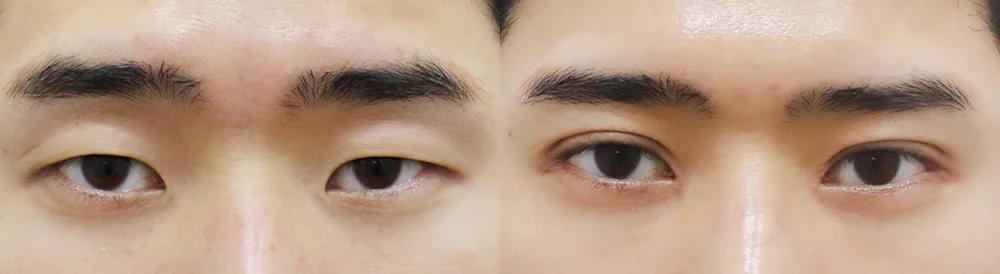
Both eyes from the front: no crease, with thick upper lids sitting low toward the lashes
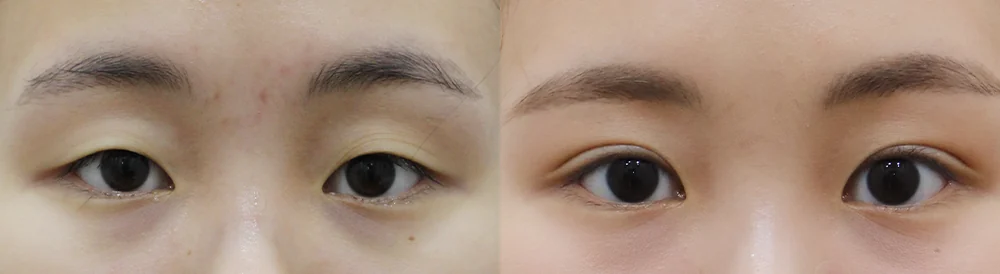
Both eyes from the front: full upper lids with no visible crease
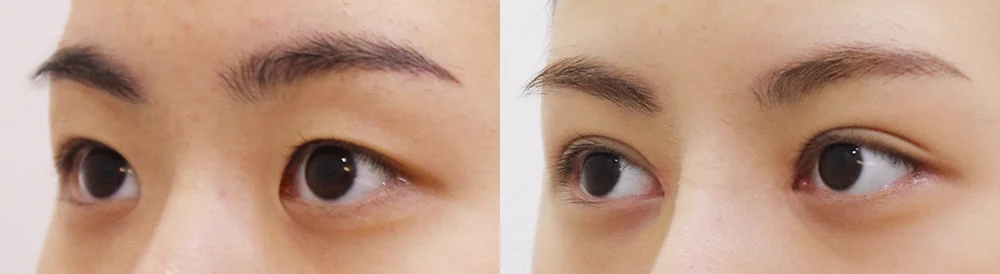
Both eyes seen from an angle
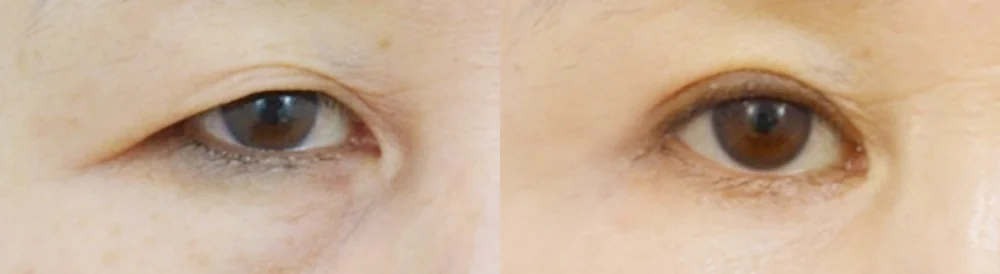
One eye up close: upper lid skin hanging down toward the lash line
* Results vary from person to person. Side effects are possible, so please decide after a thorough consultation with a doctor.
Frequently asked questions
Can the surgical method be decided from photos alone?
Photos show the crease height, differences between the sides and how much the lid covers the iris quite well. However, eye-opening strength can only be judged by moving the eyes up and down with the brow held still, and skin thickness and fat have to be felt.2 So a photo consultation narrows down the options, and the method and extent are decided after an in-person examination in Seoul.
Can I have surgery the day after I arrive in Seoul?
Under the BAAPS advice, which places the in-person consultation at least 48 hours before surgery, an examination on the day you arrive followed by surgery the next day would be sooner than advised.1 BAAPS also advises time to think between the two consultations.1 The actual order depends on your eyes and on preparation, so if your schedule is tight, tell us at the photo consultation stage. Our guide to your first consultation in Seoul explains the first visit in more detail.
Can I fly home before the stitches come out?
The usual advice is to include stitch removal and a wound check in your time in Seoul.1 The day stitches come out depends on the method, so it is set with the date of surgery. If you must leave earlier, arrange in advance who will remove them near home, and take a record of the operation with you.
Only one eye droops. Can just that side be corrected?
If only one side is corrected, the other lid can appear to drop. This happens because the effort both eyes were making to lift the drooping side eases off.2 At the examination, the other eye's height and movement are therefore checked as well, before deciding whether to operate on one side or on both.
Is the schedule for lower eyelid fat repositioning the same?
The overall order is the same. At Bonita Clinic, however, lower eyelid fat repositioning is done from the inside of the lid, so there is no incision line on the skin and there are no stitches. However, if lower eyelid skin excision is added because the skin under the eyes is loose, that involves a skin incision and may mean stitches, so the schedule is then planned again at consultation. It is done under sedation, and you go home the same day. How long swelling takes and the follow-up schedule are explained at consultation and differ from person to person. Spending the first 24 hours near the clinic applies here as it does to other eye surgery.4
What to prepare before your consultation
- Front photo (with the light reflex visible), eyes closed, looking up and down, and both 45-degree views
- What bothers you: the crease, heavy lids, puffy under-eyes, differences between the sides
- Dates and methods of any previous eye surgery or procedures, and photos from before the first surgery
- Medicines and supplements you take, and conditions such as high blood pressure
- Whether you wear contact lenses
- How long you can stay in Seoul, your flight home, and when you could come back
- What you want to change and what you want to keep
Bonita Clinic is on the 3rd floor of 565 Gangnam-daero, Seocho-gu, Seoul, about 100 m on foot from Exit 8 of Nonhyeon Station (Line 7). You can read more on our Eye Surgery, Lower Eyelid Fat Repositioning and Upper Blepharoplasty pages. The differences between methods are explained in our guide to double eyelid, canthoplasty and ptosis surgery, and home care in our aftercare guide.
References (6)
Sources that support the explanations in this article. Study findings describe general trends and do not guarantee individual results.
- British Association of Aesthetic Plastic Surgeons (BAAPS). BAAPS Cosmetic Tourism Guidelines. . 2023;September 2023 v1.BAAPS guidance for patients having surgery abroad (full document, expert opinion): two consultations before surgery, at least one in person and ideally two weeks apart, the in-person one at least 48 hours before surgery; three surgery groups with advice on stay for travel of about 4 hours or more (Group 1 nothing extra; Group 2 arrive 72 hours before, stay 1–2 weeks; Group 3 arrive 1 week before, stay 2–4 weeks); aisle seat, fluids, moving in flight, stockings; stitch removal booked before discharge, a surgeon's review before travel, follow-up at 1–2 weeks and 6 weeks–6 months
- Bacharach J, Lee WW, Harrison AR, Freddo TF. A review of acquired blepharoptosis: prevalence, diagnosis, and current treatment options. Eye (Lond). 2021;35(9):2468-2481.doi:10.1038/s41433-021-01547-5Review of acquired ptosis (full text): MRD1 (light reflex to upper lid edge, normally 4–5 mm), lifting loose skin to exclude pseudoptosis, levator function measured with the brow held from downgaze to upgaze (0–4 mm poor, 5–11 fair, 12–14 good, over 15 normal), forehead compensation, Hering's phenomenon after one-sided surgery, 8.7% revision among 1,519 ptosis operations (6.8% posterior, 9.5% anterior approach), and contact lens wear as a factor. The authors declared ties to eye-drop makers; eye-drop content was not used
- Choi CJ, Chou JC, Lefebvre DR, Yoon MK. Margin Reflex Distance: Differences Based on Camera and Flash Positions. Ophthalmic Plast Reconstr Surg. 2016;32(3):199-203.doi:10.1097/IOP.0000000000000456Prospective measurement study of 16 people (32 eyes) without eye disease (abstract): MRD1 from ring-flash DSLR, point-and-shoot and smartphone photos did not differ significantly from clinical measurement; a pop-up flash DSLR differed by about 0.7 mm. Cameras with a near-coaxial light source come closest; small sample with normal lids
- Hass AN, Penne RB, Stefanyszyn MA, Flanagan JC. Incidence of postblepharoplasty orbital hemorrhage and associated visual loss. Ophthalmic Plast Reconstr Surg. 2004;20(6):426-432.doi:10.1097/01.iop.0000143711.48389.c5Survey of American Society of Ophthalmic Plastic and Reconstructive Surgery members (abstract): 237 surgeons, 269,433 cosmetic eyelid operations; 149 orbital hemorrhages (0.055%, about 1 in 2,000) and 12 in which vision did not recover (0.0045%, about 1 in 22,000, corrected figure). Most within the first 3 hours, risk much lower after 24 hours but possible days later; common factors were high blood pressure, aspirin, vomiting and increased activity. Limited by recall
- Liu J, Fan W, Guo Y, et al. Eyelid edema reduction following blepharoplasty: a 3D imaging-based pilot study on the efficacy of Hilotherapy. Quant Imaging Med Surg. 2025;15(10):9170-9178.doi:10.21037/qims-2025-832Randomized split-face pilot at the University of Cologne (full text): 23 people (mean age 65) with upper blepharoplasty under local anesthesia, one eye cooled at 17°C for 1 hour. 3D imaging with the 3-month appearance as reference: uncooled side 1.13, 1.40 and 0.45 cm² added area right after, at 24 hours and at 2 weeks; cooled side less swollen at first, no difference at 2 weeks. Bruising not measured; older Western adults only
- Liu J, Wu J, Zeng X, et al. Patient-Specific Factors for Deformity after Upper Blepharoplasty in an Asian Population. Plast Reconstr Surg. 2025;155(2):275e-287e.doi:10.1097/PRS.0000000000011425Analysis of 202 upper eyelid revision patients at one hospital in China (abstract, evidence level III): most common deformities were asymmetric, disappeared, shallow and low creases; epicanthal fold, thick upper lid skin, weak levator, age over 30 and a short eye–brow gap before the first surgery were linked to them
About this article
This article separates general medical information from Bonita Clinic's own approach. Because the right decision depends on each person's condition, it is not a substitute for a consultation.