KOKorean
 ENEnglish
 JP日本語
 CN中文(简体)
 TW中文(繁體)


Swelling and Bruising After Facial Surgery in Seoul: How Long They Last and How to Reduce Them
Swelling is usually worst a day or two after surgery rather than straight afterwards, falls sharply over the first few weeks, and a thin layer of residual swelling can last for months depending on the area. In an upper eyelid surgery study, of the times measured, swelling was largest the next day, and about a third of it remained at two weeks; in a rhinoplasty study measured from 1–2 weeks after surgery, about two-thirds had gone by one month and 95% by six months. A facelift lifts tissue over a wide area, so the lymph drainage that carries fluid away can take months to recover. Keeping your head above your chest and using cold compresses for the first day or two can help limit early swelling and bruising, but if swelling on one or both sides suddenly grows and becomes hard and painful, contact the clinic right away.
Curious about your own case? Ask us online →
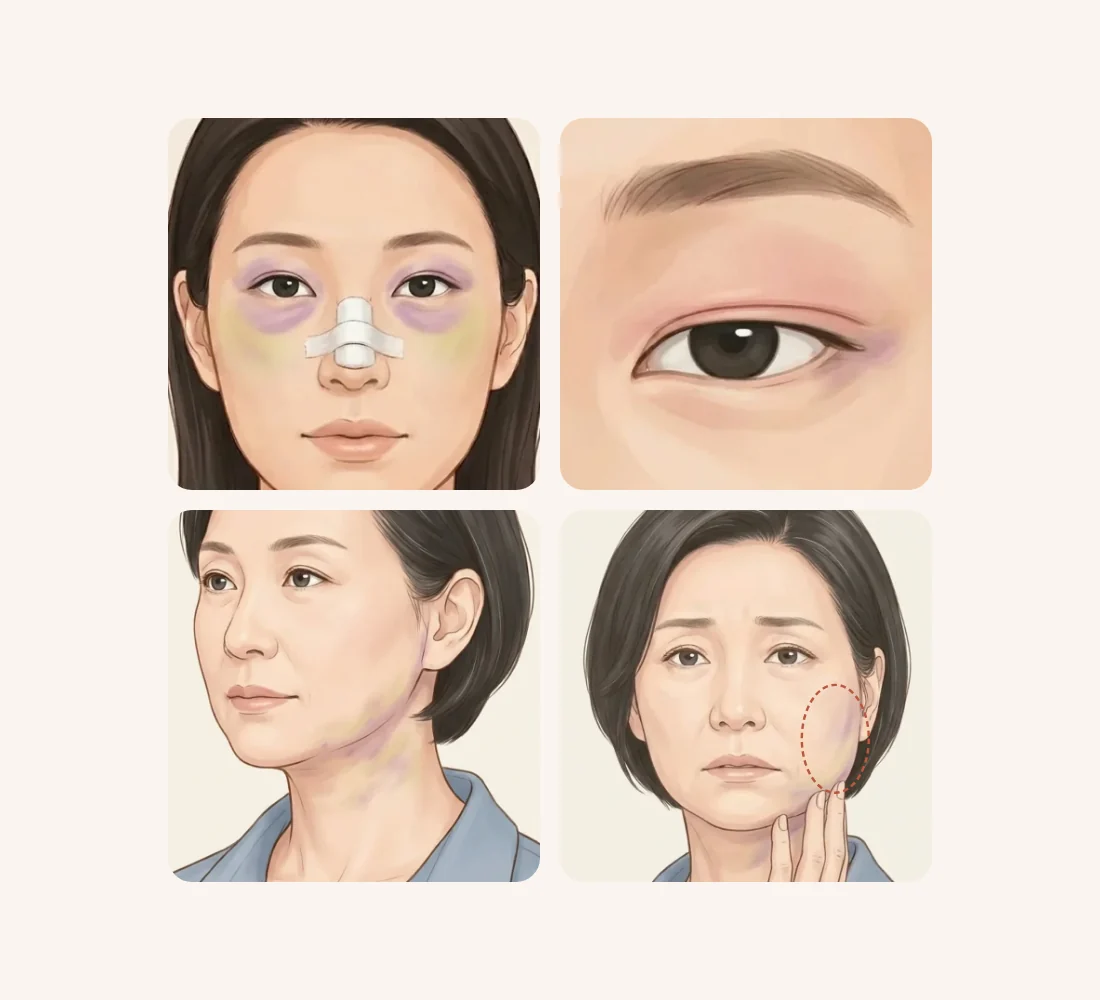
Why do swelling and bruising happen after facial surgery?
Almost everyone has some swelling and bruising after facial surgery. The two often come together, but they happen for different reasons.
- Swelling: when tissue is injured during surgery, the body sends extra blood to the area to start healing. Fluid leaks out of the tiniest blood vessels (capillaries) and collects between the tissues. That pooled fluid is what makes the area puff up.
- Bruising: blood from small vessels opened during surgery spreads under the skin. It looks purple at first, then turns greenish and yellowish and fades as the body gradually absorbs it.
Fluid that has collected between the tissues is carried away by lymph vessels. These are very fine channels that run alongside the blood vessels. They collect fluid from the tissues and return it to the bloodstream, a little like a drainage system. When surgery lifts and separates a wide area under the skin (this is called dissection), these channels are interrupted for a while too.
A small study followed the lymph drainage of three women from before their facelift until a year afterwards. Each had a different facelift technique, and in all three the drainage was interrupted to a similar degree. Most of it returned within three months, and it was back to the pre-surgery pattern after six months.3 The authors concluded that how widely the tissue is dissected, more than how deep, is probably what matters most for swelling.3 Put simply, the larger the area that was lifted, the longer it takes for the drainage routes to open up again.
Blood and fluid also sink with gravity. That is why swelling and bruising often show up a little below the operated area. Puffy, bruised lower eyelids after nose surgery are a typical example, and studies describe them as a normal part of recovery after rhinoplasty.5 Bruising around the eyes is especially common when the nasal bones are reshaped or cut (osteotomy), and the way the bones are handled can change how much swelling and bruising there is.4 After a facelift, bruising can travel from the lower cheeks down to the jawline and neck.
When is swelling at its worst, and when does it go down?
Many people are surprised when they look in the mirror the morning after surgery: the face often looks more swollen than it did straight after the operation. Swelling after surgery is generally reported to peak between 24 and 72 hours.2 In a study that measured the eyelids of 23 people with 3D photographs after upper eyelid surgery, swelling was greater the next day than immediately after surgery.2 So looking puffier on the second day is a common part of recovery.
After that peak, swelling starts to settle. It goes down noticeably over the first two weeks and more slowly after that. The last thin layer of swelling, often called residual swelling, can last several months depending on the area. The timeline below sums up the general pattern from the research. The timings are averages, and they shift earlier or later depending on the extent of surgery and on you.
The general course of swelling after facial surgery
- Day of surgerySwelling and bruising start to build · rest with your head up
- Days 1–3Often the worst point · cold compresses for the first day or two
- Weeks 1–2Visible swelling falls sharply · stitches and check-ups
- Months 1–3Thin residual swelling fades bit by bit · facelift lymph flow mostly back
- Months 6–12Remaining swelling fades very slowly · nose 97.5% by 1 year
Bruises are darkest in the first few days, then change color and fade. They can sometimes look larger as they move downward, which is also a common part of being absorbed. However, in the sources reviewed for this guide we did not find reliable studies comparing how long bruising lasts after each type of operation, so we have not put a number on it.
How does swelling go down after eyelid surgery, rhinoplasty and a facelift?
Even within facial surgery, swelling settles differently depending on the area. Three studies that measured it in different ways show the differences clearly.
Eyelids: bigger the next day than right after surgery, much smaller by two weeks
One study used 3D photographs to measure the eyelid area of 23 people (average age 65) after upper eyelid surgery. The researchers took the appearance at three months as the settled baseline and measured how much larger the eyelids were right after surgery, the next day and at two weeks. On the side that received no extra treatment, the eyelid area was on average 1.13 cm² larger right after surgery and 1.40 cm² larger the next day, and this fell to 0.45 cm² at two weeks.2 Of the times measured, the next day was the largest, and about a third of the next-day swelling was still there at two weeks. The study cannot tell us which day in between was truly the worst. It also looked at upper eyelid surgery in people with an average age of 65, so the pattern may differ for double eyelid surgery, eye-corner procedures, younger eyes, or lower eyelid fat repositioning done through the inside of the eyelid, and bruising was not measured.2 Upper eyelid surgery itself is covered in our upper blepharoplasty guide.
Nose: two-thirds in the first month, a little still left at one year
A university research team in the United States measured nose volume repeatedly with 3D photographs in 40 people after their first open rhinoplasty. Taking the volume at 1–2 weeks after surgery as the starting point and calculating from a curve fitted to the pooled measurements, about two-thirds of the swelling resolved within the first month, 95% by six months and 97.5% by one year.1 The nose volume eventually levelled off at 84.4% of its 1–2-week volume.1 Put simply, a little over 15% of the nose's volume at 1–2 weeks was swelling, and about 2.5% of that swelling was still there at one year, fading very slowly. Our dorsal hump surgery guide explains more about nasal structure and technique.
Facelift: wider dissection, longer recovery of drainage
A facelift lifts the skin and the SMAS (a thin but tough layer connected to the facial muscles) over a wide area. That is why swelling and bruising spread across the lower cheeks, the jawline and the neck. In the lymph study above, drainage was interrupted with every technique, mostly returned within three months, and was back to normal after six months.3 Because it was a preliminary study of only three people, it cannot tell us that everyone recovers at the same pace.
The three studies used different measurements and different starting points, so their numbers cannot be compared directly, as in "the nose stays swollen so many times longer than the eyelids." The overall pattern is the same, though. Swelling is worst in the first few days, falls sharply over the first few weeks, and the last residual swelling fades over months.
Where do swelling and bruising show after each operation?
Where swelling and bruising appear depends on the area operated on and on the direction in which blood and fluid sink. The four scenes below are the ones people most often see in the mirror after surgery. The first three are common parts of recovery; the last is a sign to contact the clinic right away.
What it can look like after each operation
1Swollen, bruised lower eyelids after nose surgery
Blood and fluid from around the nose have sunk downward, which is common. Keep your head up and use cold for the first day or two
Common
2Puffy eyelids that make the eyes look smaller
In an upper eyelid study, swelling was bigger the next day than right after surgery and much smaller at two weeks
Common
3Bruising that has spread to the jawline and neck
A wide area was lifted, so it spreads widely downward; residual swelling fades over months
Common
4One side keeps swelling and feels hard and painful
This can be a hematoma (collected blood), so do not wait: contact the clinic right away
Call now
When several areas are treated in one session, the swelling overlaps. For example, if the eyelids and nose are operated on together, swelling from both can gather around the eyes. Swelling can also settle at slightly different speeds on each side, so the face may look uneven for a while. That is why the final shape is judged only after the swelling has settled well.
Why do some people swell more, or for longer?
Two people having the same operation can swell quite differently. In the eyelid study above, next-day swelling averaged 1.40 cm², but its standard deviation (how widely values spread around the average) was 1.06 cm², almost as large as the average itself, so people differed a lot.2 The conditions that make swelling larger or longer-lasting fall into three groups.
- Extent of surgery: the wider the dissected area, the longer lymph drainage takes to return.3 Combining several operations makes the swelling overlap.
- Surgical technique: a systematic review (a study that gathers all relevant research by a set method) pooled 29 randomized controlled trials (studies that divide patients into groups at random) of eyelid and periocular surgery. Techniques that preserve blood vessels reduced swelling and hematoma, and removing skin only led to less swelling than removing skin and muscle together.6 A systematic review of 50 rhinoplasty studies found that nasal packing (material placed inside the nose) and lifting the periosteum (the membrane covering bone) before cutting the nasal bones increased swelling and bruising.4
- Medicines and habits that affect bleeding: aspirin, anti-inflammatory painkillers and some supplements and herbal products make bleeding harder to stop and can make bruising larger. Smoking and alcohol also affect healing. Which items to pause, and when, is covered in our guide to medicines, supplements, smoking and alcohol before surgery.
What actually helps reduce swelling and bruising?
There is not much you can do once surgery is over, but how you spend the first few days clearly makes a difference. The two measures supported by research are keeping your head raised and using cold compresses for the first day or two.
Keep your head above your chest
A systematic review of 50 studies on reducing swelling and bruising after nose surgery found agreement across the literature that raising the head after surgery reduces both.4 When your head sits higher than your chest, less blood and fluid pool in the face, and fluid that has collected can drain downward more easily. Stacking pillows so they support your back and head together keeps your neck from bending at an awkward angle. For the first while, avoid lying face down or on the side that was operated on.
Use cold compresses for the first day or two
Cold helps most in the early phase, while swelling is still building. A meta-analysis (a study that pools the results of several studies and recalculates them) of 11 trials and 627 patients after nose surgery found less eyelid swelling and bruising during the first 24 hours in people who used cold compresses.5 In the eyelid study mentioned earlier, the eyelid that received a cooling mask set to 17°C for one hour was less swollen right after surgery and the next day, but by two weeks there was no difference.2 A review of randomized trials in eyelid and periocular surgery also describes cold compresses as offering short-term relief.6 That said, researchers note that the effect of methods with unsteady temperatures, such as ice packs, is still debated.2 In short, cold is for keeping swelling from building up in the first day or two; it is not a way to remove residual swelling weeks later.
When you use cold, keep a few things in mind:
- Wrap ice or a frozen pack in a thin towel. Ice placed straight on the skin carries a risk of frostbite.2
- After nose surgery, apply it lightly around the eyes and cheeks so it does not press on the nose.
- How many minutes at a time, and how many times a day, depends on the area operated on, so follow the instructions you are given.
Medicines and supplements: ask before you take anything
Many supplements are said to bring swelling down, but the research is mixed. Arnica, from a plant in the daisy family, reduced eyelid swelling and bruising over the first seven days in a meta-analysis of nose surgery.5 A review of eyelid and periocular surgery, however, found no clear benefit from either arnica or bromelain (an enzyme from pineapple).6 There is also research on medicines surgeons may give during surgery. In the rhinoplasty literature there is agreement that steroids reduce swelling and bruising,4 and in periocular surgery tranexamic acid, which helps blood clot, was the most consistently effective option for reducing bruising.6 Whether any of these is used is decided by your medical team, based on the type of surgery and your health. Please ask first before taking any new medicine or supplement on your own.
Ways to reduce swelling and bruising: what studies found
| Method | What studies found | Good to know |
|---|---|---|
| Keeping the head up | Agreement in the nose-surgery literature that it reduces swelling and bruising | Prop up back and head together; don't press on the operated side |
| Cold compresses | Nose: less swelling and bruising in the first 24 hours / Eyelids (cooling mask): less right after and the next day, no difference at 2 weeks | First day or two · ice wrapped in a towel |
| Supplements such as arnica | Nose: less swelling and bruising over the first 7 days / Eyelids: no clear benefit | Mixed results · ask your doctor before taking them |
| Nasal taping | Higher patient satisfaction after nose surgery | How and how long to tape follows your instructions |
When is lingering swelling normal, and when should you call?
Residual swelling that lingers in small amounts for months is usually a normal part of recovery. As in the studies above, the last few percent of nasal swelling is still there after six months,1 and lymph drainage after a facelift can take around six months to return to normal.3
The following, on the other hand, are signs to act on rather than wait out.
How do your swelling and bruising look now?
- Both sides similar, a little better each dayKeep following your aftercare instructions
- One or both sides suddenly grow, feel hard, with more pain or pressureContact the clinic right awayTo check for a hematoma
- Fever, redness or dischargeBe seen right awayTo check for infection
- Blurred vision or severe eye pain after eye surgeryBe seen without delayTo check for bleeding behind the eye
- Swelling that suddenly grows: if swelling on one side, or on both, suddenly or steadily gets bigger and harder, with more pain or a feeling of pressure, blood may be collecting under the skin (a hematoma). It is easiest to notice when only one side grows, but both sides growing together counts too. A hematoma is better found and treated early.
- Neck swelling with trouble breathing or swallowing: if your neck swells quickly and breathing or swallowing becomes difficult, especially after surgery that reaches under the jaw and into the neck such as a facelift, do not wait: get emergency care right away.
- Fever, redness or discharge: if swelling that was going down gets worse again, with fever, redness or discharge, infection needs to be checked.
- Vision changes after eye surgery: if your vision blurs, your eye hurts badly or it feels as if the eye is being pushed forward after eye surgery, be seen without delay. Recovery after eye surgery is also covered in our lower eyelid fat repositioning guide.
Taking photos of your face from the front and both sides every day, in the same light and at the same angle, makes it easier to notice differences between the sides and how quickly things are settling. These photos are also useful when you contact the clinic.
How we approach it at Bonita Clinic
Bleeding, infection, inflammation and other side effects may occur after surgery, so the actual surgical plan and recovery schedule are set after an in-person examination.
Treatment options you can discuss in Seoul
Bonita Clinic has treated patients at the same location since opening in 1995, with Dr. Kwang-Seop Jung seeing patients throughout. Operations on our treatment pages that relate to this guide include:
- Face Lift: the SMAS (fascia) layer is lifted and fixed through short incisions with an endoscope; jaw liposuction, stem cell fat grafting or dissolvable threads are added only when needed
- Full Rhinoplasty: the bridge, tip, alar base and nasolabial angle are planned together for facial balance
- Lower Eyelid Fat Repositioning: fat that bulges forward is moved into the hollow below it through the inside of the eyelid
The studies above did not look at these exact procedures, so your own recovery is planned after an examination, together with which operation suits you.
Why do the plan, recovery time and cost differ?
Two people asking about what sounds like the same operation can need quite different plans. What shapes the plan, the recovery time and the cost is mainly the following.
- Which areas are treated: eyelids, nose, face and neck
- How widely tissue needs to be lifted
- Added treatments: jaw liposuction, fat grafting, threads
- Anesthesia and whether you stay overnight
- Previous surgery or fillers in the same area
- Health conditions and medicines that affect bleeding
Final plan and quote after an in-person exam
A final estimate is given only after an in-person examination, once the extent of surgery is clear. Photos help narrow down the options, but how much needs to be done, and therefore how long recovery is likely to take, is settled at the examination.
What can photos show, and what needs an in-person exam?
For a topic like swelling and recovery, a good deal can be talked through in advance. Some things, though, can only be judged by examining you in person.
Photos and messages can show
- The area you want changed, front and side
- How you bruised or swelled after past procedures
- Your important dates and travel window
- Daily recovery photos after you return home
Needs an in-person exam
- Skin, tissue and how much needs lifting
- Bleeding risk, blood pressure and medicines
- Wound healing and stitches
- Swelling that is one-sided, hard or painful
Before your visit, it helps to send clear photos of the area you would like changed from the front and both sides, along with any past procedures, how you bruised or swelled after them, the medicines and supplements you take, and the dates you need to be presentable again. You can send us a message with your photos and questions before planning your trip to Seoul. Our guide on taking photos for an online consultation explains which photos help most.
Planning important dates, your stay in Seoul and the trip home
What is confirmed in advance is the treatment information on our pages: a face lift under general anesthesia or sedation with a one-night stay (same day if stable) and stitches; full rhinoplasty under sedation or general anesthesia with same-day discharge and stitches; and lower eyelid fat repositioning under sedation with same-day discharge and no stitches to remove. How long you should stay in Seoul, when stitches come out and how many follow-up visits you need depend on the extent of surgery and how you recover, so these are planned together with you at consultation.
What the research says about timing can help you plan around it:
- Swelling is usually worst between 24 and 72 hours after surgery,2 so it makes sense to keep the first few days free for rest rather than sightseeing or meetings.
- After upper eyelid surgery, about a third of the next-day swelling was still present at two weeks,2 and after rhinoplasty about two-thirds of the swelling had gone at one month.1 Many people therefore still have some visible swelling when they travel home, and that is common.
- Cold compresses help mainly in the first day or two,25 so they matter less later in your trip.
- For events where your face will be photographed, such as a wedding or a presentation, leave more room than you would for everyday life, and tell us the dates at consultation.
If your trip home involves a long flight, our guides on flying after a facelift and flying after rhinoplasty explain what to consider. After you return home, keep taking daily photos in the same light and at the same angle, and contact a doctor promptly if swelling suddenly grows on one or both sides, becomes hard or more painful, or if you develop a fever or discharge. Our guide to aftercare once you are back home covers this stage in more detail.
Real treatment cases
These before-and-after cases are from our treatment pages. The time since surgery differs between cases, and results vary from person to person.
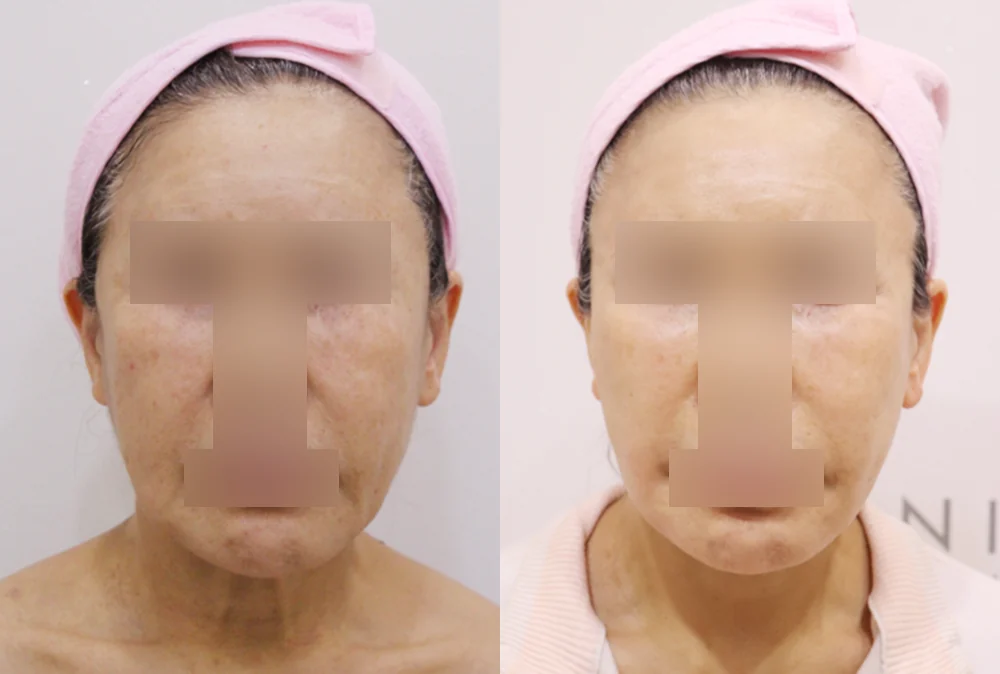
Lower cheeks, jawline and neck from the front (face lift)
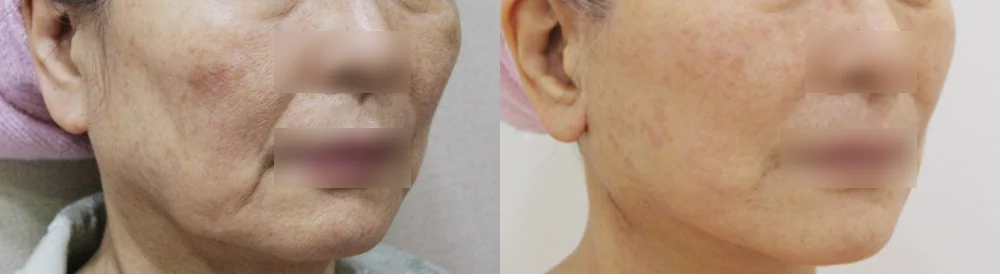
Cheek and jawline seen close up from in front of the ear (face lift)
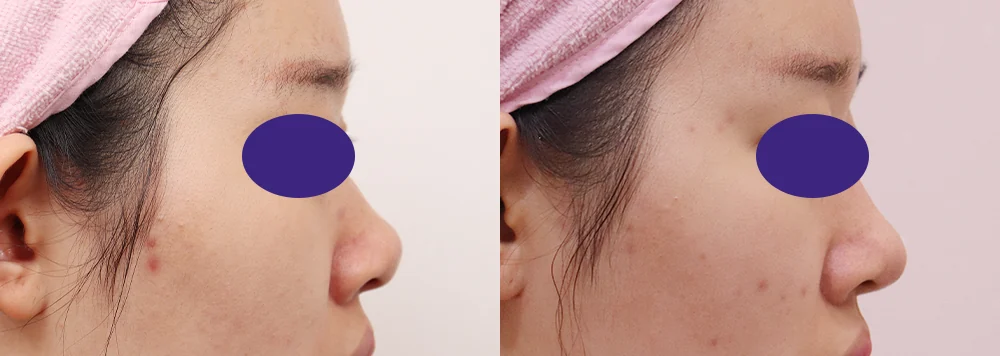
Bridge and tip in profile (full rhinoplasty)
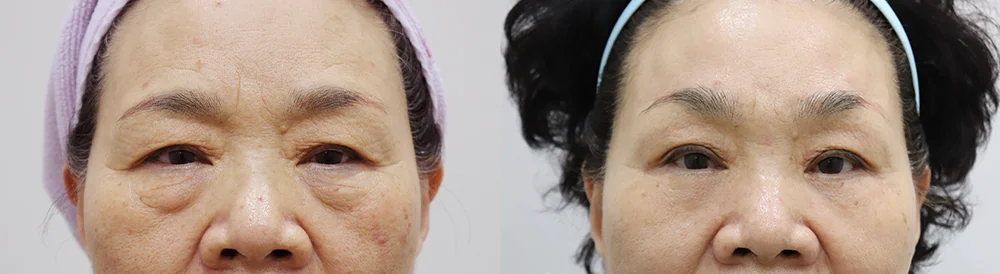
Under-eye area from the front (lower eyelid fat repositioning)
* Results vary from person to person. Side effects are possible, so please decide after a thorough consultation with a doctor.
Frequently asked questions
Is the shape right after surgery the final shape?
No. Right after surgery and for the first few weeks, what you see includes swelling. In the rhinoplasty study, a little over 15% of the nose's volume at 1–2 weeks was swelling, and about 2.5% of that swelling was still there at one year, fading very slowly.1 If swelling settles at different speeds on each side, the face can also look uneven for a while. That is why the shape is judged after the swelling has settled well.
One side is more swollen than the other. Is that normal?
Some difference between the two sides is common. If both sides are improving a little each day, it is usually enough to keep watching. But if one side keeps getting bigger, harder and more painful, it may be a hematoma, so contact the clinic right away. The same applies if both sides suddenly swell together, and if your neck swells and breathing or swallowing becomes difficult, get emergency care right away.
How long should I use cold compresses, and when can I switch to warm ones?
In studies, the benefit of cold showed mainly from right after surgery through the first and second day.25 By two weeks there was no difference between eyelids that had been cooled and those that had not.2 So concentrate on the first day or two, then follow your instructions. Always wrap ice in a towel. In the sources reviewed for this guide, we did not find studies comparing when to switch from cold to warm compresses or what warm compresses achieve. This depends on the area and how you are healing, so follow your instructions for warm compresses too, and do not apply heat on your own while the area is swollen and feels warm.
How should I sleep after facial surgery?
Stack pillows to support your back and head together, and lie at a slope so your head is higher than your chest. Raising the head is a method on which the nose-surgery literature agrees for reducing swelling and bruising.4 For the first while, avoid sleeping face down or on the side that was operated on.
Do arnica, bromelain or other supplements reduce swelling?
The evidence is mixed. Arnica reduced eyelid swelling and bruising over the first week in a meta-analysis of nose surgery,5 but a review of eyelid surgery found no clear benefit from arnica or bromelain.6 Some herbal products and supplements can also affect bleeding, so talk to your medical team before starting anything new around the time of surgery.
What to prepare before your consultation
- The dates of important events where your face will be seen (weddings, photo shoots, work trips)
- The names and doses of the medicines, supplements and herbal products you take, especially aspirin, anti-inflammatory painkillers and blood thinners
- Whether you bruised easily or stayed swollen for a long time after past surgery or procedures
- Whether you have high blood pressure and whether you smoke
- Any other areas you would like treated at the same time (combining areas makes swelling overlap)
- Your available dates in Seoul and when you need to be back home
Bonita Clinic is on the 3rd floor of 565 Gangnam-daero, Seocho-gu, Seoul, about 100 m on foot from Exit 8 of Nonhyeon Station (Line 7). You can read more on our Face Lift, Full Rhinoplasty and Lower Eyelid Fat Repositioning pages. For which kinds of sagging call for a facelift and what recovery involves, see the facelift guide; for materials and tip support in nose surgery, see the full rhinoplasty guide.
References (6)
Sources that support the explanations in this article. Study findings describe general trends and do not guarantee individual results.
- Pavri S, Zhu VZ, Steinbacher DM. Postoperative Edema Resolution following Rhinoplasty: A Three-Dimensional Morphometric Assessment. Plast Reconstr Surg. 2016;138(6):973e-979e.doi:10.1097/PRS.0000000000002760Retrospective 3D study (abstract) of 40 primary open rhinoplasty patients and 146 photos: measured from the volume at 1–2 weeks, about two-thirds of swelling resolved in the first month, 95% by 6 months and 97.5% by 1 year, with nasal volume levelling off at 84.4%
- Liu J, Fan W, Guo Y, et al. Eyelid edema reduction following blepharoplasty: a 3D imaging-based pilot study on the efficacy of Hilotherapy. Quant Imaging Med Surg. 2025;15(10):9170-9178.doi:10.21037/qims-2025-832Randomized within-patient pilot study (full text) of 23 upper blepharoplasty patients (mean age 65), one eye cooled with a 17°C mask for 1 hour: with 3 months as baseline, untreated eyelid area increase was 1.13 cm² right after surgery, 1.40 cm² the next day and 0.45 cm² at 2 weeks; the cooled side was less swollen right after surgery and the next day but not at 2 weeks. The paper cites earlier research that swelling peaks at 24–72 hours and notes unstable temperatures and frostbite risk with ice packs
- Meade RA, Teotia SS, Griffeth LK, Barton FE. Facelift and patterns of lymphatic drainage. Aesthet Surg J. 2012;32(1):39-45.doi:10.1177/1090820X11430683Preliminary lymphoscintigraphy report (abstract) of 3 facelift patients with different techniques: lymph drainage was interrupted to a similar degree, mostly recovered within 3 months and returned to baseline after 6 months; the authors conclude the extent of dissection matters more than its depth
- Ong AA, Farhood Z, Kyle AR, Patel KG. Interventions to Decrease Postoperative Edema and Ecchymosis after Rhinoplasty: A Systematic Review of the Literature. Plast Reconstr Surg. 2016;137(5):1448-1462.doi:10.1097/PRS.0000000000002101Systematic review (abstract) of 50 studies on reducing swelling and bruising after rhinoplasty: consensus that steroids, controlled low blood pressure during surgery, intraoperative cooling and postoperative head elevation reduce them, while nasal packing and periosteal elevation before osteotomy increase them
- Lee HS, Yoon HY, Kim IH, Hwang SH. The effectiveness of postoperative intervention in patients after rhinoplasty: a meta-analysis. Eur Arch Otorhinolaryngol. 2017;274(7):2685-2694.doi:10.1007/s00405-017-4535-6Meta-analysis (abstract) of 11 trials and 627 rhinoplasty patients: periorbital swelling and bruising are normal after rhinoplasty; cold compresses reduced eyelid swelling and bruising in the first 24 hours, arnica over the first 7 days, taping raised satisfaction and nasal packing was linked to more bruising; more trials are needed
- Alamoudi A, Albishry AM, Alnabihi AN, et al. Interventions for reducing bleeding and swelling in eyelid and periocular surgeries: a systematic review of randomized controlled trials. Orbit. 2025;44(6):913-927.doi:10.1080/01676830.2025.2581622Systematic review (abstract) of 29 randomized trials and 2,287 eyelid and periocular surgery patients: tranexamic acid most consistently reduced bruising, vessel-preserving techniques reduced swelling and hematoma, skin-only excision caused less swelling than skin-muscle excision, cold compresses gave short-term relief, and arnica and bromelain showed no significant benefit
About this article
This article separates general medical information from Bonita Clinic's own approach. Because the right decision depends on each person's condition, it is not a substitute for a consultation.