KOKorean
 ENEnglish
 JP日本語
 CN中文(简体)
 TW中文(繁體)


Double Eyelid Revision in Seoul: When to Redo a Loosened or Uneven Crease
A double eyelid revision is usually done once the tissue has settled after the previous surgery, after first working out why the crease loosened or became uneven. No guideline sets the timing: one oculoplastic surgeon suggests touch-ups for his own patients 6 to 12 months after surgery, and a review cites waiting up to 6 to 9 months before any revision. If a suture pulls or the eye keeps stinging or feels gritty, see a doctor without waiting. The method depends on whether the fixation loosened, the lid is puffy, the crease was set too high or eye opening is weak, and you can send photos and details of your previous surgery to see which approach may fit before planning a visit to Seoul.
Curious about your own case? Ask us online →

What does a "loosened" or "uneven" double eyelid actually mean?
After double eyelid surgery, some people feel that the crease "has come undone" or that their eyes "don't match." These sound like one problem, but they usually describe a few different situations:
- A loosened crease: the fold that forms when the eye opens has become shallow, broken in the middle, or has almost disappeared.
- An uneven crease: the height, depth or shape of the crease differs between the two eyes.
- A crease set too high: a wide, thick band of lid skin shows above the lashes, which can look sleepy or unnatural.
- A sleepy-looking eye: there is a crease, but the upper lid covers much of the iris, so the eye looks less open.
An oculoplastic surgeon in the United States (an ophthalmology-trained surgeon who specializes in eyelid surgery) reviewed 362 of his own Asian blepharoplasty cases over 12 years. Sixty-seven of them were revisions of surgery done elsewhere. Of these revisions, 51% were for a crease that had never formed or had disappeared, 34% were to lower a high crease, and 15% were to raise a low one.1 In plain terms, people seek a revision for two main reasons: the crease is gone, or its height is wrong. The author describes lowering a crease as the harder of the two.1
When the eyes look uneven, the first step is to separate *what* is different. Often it is not only the crease: the height of the lid margin or of the eyebrow may differ as well.
Which situation looks like yours?
The same word, "loosened," can hide different causes, and each cause changes how the revision is done. These are the four situations a revision consultation usually separates first.
Four things to separate when a crease looks wrong
1The fold has become shallow or broken
Check whether the fixation has loosened, then decide between re-suturing and an incision
Re-making the link
2Thick skin or fat covers the crease
Whether to reduce the tissue pressing down is considered along with re-making the link
Fat and tissue reduction
3The crease is high, with thick skin below it
Release the adhesion and re-link lower; how much skin is left is key
Lowering the crease
4There is a crease, but the lid covers the iris
Eye-opening strength is checked before the crease
Ptosis correction
In practice, two or more often overlap in one eye. For example, when a suture fixation loosens in a puffy eyelid, the crease becomes shallow and the eyes start to look uneven. On the other hand, if skin that has relaxed with age, or a brow that has dropped, now hangs over the crease, the crease has not really come undone; it is being covered. In that case, removing excess skin, as described in our upper blepharoplasty guide, or the approach in the direct brow lift guide, may fit better.
Why does a double eyelid crease loosen?
A double eyelid is the fold that forms when the eye opens. The fold line sits along the upper edge of the tarsal plate (the firm plate just inside the eyelid margin), where fibers from the tendon of the eye-opening muscle (the levator aponeurosis) reach toward the skin.1 Double eyelid surgery creates this link. The buried-suture method (non-incisional surgery) makes the link with sutures without a long skin incision, while the incisional method opens the skin and joins the tissues directly. Where the suture is anchored also varies: some methods anchor it to the tendon side, others to the tarsal plate.2
A crease "loosens" when this link weakens or breaks. There are usually two reasons the link fails: the suture or the healed attachment slackens, or the tissue sitting on top of the link is too bulky for it to hold.
Do puffy eyelids lose their crease more often?
One clinic of a Japanese cosmetic surgery group followed 513 patients for two years after non-incisional double eyelid surgery.2 The researchers defined a "puffy eyelid" as an upper lid that bulges forward because of loose skin, a thick orbicularis muscle (the thin muscle that closes the eye), thick fat beneath that muscle, or protruding fat from inside the eyelid. 54.5% of patients had puffy eyelids, and in these eyelids the risk of losing the crease and needing a revision was about 2.5 times higher.2
The fixation method mattered too. One continuous suture crossing several points and anchored on the tendon side carried a lower risk of crease loss than separate loops tied to the tarsal plate (a hazard ratio of about 0.29, meaning a substantially lower risk). This advantage was larger in puffy eyelids. The surgeon's experience (fewer or more than 100 previous cases) had no independent effect once the other factors were taken into account.2
Put simply, creases were lost more often in puffy eyelids, and the way the suture was placed also made a difference. Keep in mind that this was a look back at one clinic's records, and "crease loss" was defined as the patient feeling the crease had faded and choosing to have a revision. The 131 patients who had other procedures at the same time, such as removal of eyelid fat, were excluded, so the study does not show what reducing fat or tissue achieves.2
Separately, the US surgeon explains that reducing the tissue above the tarsal plate makes it easier for the skin to fold in, and in revisions where a crease had failed to form he also cleared remaining fat.1 Based on this association and this opinion, when a loosened crease in a puffy eyelid is redone, whether to reduce the tissue that presses down is considered along with re-making the link.
Does age make a difference?
Data from the same group were used for a second analysis: 100 cases were sampled from each of six age bands (under 20 up to 60 and over), 600 in total, out of 52,281 two-point buried-suture procedures. Among these 600, revision because the suture had loosened occurred in 22.3%. It was most common under the age of 20 (41%) and least common in people in their thirties (12%). Those aged 60 and over leaned toward a higher risk, but the difference was not statistically significant.3 Because every age band contributed the same number of cases, 22.3% is not the true overall rate of loosening. In the group's 513-patient study, age showed no independent effect, so the two studies do not fully agree.2
The US surgeon mentioned above noted that crease formation was less predictable in patients under 30 than in those over 30. His explanation is that younger eyelids may hold more fat that interferes with crease formation.1
These figures come from one specific method, the two-point buried suture, so they cannot be applied directly to every double eyelid operation. The safer reading is that the risk of a crease loosening can vary a lot with the method and the eyelid.
Why do the eyes end up looking uneven?
After double eyelid surgery, the two eyes can look different for four main reasons:
- The crease height or shape was set differently from the start.
- Only one crease has loosened or become shallow.
- One upper lid droops more than the other.
- Brow height or eyelid thickness already differed between the sides.
The third reason is the easiest to miss. A mild droop that was not obvious before surgery is sometimes called "latent ptosis." The US surgeon points out that weak eye opening and a slightly drooping lid are commonly missed before surgery. A drooping lid covers more of the cornea, and the skin cannot fold in as fully along the crease. For this reason, he recommends correcting even a mild 1–2 mm droop separately before creating a crease.1
In other words, on the side where eye opening is weaker, a crease set at the same height can still fold less and look more covered. Matching only the crease may then leave a difference, so eye-opening strength is measured first. How common asymmetry is as a complaint after a first operation is covered in our double eyelid, canthoplasty and ptosis guide.
What is the problem with a crease set too high?
A high crease widens the strip of lid skin visible above the lashes. When this strip looks thick and puffy, the eyes can appear sleepy or unnatural. The US surgeon explains that placing the crease higher than ideal can cause several problems:1
- Lagophthalmos: the eye no longer closes completely.
- A high crease with asymmetry between the sides.
- A mild secondary droop: the eye-opening muscle has to lift more skin and muscle, and its pull weakens.
He describes the most difficult revision as a high crease with little skin left.1 To lower a crease, skin from above has to come down. If a lot of skin was removed at the first operation, there may not be enough left. In his view, the crease height can be corrected as long as enough tissue remains for the eye to close properly.1
What studies of high-crease revision report
A clinic in Thailand reviewed 213 revisions to lower a high crease over four years. The crease became smaller in almost all of them (98.59%). In the authors' own rating, results were excellent in 51.17%, good in 32.40%, fair in 15.02% and poor in 1.41%.5 The authors named two key steps. The first is advancing the tendon of the eye-opening muscle (bringing it forward and fixing it). The second is placing local tissue or a fat graft between that tendon and the skin above it. Because these eyelids have already been operated on, they stressed the importance of avoiding further injury to the eye-opening muscle.5 This is one center's experience, however, and the level of evidence is low.
A hospital in China treated 90 patients with high creases. The surgeons dissected above the old incision in three planes to release the pull of the scar adhesion (scar tissue sticking layers together). They then brought down a flap of the eyelid's own fat, or grafted fat from the abdomen, so the layers would not stick again. After at least six months, the average crease height had fallen from 11.1 mm to 7.1 mm. 87.8% of patients were satisfied and 12.2% were not. Among the 11 who were dissatisfied, four had a crease that stayed or became high again, three had asymmetric creases, two still had a hollow upper lid and two could not fully close their eyes.6 A history of previous eyelid surgery, coexisting ptosis and a hollow eyelid were identified as factors related to satisfaction.6
The takeaway: a high crease can often be lowered, but the conditions are harder than at the first operation, and remaining skin, hollowness and eye-opening strength all need to be assessed together.
When can a revision be done?
At Bonita Clinic, a revision is performed once the tissue has settled after the previous surgery. Before that, we check whether the crease loosened because of the fixation method, excess skin or the eye-opening muscle.
How the eyes look right after surgery is not the final result. As swelling and bruising settle, the height and depth of the crease can also change. The US surgeon stresses that it is not enough to see whether a crease is present soon after surgery. It is also important to watch whether it shifts, becomes shallow, or whether the lid starts to droop, which can take up to a year of follow-up.1 When his own patients need a touch-up, he encourages doing it 6 to 12 months after the operation.1
No guideline sets a fixed time for revising surgery done elsewhere. A review of Asian blepharoplasty notes that some surgeons recommend waiting as long as 6 to 9 months before any revision, because prolonged swelling can make the eyes look uneven.7 This is the 6 to 9 months mentioned in our double eyelid, canthoplasty and ptosis guide.
How the timing of a revision is decided
- Right after surgeryswollen and bruised; crease height and side-to-side differences are not judged yet
- Weeks to monthswatch whether the crease shifts or fades, or the lid starts to droop
- 6–12 monthsthe period one surgeon suggests for touch-ups on his own patients
- Up to 1 yearfollow-up to see whether crease position and depth settle
The 6–12 months reflects one surgeon's practice with his own patients, and 6–9 months is an opinion some surgeons hold; neither is a rule for every case. Whether the first operation was buried-suture or incisional, how many operations you have had, and how firm the scar is all change the judgment. So rather than simply counting days, the timing is set after examining the current state of the eyelid.
When not to wait
In the following situations, it is better to be examined first rather than waiting for the tissue to settle:
- A suture can be seen or felt in the skin or on the inner side of the lid, or a pulling sensation persists
- The eye keeps stinging or feels gritty, as if sand were in it
- Swelling, pain, redness or discharge is getting worse rather than better
- The eye does not close fully, so it becomes dry and sore
- Severe eye pain, or vision that drops or becomes blurred
A study from Japan reviewed 116 patients (210 eyelids) who had suture-related problems after buried-suture surgery at other clinics. Patients with a pulling sensation showed a linear scar or a depressed deformity. Patients with a stinging eye had chronic inflammation on the inner surface of the tarsal plate, the side that touches the eye.4 The author concluded that these suture-related problems need to be treated by surgically removing the suture. To find the suture, a full skin incision was more reliable than a small one. 89.7% of these patients also had a revision double eyelid procedure at the same time as the suture removal.4
How does the revision method depend on the cause?
A revision is not simply "making a double eyelid again." It is surgery to correct the reason the crease loosened or became uneven. Here are the methods usually considered for each cause:
How a revision changes with the cause
| Cause | Usually considered | Good to know |
|---|---|---|
| Loosened fixation (thin lid) | Re-suturing, or an incision to make a new link | Repeating the same method can let it loosen again for the same reason |
| Puffy eyelid | Re-linking, with fat and thick tissue reduction considered | Removing too much fat can leave a hollow |
| Crease set too high | Releasing the adhesion, re-linking lower, tissue placed between | Little remaining skin limits how far it can come down |
| Weak eye opening | Ptosis correction first or at the same time | Redoing only the crease can leave a sleepy look |
| Suture-related problem | Removing the suture, with a revision if needed | Pulling or a gritty eye should be seen without waiting |
Can the same buried-suture method be used again?
If the eyelid is thin with little fat and only the suture has loosened, re-suturing may be an option. If the eyelid was puffy to begin with, the picture is different: repeating the same method can let the crease loosen again for the same reason. In the 513-patient study, eyelid puffiness was, along with the fixation method, a main factor separating creases that held from those that did not.2 In that case, reducing the fat and tissue that press down, or making a new link through an incision, is considered.
Can an uneven pair be fixed by operating on one eye only?
If the cause lies only in one crease, revising one side may be possible. If the cause is a drooping lid or a difference in brow height, correcting the crease alone may leave a difference. So both eyes are assessed together before deciding what to do and how far to go. As mentioned above, one surgeon recommends correcting even a mild droop before the crease.1
How is a revision different from the first operation?
Conditions in a revision are more demanding than in a first operation. A review devoted to revision describes it as especially challenging when several complications overlap and very little tissue is left, and notes that the causes of complications can be classified systematically.8 In particular:
- Scar tissue: adhesions from the previous surgery blur the layers of skin, muscle, fat and tendon. The adhesions need to be released without injuring the eye-opening muscle.56
- Limited tissue: skin and fat that were removed do not grow back. The amount of skin and fat left sets what can be done.1
- Re-adhesion: if the released layers stick together again, the crease can rise again. Placing fat or tissue between them is one way this is prevented.56
Even after revision, a crease that rises again, asymmetry, a hollow lid or incomplete eye closure have been reported.6 As with any surgery, bleeding, infection, inflammation, swelling and scarring can occur, and recovery and results differ from person to person.
How we approach it at Bonita Clinic
Eye surgery here is performed under local anesthesia or sedation, with same-day discharge, and involves stitches. Recovery time and the number of follow-up visits vary with the extent of surgery and your condition. The actual plan is decided after an in-person consultation.
Revision options you can discuss in Seoul
Bonita Clinic has treated patients at the same location since opening in 1995, and Dr. Kwang-Seop Jung, a board-certified plastic surgeon (Brazil), sees patients himself. For a crease that has loosened or become uneven, what you can discuss at consultation is the approach described on our treatment pages:
- A review of your previous surgery and of why the crease changed: fixation method, excess skin or the eye-opening muscle
- Diamond Double Eyelid (non-incisional, sutures and small beads), with refinement of thick upper-lid fat; whether a non-incisional method suits a revision depends on lid thickness and why the previous crease loosened, and studies on this specific method are limited
- Ptosis correction using the non-incisional natural adhesion method or the incisional method
- Upper blepharoplasty when relaxed skin, rather than a loosened crease, is covering the lid
- Timing set once the tissue has settled after your previous operation
Which of these you need is decided only after an examination. See our Eye Surgery and Upper Blepharoplasty pages for details.
Why do the plan and cost of a revision differ?
Two people who both say "my double eyelid came undone" may need very different operations. What shapes the plan, and therefore the cost, is the cause and how much needs to be done.
- Cause: loosened fixation, puffy lid, high crease or weak eye opening
- One eye or both
- Whether fat or thick tissue is reduced
- Whether ptosis correction is needed
- Scar adhesion and how much skin is left
- Local anesthesia or sedation
Final plan and quote after an in-person exam
A final estimate is given only after an in-person examination, once the cause, the extent of surgery and whether one or both eyes are involved are clear. Photos help narrow down the options before you plan your trip.
What can photos show, and what needs an in-person exam?
Photos are a useful start, because crease height, shape and symmetry show up well in them. What happens beneath the skin does not.
Photos can show
- Crease height and shape on each side
- Whether a crease has faded or broken
- Roughly how much each lid covers the iris
- Brow position on each side
- Changes compared with photos before surgery
Needs an in-person exam
- Eye-opening strength, measured
- How much skin and fat are left
- Scar adhesion and how firm it is
- Leftover sutures and the inner lid surface
- Whether your eyes close fully
Helpful photos: the front view with your eyes open naturally and looking straight ahead, eyes gently closed, and looking up, all in even light without makeup. If you have photos from before your first surgery, include them too, along with when and how that surgery was done. You can send us a message with your photos and these details.
Planning a revision visit to Seoul
If your first operation was recent, it is often better to send photos now and plan the visit for when the tissue has settled, rather than travelling for surgery early. One surgeon suggests 6 to 12 months for touch-ups on his own patients,1 and a review cites waiting up to 6 to 9 months,7 but the right timing for you is set after reviewing your eyelids.
What is confirmed in advance is the treatment information above: surgery under local anesthesia or sedation, same-day discharge, and stitches. How long you should stay in Seoul, when the stitches come out and how many follow-up visits you need depend on the plan, for example whether one or both eyes are revised and whether ptosis correction is included. These are planned together with you at consultation; see the preparation list below.
After you return home, contact a doctor promptly if pain, redness, swelling or discharge increases instead of settling, if your eye becomes painful or vision changes, or if your eyes do not close. Taking dated photos with your eyes open, closed and looking up makes it easier for any doctor to follow your recovery.
What to prepare before your consultation
- Date, method and number of previous eye operations (with records from the clinic that did them, if available)
- Photos before your first surgery and now: eyes open naturally, eyes closed and looking up, without makeup
- Symptoms such as pulling, a gritty feeling, watering, dryness or eyes that do not close fully
- What you want and do not want (for example, a lower, thinner crease, or only better symmetry)
- Eye-related history such as contact lens use, dry eye or thyroid disease
Bonita Clinic is on the 3rd floor of 565 Gangnam-daero, Seocho-gu, Seoul, about 100 m on foot from Exit 8 of Nonhyeon Station (Line 7). You can read more on our Eye Surgery page. If relaxed upper-lid skin is covering your crease, see Upper Blepharoplasty and the upper blepharoplasty guide; for the methods and differences in a first double eyelid operation, see the double eyelid, canthoplasty and ptosis guide.
Real treatment cases
These cases are from our eye surgery page: one where the creases looked different on each side before surgery, and one where a puffy upper lid made the crease faint. The page does not state whether these were revisions or which method was used, so only what is visible in the photos is described. Results vary from person to person.
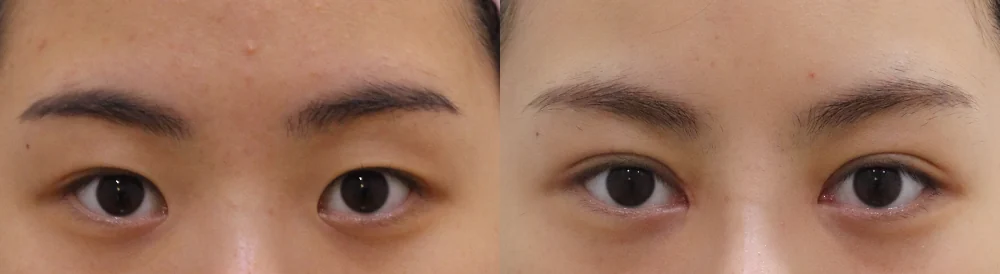
Before surgery, the shape and depth of the creases looked different on each side (general eye-surgery case; not stated as a revision)
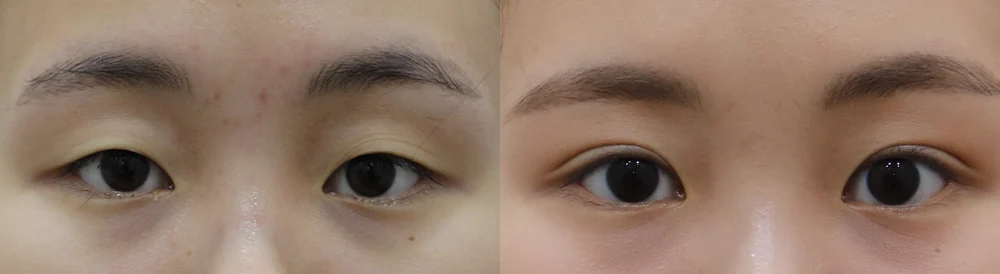
A puffy upper lid made the crease shallow and faint (general eye-surgery case; not stated as a revision)
* Results vary from person to person. Side effects are possible, so please decide after a thorough consultation with a doctor.
Frequently asked questions
My surgery was two weeks ago and my eyes look uneven. Should I have it redone now?
Usually there is no rush. Swelling and bruising are still present early on, so what you see now is not the final result. One oculoplastic surgeon watches for up to a year whether the crease shifts or fades, and suggests touch-ups for his own patients at 6 to 12 months.1 A review cites waiting up to 6 to 9 months before any revision, because prolonged swelling can make the eyes look uneven.7 However, if a suture is pulling or your eye keeps stinging or feels gritty, see a doctor without waiting.4
My buried-suture crease came undone. Can I have the same method again?
If the eyelid is thin with little fat and only the suture has loosened, re-suturing may be possible. But in a study of 513 non-incisional patients, creases were lost more often in puffy eyelids.2 In that case, whether to reduce the fat and tissue that press down, or to switch to an incisional method, is considered.
My crease is too high. Can it be lowered?
Often it can, but the amount of skin left is the key factor. To lower a crease, skin from above has to come down, and if a lot of skin was removed before, there is little to spare.1 Studies describe releasing the adhesion, re-linking lower, and placing fat or tissue between the layers so they do not stick again.56
Can the crease loosen or rise again after a revision?
It can. In the 90-patient study of high-crease revision, four patients had a crease that stayed or became high again, and three had asymmetry.6 That is why the revision addresses the cause, such as bulky tissue, adhesion or weak eye opening, rather than only re-making the crease.
Can I just have the buried suture removed?
If a suture is causing pulling or a gritty feeling, removing it alone is sometimes enough. In a study of 116 patients who had sutures removed after buried-suture surgery elsewhere, 12 (10.3%) had the suture removed only, while 104 (89.7%) also had a revision double eyelid procedure at the same time.4 Whether to stop at suture removal or combine it with a revision is decided at consultation, based on the kind of suture problem and the crease you want.
References (8)
Sources that support the explanations in this article. Study findings describe general trends and do not guarantee individual results.
- Chen WPD. Techniques, Principles and Benchmarks in Asian Blepharoplasty. Plast Reconstr Surg Glob Open. 2019;7(5):e2271.doi:10.1097/GOX.0000000000002271One oculoplastic surgeon's 12-year review of 362 cases (67 revisions; full text): reasons for revision (absent or lost crease 51%, lowering 34%, raising 15%), the hardest case is a high crease with little skin left, a crease set too high risks incomplete eye closure, asymmetry and mild ptosis, latent ptosis is often missed and even 1–2 mm should be corrected before the crease, crease formation less predictable under 30, follow-up up to 1 year and touch-ups at 6–12 months; a single surgeon's experience
- Inoguchi K, Tamura T, Okuma H, et al. The HIROSHIMA Study: A High-Volume, Institutional, Retrospective, Observational Study of Hidden Non-Incisional Suture Double Eyelid Surgery for Multivariate Analysis of Crease Loss. Arch Plast Surg. 2026;53(2):135-141.doi:10.1055/a-2796-6824Two-year follow-up of 513 non-incisional double eyelid patients at one clinic of a cosmetic surgery group with over 100 clinics (full text, retrospective): puffy eyelids in 54.5% with about 2.5 times the risk of crease loss, continuous tendon-side fixation lower risk than separate tarsal loops (HR 0.29), especially in puffy lids; surgeon experience, age and crease design not independent factors; 131 patients with combined procedures such as orbital fat removal excluded, so the effect of fat removal was not tested; crease loss defined as revision for patient-reported fading
- Okumura K, Tamura T, Funakoshi Y, Teranishi H. Age-Related Variations in Reoperation Risk from Suture Loosening in Two-Point Buried Suture Double Eyelid Surgery: A Stratified Retrospective Cohort Analysis. Aesthetic Plast Surg. 2025;49(23):6431-6438.doi:10.1007/s00266-025-05404-8Age-stratified sample of 600 cases (100 per age band, six bands) from 52,281 two-point buried-suture procedures (abstract): revision for suture loosening in 22.3% of the sample, which is not the true overall rate; highest under 20 (41%), lowest in the thirties (12%), a non-significant trend in those 60 and over (HR 1.34, p = 0.327); one method and one clinic group
- Mizuno T. Treatment of Suture-related Complications of Buried-suture Double-eyelid Blepharoplasty in Asians. Plast Reconstr Surg Glob Open. 2016;4(8):e839.doi:10.1097/GOX.0000000000000835116 patients (210 eyelids) with suture-related problems after buried-suture surgery elsewhere (abstract): pulling linked to linear scars or depressions, stinging to chronic inflammation on the inner tarsal surface; such problems should be treated by suture removal, full skin incision more reliable than a small incision; 89.7% also had a revision
- Wattanakrai K, Chiemchaisri N, Wattanakrai P. Secondary Blepharoplasty: Correction of the High Fold. Aesthetic Plast Surg. 2016;40(6):914-920.doi:10.1007/s00266-016-0713-y213 high-crease revisions at one center over 4 years (abstract): crease reduced in 98.59%, rated by the authors as excellent 51.17%, good 32.40%, fair 15.02%, poor 1.41%; key steps are levator advancement and tissue or fat placed between tendon and skin, avoiding levator injury; level of evidence V
- Liu C, Zhao Q, Zhu S, et al. Correction of High Eyelid Folds Using Three-Plane Dissection and Fat Repositioning/Grafting in Revisional Blepharoplasty. Aesthetic Plast Surg. 2025;49(16):4597-4606.doi:10.1007/s00266-025-05005-590 patients with high creases (abstract, retrospective, at least 6 months): scar adhesion released in three planes with eyelid fat repositioning or abdominal fat grafting, average crease height 11.1 to 7.1 mm, 87.8% satisfied and 12.2% not (recurrent or persistent high crease 4, asymmetry 3, hollowness 2, incomplete closure 2); previous eyelid surgery, ptosis and hollowness related to satisfaction
- Nguyen MQ, Hsu PW, Dinh TA. Asian Blepharoplasty. Semin Plast Surg. 2009;23(3):185-197.doi:10.1055/s-0029-1224798Review of Asian blepharoplasty (full text): buried-suture and incisional methods, crease loss in 0–3%, asymmetry reported in up to 35%, a high fold in about 6–7%, aggressive fat resection linked to a high fold with a hollow sulcus; notes that some recommend waiting as long as 6–9 months before any revision because prolonged swelling can cause asymmetry
- Yang CC. Revision of Asian Upper Blepharoplasty. Clin Plast Surg. 2023;50(1):111-120.doi:10.1016/j.cps.2022.08.007Narrative review of revision Asian upper blepharoplasty (abstract): revision is especially challenging when several complications overlap and very little tissue is left, and the causes of complications can be classified systematically; the abstract gives no timing figures, so it is not used for timing
About this article
This article separates general medical information from Bonita Clinic's own approach. Because the right decision depends on each person's condition, it is not a substitute for a consultation.