KOKorean
 ENEnglish
 JP日本語
 CN中文(简体)
 TW中文(繁體)


How Soon Can You Fly Home After Liposuction or Buttock Fat Grafting in Seoul?
There is no single day after liposuction or buttock fat grafting when a long-haul flight becomes right for everyone; it depends on the extent of surgery and how you are recovering. Blood clots are far more common after body surgery than after face surgery, and clot risk rises with every extra 2 hours of flying, so plan your compression garment, walking and stockings in advance. At Bonita Clinic, your return date, and how you will sit if fat was grafted to your buttocks, are planned together at consultation rather than promised as a number of days. If you are considering liposuction or a BBL in Seoul, send us your photos and travel dates to start planning.
Curious about your own case? Ask us online →
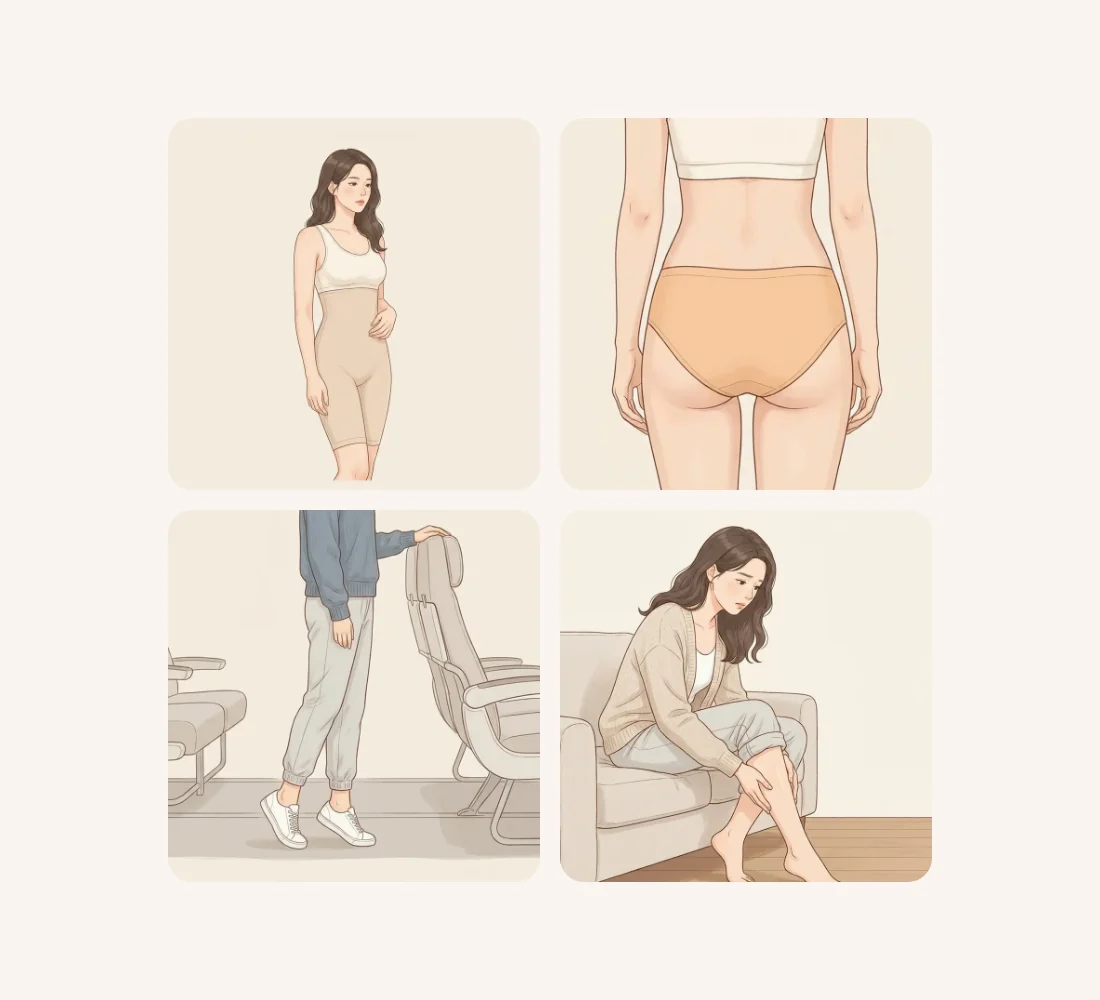
Flying after liposuction or buttock fat grafting: how is it different from face surgery?
If you are having liposuction or buttock fat grafting (often searched as a Brazilian butt lift, or BBL) in Seoul and flying home afterwards, the first thing you probably want to know is how many days you need to wait. There is no single answer that fits everyone. Reducing one area, reducing several areas at once, or moving the removed fat into the buttocks are very different operations, and each comes with a different recovery. So before picking a date, it helps to understand what a body that has just had surgery needs to be careful about on a long flight where you sit for hours.
Four things shape a flight plan after body surgery:
- Blood clots: clumps of blood that form inside a vein. They are far more common after body surgery than after face surgery.1
- Swelling and seroma: swelling where you had surgery, and seroma, a pocket of clear fluid that can collect under the skin where fat was removed.2
- Compression garment: the snug garment that holds the treated areas. Many people are still wearing it on the day they fly.
- Sitting: if fat was grafted to your buttocks, simply sitting in a plane seat for hours becomes a real question.
After face surgery, nosebleeds, ear pressure or a hematoma on the first day tend to be the main concerns. After body surgery, the plan centers on blood clots, the hours spent sitting, and how your garment and your seat interact with the treated areas. We cover flying after nose surgery and after a facelift in separate guides: flying after rhinoplasty and flying home after a facelift. The cards below show situations people often meet around their flight home.
If this is you around your flight home
1If you are wearing a compression garment after liposuction
Wear it for the period you were told, and check before you leave that nothing digs in or bunches when you sit
Compression garment
2If fat was grafted to your buttocks
Agree before surgery how you will sit on a flight that lasts hours
Sitting
3If your journey is longer than about 4 hours
Plan an aisle seat, fluids, regular walks and anti-clot stockings in advance
Clot prevention
4If only one leg is swollen and painful
It may be a clot, so see a doctor straight away
After you get home
Swelling, stitches and seroma: the weeks after liposuction or fat grafting
At Bonita Clinic, liposuction is performed under sedation combined with local anesthesia, and you go home the same day. Buttock fat grafting is performed under sedation or general anesthesia, also with same-day discharge. Both involve stitches. How long recovery takes and how many follow-up visits you need depend on the extent of surgery and on your own condition. Longer operations that run from liposuction straight through to grafting, such as our Brazilian layered hip-up, are scheduled with extra time. The surgery itself is explained in our liposuction guide and buttock fat grafting guide.
Recovery usually unfolds in this order. First, the areas where fat was removed and where it was placed become swollen, bruised and sore. You wear your compression garment, and on a set day the stitches come out and the wounds and swelling are checked. After that, swelling goes down slowly and your new contour gradually shows. How fast swelling settles depends on how much fat was removed, how many areas were treated and on you, so we have deliberately not written "the swelling is gone after X days" anywhere in this guide.
From surgery to after you get home: the usual course
- Day of surgeryHome the same day once awake · garment as instructed
- First few daysSwelling, bruising and soreness at their peak
- Follow-up checkWounds, stitches, swelling and seroma checked
- Before departureFly home once your condition is checked
- After you get homeSwelling eases slowly · watch for clot signs
What is a seroma, and how common is it?
A seroma is clear fluid (serum) that collects under the skin where fat was removed. When you press on it, it can feel like a soft water balloon. When 23 studies of large-volume liposuction (3,583 patients) were pooled in a meta-analysis (a study that pools and re-analyses the results of many studies), the average volume removed was about 7.7 liters, and seroma was the most common minor complication, at 5.51%.2 Put simply, about 5 or 6 in every 100 people who had a large amount removed developed one.
That figure cannot simply be applied to smaller operations. Still, a seroma can become noticeable only after a while, so some people first spot one after they are back home. That is why it helps to have the treated areas checked once more before you leave, and to agree in advance what you should look out for and when to contact us.
Why do blood clots matter more after body surgery?
A clot in a deep vein of the leg is called a deep vein thrombosis (DVT). If part of it breaks off and blocks a blood vessel in the lungs, it is called a pulmonary embolism (PE), which can cause sudden breathlessness and chest pain and is a medical emergency. Together, the two are called venous thromboembolism (VTE).
US cosmetic surgery insurance data on 129,007 people operated on between 2008 and 2013 show that 116 had a confirmed VTE within 30 days of surgery, about 0.09%. Split by body area, the rate was 0.01% after face surgery, 0.21% after body surgery and 0.28% after combined body and breast surgery.1 In plain terms, a clot after body surgery happened to about 1 in 500 people, far more often than after face surgery (about 1 in 10,000).
Note, though, that this body group combines liposuction with many other operations on the trunk and limbs, so 0.21% is not a liposuction-only figure. A separate analysis of the same insurance data looked at liposuction on its own: among 11,490 liposuction procedures performed alone, confirmed clots within 30 days occurred in 0.06% (about 6 in 10,000). When liposuction was added to another cosmetic operation, however, the risk of a confirmed clot was 5.65 times that of the other operation done alone (relative risk).7
In the 129,007-patient data, people who had several procedures at once had more clots than those who had one (0.20% versus 0.04%). When several factors were analyzed together, body procedures, combined procedures, body mass index (BMI, a measure of weight relative to height) and age all raised the risk.1 So if your plan covers a wide area or adds other procedures, clot risk is weighed against the whole extent of surgery.
In the meta-analysis of large-volume liposuction mentioned above, pulmonary embolism occurred in 0.18% and DVT in 0.12%. The most common major complication in that analysis was bleeding that needed a blood transfusion (2.89%), and no fat embolism or death was reported in the included studies.2 Clots are uncommon, but they can be serious when they happen, which is why they are worth planning for.
What is common after liposuction, how rare clots are, and flight time
How much does a long-haul flight add to clot risk?
Pooling 14 studies of travel and VTE (4,055 people with clots), a meta-analysis found that travelers overall had about twice the clot risk of non-travelers. When studies whose method of choosing comparison groups could bias the result were left out, the risk was about 2.8 times higher.3 The risk also rose by 18% for every extra 2 hours of travel of any kind, and by 26% for every extra 2 hours of flying.3 In other words, the longer the flight, the more the risk adds up. All of these studies were done in Western countries.
The British Association of Aesthetic Plastic Surgeons (BAAPS) has published guidance for patients who have surgery in another country. It notes that a long-haul flight is usually defined as more than 6 hours, but that a total journey of around 4 hours already affects risk.6 So it is more accurate to plan around your door-to-door time, including the trip to the airport, waiting before boarding, layovers and connections, rather than the flight time alone.
Body surgery and long-distance travel each raise clot risk on their own. If they fall in the same period, you need to plan not only when you fly but also what you will do during the journey.
How do sitting and a compression garment affect your leg veins?
Blood in the leg veins has to travel uphill, against gravity, back to the heart. When you walk, your calf muscles tighten and squeeze the veins, which pushes the blood upward. This is why the calf muscle is sometimes called the "second heart." When you sit for hours, the calf muscles barely move and your hips and knees stay bent, so blood flows slowly. Slow-moving blood is one of the conditions in which clots form.
A compression garment can also affect this flow. Researchers in Brazil used Doppler ultrasound to measure the large vein below the groin (the common femoral vein) in 15 women who had never had abdominal surgery. With an abdominal compression garment or a Velcro binder on, blood in that vein moved more slowly (venous stasis increased), with no difference between the two types. A semi-reclined position in bed with the back raised (the Fowler position) slowed the flow further compared with lying flat.4
This study has clear limits. It measured 15 volunteers who had never had abdominal surgery, not surgical patients, and it did not look at whether clots actually increased.4 It also measured a semi-reclined position in bed (the Fowler position), not sitting in an airplane seat. So this result alone is no reason to stop wearing a garment. Put simply: wear your garment as instructed, and the longer you sit in it, the more important it becomes to get up and move your legs often.
What happens in your leg veins when you sit for hours
Should you wear your compression garment on the plane?
At Bonita Clinic, how long you wear the compression garment depends on the area and extent of surgery, and we explain it before surgery. If your flight falls within that period, the general rule is to keep wearing it on the plane as instructed. But after hours of sitting, the places where your body folds (the groin, behind the knees and the waist) can feel tighter than when you stand. It helps to check these points at your pre-departure visit:
- Fit: whether it has become loose as swelling went down, or whether one spot is digging in
- Folds: whether the fabric bunches up and presses on the skin when you sit
- Changing: whether you can take it off and put it back on by yourself in an airplane bathroom, and whether you need a spare
- Numbness: what to do if your legs feel numb, cold or change color
A compression garment and anti-clot stockings are different things. The garment holds the treated areas, while compression stockings press more firmly at the ankle than higher up the leg, helping blood in the leg veins move upward. If your garment ends above the knee, your calves are not compressed at all.
A compression garment is not the same as anti-clot stockings
| Item | Covers | What it does | How it is chosen |
|---|---|---|---|
| Compression garment | The treated areas (belly, waist, thighs, buttocks) | Holds the treated areas with even pressure | Wearing period explained before surgery, by area and extent |
| Anti-clot stockings | Ankles and calves (up to the thigh in some types) | Press more firmly at the ankle to help blood move up the leg | Pressure, length and use with the garment agreed with your team |
Do compression stockings help on a flight?
A Cochrane systematic review (a review that gathers all relevant studies by a set method and assesses them together) pooled 12 randomized trials with 2,918 passengers on flights of more than 5 hours, comparing people who wore compression stockings with those who did not. In the trials of stockings on both legs, 50 of the 2,637 people followed up were found to have a DVT without symptoms. Of those 50, 3 had worn stockings and 47 had not. The reviewers rated the certainty of this result as high. Leg swelling was also reduced, but because of the way swelling was measured, that result had low certainty.5
Compression stockings on flights: 12 randomized trials
Be careful when applying this to a flight after surgery. The participants had not just had surgery. And because no deaths, pulmonary emboli or symptomatic clots occurred, the review could not tell how much stockings prevent these serious problems.5 The British association advises anti-embolism stockings for patients traveling after surgery, for two weeks or for at least two weeks after surgery depending on the size of the operation.6 The pressure and length of the stockings, and how to wear them together with your garment, should be decided with your surgical team.
After buttock fat grafting, how should you sit on a long flight?
Buttock fat grafting moves fat removed from areas you want to reduce, such as the waist, flanks or thighs, into the buttocks and the sides of the hips. As our treatment page explains, part of the grafted fat is absorbed and the part that takes hold remains. That is why "how should I sit and lie while the fat settles?" is one of the most common questions after this surgery.
However, we could not find studies that directly compare how long, or in what way, sitting should be limited. In practice, the advice varies quite a lot between surgeons and techniques. So this guide does not give a number of days to avoid sitting. The instructions from your own surgical team are the most accurate guide.
A flight is when this question matters most, because hours in a seat keep pressure on the lower buttocks and the backs of the thighs. If you have had fat grafted to the buttocks and are planning to fly, these are worth discussing before surgery:
- Where the fat went: pressure when sitting differs depending on whether fat was placed in the lower buttock, the sides of the hips or higher up.
- How to sit: follow the cushion and position advice you were given after surgery on the plane as well.
- Breaking up sitting time: getting up to walk the aisle when it is safe to do so also matches clot-prevention advice.6
- Seat choice: an aisle seat makes it easier to stand up.6
Fat embolism, the complication taken most seriously in buttock fat grafting, is a different problem from blood clots in the leg veins. The depth at which fat is placed and the international safety recommendations are covered in our Brazilian butt lift (BBL) safety guide.
Is there a set number of days before flying after liposuction or buttock fat grafting?
We could not find research that sets the day it is fine to fly after liposuction or buttock fat grafting. The most useful reference is the BAAPS guidance for patients having surgery abroad, introduced above. For patients traveling around 4 hours or more, it sorts operations into three groups by anesthesia, length and extent, and suggests how long to stay in the country of surgery and how to prevent clots for each group (British society guidance · level of evidence: expert opinion · not a Bonita Clinic standard).6
| Group | Type of operation (BAAPS grouping) | BAAPS suggested stay (expert opinion) | BAAPS clot prevention |
|---|---|---|---|
| 1 | Local anesthetic procedures, usually under 90 minutes | No set period | No additional measures |
| 2 | General anesthetic surgery up to 3 hours, or local anesthetic procedures over 90 minutes | 1–2 weeks | Stockings for 2 weeks, fluids and walking, consider a preventive injection case by case |
| 3 | General anesthesia over 3 hours, multiple-site surgery, restricted mobility, higher clot risk | 2–4 weeks | Stockings for at least 2 weeks, fluids and walking, strongly consider a preventive injection |
The same guidance also suggests arriving before surgery: at least 72 hours beforehand for group 2, and a week beforehand for group 3.6 One way to read this is that you should avoid going straight from a long flight into a major operation.
Keep three things in mind when reading this table. First, as the association itself states, the level of evidence is expert opinion.6 Second, BAAPS lists multiple-site surgery under group 3, so liposuction of several areas, or liposuction with the fat moved to the buttocks, can be regarded as group 3. Third, this is a British association's guidance, not a standard set by Bonita Clinic. Rather than reading it as a promise that you are fine once the period has passed, it is more accurate to read it as a reminder: the bigger the operation, the more time you should allow in Seoul to see how your recovery goes.
The guidance also names people who need particular attention: those who have had bariatric or circumferential (all-around) body procedures, a BMI over 30, age over 40, a personal or family history of clots, and those taking the contraceptive pill or hormone replacement therapy.6 If any of these apply to you, please tell us at consultation.
In the end, your actual schedule depends on:
- Extent of surgery: how many areas and how much fat, and whether buttock grafting is included
- Anesthesia and operating time: sedation with local anesthesia or general anesthesia, and how long the operation takes
- Recovery: whether swelling and pain are easing, the state of wounds and stitches, and whether there is a seroma
- Journey: total door-to-door time and any layovers
- Personal risk: clot history, age, BMI, hormone medicines and other medicines you take16
At Bonita Clinic, we look at these together at consultation and set your return date with a follow-up check built in.
On the plane after body contouring: garment, stockings and walking
BAAPS advises patients traveling after surgery to sit in an aisle seat, keep well hydrated, move about during the flight and wear anti-embolism stockings.6 Here is what to do on board after body surgery, paired with the reason for each.
What to do on board, and why
A few things also matter outside the cabin:
- Walk at the airport too: keep walking while you wait to board and during connections. Risk relates to your whole journey, not just the time in the air.36
- Luggage: if you were told not to lift heavy things, follow that at the airport and on the plane. Ask a companion or the cabin crew to put bags in the overhead bin.
- Medicines: carry prescribed medicines in your hand luggage, and ask beforehand how to time doses across time zones.
- Wounds: if you notice fluid or blood at the small liposuction incisions or where the garment presses, take photos after you land and contact us.
Back home after liposuction or buttock grafting: clot, seroma and wound warning signs
Clots after body surgery can still form after you leave the clinic; the 129,007-patient study followed people for 30 days after surgery.1 Once you are home, see a doctor without delay if you notice:
- Swelling, pain, redness or warmth in one leg, especially the calf
- Sudden breathlessness, chest pain or coughing up blood. This needs emergency care.
- Fever, or an incision that becomes red or leaks pus
- A treated area that keeps swelling and feels like it is sloshing with fluid (it may be a seroma)
- Skin under the garment turning dark red or purple, or blistering
The BAAPS guidance covers follow-up after you return as well. It advises phone or video follow-up once you are home, with an early check 1 to 2 weeks after surgery and a later one between 6 weeks and 6 months. It also advises knowing in advance how to get emergency care in your home country, and what to do if a problem such as a DVT needs a different specialist.6
When you see a local doctor, tell them the date of surgery, where fat was removed and where it was placed, and the medicines you take. Please also contact Bonita Clinic to share how you are doing, as it helps us follow your recovery. Our guide to aftercare back home after surgery in Korea covers what to look after at home in more detail.
Liposuction and fat grafting options you can discuss in Seoul
Bonita Clinic has been at the same location since opening in 1995, and Dr. Kwang-Seop Jung, a plastic surgeon board-certified in Brazil, has seen patients there ever since. The options you can discuss at consultation are those described on our treatment pages:
- Liposuction: the waist, upper arms and thighs are reduced while curves are kept where they are needed, and the skin and how each area joins its surroundings are assessed as carefully as the fat. If sagging is expected, we explain it before surgery and decide whether to tighten with Renuvion as well. See Liposuction.
- Buttock fat grafting: fat suctioned from areas you want to reduce, such as the waist, love handles, upper arms or thighs, is moved to the buttocks, with the amount and position based on the line from waist to hips to thighs rather than size alone. See Buttock Fat Grafting.
- Brazilian layered hip-up: fat is built up in layers across the hips, the hip joint area and the saddlebag area that lack volume, and fat-derived stem cells separated from the harvested fat are grafted together with it. Some fat may be absorbed, so a touch-up may follow. Because it takes considerable time from suction to grafting, it is scheduled with extra time. See Brazilian Layered Hip-up.
- Revision of earlier liposuction: irregularities, asymmetry or sagging left after earlier surgery can be assessed for correction. See our liposuction revision guide.
Which of these suits you, and how long your recovery in Seoul is likely to take, can only be decided after an examination.
Why do liposuction and buttock grafting plans, stays and costs differ?
Two people who both ask for "liposuction" may need very different operations, and very different amounts of time in Seoul. What shapes the plan, and therefore the cost, is how much needs to be done and how.
What shapes your plan and cost
- Areas and volume to be suctioned
- Whether fat is grafted to the buttocks or hips
- Anesthesia: sedation with local, or general
- Skin tightening added when sagging is expected
- Revision of earlier liposuction or grafting
- Check-ups needed before your flight home
Final plan and quote after an in-person exam
A final estimate is given only after an in-person examination, once the extent of surgery is clear. Photos help narrow down the options; the extent of surgery, and with it the length of your stay, is settled at the examination.
What can body contouring photos show, and what needs an in-person exam?
Photos are a good place to start. They show where fat sits and which part of your body outline bothers you. What they cannot show is how elastic your skin is, how thick the fat really is when pinched, or whether earlier surgery has left firm or stuck-down areas.
Photos can show
- Where fat sits: belly, waist, thighs, arms
- Body outline from the front, side and back
- Dents or bumps after earlier liposuction
- The line from waist to hips and buttocks
Needs an in-person exam
- Skin elasticity and likely sagging
- Fat thickness when pinched, and how much can be moved
- Firm or stuck-down areas from earlier surgery
- Health, medicines and clot risk for your journey
Helpful photos: front, both sides, back and both 45-degree views, standing straight in plain light, in underwear that leaves the areas of concern visible. Please send only the areas that are needed. Along with your photos, tell us where you want to reduce and where you want to fill, any previous liposuction or fat grafting, your height and weight, your rough travel dates and journey length, and whether you or your family have ever had a blood clot. You can send us a message with your photos and questions before planning your trip to Seoul.
How we approach it at Bonita Clinic
Bonita Clinic is on the 3rd floor of 565 Gangnam-daero, Seocho-gu, Seoul, about 100 m on foot from Exit 8 of Nonhyeon Station (Line 7).
Real treatment cases: liposuction and buttock fat grafting
These are Bonita Clinic cases from the treatments this guide is based on. The time since surgery could not be confirmed for each photo, so it is not shown. Results vary from person to person.
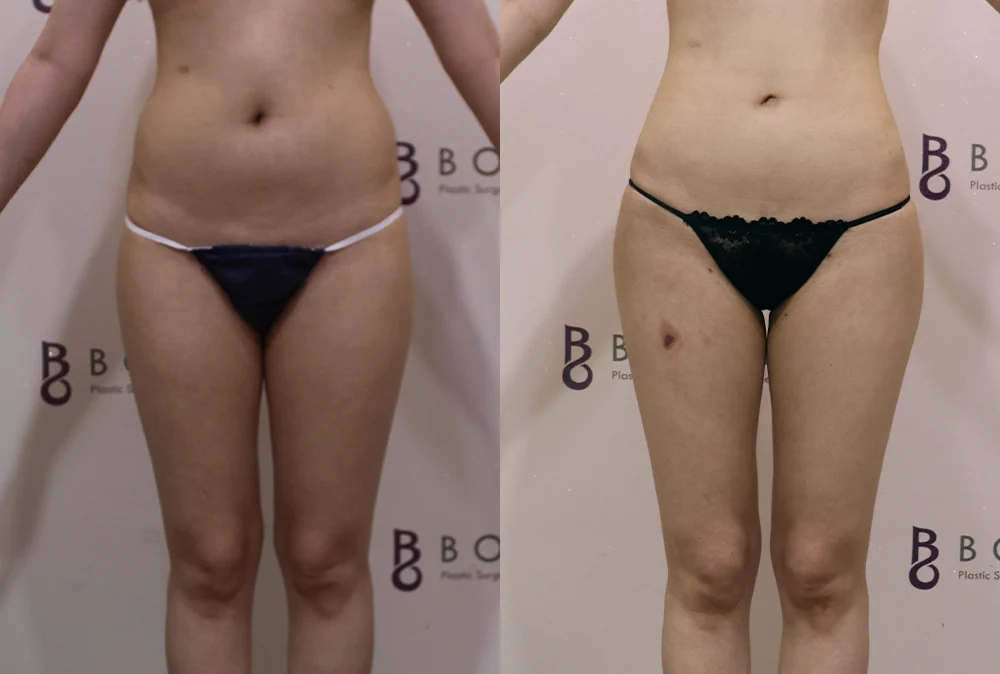
The belly, flanks and thighs from the front
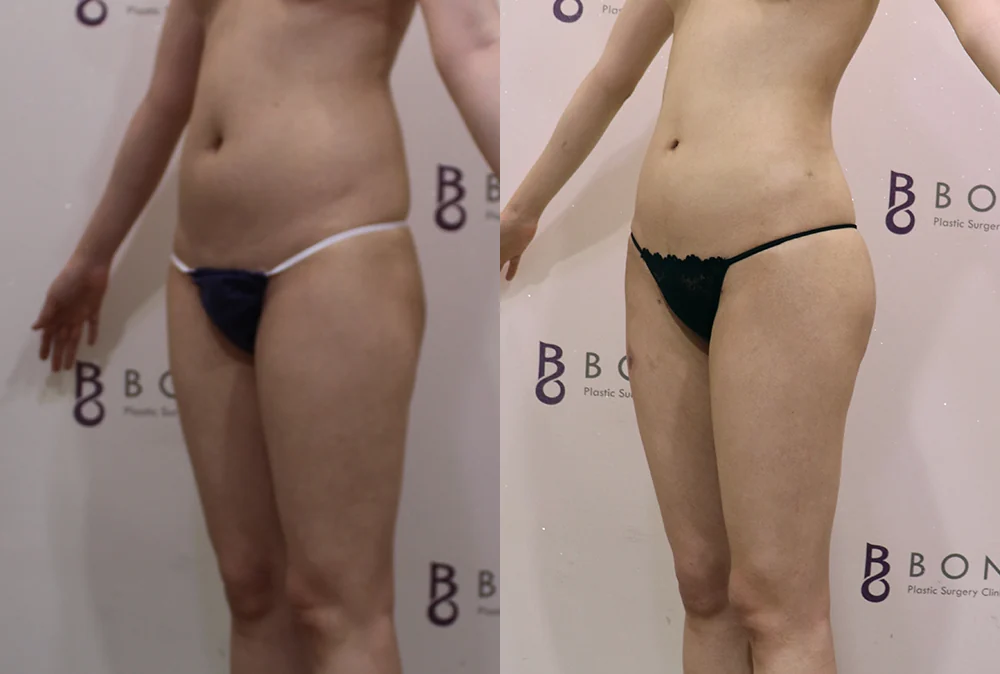
The belly and waistline from an angle
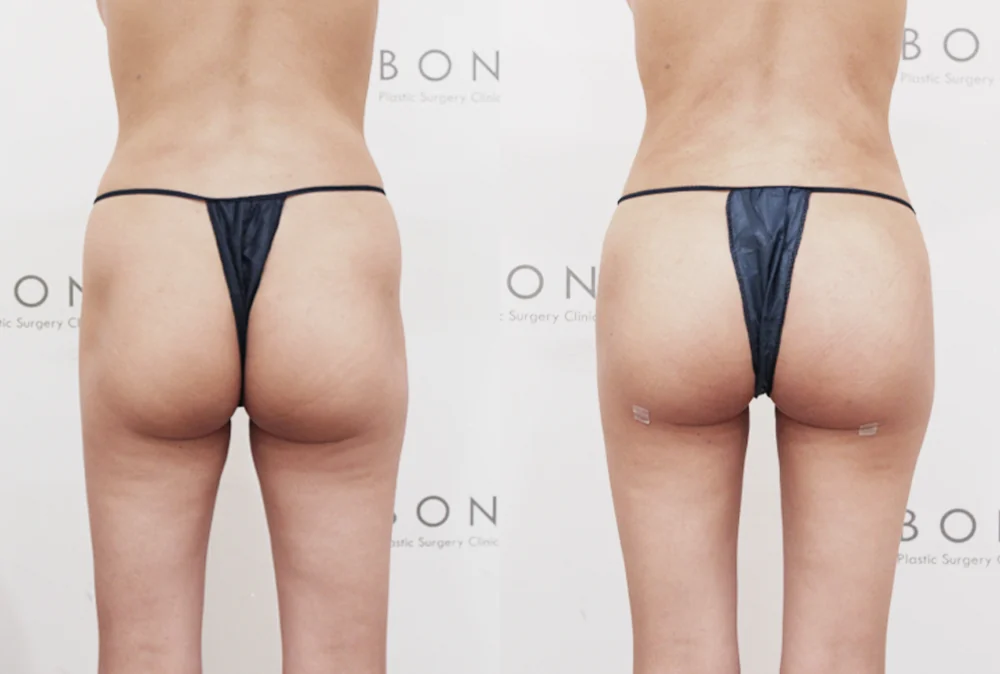
The line from the waist to the buttocks, from behind
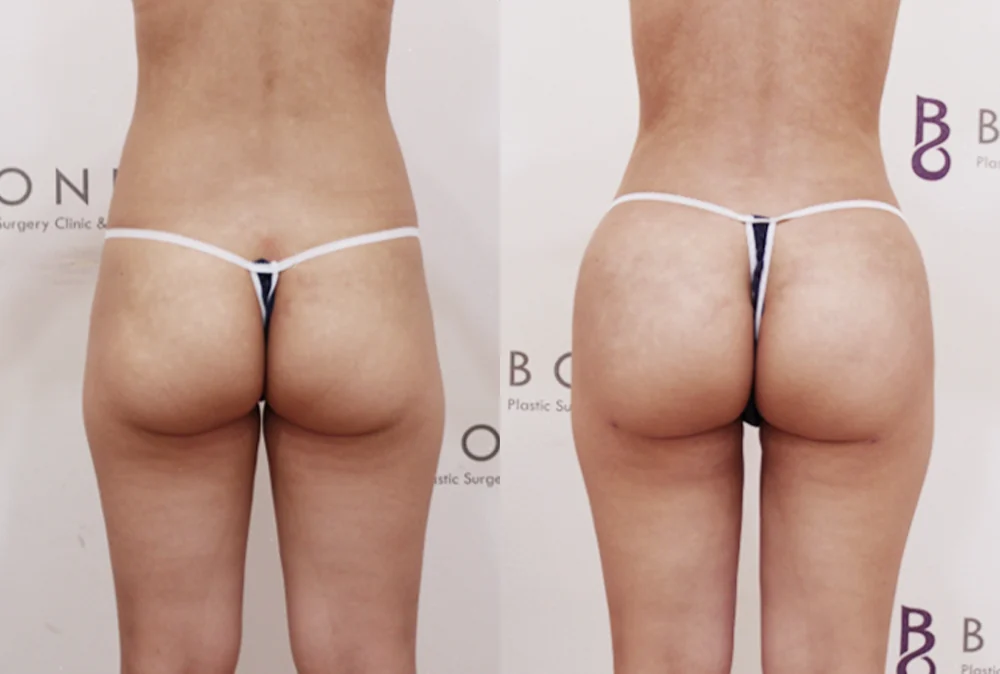
The buttocks and the line into the thighs, from behind
* Results vary from person to person. Side effects are possible, so please decide after a thorough consultation with a doctor.
Frequently asked questions
Can I fly the day after liposuction?
It is hard to recommend. Clots are more common after body surgery than after face surgery,1 and the risk adds up the longer you fly.3 There are also stitches, wounds and swelling to be checked. The BAAPS guidance likewise advises at least one post-operative review by the operating surgeon before you travel home.6 Your return date is set together at consultation, based on the extent of surgery and your recovery.
Can I take my compression garment off during the flight?
If you are still within the period you were told to wear it, the general rule is to keep it on during the flight. That said, sitting for a long time can make the folds tighter, and one study found that a garment and a semi-reclined position in bed each slowed flow in the large vein at the top of the thigh (it did not test sitting in a seat).4 So rather than taking it off, check the fit and any folds before you leave, and plan to move often during the flight. Ask your surgical team in advance what to do if it feels too tight or your legs go numb.
After buttock fat grafting, can I sit in a plane seat for hours?
We could not find studies that directly compare how much sitting should be limited, and advice varies between surgeons and techniques. How you should sit depends on where and how much fat was placed and how long ago surgery was, so please tell us your flight plans before surgery. Breaking up your sitting time and getting up often is also in line with the clot-prevention advice from surgical societies.6
Do I need an anti-clot injection or medicine?
Not everyone does. The British guidance suggests considering a preventive injection (low-molecular-weight heparin) for larger operations, guided by your individual situation or a recognized risk-scoring system.6 Medicines that stop blood from clotting also affect bleeding, and bleeding needing transfusion was the most common major complication after large-volume liposuction,2 so please do not take them on your own; decide with your surgical team.
My legs are swollen after the flight. Is it a clot?
Mild swelling of the ankles and calves is common after sitting for a long time; long-haul flight trials even measure leg swelling as a separate outcome.5 After surgery you also have swelling in the treated areas. Swelling that is similar on both sides and goes down when you raise your legs and rest is common. But if only one leg is swollen and painful, or red and warm, it may be a clot, so see a doctor straight away. If you are short of breath or have chest pain, get emergency care.
What to prepare before a body contouring consultation from abroad
- Rough dates of your flight home, total door-to-door journey time and any layovers
- Where you want to reduce and where you want to fill, and any previous liposuction or fat grafting, with dates
- Any history of blood clots (including in your family), medicines you take (including the pill, hormone therapy and blood thinners), medical conditions and whether you smoke
- Your height and weight
- How long you can stay in Seoul, and whether someone will travel with you
You can read about each procedure on our Liposuction, Buttock Fat Grafting and Brazilian Layered Hip-up pages. For the surgery itself, see our liposuction guide and buttock fat grafting guide; for how long to wear the garment and how to care for it, see our compression garment guide.
References (7)
Sources that support the explanations in this article. Study findings describe general trends and do not guarantee individual results.
- Winocour J, Gupta V, Kaoutzanis C, et al. Venous Thromboembolism in the Cosmetic Patient: Analysis of 129,007 Patients. Aesthet Surg J. 2017;37(3):337-349.doi:10.1093/asj/sjw173Prospective cohort from the US CosmetAssure database, 2008–2013, 129,007 patients (abstract): 116 VTEs within 30 days (0.09%). Face 0.01%, breast 0.01%, face plus body 0.16%, body 0.21%, body plus breast 0.28%; combined procedures 0.20% vs single 0.04%. Risk factors: body procedures (RR 13.47), combined procedures (RR 2.4), BMI and age — the basis for clots being more common after body surgery than face surgery
- Kanapathy M, Pacifico M, Yassin AM, et al. Safety of Large-Volume Liposuction in Aesthetic Surgery: A Systematic Review and Meta-Analysis. Aesthet Surg J. 2021;41(9):1040-1053.doi:10.1093/asj/sjaa338Systematic review and meta-analysis of large-volume liposuction (abstract; 23 studies, 3,583 patients, mean aspirate about 7,735 mL): major complications 3.35% (bleeding needing transfusion 2.89%, pulmonary embolism 0.18%, hematoma 0.16%, necrotizing fasciitis 0.13%, DVT 0.12%), no fat embolism or death reported; minor complications 11.62%, seroma the most common (5.51%). Limited by the lack of level 1 evidence
- Chandra D, Parisini E, Mozaffarian D. Meta-analysis: travel and risk for venous thromboembolism. Ann Intern Med. 2009;151(3):180-190.doi:10.7326/0003-4819-151-3-200908040-00129Meta-analysis of travel and VTE (abstract; 14 studies, 4,055 cases): relative risk 2.0 for travelers, 2.8 after excluding studies with referred controls; 18% higher risk for each extra 2 hours of travel and 26% for each extra 2 hours of air travel (dose-response). All studies were from Western countries
- Berjeaut RH, Nahas FX, Dos Santos LKIL, et al. Does the use of compression garments increase venous stasis in the common femoral vein?. Plast Reconstr Surg. 2015;135(1):85e-91e.doi:10.1097/PRS.0000000000000770Doppler study of the common femoral vein in 15 female volunteers with no previous abdominal surgery (abstract): both a compression garment and a Velcro binder increased venous stasis, with no difference between them; the semi-seated (Fowler) position increased stasis compared with lying flat. Limited because participants were not surgical patients and clots were not measured
- Clarke MJ, Broderick C, Hopewell S, et al. Compression stockings for preventing deep vein thrombosis in airline passengers. Cochrane Database Syst Rev. 2021;4(4):CD004002.doi:10.1002/14651858.CD004002.pub4Cochrane systematic review (abstract; 12 randomized trials, 2,918 passengers, all flights over 5 hours): in trials of stockings on both legs, 50 of 2,637 followed up had a symptomless DVT (3 wearing stockings, 47 not; OR 0.10, high-certainty evidence); leg swelling reduced (low certainty); no deaths, pulmonary emboli or symptomatic DVTs, so those outcomes could not be assessed
- British Association of Aesthetic Plastic Surgeons (BAAPS). BAAPS Cosmetic Tourism Guidelines. . 2023;September 2023 v1.BAAPS guidance for surgery abroad (whole document read; expert opinion): aisle seat, hydration, moving in flight, anti-embolism stockings; total travel of about 4 hours affects risk; suggested stays by group (group 2: at least 72 h before, 1–2 weeks after; group 3: 1 week before, 2–4 weeks after) and clot prevention (stockings 2 weeks / at least 2 weeks; consider / strongly consider LMW heparin); extra care for circumferential procedures, BMI over 30, age over 40, clot history, hormones; surgeon review before travel; follow-up at 1–2 weeks and 6 weeks–6 months
- Kaoutzanis C, Gupta V, Winocour J, et al. Cosmetic Liposuction: Preoperative Risk Factors, Major Complication Rates, and Safety of Combined Procedures. Aesthet Surg J. 2017;37(6):680-694.doi:10.1093/asj/sjw243Prospective cohort from the same CosmetAssure database, looking at liposuction on its own (abstract): of 31,010 liposuction procedures, 11,490 (37.1%) were done alone; liposuction alone had a 30-day major complication rate of 0.7% (hematoma 0.15%, pulmonary 0.1%, infection 0.1%, confirmed VTE 0.06%). Adding liposuction to another cosmetic operation raised the risk of confirmed VTE (RR 5.65) compared with that operation alone — the basis for noting that 0.21% is not a liposuction-only figure and that combined procedures add risk
About this article
This article separates general medical information from Bonita Clinic's own approach. Because the right decision depends on each person's condition, it is not a substitute for a consultation.