KOKorean
 ENEnglish
 JP日本語
 CN中文(简体)
 TW中文(繁體)


How Long to Wear a Compression Garment After Liposuction in Seoul
There is no single number: how long you wear a compression garment depends on the areas treated, the extent of liposuction and your skin. Published guidance speaks of several weeks, often 4 to 6, and up to 8 to 12 weeks when the skin may not retract well. How evenly the garment fits matters more than the exact count of days, and wearing one does not replace walking early and often. At Bonita Clinic we explain the planned wearing period for your areas before surgery, so if you are planning liposuction in Seoul you can see how it fits your stay and your flight home.
Curious about your own case? Ask us online →
Why wear a compression garment after liposuction?
Liposuction removes fat through a thin tube (a cannula) passed through the fat layer under the skin. The tube leaves small gaps behind, and the surrounding tissue swells as it starts to heal. A review of liposuction outcomes describes this swelling as a normal reaction that follows almost every liposuction.3 The American Society of Plastic Surgeons (ASPS) advisory says patients should expect significant bruising and swelling for at least the first 48 to 72 hours.1
A compression garment is a close-fitting garment that wraps the treated areas evenly from the outside during this time. The literature gives it three main jobs:
- Controlling swelling. A garment put on right after surgery is described as the basic way to keep swelling in check.3
- Helping the skin retract. A well-fitting garment is said to help the skin over the treated area tighten, or retract.3
- Limiting fluid pockets. A garment that fits poorly, or one that is repeatedly taken off and put back on, can contribute to a seroma, a pocket of clear fluid that collects in one spot.3
How strong is the evidence?
It is worth being honest about this. Compression garments have been routine for decades, but few studies have tested them rigorously. A 2023 practical review gathered the research on garments after plastic surgery. For body contouring, including liposuction, it found no randomized or comparative studies of garment versus no garment.2 The authors concluded there is "little to no evidence" to judge the value of compression objectively in this setting.
They did not conclude that garments should be dropped. In their view, the gap may reflect a lack of research rather than a lack of effect. They recommended that surgeons guide the choice of garment and how it is worn, rather than leaving patients to work it out alone, and that patients are seen early and often after surgery.2 In plain terms, a garment is not something that helps just by being worn; it helps when it fits and is worn well.
How long should you wear a compression garment?
There is no single period that suits everyone. The ASPS advisory says only that compression garments and elastic stockings are generally used "for several weeks" after surgery.1 A review of liposuction complications speaks of 4 to 6 weeks as usual.3 The surgeon credited with first using garments in cosmetic surgery, Yves-Gérard Illouz, reported in 1989 on 189 patients asked to wear them for 3 to 8 weeks. That report had no statistical testing, was produced for a garment company and was never peer reviewed.2
Studies comparing one wearing period with another are hard to find.2 So the period is less a number fixed by research and more a judgment based on how swelling settles and how your skin behaves. One review advises that people whose skin may not retract fully should wear the garment longer than the usual 6 weeks, up to 8 to 12 weeks, to give the skin the most time to tighten.3 The same authors managed swelling that stayed firm for a long time with longer garment wear combined with massage.3
| Situation | What the literature describes |
|---|---|
| Typical case | Several weeks, often 4–613 |
| Skin that may not retract well | Up to 8–12 weeks, to give the skin time3 |
| Swelling that stays firm for a long time | Longer wear with massage, from clinical experience3 |
| A garment that does not fit | Correct the fit before thinking about wearing it longer23 |
Longer is not automatically better either. Illouz later acknowledged that removing a garment early does not lead to worse outcomes. He also argued that a good operation without a garment is better than a mediocre one followed by long garment use that simply masks the defects.2 What matters first is the extent of surgery, the state of your skin and whether the garment you are wearing actually fits.
What goes wrong when a garment fits badly?
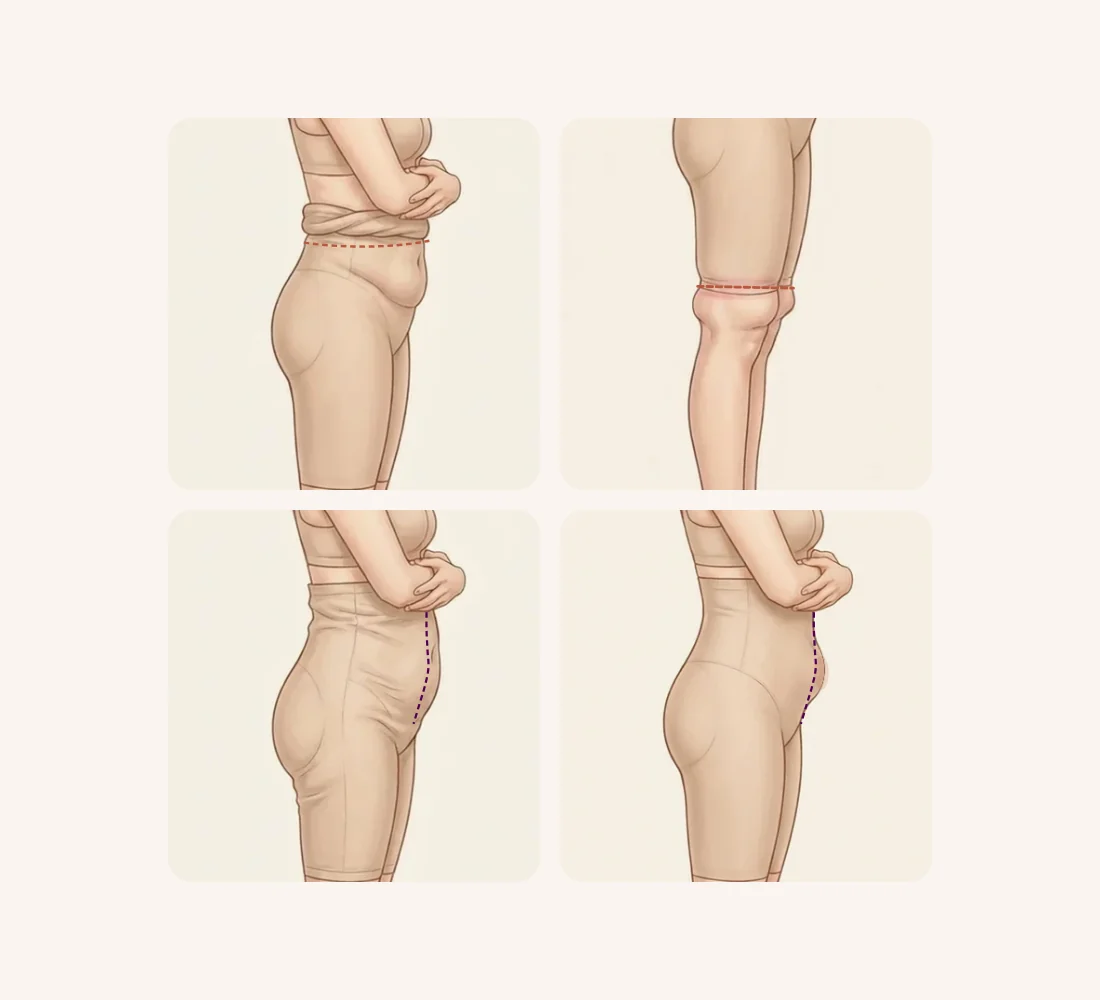
Compression helps when it is even. Pressure concentrated in one place, folds, or a garment that has gone loose can cause problems of their own. Here is what you can check in a mirror:
If your garment looks like this
1The top edge has rolled down and folded
The fold can press a mark along its line; unroll it and smooth the garment back into place
Folding
2The leg band cuts into your skin
Pressure along one line can injure skin; have the size and shape checked
Too tight
3It has gone loose as swelling settles
Uneven pressure lets fluid collect more easily; get the fit corrected
Too loose
4One spot bulges and feels fluid
It may be a seroma (a pocket of fluid); have it checked
Seroma
Taking them one at a time:
- Folds and creases. An ill-fitting garment, especially combined with poor posture, can cause surface irregularities. The authors of one review therefore show their patients how to wear the garment so that folds and creases are limited, and check regularly that it is being worn properly.3
- Too much pressure. Excessive pressure from a garment is listed among the causes of hyperpigmentation, a darkening of the skin after liposuction.3 Ill-fitting garments are also linked to discomfort, skin injury and even skin necrosis (death of skin tissue), and to slower blood flow in the veins.2
- Too loose, or on and off repeatedly. A garment that does not fit, or one the patient keeps removing and putting back on, can contribute to seroma formation.3 A seroma is usually noticed on day 5 to 7. In one team's experience, adding padding over the spot inside the garment let many settle within 7 to 10 days; persistent ones may need to be drained with a needle.3 It is a reason to show your surgeon, not to manage alone.
- Uneven pressure and blood flow. Illouz warned that excessive or poorly distributed compression can lead to venous stasis (blood pooling in the veins) and thrombosis (clotting), as well as folding and bulging of the skin.2
Poor fit is more common than you might expect. The practical review cites a study of postoperative orthopedic patients in which 4% to 44% of compression stockings were incorrectly sized.2 That is why the fit is worth rechecking not only on the first day but also as swelling goes down.
Is it safe to sit for long periods in a compression garment?
Wearing a garment does not automatically improve circulation in the legs. A study from Brazil put compression garments and Velcro abdominal binders on 15 healthy women who had never had abdominal surgery. It then measured flow in the large vein at the groin (the common femoral vein) with Doppler ultrasound, which shows blood flow.4 Both garments slowed venous flow, with no difference between them. Flow slowed further in the Fowler position, lying in bed with the upper body raised.4
The study was designed with abdominoplasty in mind and measured healthy volunteers. It did not count whether actual clots formed after surgery, and it did not measure sitting in a chair, a car or a plane. Even so, it is a useful reminder that the garment did not speed up flow in the leg veins, and that flow was slower still with the upper body raised. A garment does not replace walking.
Conditions listed as raising the risk of deep vein thrombosis (a clot in a deep leg vein) include surgery lasting more than 2 hours, obesity, dehydration, age over 60, varicose veins, smoking and oral contraceptives. The same review notes that moving early after surgery significantly reduces that risk.3 At home or in your hotel, it helps to:
- Get up and walk around regularly while you are awake.
- Each time you stand up from sitting, check that the fabric is not folded at the groin or behind the knees, and smooth it out.
- Drink enough water.
- Tell your surgeon in advance about long car journeys, long periods of sitting and, if you are traveling, your flight.
Lymphatic massage: when does it start, and do you need it?
The massage most often discussed after liposuction is manual lymphatic drainage (MLD). Lymphatic vessels are thin channels that carry tissue fluid back toward the circulation. MLD uses light, rhythmic strokes along those pathways to help trapped fluid move on; it is not the same as a firm, kneading massage of the muscles.
A systematic review (a study that gathers all the relevant research by a set method), published in October 2026, looked for studies of MLD after cosmetic procedures such as liposuction and abdominoplasty. Only a few met its criteria, and even the count is inconsistent: the abstract says seven, while the results section lists four.5 MLD, alone or combined with other treatments, gave a moderate benefit in reducing swelling. Effects on pain and on fibrosis (tissue hardening into firm patches) were inconsistent. Results were better when MLD started early, on days 2 to 5, and was given in 6 to 12 sessions, and adverse effects were minimal.5
A few points help put this in context:
- The studies were small and varied in design, so the results could not be pooled into a single calculation.5
- The studies used structured lymphatic drainage techniques. They did not test vigorous self-massage at home.
- The authors saw MLD as an addition to standard care such as compression, not a replacement for it.5 In one observational study of lipedema surgery, minor complications such as seromas and chafing were linked mainly to inadequate compression.5
For swelling that stays firm, longer garment wear together with massage is one approach that has been used.3 Whether you have massage, and when it starts, should be decided with the clinic that did your surgery, once the incisions and bruising have been checked.
When can you exercise again after liposuction?
It helps to think about two kinds of activity: light movement such as walking, and exercise that makes you sweat.
Light activity such as walking: early
As described above, early movement lowers the risk of blood clots.3 At Bonita Clinic, too, we advise keeping the garment on during recovery and starting with light activity.
Exercise that makes you sweat: guided by swelling and healing
For running, weight training and other exercise that moves the treated areas a lot, there is little research to say exactly when to restart. It is decided at follow-up, based on whether the incisions have healed, how much swelling and bruising remain, and which areas were treated and to what extent.
Why exercise helps protect the result
Exercise also matters after recovery is over. In a randomized trial, 36 normal-weight women had small-volume abdominal liposuction. Two months after surgery they were randomly split into two groups.6 One group followed a 4-month exercise program; the other did not. On CT scans, the reduction in fat under the skin of the abdomen held up to 6 months in both groups. But visceral fat (fat around the internal organs) rose by 10% from before surgery in the group that did not exercise, while the exercise group did not show that increase.6
Put simply, the treated fat did not grow back, but with less activity the body may store fat elsewhere. This was a small study limited to normal-weight women, so it cannot be applied directly to everyone. It does point the same way as the advice that a sensible diet and regular exercise after recovery help the result of liposuction.3
What changes from day one to month three?
Here is the garment, massage and exercise on one timeline. The course of swelling and bruising follows one review:3
- Swelling appears within a day or two and can increase slightly up to days 10 to 14.
- By 2 to 3 weeks it feels firm, even woody.
- From about 4 weeks it softens in patches, and by 6 to 8 weeks the whole area is evenly soft.
- Depending on the extent of surgery, the tissue returns to a normal, pliable feel by about 3 months.
- Bruising is darkest at 7 to 10 days and usually disappears within 2 to 4 weeks.
Reduced sensation over the treated area is common and usually returns close to normal within a year.3 Many people worry that firm swelling at weeks 2 to 3 means something went wrong, but it is a common stage. On the other hand, swelling that suddenly grows on one side, or pain that gets worse day by day, is a change to have checked rather than wait out.
Which symptoms need medical attention right away?
Some problems are solved by putting the garment right. Others need medical attention at once, and it is important to tell them apart.
If you notice this
Wearing your garment, you notice…
- Breathlessness or chest pain, or one calf painful and swollenSeek a hospital or emergency care nowPossible blood clot
- One spot that bulges and feels fluidHave it checked by your surgeonPossible seroma
- A band cutting in, with pain, blisters or broken skinCorrect the garment and tell the clinicSize and shape checked
- Fabric folded or rolled into a creaseSmooth it out so it lies flatAsk if it keeps happening
The ASPS advisory lists calf pain, leg swelling and engorged veins as signs of deep vein thrombosis. Chest pain, shortness of breath, coughing up blood and a fast heart rate are listed as signs of pulmonary embolism (a clot blocking blood vessels in the lungs).1 Fat embolism syndrome, caused by fat droplets blocking blood vessels, shows as breathing difficulty, confusion and a rash of tiny red spots, usually within 24 to 48 hours of surgery.1 Any of these means seeking a hospital or emergency care straight away.
Pain that gets worse day by day, or a change at the incisions such as spreading redness, should also be reported to the clinic that did your surgery without delay, because it can be a sign of infection or another complication.13
How we approach it at Bonita Clinic
Recovery at Bonita Clinic
- 1Before surgeryWearing period explained for your areas
- 2Right after surgeryGarment on; swelling and bruising managed
- 3While you recoverGarment kept on; light activity first
- 4Settling periodSwelling goes down and the line shows
Liposuction at Bonita Clinic is performed as surgery under sedation combined with local anesthesia. You go home the same day without a hospital stay, and there are stitches to be removed later. This is as listed on our treatment page; it can vary with the extent of surgery and your individual condition.
Bonita Clinic has been at the same location since opening in 1995, where Dr. Kwang-Seop Jung, a board-certified plastic surgeon (Brazil), has been seeing patients. For liposuction and its recovery, what you can discuss at consultation in Seoul is the approach described on our treatment pages:
- Which areas to reduce and which to keep, including the waist, upper arms and thighs
- Whether fat that is removed could be moved to areas that need a curve
- Whether Renuvion skin tightening should be added if sagging is expected
- How long the garment is planned for your areas, and how recovery fits your schedule
If an earlier liposuction left dents, bulges or unevenness, see our liposuction revision page. Which steps you need is decided only after an examination.
Why do the plan and cost differ from person to person?
Two people who both want "liposuction of the belly" can need quite different operations, and quite different recovery. What shapes the plan, and therefore the cost, is how many areas are treated, how much is removed and what is combined with it.
- Number and size of the areas treated
- Volume removed, and whether it is split into stages
- Moving fat to another area (fat grafting)
- Adding Renuvion skin tightening
- Anesthesia: sedation with local
- Previous liposuction or revision
Final plan and quote after an in-person exam
A final estimate is given only after an in-person examination, once the areas, the volume and any combined procedures are clear. Photos help narrow down the options before you travel; the extent of surgery is settled at the examination.
What can photos show, and what needs an in-person exam?
Photos are a good place to start, because body contour is largely about outline and proportion. They cannot show how thick the fat is, how elastic the skin is or what lies under the surface.
Photos can show
- Which areas bother you
- Front, side and back proportions
- Visible skin folds or stretch marks
- Dents or bulges after earlier liposuction
- Scars from past surgery
Needs an in-person exam
- How thick the fat is (pinch test)
- Skin elasticity and likely sagging
- Firm areas or adhesions under the skin
- Clot risk and medical history
- How the area changes standing and lying
Helpful photos: front, both sides and back, standing relaxed in plain underwear, against a plain wall in even light, with the camera at waist height. If you have had liposuction before, photos from before that surgery and the approximate date help. You can send us a message with your photos and a short note on which areas you want to change and what you want to keep.
Planning your stay, the flight home and garment care abroad
What is confirmed in advance is the treatment information above: surgery under sedation with local anesthesia, same-day discharge, and stitches. How long you should stay in Seoul, when the stitches are checked or removed, and how many follow-up visits you need all depend on the areas and the extent of surgery. These are planned together with you at consultation.
Because garments are usually worn for several weeks,13 most of that period will probably fall after you return home. It helps to plan for that:
- Know your garment before you leave. Ask how long you should wear it, how to put it on and smooth it, and when you may take it off. Check in a mirror for the four problems shown above.
- Expect the fit to change. As swelling goes down, a garment can become loose, and uneven pressure can let fluid collect.3 Discuss in advance what to do if this happens after you are home.
- Sitting on the flight. In volunteers, a garment slowed flow in the main groin vein, more so when semi-reclined in bed.4 Sitting on a plane was not measured, but the garment alone should not be relied on, and long surgery, dehydration and oral contraceptives add to clot risk.3 Tell us your flight plans at consultation. On board, walk whenever you safely can, drink water and check the fabric at your groin and behind your knees.
- Keep a record. Dated photos of the treated areas taken in the same light make it easier for any doctor to follow your progress.
After you return home, contact a doctor promptly if pain, redness, swelling or bleeding increases instead of settling, or if one area bulges with fluid. For breathlessness, chest pain or a painful swollen calf, seek emergency care at once.1
Real treatment cases
These cases are from our liposuction page. Results vary from person to person.
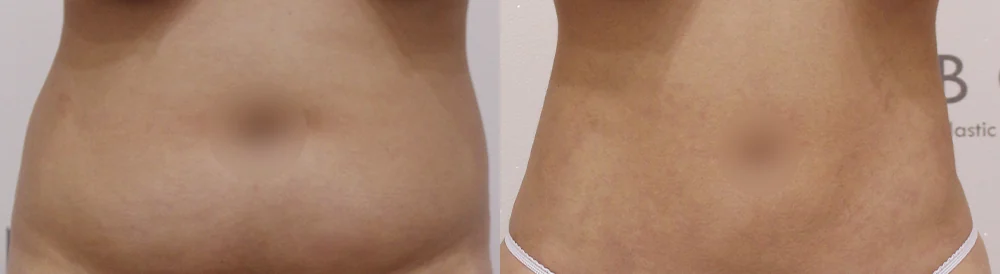
Fullness of the lower abdomen below the navel (front, close-up)
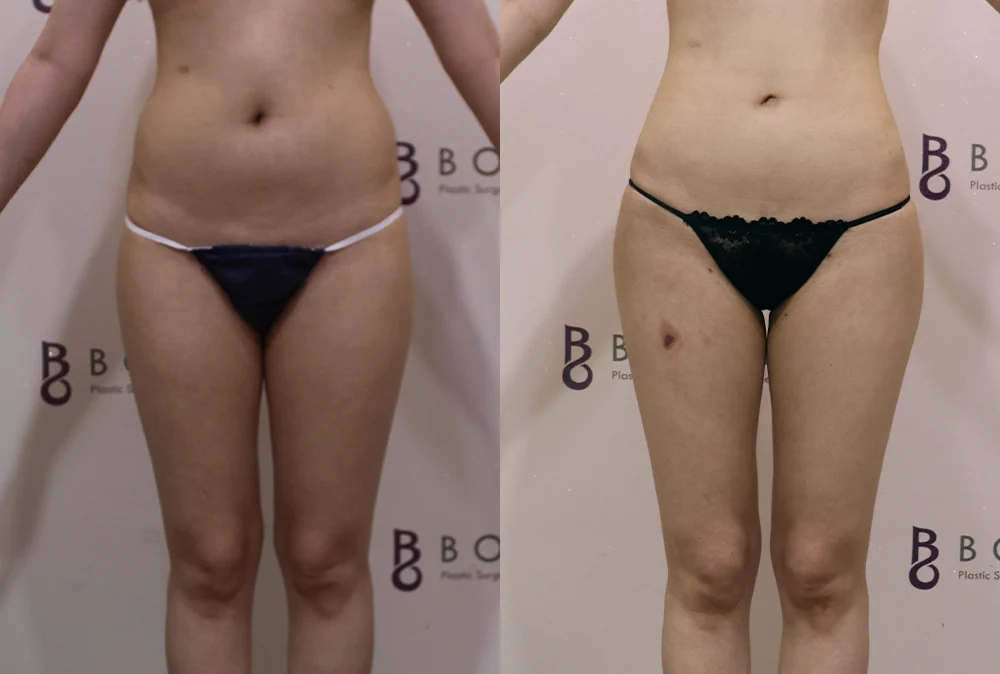
Fullness around the abdomen and thighs (front)
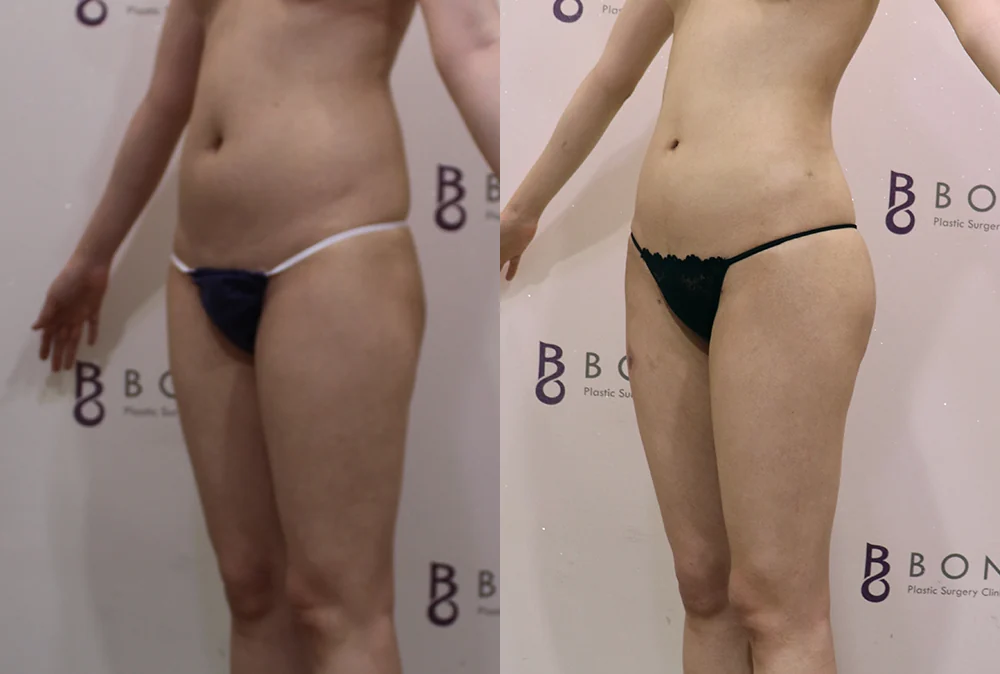
Fullness of the abdomen and the side of the waist (angled view)
* Results vary from person to person. Side effects are possible, so please decide after a thorough consultation with a doctor.
Frequently asked questions
Do I need to wear the garment while I sleep?
Follow the instructions of the clinic that did your surgery on when you may take it off. One review starts garment wear immediately after surgery and notes that repeatedly taking it off and putting it back on can contribute to seromas.3 In the first weeks, it is better to limit removal to when it is really needed, such as washing.
Will wearing it longer give a better result?
There is no clear evidence for that. Very few studies compare wearing periods, and the surgeon who introduced garments said that removing one early does not lead to worse outcomes.2 When the skin may not retract well, a longer period is sometimes used to give the skin time.3 Wearing it correctly comes before wearing it longer.
One spot is swollen and feels like fluid. Is it the garment?
It may be a seroma, a pocket of clear fluid in the treated area. Seromas are usually noticed on day 5 to 7 and are most common on the outer and back thighs and the lower abdomen. A garment that does not fit, or frequent removal, can contribute.3 Treatment varies from extra padding under the garment to drainage with a needle, so take a photo and show the clinic.
My garment left dark marks on my skin. Will they fade?
Darkening after liposuction can come from pigment left by bruising, excessive garment pressure, friction at the incisions and sun exposure.3 In one team's experience, 18.7% of patients developed hyperpigmentation in the treated areas, and it usually faded within a year.3 Check that the garment is not pressing too hard in one place, avoid the sun and use sunscreen.3
I have a long journey soon after surgery. Is wearing the garment enough?
In a volunteer study, wearing a garment slowed flow in the main groin vein, and more so when semi-reclined in bed.4 Long sitting in a car or plane was not measured, but the garment alone should not be relied on. Surgery lasting more than 2 hours, dehydration and oral contraceptives also add to clot risk.3 On the way, take walking breaks, drink enough water and check that the fabric is not folded at the groin or behind the knees. If you will travel far soon after surgery, tell us at consultation.
What to prepare before your consultation
- The areas you want to reduce, and what you want to keep (garment shape and wearing period depend on the areas)
- Your schedule during recovery: work, long periods of sitting, flights, exercise plans
- Anything related to blood clots: oral contraceptives or hormone therapy, smoking, varicose veins, any past clot
- Whether your skin darkens easily or chafes easily
- Anything that bothered you about garments after an earlier liposuction
Bonita Clinic is on the 3rd floor of 565 Gangnam-daero, Seocho-gu, Seoul, about 100 m on foot from Exit 8 of Nonhyeon Station (Line 7). For the operation itself, see our liposuction guide; for fitting the scope to a short schedule, the one-day liposuction guide; and for unevenness after earlier surgery, the liposuction revision guide. Our approach is described on the Liposuction page, the One-Day Liposuction page and the Liposuction Revision page.
References (6)
Sources that support the explanations in this article. Study findings describe general trends and do not guarantee individual results.
- Iverson RE, Lynch DJ; ASPS Committee on Patient Safety. Practice advisory on liposuction. Plast Reconstr Surg. 2004;113(5):1478-1490.doi:10.1097/01.prs.0000111591.62685.f8ASPS practice advisory (full text): significant bruising and swelling for at least 48–72 hours; compression garments and elastic stockings generally used for several weeks; warning signs of deep vein thrombosis, pulmonary embolism and fat embolism syndrome (within 24–48 hours)
- Ormseth BH, Livermore NR, Schoenbrunner AR, Janis JE. The Use of Postoperative Compression Garments in Plastic Surgery—Necessary or Not? A Practical Review. Plast Reconstr Surg Glob Open. 2023;11(9):e5293.doi:10.1097/GOX.0000000000005293Practical review (full text): no randomized or comparative studies of garments after body contouring, so little to no evidence; Illouz's 1989 report (189 patients, 3–8 weeks, no statistics, company-sponsored, not peer reviewed); his view that early removal does not worsen outcomes; venous stasis, skin injury and poor fit (4–44% in orthopedic patients) with ill-fitting garments; surgeon-guided wear and early follow-up recommended
- Dixit VV, Wagh MS. Unfavourable outcomes of liposuction and their management. Indian J Plast Surg. 2013;46(2):377-392.doi:10.4103/0970-0358.118617Review (full text): course of swelling and bruising, garments for 4–6 weeks from right after surgery and 8–12 weeks when skin may not retract, longer wear with massage for persistent swelling, poor fit and repeated removal contributing to seroma (day 5–7, padding, aspiration), garment folds and surface irregularities, garment pressure and hyperpigmentation (18.7%, usually fading within a year), clot risk factors and early mobilisation, return of sensation, diet and exercise
- Berjeaut RH, Nahas FX, Dos Santos LK, et al. Does the use of compression garments increase venous stasis in the common femoral vein?. Plast Reconstr Surg. 2015;135(1):85e-91e.doi:10.1097/PRS.0000000000000770Volunteer study (abstract): in 15 healthy women, both a compression garment and a Velcro binder slowed flow in the common femoral vein, more so in the Fowler (semi-sitting) position; actual clots were not counted
- Alsairefi S, Alqallaf N, Ali S, et al. Efficacy of Manual Lymphatic Drainage in Reducing Postoperative Complications After Cosmetic Plastic Surgery: A Systematic Review. Plast Reconstr Surg Glob Open. 2026;14(10):e8139.doi:10.1097/GOX.0000000000008139Systematic review (full text): MLD after cosmetic surgery; the abstract reports seven included studies, while the results section and table list four (liposuction or lipoabdominoplasty 18, lipedema liposuction 293, abdominoplasty 20, orthognathic surgery 26); moderate benefit for swelling, inconsistent effects on pain and fibrosis, better when started on days 2–5 with 6–12 sessions, minimal adverse effects, an adjunct to standard care; small heterogeneous studies; minor complications in one lipedema series linked mainly to inadequate compression
- Benatti F, Solis M, Artioli G, et al. Liposuction induces a compensatory increase of visceral fat which is effectively counteracted by physical activity: a randomized trial. J Clin Endocrinol Metab. 2012;97(7):2388-2395.doi:10.1210/jc.2012-1012Randomized trial (abstract): 36 normal-weight women after small-volume abdominal liposuction, randomized at 2 months to a 4-month exercise program or none; abdominal subcutaneous fat stayed reduced at 6 months in both, but visceral fat rose 10% without exercise and not with exercise
About this article
This article separates general medical information from Bonita Clinic's own approach. Because the right decision depends on each person's condition, it is not a substitute for a consultation.