KOKorean
 ENEnglish
 JP日本語
 CN中文(简体)
 TW中文(繁體)


UltraClear Laser Recovery in Seoul, Day by Day: What "No Downtime" Does and Doesn't Mean
UltraClear recovery cannot be summed up in a single number of days. With the shallow mode, which only skims the top of the skin, redness and mild swelling usually settle the same day or the next. With the deep mode, which makes fine channels into the dermis, redness, swelling, pinpoint bleeding and thin brown crusts last several days, and in a study where the whole face was treated with several passes they lasted 5 to 7 days. So "no downtime" really describes the shallow mode; picking crusts off does not speed healing, and even once the surface looks smooth, the reaction inside the skin continues for about two weeks. Gentle lukewarm washing and moisturizing start on the day of treatment, makeup and sweaty workouts wait until crusts and flakes have come off on their own, and at Bonita Clinic we advise avoiding harsh cosmetics and scrubs for one week. If you are planning UltraClear in Seoul around travel or an important event, you can send photos and your dates first so we can discuss which depth fits your schedule.
Curious about your own case? Ask us online →
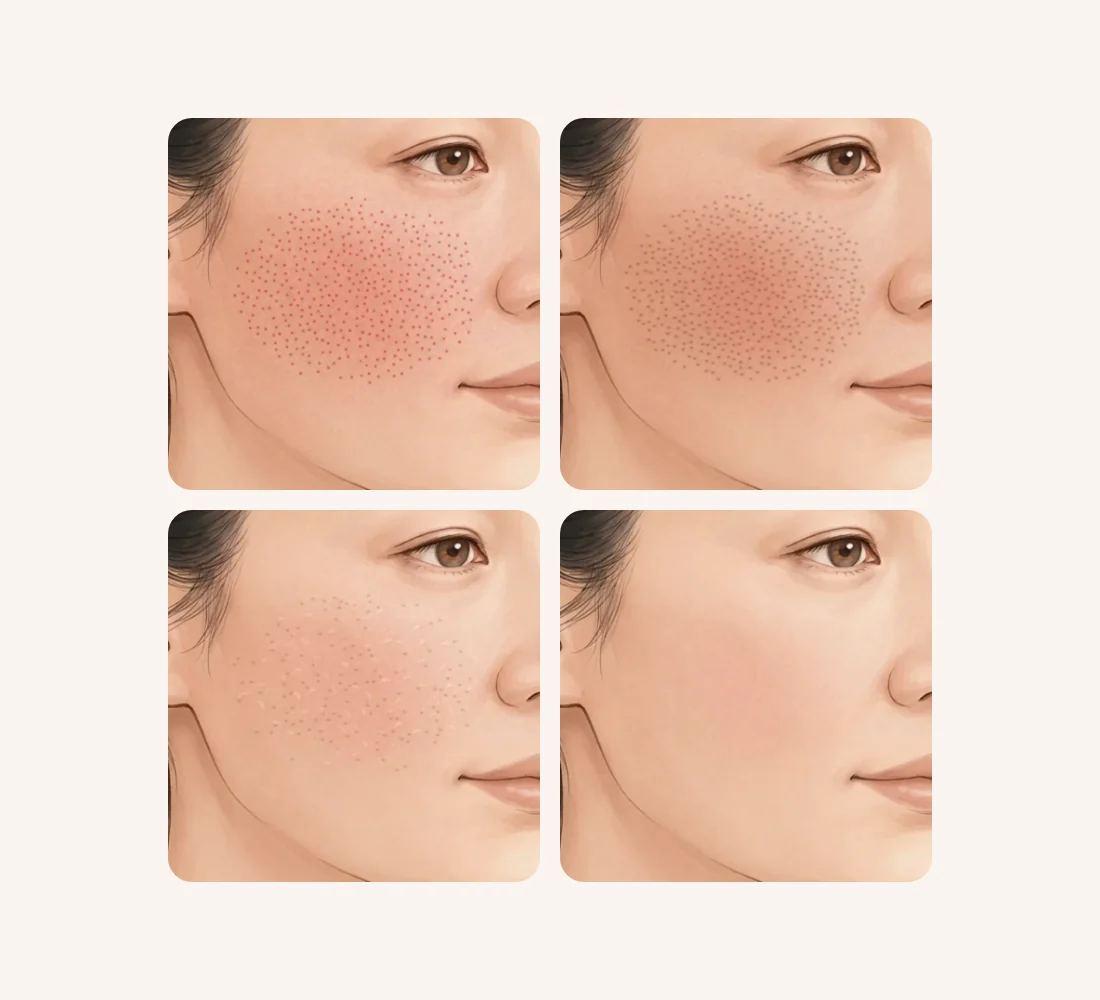
Why does UltraClear recovery take one day for some people and a week for others?
UltraClear is an ablative fractional laser. It uses a 2,910 nm wavelength to make very fine, closely spaced openings in the skin. How it works and which skin concerns it suits are covered in our UltraClear laser guide. This guide focuses on something else: what your skin looks like on each day after treatment, and when you can go back to washing, makeup and exercise as usual.
What decides recovery time is not the device name but how the treatment was done:
- Depth: whether only the very top of the skin was skimmed (the shallow mode), or fine channels were made down into the dermis, the thick layer under the surface (the deep mode)
- Density: how closely the channels were placed
- Passes and area: how many times the same spot was treated, and whether it was part of the face or the whole face
The manufacturer also describes two kinds of recovery. After the light, surface option, you will likely have some redness and mild swelling right after treatment, but you can usually put on makeup within a few hours and return to work the same or the next day. A more intense option for deeper wrinkles, lines around the eyes or acne scars typically needs an average of three or more days of downtime.5
The studies point the same way. One study followed two groups: one had up to four treatments with mild settings, and the other had a single treatment with deeper settings. Redness, swelling and pinpoint bleeding after treatment were mild to moderate and lasted up to about 5 days. There was no scarring and no change in pigment.1 In another study, the whole face and neck were treated with several overlapping passes. Pinpoint bleeding, redness, swelling and thin, soft crusts appeared, and these reactions lasted 5 to 7 days.2 In simple terms, the lighter and shallower the treatment, the closer recovery is to a day or two; the deeper and wider it is, the closer it gets to a week.
What you may see after UltraClear, day by day
Where does the "no downtime laser" idea come from?
You may have read that UltraClear has "almost no downtime", meaning the time before you feel ready to be seen in public. That description mostly refers to the shallow option. Even in the manufacturer's own information, "little-to-no downtime" is attached only to the light option, while the deeper approach is listed with several days of recovery.5 Our UltraClear treatment page also says the treatment method changes with your skin's condition, and so do pain and recovery time.
So "I had UltraClear" on its own does not tell you how many days you will need. Ask which depth was used, on which areas and at what density. With those three answers, your recovery plan becomes much clearer.
What you often hear about recovery
What happens day by day after the shallow mode?
The shallow mode skims the outermost layer (the stratum corneum) and the epidermis very lightly. In one study it was set to an estimated depth of about 10 µm (0.01 mm), covering about 25% of the skin surface.3 Because the surface is barely opened, recovery is short.
- Day of treatment: your face may look red, slightly puffy and feel warm. In the same study, redness and swelling were mild to moderate, and pain during treatment averaged 1.9 out of 10.3
- The next day: redness has usually settled a lot. The manufacturer says you can go back to work the same or the next day.5 If your skin feels a little rough or tight, moisturizer helps.
- Days 2 to 5: some fine flaking may appear. Our UltraClear page also notes that, depending on the device and intensity, redness or flaking can last a few days.
- Around 2 weeks: your skin may look normal from the outside, but the reaction inside continues until about this point. We explain this below.
Sometimes the whole face is treated with the shallow mode while only areas with more damage, such as acne scars or lines around the mouth, also receive the deep mode.1 In that case, those areas follow the deep-mode timeline. It helps to ask which areas were treated deeply.
What happens day by day after the deep mode?
The deep mode makes fine, column-shaped channels down into the dermis. Because tiny openings really are made in the skin surface, the visible reaction is larger and lasts longer than with the shallow mode.
- Day of treatment: redness, swelling and a warm feeling, with pinpoint bleeding where the channels were made.12
- Days 1 to 3: redness and swelling are at their most visible. Thin brown crusts form in tiny dots over the channels, so the skin may look slightly darker and feel like fine sandpaper.2 These crusts act as a cover while the skin underneath closes over.
- Days 4 to 7: crusts and flakes start to come off on their own, and redness fades day by day. In the full-face and neck study, reactions including crusting lasted 5 to 7 days.2
- Weeks 1 to 2: the surface is smooth again, but a faint pink tone may remain. From now and over the next few weeks, watch for any area turning brown. In the same study, two participants had temporary darkening of pigment.2
After the deep mode, the cheek changes like this
1Day 0: red, warm, pinpoint bleeding
Cool the skin, rinse gently with lukewarm water, then apply an ointment-type moisturizer
Cool and moisturize
2Days 1–3: tiny brown crusts
Leave the crusts alone, moisturize generously, and use a hat and sunscreen outdoors
Do not pick
3Days 4–7: crusts and flakes shedding
Let them fall off; skip harsh cosmetics and scrubs for one week
Bonita Clinic advice
4Weeks 1–2: a faint pink tone
Once the surface has closed, restart makeup and workouts, and watch for browning
Watch pigment
Putting the two modes side by side looks like this. The table shows a common course from studies and manufacturer information; not everyone recovers on exactly these days.
| Time | Shallow mode | Deep mode | Care at this stage |
|---|---|---|---|
| Day 0 | Redness, mild swelling | Redness, swelling, pinpoint bleeding | Cool, rinse with lukewarm water, moisturize |
| Days 1–3 | Usually settled, fine flaking | Redness and swelling peak, tiny crusts | Leave crusts, moisturize generously |
| Days 4–7 | Mostly back to normal | Crusts and flakes shed, redness fades | No harsh cosmetics or scrubs for one week |
| Weeks 1–2 | Surface normal, inside still settling | A faint pink tone may remain | Sun protection, watch for pigment change |
Once the skin looks smooth, is recovery complete?
Not quite. Visible recovery and recovery inside the skin run on different clocks.
In one study, small skin samples were taken and examined under a microscope after the shallow mode. One day and one week after treatment, there was still an inflammatory reaction in the dermis. It returned to its pre-treatment state only at two weeks.3 So while surface redness settled in a day or two, the reaction inside lasted close to two weeks. The researchers suggested that this inflammation, triggered by a very shallow injury, may help improve the skin.3
Visible change takes even longer. The manufacturer says improvement after its deeper options can continue for up to six months, and that its channel-based approach takes about two to three months because that is how long it takes to build new collagen and elastic fibers.5 The full-face study also assessed results 90 days after the last treatment.2
The surface heals fast; the inside takes longer
This matters for two reasons. First, one week after treatment is too early to decide that "nothing has changed". Second, a healed surface is not a signal to book the next session right away or to rush back to strong products such as exfoliating acids or retinoids.
When and how should you wash and moisturize?
With both modes, washing and moisturizing start on the day of treatment. The method differs a little.
After the shallow mode, the surface is barely opened. From the evening of treatment you can wash gently with lukewarm water and apply your usual mild moisturizer generously. At Bonita Clinic, we also advise washing with lukewarm rather than hot water, and using enough moisturizer to keep the skin hydrated.
After the deep mode, take more care for the first few days while the channels are open. UltraClear studies did not compare aftercare day by day, so we refer to an expert consensus on ablative CO2 lasers, which have a longer recovery. In that consensus, most experts agreed on covering the skin with an ointment such as petrolatum for the first three days, and the largest share allowed a facial cleanser from days 2 to 3.4 The consensus reflects 21 specialists who use one company's device, many with ties to that company. It is better used as a guide to the order of care while the surface is open than copied directly to UltraClear.
When washing:
- Cup lukewarm water in your palms and rinse as if wetting the face; do not rub.
- Pat dry with a towel instead of wiping.
- Do not try to remove crusts or flakes while washing.
- Do not test new products right after treatment. Simple products you have used before without trouble are the safer choice.
When can you use sunscreen and wear makeup?
Sun protection is the most important part of care throughout recovery. At Bonita Clinic, we advise applying sunscreen thoroughly whenever you go out after treatment, because skin that is still red can darken to brown when exposed to the sun. On the first day after the deep mode, while there is pinpoint bleeding or moisture, shade your face with a hat or umbrella first and apply sunscreen once the surface is dry.
Makeup timing depends on the mode.
- Shallow mode: the manufacturer says makeup can be applied within a few hours.5 Bonita Clinic, however, advises avoiding harsh cosmetics for one week. If you wear makeup, keep it light with your usual gentle products, applied over sunscreen.
- Deep mode: wait until the crusts and flakes have come off on their own and there is no oozing or stinging. Heavy cover-up over crusts, or rubbing when removing makeup, can pull crusts off early.
Strong products, such as exfoliating acids (AHA and BHA), retinoids and high-strength vitamin C, as well as gritty scrubs, come last. Our advice is to wait at least one week, and longer after a deep treatment until the surface has fully settled. In the CO2 consensus as well, most experts had patients restart such ingredients gradually from day 8 onward.4
When are workouts, saunas and alcohol okay?
We found no study that compared when to restart exercise after UltraClear, so the guide is the state of your skin rather than a date. Heavy sweating or getting hot sends more blood to the face, and redness and warmth that had settled can come back. That is why we advise avoiding hot baths and saunas and limiting sudden temperature changes.
- Light movement with little sweat, such as walking: after the shallow mode, usually fine from the next day once redness and warmth have settled.
- Sweaty workouts, hot yoga, hiking: after the shallow mode, once redness is gone; after the deep mode, once all crusts and flakes have come off. Rinse with lukewarm water right after sweating.
- Swimming pools and the sea: after the deep mode, wait until the surface has fully closed. Chlorinated water and salt water can irritate healing skin, and outdoors you also get sun.
- Saunas, hot rooms and hot tubs: last of all. If redness comes back after a visit, rest a little longer.
- Alcohol: it flushes the face for the same reason a sauna does, so it is reasonable to wait until redness has settled.
How can you tell normal healing from a sign to call the clinic?
Redness, swelling, pinpoint bleeding, crusts and flaking are common reactions reported in the studies.12 The simplest test is: "Is it getting less every day?" If it is fading day by day, keep caring for your skin and watch. If it is getting worse, contact the clinic.
What to watch and what to report
Watch if it fades daily
- Redness, swelling, warmth
- Pinpoint bleeding on the day
- Tiny brown crusts, fine flaking
- A faint pink tone at 1–2 weeks
Contact the clinic right away
- Pain or redness getting worse after day 3
- Yellow crusts, pus, increasing oozing
- Clusters of small blisters, especially near the lips
- Crusts not falling off after nearly 2 weeks
- Fever or chills
A few things are worth knowing in advance:
- Cold sores (herpes): ablative lasers can reactivate a dormant cold sore virus. In the CO2 consensus, 95% of experts said they use antiviral medicine to prevent this.4 If you get cold sores often, please tell us before treatment.
- Crusts and swelling: the same consensus treated crusts lasting more than 5 to 14 days as a sign to check, and swelling lasting more than 1 to 2 weeks as an unwanted course.4
- Brown darkening: this can appear in the weeks after redness fades. It is not urgent, but it is important for setting the interval and intensity of your next session. Please send dated photos.
How should you plan the next session and important events?
The next session is timed not by when the surface heals but by when the inside has settled. In the studies, the shallow mode was done twice, two months apart,3 and deep full-face treatment three times, 6 to 8 weeks apart.2 At Bonita Clinic, some treatments are completed in one session and others are divided into several sessions at intervals, and we explain the recommended number and spacing in advance. For repeated scar treatments, see also our guide to scar laser sessions and intervals.
Important events: please tell us about them at your consultation; our treatment page asks for the same. Two kinds of time matter:
- Time for crusts and redness to clear: a day or two after the shallow mode, close to a week after the deep mode.25
- Time to watch for pigment change: brown marks can appear after redness fades, so leave a margin rather than treating right before the event.
If you have had a bad sunburn just before treatment, it is better to postpone. In the CO2 consensus, many experts listed heavy sun exposure in recent weeks as a reason to avoid treatment.4 If a beach holiday or outdoor event falls just before or after treatment, we adjust the timing together.
How we approach it at Bonita Clinic
Bleeding, infection, inflammation and other side effects can occur after any procedure, and recovery varies from person to person. The actual plan is made after an examination.
What UltraClear treatment can you discuss in Seoul?
At Bonita Clinic in Seoul, UltraClear is used for skin texture and tone, fine lines and pores, and is combined with other devices where the cause calls for it. Which mode fits depends on your skin: a light, shallow treatment for texture and dullness, a deeper treatment for lines or acne scars, or a combination with deeper work only on selected areas. If firmness is the main concern, other devices may be planned alongside. The UltraClear treatment page describes the procedure, and the Mediostar treatment page covers firming and contouring.
Why do the plan and cost differ from person to person?
UltraClear is not a single fixed treatment, so the plan and cost are not set before your skin is examined.
- Shallow, deep or combined mode
- Treatment area: part of the face or the whole face
- Density and number of passes
- Number of sessions and interval
- Other devices combined
Final plan and quote after an in-person exam
The deeper and wider the treatment, the longer the recovery as well. When you plan a trip, recovery days matter as much as the treatment itself, so we look at both together.
What can photos show, and what needs an in-person exam?
Photos sent before your visit help us understand your main concern and give a rough idea of which mode may be discussed. The actual depth and settings are decided after we see your skin in person.
Photos can show
- The main concern: texture, fine lines, scars, dullness
- Which areas bother you
- Visible spots that may be pigment
- Your schedule and recovery window
Needs an in-person exam
- Skin type and how easily it darkens
- Whether melasma is mixed in
- Depth of scars and lines under good light
- Skin thickness and sensitivity
- Recent treatments and products that affect healing
You can send us a message with photos and your travel dates before planning your visit to Seoul.
How should you plan a visit to Seoul around UltraClear recovery?
Because recovery depends so much on depth, it is better to plan the treatment around your schedule than to fit your schedule to one number. After the shallow mode, many people return to daily life the same or the next day.5 After the deep mode, crusts and redness can take close to a week,2 and sun protection is needed for weeks afterwards. If you will be sightseeing outdoors, traveling home or attending events, tell us your dates. We decide together, at consultation, which depth suits your stay and recovery. Bonita Clinic is in Seoul at 565 Gangnam-daero, 3rd floor, about 100 m on foot from Exit 8 of Nonhyeon Station on Line 7. Since 1995, Dr. Kwang-Seop Jung has been seeing patients in the same place.
Frequently asked questions
Can I go to work the day after the shallow mode?
Usually, yes. The manufacturer says you can return to work the same or the next day after the light option.5 Some redness and mild swelling may remain for about a day, so leave a margin if your face will be in photos or on camera. If deep mode was added to some areas, those areas follow the deep-mode course.1
Tiny brown crusts appeared. Can I peel them off?
Please do not. They are thin crusts over the tiny channels made by the deep mode, and they act as a cover while the skin below closes over. Pulling them off or scrubbing can expose skin that has not finished healing, so redness may last longer or the area may darken. Keep moisturizing and let them fall off on their own. In the study, reactions including crusting lasted 5 to 7 days,2 and if crusts remain for nearly two weeks, please let us know.4
Redness has lasted more than a week. Is that normal?
If it is fading every day, it is usually part of normal healing. The deeper and denser the treatment, the longer redness lasts, and a faint pink tone can remain for 1 to 2 weeks. If redness gets darker again, or pain and oozing increase, contact us right away. If the area seems to be turning brown, it is not urgent, but please tell us before your next visit.2
Exactly how many days until I can work out or use a sauna?
We found no study that compared exact dates, so it depends on your skin. After the shallow mode, start with light exercise once redness and warmth have settled; after the deep mode, start sweaty workouts once all crusts and flakes have come off. Saunas and hot tubs come last, and if redness comes back afterwards, rest a little longer.
Once the surface has healed, can I have the next session right away?
Even when the surface has healed, the reaction inside continues. In the shallow-mode study, it took two weeks for the inflammatory reaction in the dermis to return to normal.3 Treatment intervals in the studies were 6 to 8 weeks or 2 months.23 At Bonita Clinic, we explain the recommended number of sessions and spacing in advance, based on your goals and skin.
What to prepare before your consultation
- What you most want to change (texture, fine lines, pigment, acne scars, firmness) and in what order
- How long you can live with redness and crusts, and dates to avoid (weddings, photo shoots, presentations, travel)
- Recent laser, peel or injection treatments, their dates, and how long redness lasted
- Whether your skin has darkened after laser before, or whether you have been told you have melasma
- Whether you get cold sores often, and any retinoids or exfoliating products you use now
What UltraClear is, and how it differs from CO2 fractional lasers, is covered in our UltraClear laser guide and UltraClear vs CO2 fractional laser guide.
References (5)
Sources that support the explanations in this article. Study findings describe general trends and do not guarantee individual results.
- Selim MM, Lowery JA, Maredia HS, Zelickson BD. Clinical evaluation of a new fractional ablative 2910 nm erbium laser on photodamaged skin: A pilot study. Lasers Surg Med. 2023;55(8):715-723.doi:10.1002/lsm.23714UltraClear (2,910 nm) pilot study, 37 enrolled (35 completed): up to four mild-setting treatments (deeper on some areas) vs one deeper treatment — redness, swelling and pinpoint bleeding were mild to moderate and lasted up to about 5 days; no scarring or pigment change; both groups improved at 3 months
- Murray TN, Hu JK, Friedman PM. Full-face and neck resurfacing with a novel ablative fractional 2910 nm erbium-doped fluoride glass fiber laser for advanced photoaging. Lasers Surg Med. 2024;56(3):249-256.doi:10.1002/lsm.23764UltraClear full-face and neck multi-pass treatment, three sessions 6–8 weeks apart (22 enrolled, 15 completed): pinpoint bleeding, redness, swelling and soft crusting for 5–7 days; no infection, scarring or hypopigmentation; two cases of temporary hyperpigmentation; results assessed 90 days after the last session; average pain 4.9/10
- Bernstein EF, Sanzo JF, Wang JY, et al. Low-fluence treatment with a novel fractionated 2,910-nm fiber laser improves photodamage. Lasers Surg Med. 2023;55(1):35-45.doi:10.1002/lsm.23624Shallow mode (estimated 10 µm depth, 25% coverage), two full-face sessions 2 months apart (20 people): mild to moderate redness and swelling, pain 1.9/10; biopsies showed dermal inflammation at 1 day and 1 week, back to baseline at 2 weeks, which may contribute to improvement
- Levy T, Lerman I, Waibel J, et al. Expert Consensus on Clinical Recommendations for Fractional Ablative CO2 Laser, in Facial Skin Rejuvenation Treatment. Lasers Surg Med. 2025;57(1):15-26.doi:10.1002/lsm.23850Consensus of 21 specialists on ablative fractional CO2 lasers (single device, 14 with company ties): petrolatum for the first 3 days (76%), cleanser from days 2–3 (62%), active ingredients resumed gradually from days 8–42 (76%), crusts beyond 5–14 days a concern, swelling beyond 1–2 weeks undesirable (59%), antiviral prophylaxis (95%), recent heavy sun exposure a contraindication (67%) — based on a device with longer recovery than UltraClear
- Acclaro Medical. Laser Treatment FAQs | Acclaro UltraClear. . 2026.Manufacturer information: the light option (3DMIRACL) causes redness and mild swelling right after, with makeup in a few hours and work the same or next day; deeper options for deep wrinkles, eye lines and acne scars average 3+ days of downtime; deeper options improve for up to 6 months, Laser-Coring 2–3 months. Company claims about efficacy and safety for all skin types are not repeated
About this article
This article separates general medical information from Bonita Clinic's own approach. Because the right decision depends on each person's condition, it is not a substitute for a consultation.