KOKorean
 ENEnglish
 JP日本語
 CN中文(简体)
 TW中文(繁體)

UltraClear vs CO2 Fractional Laser in Seoul: What Each Can and Cannot Do for Scars and Texture
UltraClear is an ablative fractional laser that uses 2,910 nm light from an erbium fiber, and a CO2 fractional laser uses 10,600 nm light; both make a dense grid of very thin channels in the skin. CO2 leaves more heat around each channel, which can produce a larger change in deep scars but usually means more pain and a longer recovery, while UltraClear leaves less thermal injury and a lighter recovery. What they cannot do matters as much: UltraClear, marketed as a "cold" laser, can still cause dark marks; CO2 is not the better choice for everyone; and neither lifts the base of deeply tethered scars or sagging skin. Which one fits depends on scar depth, how easily your skin darkens and how much recovery time you can allow. If you are considering laser resurfacing in Seoul, you can send us photos and your treatment history first to see which approach may be realistic.
Curious about your own case? Ask us online →
What do UltraClear and CO2 fractional lasers have in common?
UltraClear and CO2 fractional lasers look different and carry different names, but they work on the same principle. Both are ablative fractional lasers.
- Ablative means the light actually removes a very thin piece of skin tissue. It is closer to vaporizing tissue in an instant than to cutting it.
- Fractional means the laser does not treat the whole surface at once. It makes a dense grid of very thin channels and leaves the skin between them untouched. That untouched skin acts as a base for fast healing, and during healing the collagen in the skin (the protein fibers that hold skin firm) is rebuilt.
Both lasers target water in the skin. Lasers that target water have been a mainstay of facial laser treatment for decades.2 The difference is the wavelength: CO2 fractional lasers use 10,600 nm light, while UltraClear uses 2,910 nm.31 With a different wavelength, the same-sized channel leaves a different amount of heat around it. That difference carries through to results, pain, recovery time and the risk of pigment changes.
"Fraxel" is often used as a general word for fractional lasers, and "CO2 Fraxel" for the CO2 type. Fraxel re:pair, a device used in many studies, is itself a fractional CO2 laser.4 UltraClear's own modes and studies are covered in our separate UltraClear guide. This article puts the two lasers side by side and looks at how to choose between them.
Why does wavelength change how much heat is left behind?
Laser light turns into heat as it is absorbed by water in the skin. Light that water absorbs very strongly vaporizes only the spot it hits, and little heat spreads around it. Light that is absorbed less strongly warms more of the surrounding tissue while making the same channel. That warmed tissue becomes a thin, heat-set layer called the coagulation zone.
A meta-analysis (a study that pools and re-analyzes the results of several studies) summarizes the two families this way. Fractional CO2 lasers generally produce more thermal coagulation and deeper tissue remodeling. Erbium-type lasers may cause less thermal injury and allow a shorter recovery.3 UltraClear produces its light in an erbium-doped glass fiber, so it belongs to the erbium family.1 The manufacturer markets it as a "cold" ablative laser, meaning less heat is left behind.
Same principle, different heat
Put simply, CO2 leaves plenty of heat and delivers a strong stimulus, while UltraClear removes tissue but leaves less heat behind. More heat is not automatically better or worse. Some concerns, such as deep scars, call for a strong stimulus. Some skin, especially skin that darkens easily, is better treated with less heat.
How do they compare side by side?
The table below sets out what studies have reported, item by item. The numbers are averages from study participants, not a prediction for any one person.
UltraClear and CO2 fractional compared
| Item | UltraClear | CO2 fractional |
|---|---|---|
| Wavelength | 2,910 nm · erbium fiber | 10,600 nm |
| Heat around channels | Less | More · deeper stimulus |
| Pain | Mild in shallow mode | Higher than erbium-type |
| Recovery | Short if shallow; 5-7 days if intense | Longer than erbium-type |
| Scar response | Studies still small | Tends to be larger in comparisons |
| Item | UltraClear | CO2 fractional |
|---|---|---|
| Wavelength | 2,910 nm, erbium fiber laser1 | 10,600 nm3 |
| Pain | Shallow mode averaged 1.9 out of 10;2 a study with multiple passes over the face and neck averaged 4.91 | On average about 1.9 points higher (out of 10) than erbium-type lasers3 |
| Recovery | Shallow mode: mild to moderate redness and swelling;2 intense multipass treatment: pinpoint bleeding, redness, swelling and crusting for 5-7 days1 | On average about 3.7 days longer than erbium-type lasers3 |
| Pigment changes | Temporary darkening in two people in an advanced sun-damage study1 | After one treatment in nine Asian patients: five at one month, one at six months4 |
The CO2 figures mean "how much more than erbium-type lasers." The erbium-type lasers in that comparison were ablative Er:YAG (2,940 nm) and non-ablative erbium glass lasers; UltraClear was not included.3 So these numbers show the direction of the difference between UltraClear and CO2 rather than its exact size.
Does CO2 give stronger results?
For acne scars, a slightly larger response has been reported with CO2. A meta-analysis that pooled five comparison studies (130 people) found that the share of people whose scars improved by more than half was higher with fractional CO2.3 When only studies with confirmed random allocation (treatment assigned by chance, like drawing lots) were analyzed, the direction stayed the same, but the difference was no longer statistically clear.3 In plain terms: deep scars may respond a little more to CO2, but it is too early to call it a settled difference.
UltraClear has its own evidence. In skin with mild sun damage, two shallow-mode sessions produced an average improvement of about 25% when blinded reviewers (who did not know which photo was before or after) compared photos.2 In advanced sun damage, three multipass treatments of the face and neck produced moderate to marked improvement.1 These studies, however, had a few dozen participants or fewer and no comparison group.
A study of a single fractional CO2 treatment in Asian patients also found statistically significant improvement in texture, laxity, wrinkles, pores and acne scars, but the improvement was mild to moderate.4 With either laser, it is more realistic to think of a course of treatments that build up over time than of one large change.
How different are pain and recovery?
Recovery here means the days when redness, swelling or crusting make daily life less comfortable. That period depends more on how deep and how dense the treatment is than on the device name.
- UltraClear, shallow mode: it refines the very top of the skin to an estimated depth of about 10 µm. Pain averaged 1.9 out of 10, and the reaction afterward was mild to moderate redness and swelling.2
- UltraClear, intense treatment: in a study with multiple passes over the whole face and neck, pain averaged 4.9. Pinpoint bleeding, redness, swelling and thin crusts lasted five to seven days.1
- CO2 fractional: pooling studies that compared it with erbium-type lasers, pain was on average about 1.9 points higher out of 10, and recovery was on average about 3.7 days longer. Only two studies had recovery data that could be compared.3
UltraClear investigators reported less discomfort and downtime than with conventional ablative fractional lasers.1 If an important event is coming up, a shallow UltraClear treatment is the lighter option. On the other hand, intense, multipass UltraClear can also need close to a week to recover. Try not to assume UltraClear always heals in a day or two.
If UltraClear is a "cold" laser, is darkening no longer a worry?
No. UltraClear, which the manufacturer calls a "cold" laser, is still an ablative laser that removes tissue with light. "Cold" means less heat is left behind; it does not mean inflammation or pigment changes cannot happen.
In Asian skin, including Korean skin, the most common problem after ablative lasers is post-inflammatory hyperpigmentation: the area where laser inflammation has passed turns brown. In skin with melasma, the melasma can also rebound and darken after treatment.5
In one study, nine Chinese patients with skin types III-IV (skin that tans moderately, common in East Asia) had a single fractional CO2 treatment. One month later, five of the nine had darkening; at six months, it remained in one of the nine.4 Because the rate was high, the authors wrote that the role of fractional CO2 in Asian patients needed to be reconsidered.4
Darkening after CO2 fractional: how often, how long
This does not mean UltraClear never causes darkening. Two people in an UltraClear study also had temporary darkening.1 The meta-analysis mentioned above did not find a clear difference in darkening rates between CO2 and erbium-type lasers.3 In plain terms, there are not yet enough studies to say that one of them clearly causes less.
A review of fractional lasers in Asian skin concludes that more sessions at lower density, spaced further apart, lower the risk of darkening without greatly reducing the effect.5 For melasma, it describes only cautious use of non-ablative devices in selected cases.5 That is why checking for melasma comes before choosing either laser.
Which one may suit your concern?
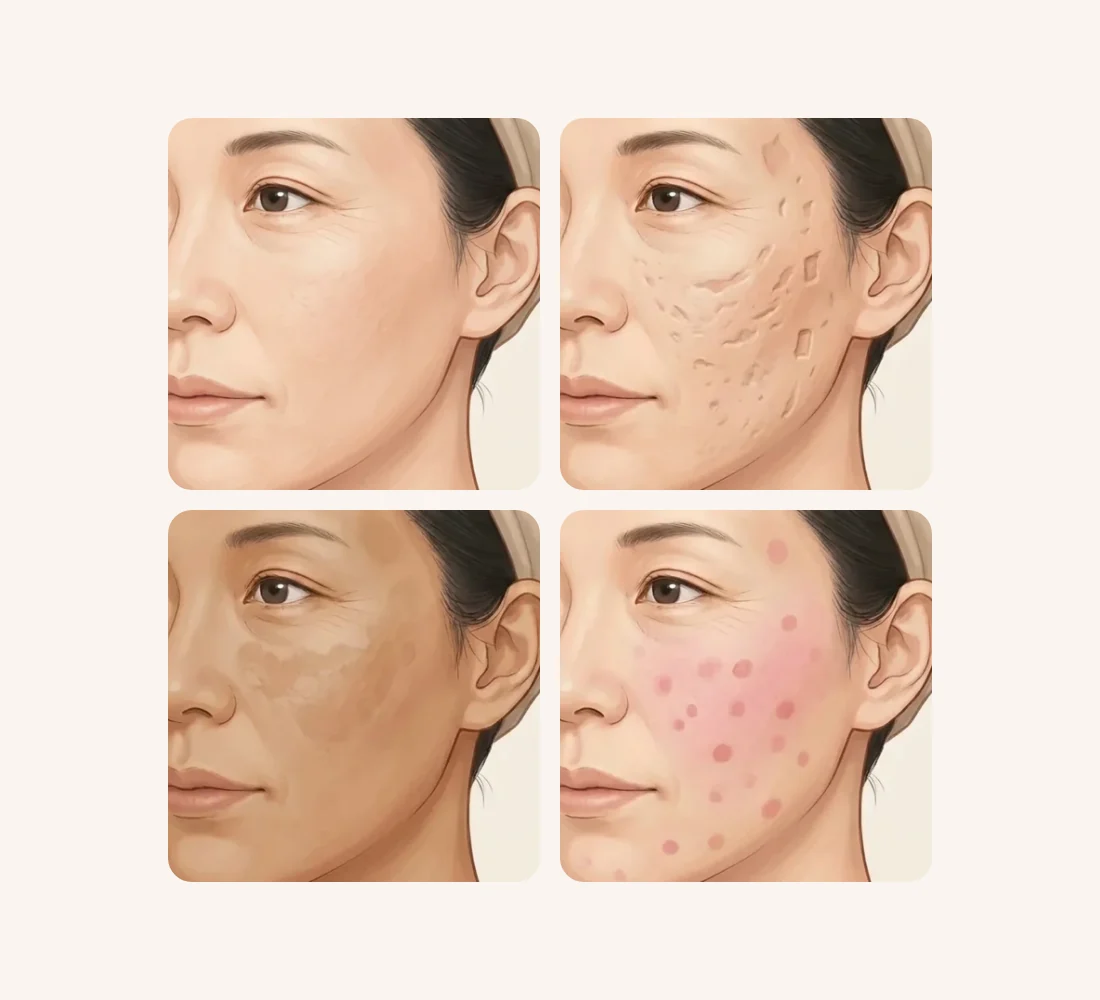
Which laser is considered first depends on the concern. The cards below change only the skin of the same person to show what is looked at first in each case.
Which laser is considered first, by concern
1If it is fine lines or rough texture
UltraClear's shallow mode, with its lighter recovery, is considered first
UltraClear
2If acne scars are deep and wide
CO2 fractional, with more heat, is considered alongside treatments that lift the scar base
CO2 fractional · scar care
3If you have melasma or darken easily
With either laser, melasma is checked first and density is kept low over more sessions
Diagnosis first
4If the marks are red rather than pitted
A vascular laser is considered before an ablative one
Vascular laser
What would you most like to improve first?
- Fine lines, texture, dullnessUltraClear shallow mode firstShort recovery, several sessions
- Deep, pitted scarsConsider CO2 fractionalLift the scar base first
- Skin that darkens easilyLow density with either laserCheck melasma, wider intervals
- Recovery must be very shortUltraClear, shallowSave intense treatment for later
Most people do not fit neatly into one branch. Fine lines and scars often appear together, and scars can be mixed with pigment and redness. In that case, the strength and the device can be planned differently for each area of the same face.
When is neither laser the first step?
Ablative lasers treat the skin surface and the layer just beneath it. If the cause lies deeper or is of a different kind, another treatment comes first.
- Deeply sunken scars: if the base of a scar is tethered to deeper tissue like a cord, smoothing the surface with a laser leaves the dip behind. At Bonita Clinic, deep scars are first lifted from the base with punch techniques or release of the tethering bands, broad depressions are filled with fat grafting, and lasers come last to even out the surface and pores. Our guide Why acne scars stay after many laser sessions explains this in more detail.
- Red marks and flushing: redness left after acne is often a blood-vessel problem rather than a pitted scar. In our equipment list, red scars and flushing are handled separately with vascular lasers such as the Vbeam.
- Melasma: it can darken after ablative lasers, so diagnosis comes first.5
- Sagging: lasers that resurface the skin do not lift sagging skin. If sagging is the main concern, firming devices such as ultrasound or radiofrequency are considered separately.
How we choose at Bonita Clinic
Treatment options you can discuss in Seoul
Bonita Clinic has been at the same address in Seoul since 1995, and Dr. Kwang-Seop Jung, a plastic surgeon board-certified in Brazil, sees patients himself. For skin texture, fine lines, pigment and scars, the devices described on our pages include:
- UltraClear (2,910 nm ablative fractional laser)
- Fraxel re:pair (fractional laser for depressed scars and texture) and a CO2 laser for evening out uneven, bumpy scar surfaces
- Lotus III (Er:YAG laser for scars, pores and texture)
- Vbeam (vascular laser for red scars and flushing) and Sculpio (picosecond laser)
- Scar treatments that lift the base, such as punch techniques, release of tethering bands and fat grafting
Device descriptions reflect general use. Which of them you need, and in what order, is decided after your skin is examined.
Why do the plan and cost differ from person to person?
Two people asking "UltraClear or CO2?" can need very different plans. The cost follows the plan, and the plan follows your skin.
- Main concern: texture, lines, scars or pigment
- Which laser, and how deep and dense
- Area: spot treatment or full face
- Number of sessions and spacing
- Skin type and risk of darkening
- Other scar treatments needed first
Final plan and quote after an in-person skin exam
A final quote is given after the in-person exam, once the device, depth, area and number of sessions are clear. Photos can point in a direction, but they cannot fix the plan.
What can photos show, and what needs an in-person exam?
Photos are a useful first step for understanding your concern. They cannot show everything that the choice between these two lasers depends on.
Photos can show
- Overall texture and visible fine lines
- Where scars, pigment and redness are
- The outline of acne scars in good light
- How your skin reacted to past lasers
Needs an in-person exam
- Scar depth and tethering under side light
- Whether pigment includes melasma
- Skin type and how easily it darkens
- Active acne or inflammation
- Whether the base must be lifted first
Helpful photos are taken front-on and from both sides at 45 degrees, in daylight and without makeup. A photo with light coming from the side shows the depth of scars better. If you have had lasers before, tell us the device or type and whether your skin darkened afterward. You can send us a message with your photos and a short treatment history.
Planning your visit and recovery
What is confirmed in advance for UltraClear is limited to the treatment information above: a non-surgical procedure with numbing cream, going home the same day and no stitches. In studies, the shallow mode caused mild to moderate redness and swelling, while intense multipass treatment needed five to seven days.21 Studies comparing CO2 with erbium-type lasers found recovery to be on average a few days longer with CO2.3 Your own course depends on the device and settings chosen.
Studies spaced repeat sessions from three weeks to two months apart.312 A plan with several sessions therefore means either returning to Seoul or choosing a gentler approach that fits your schedule. How many visits make sense for you is decided together at consultation, based on your skin and your plans.
After you return home, protect the treated skin from the sun, keep skin care gentle and avoid other lasers or peels on the area unless a doctor advises them. If you notice darkening, oozing or blisters, see a local doctor and keep dated photos; they help any doctor who sees you later.
Frequently asked questions
Will one UltraClear session fill in my pitted scars completely?
That is unlikely. UltraClear studies built up results over several sessions, such as two shallow sessions2 or three multipass treatments of the face and neck.1 And when the base of a scar is tethered to deeper tissue, a laser that refines the surface leaves the dip behind. At Bonita Clinic such scars are lifted from the base first, and lasers are used last to even out the surface and pores.
Will a CO2 fractional laser definitely leave dark marks?
Not definitely, but it is fairly common in Asian skin. Among nine patients treated once, five had darkening at one month and one still had it at six months.4 Temporary darkening also occurred in an UltraClear study,1 and studies have not shown a clear difference between the two families.3 Lower density, more sessions and wider intervals are described as lowering the risk,5 and if melasma is suspected it is diagnosed first.
Is UltraClear weaker than a CO2 fractional laser?
It is less a question of strength than of how heat is used. For deep acne scars, a slightly larger response has been reported with fractional CO2, but UltraClear was not part of that comparison and the difference was not settled.3 UltraClear can also be used intensely: in an advanced sun-damage study, multipass treatment of the face and neck produced moderate to marked improvement.1 Which suits you better depends on scar depth and shape, your skin type and how much recovery time you can allow.
How many sessions will I need?
It depends on the goal and intensity. UltraClear studies used two shallow sessions two months apart2 or three multipass treatments six to eight weeks apart.1 Studies comparing CO2 with erbium-type lasers treated at intervals of three weeks to two months.3 One study found only mild to moderate improvement after a single CO2 treatment,4 so treatment is usually divided into sessions. The recommended number and interval are explained at consultation.
Which should I choose if my schedule is tight?
If recovery time matters most, UltraClear's shallow mode is the lighter option; in studies the reaction was mild to moderate redness and swelling.2 The improvement is also smaller than with intense treatment. Intense multipass UltraClear needed five to seven days to recover,1 so tell us about photos, presentations or travel dates when you consult. The two lasers can also be planned for different areas of one face, but whether that happens on the same day or with a gap depends on your skin.
What to prepare before your consultation
- What you most want to improve first (fine lines, texture, acne scars, pigment or redness), in order of priority
- The names or types of lasers you have had, and whether your skin darkened afterward
- Whether you have ever been diagnosed with melasma
- How long you can accept redness and crusting, and any dates to avoid
- Whether you often get cold sores, and whether your wounds tend to heal thick
You can read about the treatment process on our UltraClear page and about scar treatment on our acne and pore scar page. For pigment and tone, see our Sculpio picosecond laser page. UltraClear's modes and studies are explained in detail in our UltraClear laser guide.
References (5)
Sources that support the explanations in this article. Study findings describe general trends and do not guarantee individual results.
- Murray TN, Hu JK, Friedman PM. Full-face and neck resurfacing with a novel ablative fractional 2910 nm erbium-doped fluoride glass fiber laser for advanced photoaging. Lasers Surg Med. 2024;56(3):249-256.doi:10.1002/lsm.23764UltraClear (2,910 nm erbium-doped fluoride glass fiber) study: 22 enrolled, 15 completed; three multipass face-and-neck treatments 6-8 weeks apart; pain 4.9/10; pinpoint bleeding, redness, swelling and crusting for 5-7 days; moderate to marked blinded improvement; two cases of temporary darkening; authors concluded less discomfort and downtime than conventional ablative fractional lasers (no direct comparison group)
- Bernstein EF, Sanzo JF, Wang JY, et al. Low-fluence treatment with a novel fractionated 2,910-nm fiber laser improves photodamage. Lasers Surg Med. 2023;55(1):35-45.doi:10.1002/lsm.23624UltraClear shallow mode (estimated depth 10 µm), two sessions two months apart in 20 people: about 25% blinded photo improvement, pain 1.9/10, mild to moderate redness and swelling; background that water-targeting lasers have long been central to facial laser treatment
- Song X, Zhi BW. Comparative efficacy and safety of fractional carbon dioxide and erbium-based fractional lasers for atrophic acne scars: A systematic review and meta-analysis. Lasers Med Sci. 2026;41(1):222.doi:10.1007/s10103-026-05022-zMeta-analysis of 5 studies (130 people) comparing CO2 (10,600 nm) with erbium-type lasers (three Er:YAG 2,940 nm, two non-ablative erbium glass; no UltraClear) for acne scars: higher share with >50% improvement after CO2 (not significant in randomized-only analysis), pain 1.86 points higher, recovery 3.67 days longer (2 studies), no significant difference in darkening; introduction notes more thermal coagulation and deeper remodeling with CO2; intervals 3 weeks to 2 months
- Chan NP, Ho SG, Yeung CK, et al. Fractional ablative carbon dioxide laser resurfacing for skin rejuvenation and acne scars in Asians. Lasers Surg Med. 2010;42(9):775-783.doi:10.1002/lsm.20974Single fractional CO2 (Fraxel re:pair) treatment in nine Chinese patients (skin types III-IV): significant but mild to moderate improvement in texture, laxity, wrinkles, pores and acne scars; post-inflammatory darkening 55.5% (5 of 9) at one month and 11.1% (1 of 9) at six months; authors called for its role in Asians to be reviewed
- Wat H, Wu DC, Chan HH. Fractional resurfacing in the Asian patient: Current state of the art. Lasers Surg Med. 2017;49(1):45-59.doi:10.1002/lsm.22579Review of fractional resurfacing (including CO2 and Er:YAG) in Asian patients: main complications are post-inflammatory darkening and melasma rebound; more sessions at lower density and wider intervals lower the risk without compromising efficacy; melasma only in selected cases with non-ablative devices, cautiously
About this article
This article separates general medical information from Bonita Clinic's own approach. Because the right decision depends on each person's condition, it is not a substitute for a consultation.