KOKorean
 ENEnglish
 JP日本語
 CN中文(简体)
 TW中文(繁體)


UltraClear for Acne Scars in Seoul: How Many Sessions, How Far Apart, and What They Can and Cannot Do
UltraClear is a 2,910 nm ablative fractional laser that makes very fine channels in the skin; for acne scars, its deeper mode, which reaches the dermis, is usually used. In a study of 13 people with rolling and boxcar scars treated three times at 6–8 week intervals, blinded reviewers rated the average improvement at 47.3% three months after the last session, and manufacturer and clinic guidance describes a few sessions spaced roughly six weeks to two months apart. Three sessions, however, was the study's protocol, not a promise that scars will be filled in: narrow ice pick scars and scars tethered from below often keep their shadows however many sessions you add, so punch techniques or subcision may come first. The number and spacing depend on your scar types and depth, whether your skin darkens easily, and how your skin recovers and responds after each session. If you are considering acne scar treatment in Seoul, you can start by sending a cheek photo taken with light from the side.
Curious about your own case? Ask us online →

Why are acne scars treated with UltraClear in several sessions?
UltraClear is an ablative fractional laser that uses a 2,910 nm wavelength to make very fine, closely spaced channels in the skin. "Ablative" means it removes a tiny amount of tissue; "fractional" means it treats only a fraction of the skin at a time and leaves the skin between the channels intact, so that untouched skin can drive healing. How the device works and how its depth modes differ is covered in our UltraClear laser guide. This article focuses on one practical question: how many sessions, and how far apart, when the target is acne scarring.
For acne scars, the deeper mode is usually used, sending micro-channels down into the dermis (the thick layer of skin beneath the surface). The manufacturer also recommends a more intensive approach for deeper wrinkles and acne scars.2 As each channel heals, collagen (the protein fibers that support the skin) is rebuilt around it.
Each session, however, treats only part of the skin, and new collagen takes months to settle. So instead of trying to fill a scar in one go, treatment works by softening the edges and the floor of the scar a little at a time, with rest periods in between.
What builds up with each session
Put simply, each session adds a layer rather than digging deeper. But as the right side of the drawing shows, when the floor of a scar is tied down to deeper tissue by fibrous bands, repeating laser sessions rarely releases those bands. We come back to this below.
How many sessions, and how far apart, do studies and the manufacturer describe?
One study looked specifically at UltraClear for acne scars. In the United States, 14 people with rolling scars (broad, gently sloping depressions) or boxcar scars (round scars with sharp edges) enrolled, and 13 completed the study. They received three treatments 6–8 weeks apart.1
Results were judged by comparing photos taken before treatment with photos taken 1 and 3 months after the last session. Two reviewers who did not know which photos were "after" did the scoring.1
- Three months after the final treatment, the reviewers' mean improvement score was 47.3%, with variation between people.
- Participants and the treating physician also rated improvement at each visit, and both saw improvement.
- Side effects averaged trace-to-mild redness, swelling and pinpoint bleeding.1
Neither the manufacturer nor other clinics fix the number of sessions. The manufacturer's patient information says some people see meaningful improvement after a single session and that the plan is set at consultation. For deeper ("advanced") treatments it describes 5–10 days of moderate redness and peeling, with peak results visible at around 3–6 months.2 One U.S. dermatology practice describes starting with a single treatment that combines superficial and deeper passes; because improvement continues over six months, it notes that additional treatments can be done as early as two months apart.3
| Source | Number of sessions | Interval | When results were judged |
|---|---|---|---|
| Acne scar study (13 people)1 | 3 | 6–8 weeks | 1 and 3 months after the last session |
| Manufacturer patient information2 | Some see change after one; plan set at consultation | Not specified | Clearest at around 3–6 months |
| A U.S. dermatology practice3 | Describes many patients improving after 1–2 | At least 2 months apart | Improvement over 6 months |
Taken together, the sources overlap on "a few sessions, roughly six weeks to two months apart." The three sessions in the study were a research protocol chosen in advance, not a number that fits everyone.
Where does "three sessions and the scars are gone" come from?
Because the study used three treatments, "UltraClear means three sessions" may have become a shorthand. What the study actually showed is that after three sessions, the reviewers' average improvement score was 47.3%.1 That is not the same as the scars being completely filled in.
What you often hear about sessions
The size and makeup of the study matter, too. Only 13 people completed it, and there was no untreated comparison group. All participants had Fitzpatrick skin type II or III.1 Skin type groups skin by how easily it burns or tans; higher numbers mean darker skin that is more prone to pigmentation. There is less data for type III–IV skin, which is common in East Asian patients, and especially for skin that darkens after lasers. The manufacturer itself notes that its advanced treatments are optimized for skin types I–III.2
So the figure should be read as evidence that this laser can improve rolling and boxcar acne scars. It is not a prediction of how much one person will improve, or after how many sessions.
What can you expect from each session?
Change does not arrive all at once at the end of each session. Surface recovery passes within days, while changes underneath carry on even after the next session. Laid out on a single line, the study schedule looks like this.
The study schedule at a glance
- Right after session 1: after the deeper mode, expect a few days of redness, swelling and pinpoint bleeding, followed by thin crusts that flake off. The manufacturer says treated areas are fully healed within 1–2 weeks.2 Day-by-day guidance on washing, makeup and exercise is in our UltraClear recovery guide.
- Between sessions: even after the surface looks smooth, collagen is still being rebuilt underneath, so you may not notice much in the mirror.
- Sessions 2 and 3: repeating the cycle aims to soften the edges of shallow scars a little more each time. How long redness lasted and whether any area turned brown after the previous session guide the depth and density of the next.
- After the last session: the study assessed results three months after the final treatment,1 and the manufacturer says results are clearest at around 3–6 months.2 That is why results are not judged right after the last session.
Because change builds slowly, photos taken in the same place, light and angle at each visit help. Side lighting in particular shows the shadows of depressed scars, which makes it easier to compare several sessions.
Do scar types change the number and order of sessions?
Yes. A systematic review of energy-based treatments (a study that gathers and summarizes all relevant research using set methods) found that rolling and boxcar scars respond most to fractional lasers, while ice pick scars, which are narrow and deep like a puncture, respond least because they extend deeper than the laser reaches. It also noted that adding punch elevation (lifting the scar's floor) helps deep scars, and that the overall effect of fractional lasers depends largely on which scar types dominate a face.4 The UltraClear study above included only rolling and boxcar scars.1
How the session plan changes with scar type and skin
1Mostly shallow boxcar and rolling scars
UltraClear sessions are the core of the plan, spaced out to soften edges and texture
UltraClear
2Broad, wavy depressions pulled down from below
Subcision to release the bands comes first; laser sessions follow
Subcision + laser
3Narrow, deep ice pick scars mixed in
They respond least to lasers, so punch techniques come first and the laser comes last
Punch + laser
4Skin that turns brown after lasers
Lower density and wider intervals, which may mean more sessions
Adjusted spacing
Most faces have a mix of scar types. So before deciding "how many UltraClear sessions," the first step is to sort out which types are where, and how many. Differences between scar types are explained in more detail in our acne scar types guide.
Does booking sessions closer together finish treatment sooner?
Not necessarily. When setting the next session, the skin comes before the calendar.
- Has the surface recovered? Treating again before redness, swelling and crusts have settled adds stress to skin that is still healing.
- Does the skin darken easily? A review of fractional resurfacing in Asian skin names post-inflammatory hyperpigmentation (brown darkening after a laser or injury) as the most common problem. It concludes that lower density (fewer channels per pass), more sessions and wider intervals lower this risk without greatly reducing the effect.6
In other words, for skin that darkens easily, "gentler, further apart, more times" may suit better than "stronger and more often," and the total can end up higher than the study's three sessions. Interval research on scar lasers in general, including a trial comparing one-month and three-month spacing, is summarized in our scar laser sessions and intervals guide.
How is the schedule planned with subcision or fillers?
When a scar's floor is tethered or the area has lost volume and sunk broadly, laser treatment alone tends to leave a shadow. In these cases, subcision (releasing the fibrous bands under the scar) or a filling treatment is planned alongside the laser.
A randomized study tested whether combining helps. People with depressed acne scars were split into three groups of 20: subcision alone, subcision plus hyaluronic acid filler, and subcision plus fractional CO2 laser. The combination groups were treated once a month for up to three sessions. Six months after the last treatment, the average reduction in scar scores was 44.29% for subcision alone, 62.29% with filler and 68.58% with the laser; the difference between the filler and laser groups was not significant.5
Put simply, releasing the bands and then refining the surface can do better than one method alone. That study used a CO2 laser, though, and we did not find a comparison study that paired UltraClear with subcision. The order and spacing are therefore set by how each treatment heals.
Order when combined with other treatments
- 1Sort the scarsShape, depth, tethering and lost volume
- 2Lift the floorPunch for deep scars, subcision for tethered ones
- 3Fill hollowsFat grafting for broad depressions
- 4Refine the surfaceUltraClear sessions for texture and pores
- 5Check, then next sessionSpacing set by recovery and pigment response
What scars remain, not a fixed number, decides the next step
Bonita Clinic follows this order as well. Deep scars are lifted with punch techniques or subcision, broad hollows are filled with fat grafting, and the laser comes last to even out the surface and pores. When subcision and fillers are needed is covered in detail in our subcision and filler guide.
When should sessions stop or the plan change?
Filling a fixed number of sessions is not the goal. What remains after each session decides the next step.
- Texture and shallow scars are still improving: continue the plan, adjusting spacing and intensity to how the skin responds.
- Shadows of depressed scars stay the same after several sessions: the floor may be tethered or volume may be lost. Rather than adding more laser, the plan is reassessed for release or filling. The reasons are explained in why acne scars may not improve after many laser sessions.
- The skin turned brown after a laser: the next session waits until the color settles, then density is lowered and the interval widened.6
- Red marks bother you more than depressions: red scars are often treated first with a different kind of device, such as a vascular laser. In Bonita Clinic's scar treatment, red scars are treated with a vascular laser (Vbeam).
How we approach it at Bonita Clinic
Treatment options you can discuss in Seoul
Bonita Clinic has been in the same location since it opened in 1995, where Dr. Kwang-Seop Jung treats patients. It is about 100 m from Nonhyeon Station (Line 7, Exit 8). For acne scars, the options listed on our scar treatment page are combined according to each scar:
- Punch techniques and subcision to lift deep or tethered scars
- Fat grafting to fill broad depressions
- Lasers to refine the surface, chosen by purpose: UltraClear, fractional laser (Fraxel re:pair), CO2 laser, the Potenza RF microneedling device, pico lasers and the Vbeam vascular laser for red scars
Which of these you may need, and in what order, is decided after seeing the scars.
Why do the plan and cost differ from person to person?
The cost of acne scar treatment depends on what the plan includes. The number of UltraClear sessions is only one part of it. The main factors are below, and the final plan and quote are given after an in-person exam.
- Scar shapes and how they are mixed
- Area and depth to treat
- Number of sessions and spacing
- Whether subcision, punch or fat grafting is added
- Skin type and pigment tendency
Final plan after an in-person exam
What can photos show, and what needs an in-person exam?
Photos are useful for a first look. Send one clear front photo taken in bright light and one with light falling from the side, so the depressions cast shadows. Some things, however, can only be judged in person.
Photos can show
- Where the scars are and how widely they spread
- Rough mix of shallow, broad and pinpoint scars
- Redness or brown marks
- Changes since earlier treatments
Needs an in-person exam
- True depth under different light
- Whether the floor is tethered when stretched
- Skin thickness and pigment tendency
- How the skin healed after earlier lasers
Depth, tethering and how your skin healed after earlier lasers are confirmed at the in-person exam, and the session plan may change at that point. If you would like an opinion on your scars before planning a visit to Seoul, you can send us your photos and questions.
Planning your visits and recovery
UltraClear for acne scars is usually spread over several sessions with gaps of weeks in between: 6–8 weeks in the study and, in one practice's guidance, at least two months.13 For patients coming from abroad, that means planning either repeat visits or a single visit that combines the treatments that make sense together.
- After a deeper session, a few days of redness, swelling and pinpoint bleeding are common, and the treated area usually heals within 1–2 weeks.2 It helps to keep the first days after a session free of important events.
- Sunscreen, gentle cleansing and moisturizing continue after you return home. Bonita Clinic's aftercare guidance is to avoid harsh cosmetics and scrubs for a week and to avoid hot baths and saunas.
- If subcision, punch techniques or fat grafting are included, recovery differs from that of the laser alone, so the order and dates are planned around them.
How many visits and how long a stay make sense is decided together at consultation, based on the plan and how your skin recovers.
Real treatment cases
These cases appear on Bonita Clinic's acne and pore scar treatment page. Treatments and the number of sessions differed from person to person, so only what is visible in the photos is described; they are not cases treated with UltraClear alone. Results vary from person to person.
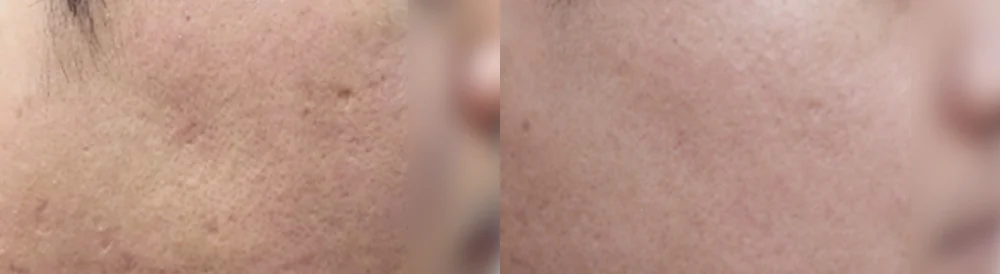
Small depressions and rough texture spread across the cheek
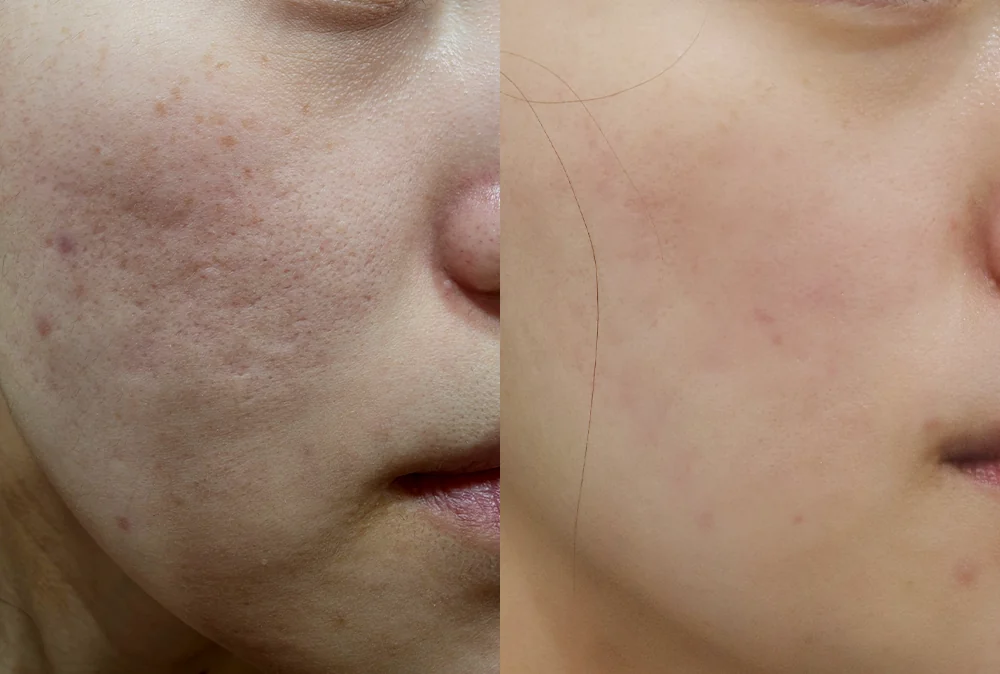
Shallow depressions mixed with red marks on the cheek
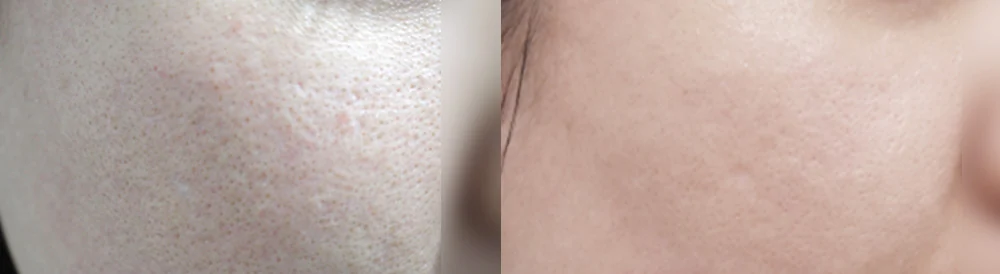
Prominent pore-like pitted scars on the cheek
* Results vary from person to person. Side effects are possible, so please decide after a thorough consultation with a doctor.
Frequently asked questions
Can a single session make a difference?
It depends on the scars and the depth used. The manufacturer says some people see meaningful improvement after one session.2 The acne scar study, however, judged results after three sessions,1 and deeper or wider scars usually need treatment split into several sessions. After one session, it is worth allowing the following months, while remodeling continues, before judging.
Exactly how many weeks until the next session?
The study used 6–8 weeks,1 and one U.S. practice advises at least two months.3 The actual date depends on whether redness and crusts have settled and whether any area has darkened. For skin prone to pigmentation, the interval may be set wider.6
I've had three sessions and still have scars. Should I keep going?
That depends on what remains. If shallow scars and texture are still improving, more sessions may help. If tethered scars or narrow, deep scars remain, other methods such as subcision or punch techniques are usually considered before adding more of the same laser.4
When should results be judged?
Not right after the last session, but months later. The study assessed results three months after the final treatment,1 and the manufacturer says results are clearest at around 3–6 months.2 Comparing photos taken under the same conditions at each visit helps.
Can I switch to UltraClear partway through another laser treatment?
Yes. First, though, we check that redness or pigment changes from the earlier laser have settled. Telling us which laser you had, when, how many times and how your skin reacted helps us set the spacing and depth.
What to prepare before your consultation
- A front photo in bright light and a cheek photo with light from the side
- Lasers, subcision or fillers you have had: type, number of sessions and the date of the last one
- Whether your skin has ever turned brown after a laser
- Whether you still get breakouts
- How many recovery days you can set aside, and dates to avoid
The treatment process is described on our UltraClear page and our acne and pore scar page. How UltraClear compares with CO2 fractional lasers is covered in our UltraClear vs CO2 fractional guide.
References (6)
Sources that support the explanations in this article. Study findings describe general trends and do not guarantee individual results.
- Bernstein E, Alajmi A, Wang J, et al. The 2910-nm Fiber Laser Is Safe and Effective for Improving Acne Scarring. Lasers Surg Med. 2024;56(9):755-761.doi:10.1002/lsm.23845UltraClear (2,910 nm erbium-doped fluoride glass fiber laser) acne scar study, abstract only: 14 enrolled, 13 completed, skin types II–III, three treatments 6–8 weeks apart; blinded photo review showed mean improvement of 47.3% ± 14.2% (mean ± SEM) 3 months after the last session; side effects averaged trace-to-mild; no control group
- Acclaro Medical. Patient Resources | Laser Treatment Information | Acclaro UltraClear. . 2026.Manufacturer patient information: some patients see meaningful improvement after one session and the plan is set at consultation; advanced treatments involve 5–10 days of redness and peeling; treated areas heal within 1–2 weeks; peak results at 3–6 months; advanced treatments optimized for skin types I–III. Company material, so no effect sizes are taken from it
- Krauss Dermatology. UltraClear vs. Fraxel: Which Is Better for Acne Scars and Texture?. . 2025.Patient information from a U.S. dermatology practice (promotional blog): one initial treatment combining superficial, deep and coring passes; improvement continues over six months and further treatments can be done as early as two months apart; many patients improve after 1–2 treatments; 4–8 days of bleeding, crusting and redness
- Kravvas G, Al-Niaimi F. A systematic review of treatments for acne scarring. Part 2: Energy-based techniques. Scars Burn Heal. 2018;4:2059513118793420.doi:10.1177/2059513118793420Systematic review of 59 energy-based studies since 2008: rolling and boxcar scars respond most to fractional lasers and ice pick scars least; punch elevation helps deep scars; effect depends on which scar types predominate
- Abdelwahab AA, Omar GAB, Hamdino M. A combined subcision approach with either fractional CO2 laser (10,600 nm) or cross-linked hyaluronic acid versus subcision alone in atrophic post-acne scar treatment. Lasers Med Sci. 2022;38(1):20.doi:10.1007/s10103-022-03677-yRandomized study of depressed acne scars (20 per group): subcision alone vs subcision plus hyaluronic acid filler vs subcision plus fractional CO2 laser; mean score reduction 6 months after the last treatment 44.29%, 62.29% and 68.58%; filler vs laser difference not significant. A CO2 laser study, not UltraClear
- Wat H, Wu DC, Chan HH. Fractional resurfacing in the Asian patient: Current state of the art. Lasers Surg Med. 2017;49(1):45-59.doi:10.1002/lsm.22579Review of fractional resurfacing in Asian patients: post-inflammatory hyperpigmentation is the most common side effect; lower density, more sessions and wider intervals reduce the risk without greatly reducing efficacy
About this article
This article separates general medical information from Bonita Clinic's own approach. Because the right decision depends on each person's condition, it is not a substitute for a consultation.