KOKorean
 ENEnglish
 JP日本語
 CN中文(简体)
 TW中文(繁體)


C-Section Scar Treatment in Seoul: Can a Raised or Sunken Scar Improve?
In many cases, yes. But C-section scars are not all alike. A line that has spread into a wide band, a scar that is red, thick and raised, a scar that is sunken and pulls inward, and a scar hidden under a fold of skin have different causes, so the right choice among laser, injections, excision, adhesion release and fat grafting differs. Whether the scar is still settling, and whether you plan another pregnancy or cesarean, also shape when and how to treat it. The goal is not to restore the skin you had before giving birth, but to reduce the thickness, dip, pulling and color that stand out. Wondering which approach may fit your scar? You can send photos and questions before planning your visit to Seoul.
Curious about your own case? Ask us online →
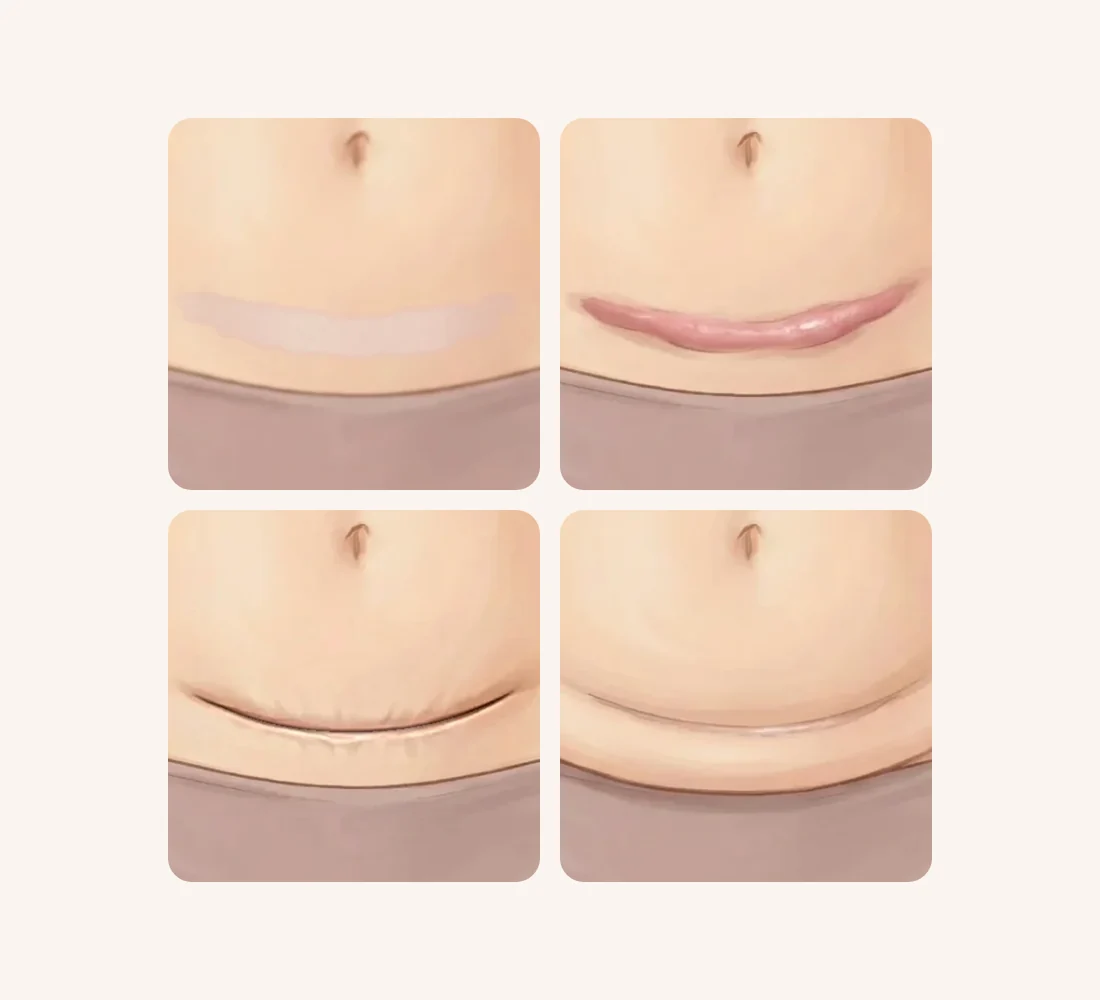
Why do C-section scars heal so differently from one person to the next?
A cesarean section (C-section) opens the skin and the layers beneath it in the lower abdomen to deliver the baby, then closes them again layer by layer. The skin is usually opened either horizontally, just above the underwear line, or vertically, down the middle of the abdomen below the navel. In a Japanese survey of 991 women who had a C-section, about one in three (34%) had a vertical incision, although this share can vary by country, hospital and the circumstances of the surgery.1
Two women can have the same operation and end up with very different scars. The lower abdomen is a place where the skin stretches and relaxes every time you bend, sit up, lift your baby or tighten your stomach. The Japan Scar Workshop consensus document (recommendations written by specialists after reviewing the evidence) explains that tension on the skin makes hypertrophic scars (red, thick, raised scars) and keloids (scars that grow beyond the edges of the original wound) worse, and that these scars tend to grow in the direction in which the skin is pulled most.2 It also notes that operations through a vertical midline incision often lead to these scars, and that horizontal abdominal incisions are another cause.2
How common is this? The Japanese survey asked women 6 to 18 months after their C-section to compare their scar with photo examples and pick the closest one. Some 34.0% chose a "mature" scar, meaning flat and faded. 64.4% chose a hypertrophic scar, and 1.6% chose a keloid.1
6–18 months after a C-section: how 991 women rated their scar
These figures need careful reading. They are not doctors' diagnoses; each woman rated her own scar from photos. The researchers themselves point out that thickness and other things you feel with your fingers cannot be judged from a photo, so some scars may have been put in the wrong group.1
Even so, the survey tells us something useful. A C-section scar that does not settle into a fine, flat line is not unusual, and it can be bothersome. Women who picked a less mature scar scored slightly worse on a skin-related quality-of-life questionnaire (a median of 1 versus 0 on a 0–30 scale, so the difference itself was small). The largest differences were in symptoms such as itching and stinging, and in emotions. The 15 women who picked a keloid also had higher scores on a screening questionnaire for postnatal depression, although with so few women this finding should be read with caution.1 Put simply, if your C-section scar bothers you, you are far from alone, and it is a reasonable thing to seek help for.
What does your scar look like?
"I don't like my C-section scar" can mean several different things. Sorting the most common appearances into four groups helps, because each has a different cause and a different first approach.
If your C-section scar looks like this
1If the line has spread into a wide band
If it is not raised or red, cutting it out and closing it finely is considered
Excision and re-closure
2If it is red, thick, raised and itchy
First we tell a hypertrophic scar from a keloid, then look at calming it, for example with injections
Injections · recurrence control
3If the line is sunken and pulls inward
Releasing where it is stuck to deeper tissue, and filling lost volume with fat, are considered
Adhesion release · fat grafting
4If skin above folds over the scar
We separate how much the scar is pulling from how much extra fat and skin there is
Sorting out the cause
- Widened scar: neither raised nor sunken, but the line has spread into a broad band that looks white or pale pink. The consensus document explains that even when a thick scar is flattened and matured with injections or tape, the shape of the scar itself remains.2 Width is likewise a matter of shape, so if width is the main concern, the treatment that changes the shape, cutting out the scar and closing it again, becomes central.
- Thick, raised scar: red, firm and raised, sometimes itchy or stinging. If it stays within the original incision line, it is treated as a hypertrophic scar; if it spreads beyond the line into normal skin, it leans towards a keloid. Our guide to telling a keloid from a hypertrophic scar explains how the two are distinguished.
- Sunken, tight scar: the line dips in and casts a shadow, and the skin around it looks puckered as if it is being pulled inward. When the fat layer under the skin is damaged, a scar can become stuck to deeper structures.5 This sticking of scar tissue to the tissue below is called an adhesion.
- Scar with a fold of skin above it: the skin just above the scar bulges out and hangs over it, so the scar sits hidden in a crease. This is explained in its own section below.
It is common for one scar to have two or three of these features. One end of a raised scar may be sunken, for instance, with a fold of skin above it. So the starting point is not "which treatment is good?" but "what is the most noticeable problem with my scar?"
Is the "C-section shelf" or overhang caused by weight gain?
Not necessarily. In English this appearance is often called a C-section shelf, pouch, bulge or "cesarean apron". A 2026 paper in the American Journal of Obstetrics and Gynecology describes it as a common but often overlooked deformity, in which extra skin and subcutaneous fat (the fat layer under the skin) hang over the cesarean scar. It ranges from a slight bulge above the pubic area to a large apron. It occurs in people with and without obesity, and can cause physical discomfort, skin irritation and considerable distress about body image.6
The authors also propose an explanation. Within the fat of the lower abdomen there is a thin membrane called Scarpa's fascia. If it is not closed during the cesarean, its edges are thought to pull back, leaving a space through which deeper fat pushes upward and forms a bulge. As the wound heals, scarring above and below the gap is thought to tether the scar downward, so the scar sinks while the area above it bulges more.6 The paper sorts the deformity into four grades and describes treatment ranging from liposuction and limited scar revision for milder cases to a mini or full abdominoplasty (tummy tuck, which removes excess lower abdominal skin and fat) for advanced ones. The authors are clear that this explanation is a proposal and that more research is needed.6
In short, a fold above a C-section scar is often the combined result of two things: the scar pulling down, and extra fat and skin above it. Which one dominates decides how much can be addressed with scar treatment and how much belongs to body-contouring surgery.
Why isn't laser enough for a sunken C-section scar?
Lasers mainly work on texture and color at the surface and in the shallow layers of the skin. With a sunken C-section scar, though, the problem usually lies below the surface. Either the scar is stuck to deeper layers and holds the skin down, or volume has been lost under the scar so its floor has dropped. In either case, smoothing the surface still leaves a shadow. The cord that holds the skin down has to be released first, and the empty space filled, before the floor can rise.
Grafting fat under adherent scars has been studied. A team at a Dutch burn center treated 40 patients with scars stuck to the tissue beneath them with a single fat-grafting session and measured scar elasticity with a device three months later. Elasticity, meaning how well the scar springs back after being stretched, improved by 22.5%, and how far the scar could stretch improved by 15.6%. Scar scores given by both patients and observers also improved. The color difference between the scar and the surrounding skin, however, did not change.5
In plain terms, fat grafting may help soften an adherent scar by rebuilding a "sliding layer" beneath it, but it does not change its color. Keep in mind that this study did not focus on C-section scars, had no comparison group and followed patients for only three months.5 That is why, at Bonita Clinic, a sunken scar is planned in stages: release, then fill, then treat any remaining texture or color with laser.
Which C-section scars can laser help?
Lasers suit what is left on a scar that is already flat: rough texture, redness, discoloration and stiffness. A randomized controlled trial in Denmark (patients' treatments are allocated by chance and compared) studied 12 people with mature C-section scars. Each scar was split in half: one half received three sessions of fractional CO2 laser, while the other half was left untreated for comparison. A fractional laser makes a dense grid of very fine, column-shaped micro-injuries in the skin so that new tissue can grow back in.4
The results changed over time.4
- At 1 month: the treated half was more pliable and had a smoother surface.
- At 1–3 months: temporary redness and darkening of the skin (hyperpigmentation) dominated, so the treated half could actually look more noticeable.
- At 6 months: the difference in overall scar scores did not quite reach statistical significance, but assessors who did not know which half had been treated rated the laser side better in photos. 64% of participants wanted the untreated half to be lasered too.
So laser changes appear gradually over several months, with a temporary phase of redness or darkening in between. This was also a small study, with only 11 people completing it.4 And laser cannot lift a dip that is tethered from below, nor reduce a fold of skin hanging over the scar.
At Bonita Clinic, remaining marks such as redness, pigmentation and uneven texture are treated with 2–3 lasers, each matched to the type of mark. Depending on the purpose, we combine devices such as a fractional laser, a CO2 laser, a vascular laser for red scars and a picosecond laser for pigment. Research on each individual device specifically for C-section scars is limited, so the study above should be read as evidence for the same family of treatment (fractional laser).
What comes first for a thick, raised C-section scar?
For a red, thick, raised scar, the first step is to tell whether it is a hypertrophic scar or a keloid. A hypertrophic scar stays within the original wound and tends to settle over time; a keloid grows beyond the edges and is likely to grow back if it is simply cut out.
For abdominal scars away from the midline, such as a low horizontal cesarean scar, the Japan Scar Workshop consensus recommends this order:2
- Small scars with mainly hypertrophic features: corticosteroid tape or plasters, or steroid injections, come first. Steroids calm the inflammation that keeps the scar thick.
- Large or multiple scars, or scars with strong keloid features: surgery is considered. The document lists the patient's age and, for women, plans to have more children among the factors that decide whether to operate.
- After surgery: recurrence is controlled with radiotherapy or with steroid tape and injections, and the wound is held still with tape or gel sheets for six months to a year. For the abdomen, an abdominal binder and a lumbosacral corset are also recommended.
Keloids in particular need recurrence control. According to these recommendations, keloids come back in 50–80% of cases after surgery alone, and adding radiotherapy after surgery lowers this to 10% or less.2 Radiotherapy is given at hospitals with radiation-therapy facilities and is not part of Bonita Clinic's treatment menu, so it is included here only as general medical information.
Injections also have practical points. The consensus describes injecting at the border between the scar and normal skin and into the deeper part of the scar, repeated at two-week intervals; small scars may improve after one or two injections. On the other hand, the drug can cause the fat to shrink if it reaches the fat layer, so care is needed, and these injections should not be given during pregnancy.2 High doses can also cause menstrual irregularities, so the dose is chosen with care, and if the skin under steroid tape starts to thin or small blood vessels become visible, the recommendations advise switching to a moisturizing ointment.2
How Bonita Clinic manages keloids is summarized below, under "How we approach it at Bonita Clinic". For more on controlling recurrence after a keloid is removed, see our guide to keloid and raised burn scar treatment.
Can a wide or thick scar simply be cut out and stitched again?
For a scar that has spread wide or a line that has thickened, cutting out the scar and closing the wound again (excision and re-closure) is the central option. But cutting it out is not the end of the story. The new line goes through its own healing process, and if the same pulling forces remain, it can widen or thicken again. How the wound is closed makes a large difference.
The JSW consensus also sets out principles for removing abdominal scars:2
- The fat tissue directly beneath the scar is removed as well.
- The deep fascia and then the superficial fascia (tough membranes that wrap the muscles or lie within the fat layers) are stitched, so that the skin edges meet on their own and the deeper layers take the tension instead of the skin.
- For a long scar, a single Z-shaped adjustment in the middle (a Z-plasty) can break up the pull along one direction.
Put simply, the new line has a better chance of staying fine when the deeper layers, not the skin surface, carry the strain. Even with careful closure, a scar with strong keloid features still needs recurrence control planned from the start.
Options usually considered for each type of scar
| Option | Mainly suits | Good to know |
|---|---|---|
| Silicone, tape, compression | Red scars still settling | Reduces tension, supports maturing |
| Steroid injections or tape | Thick raised scars, keloids | Not during pregnancy; fat loss, irregular periods |
| Fractional laser | Leftover texture, redness, color | Changes over months; cannot lift a tethered dip |
| Adhesion release, fat grafting | Sunken, tight scars | Color unchanged; may be done in stages |
| Excision and re-closure | Widened or thickened lines | The new line must settle again |
| Liposuction, abdominoplasty | Large fold of skin above the scar | Different surgery from scar treatment |
Planning another pregnancy? How timing changes
This is what sets C-section scar treatment apart from treating other scars: your plans for future pregnancies and deliveries can change the timing and the choice of treatment.
First, scars can get worse in pregnancy. The JSW consensus states that both hypertrophic scars and keloids are known to worsen during pregnancy. It also advises against steroid injections in pregnancy and against long-term steroid tape over large areas.2 As noted above, the same document counts plans to have more children among the factors in deciding on surgery for abdominal scars.2
Second, if you expect to have another C-section, the old scar can be removed during that operation. A retrospective study from a hospital in Türkiye looked back at 145 women whose previous horizontal scar was cut out during a repeat cesarean. At least a year later, 13% (19 women) had a raised scar again. No additional treatment was given. Emergency cesareans were more common among the women whose scar returned, but in the analysis that took several factors into account together, this difference did not reach statistical significance.3 Of the 66 scars examined under the microscope, however, 76% were hypertrophic scars and only 6% were keloids.3 So these results cannot be compared directly with the 50–80% recurrence of keloid-like scars removed by surgery alone,2 and a keloid needs recurrence control planned alongside. The authors suggested that women without symptoms who are planning another pregnancy, and who do not want radiotherapy or steroid injections, could wait and have the scar removed at their next planned cesarean.3
There are conditions attached to this approach. It is decided by the obstetric team performing your next cesarean, and it depends on the situation on the day, such as whether the delivery becomes an emergency. Some scars thicken again after removal, so scar care is still needed afterward.3 And if your scar is itchy, painful or growing now, there is no reason to wait until your next delivery. Treatment can be chosen to suit whether you are pregnant or breastfeeding.
In summary:
- If you are not planning more children: plan revision to suit the scar once it has settled.
- If another cesarean is expected: for a symptom-free scar, removal during that operation can be discussed with your obstetrician.
- If you are pregnant: scars may worsen, and steroid injections are avoided.
- If the scar has symptoms or is growing: have it examined regardless of your plans, and start with the treatment that suits your situation now.
What is recovery like, and what are the limits?
At Bonita Clinic, restoration of sunken or widened body incision scars is performed as surgery, under local anesthesia (only the treated area is numbed) or sedation, as a day procedure with no overnight stay, and with stitches. Keloids and hypertrophic scars are mainly treated with procedures, with excision when needed, under local anesthesia as a day procedure; there are stitches if the scar is excised. Recovery time and follow-up visits vary with the extent of treatment and your individual condition.
Right after treatment, the area is protected. During recovery, redness and swelling gradually settle, and sun protection matters from this point on. While the tissue settles, we review the progress and decide whether more treatment is needed.
There are limits to be aware of:
- A newly closed line also needs time to settle, and it may widen or thicken again where tension is high or if you tend to scar easily.
- Keloids can recur even after excision, so they are followed up for a long time.2
- How much grafted fat survives varies from person to person, so filling may be done in stages rather than all at once.
- Scar treatment does not reduce extra fat or loose skin above the scar. If that is a large part of the problem, a different operation such as liposuction or an abdominoplasty may be needed.6
- Bleeding, infection, inflammation and other side effects can occur after surgery or procedures.
The aim is not to bring back the skin you had before giving birth. A realistic goal is to reduce the thickness, dip, pulling and color that stand out, so the scar bothers you less in daily life.
How we approach it at Bonita Clinic
How treatment proceeds at Bonita Clinic
- 1Surgery and scar reviewIncision type and timing; hypertrophic or keloid
- 2InjectionsRed, firm raised scars, repeated at intervals
- 3Release and fat graftingSunken, tight scars; restoring lost volume
- 4Excision and re-suturingLines that have spread or thickened
- 5Combined lasersOnly if redness, pigment or texture remain
- 6Follow-upNumber of restoration sessions varies by scar
Only the steps you need are chosen and ordered
At Bonita Clinic, keloids and hypertrophic scars after a cesarean are treated under Burn & Keloid Treatment, and sunken or widened surgical scars under Body Depressed & Incision Scars. The same restoration methods (adhesion release, fat grafting, excision and re-suturing) are also described on the Body Surgical Scars page. The actual plan is set after an in-person examination.
Real treatment cases
These are abdominal surgical scar cases shown in Bonita Clinic's Burn & Keloid Treatment information. The type of surgery cannot be confirmed from the photos, so only what is visible is described. Results vary from person to person.
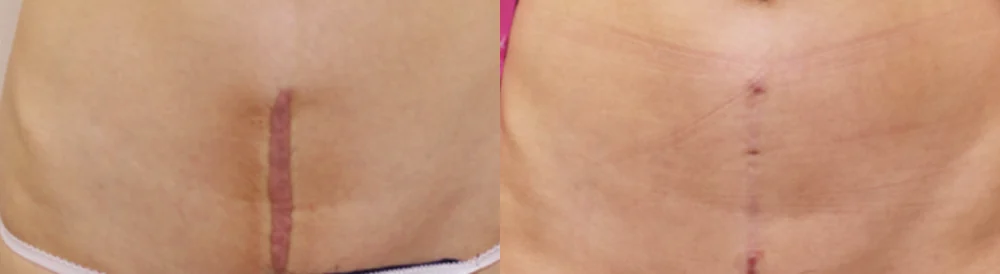
A vertical surgical scar in the middle of the abdomen below the navel, red and raised along its length
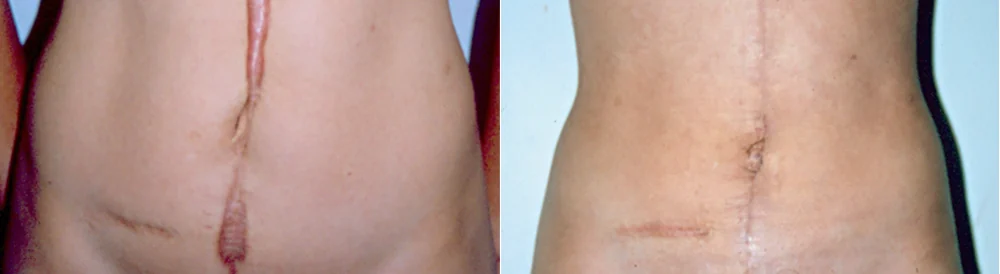
A vertical scar running through the middle of the abdomen, thick and lumpy (with a horizontal scar on one side of the lower abdomen)
* Results vary from person to person. Side effects are possible, so please decide after a thorough consultation with a doctor.
C-section scar treatment options you can discuss in Seoul
Bonita Clinic is a plastic surgery and scar clinic near Nonhyeon Station (Line 7) in Seoul, about 100 m on foot from Exit 8. Since opening in 1995, Dr. Kwang-Seop Jung, a board-certified plastic surgeon in Brazil, has seen patients at the same location. Because the clinic treats both cosmetic surgery and scar restoration, the first step is always to understand at which stage of healing or surgery the problem arose.
For C-section scars, the options you can discuss in consultation include:
- injections and recurrence management for raised hypertrophic scars and keloids
- adhesion release for sunken, tethered scars
- fat grafting, with stem cells separated from the fat, for lost volume
- excision and fine re-suturing for widened or thickened lines
- combined lasers for remaining redness, pigment and texture
Which of these you need, and in what order, depends on your scar and on your plans for future pregnancies.
Why do the plan and cost differ from one scar to another?
No two C-section scars are the same, so there is no single fixed treatment or fee. The plan, and therefore the cost, depends on several factors:
- whether the scar is widened, raised, sunken or overhung, and how many of these features it has
- its length and depth, and how much tissue is stuck or missing
- whether it behaves more like a hypertrophic scar or a keloid, which changes how much recurrence control is needed
- which methods are combined, such as injections, adhesion release, fat grafting, excision or laser
- the type of anesthesia, and how many sessions or stages are needed
- Scar type and how many features
- Length, depth, adhesion
- Hypertrophic or keloid nature
- Methods combined
- Anesthesia and number of sessions
Final plan and estimate after an in-person exam
The final plan and estimate are given after an in-person examination at the clinic. Photos help us give you an initial idea of what may be involved before you travel.
What can photos show, and what needs an in-person exam?
You can send photos before visiting Seoul to get an initial opinion. Photos can show some things well, while others can only be judged by touch and examination.
Photos can show
- Location, length and color
- Visible width of the line
- Horizontal or vertical incision
- Changes compared with older photos
Needs an in-person exam
- Thickness and firmness
- How deeply it is stuck
- How much skin and fat overhang
- Hypertrophic scar or keloid
- Lying down versus standing
Helpful photos include the whole lower abdomen from the front and from the side while standing, a close-up of the scar, and, if there is a fold above the scar, a photo taken while lying down as well. If you have photos from shortly after the birth or from around the time the stitches came out, please include them. Only the area concerned is needed; you do not need to send photos of your face or any ID.
Planning your visit and caring for the scar back home
How long to stay in Seoul and when to return for follow-up depend on which treatments you need, so we plan the schedule together with you in consultation, based on the extent of treatment and how you recover. We do not set a single fixed stay for everyone.
Some general points help with planning:
- Injections and lasers are usually repeated at intervals, so the number of visits is planned with you in consultation.
- Surgery such as adhesion release, fat grafting or excision involves stitches and a period in which the wound is protected. Redness and swelling settle gradually, and the new line keeps maturing for months after you leave.
- After you return home, taping or gel sheets to keep the wound still and protecting it from the sun are part of scar care.2 Photos taken at regular intervals help us follow how the scar is settling.
- Future pregnancies: if you are planning another pregnancy, or another cesarean, tell us before choosing the treatment, and keep your obstetrician informed as well.
If anything unexpected happens after you return, such as increasing redness, swelling, discharge or pain, see a local doctor promptly and let us know.
Frequently asked questions
My baby is only a few months old. Can I start scar treatment now?
In the first months after birth, a scar is still settling, and it is common for it to be red and firm. In this phase, keeping the wound still with tape or gel sheets to reduce tension and keep the surface moist is described as helping the scar mature.2 But if it keeps getting thicker, itches or hurts, or spreads beyond the line, do not wait; have it examined. If you are breastfeeding or planning another pregnancy, be sure to mention it when choosing a treatment. Our guide on when to start treating a surgical scar explains timing in more detail.
Can I ask for my old scar to be removed at my next C-section?
That is an option. In a study of 145 women whose previous scar was cut out during a repeat cesarean, 13% had a raised scar again after a year or more.3 Most of the scars examined in that study were hypertrophic scars rather than keloids, so a keloid needs recurrence control planned alongside.3 This is also a decision for the obstetric team performing your next delivery, and plans can change if the delivery becomes an emergency. Discuss it with them in advance; any remaining texture, color or re-thickening afterward can be treated separately.
There is a fold of skin hanging over my scar. Will scar treatment fix it?
If the fold is mainly caused by the scar pulling down, releasing the adhesion and filling the dip may help. If there is a lot of extra fat and skin above the scar, however, scar treatment alone will not reduce it. The paper describing this deformity divides treatment by severity, from liposuction and limited scar revision to abdominoplasty.6 So we examine how the fold changes lying down and standing, and how firmly the scar is stuck.
Can a vertical C-section scar be treated too?
Yes. Hypertrophic scars and keloids are described as common after operations through a vertical midline incision.2 In the Japanese survey, 12 of the 15 women who chose a keloid had a vertical incision, but the numbers are too small to draw firm conclusions.1 The principles are the same as for horizontal scars: raised scars are calmed first, widened lines are considered for excision and re-closure, and for long scars a closure that spreads out the tension is planned.2
Do silicone sheets or scar tape help?
They can help a scar that is still settling. The consensus document explains that fixation tape and gel sheets keep the scar surface moderately moist and support maturation, and that compression such as an abdominal binder suits abdominal scars.2 They cannot, however, change the shape of a scar that has already widened or sunk. Our scar care guide covers how long to use silicone, tape and sunscreen.
What to prepare before your consultation
- The date and number of your C-sections, whether the incision was horizontal or vertical, and whether it was an emergency
- Photos showing how the scar has changed (soon after the birth, around stitch removal, and now)
- Whether it itches, hurts or pulls, and whether sitting or straightening up is uncomfortable
- Care and treatments so far: silicone, tape, injections, laser
- Plans for future pregnancies and deliveries, and whether you are breastfeeding
- Any keloids elsewhere on your body, or in your family
For details of the treatment process, see Body Depressed & Incision Scars and Body Surgical Scars, and for raised scars, Burn & Keloid Treatment. For scars after body or breast surgery, see our guide to scars and irregularities after cosmetic surgery, and for sunken scars on the body, the guide to depressed scars on the body.
References (6)
Sources that support the explanations in this article. Study findings describe general trends and do not guarantee individual results.
- Sugita Y, Komatsu H, Kodera C, et al. Impact of abnormal cesarean section scar formation on quality of life and postpartum depression: A cross-sectional study in Japan. Int J Gynaecol Obstet. 2026;172(2):1015-1022.doi:10.1002/ijgo.70469Nationwide web survey in Japan (cross-sectional): 991 women rated their own scar against photo examples 6–18 months after a cesarean — mature 34.0%, hypertrophic 64.4%, keloid 1.6%; 34% vertical incisions (12 of 15 keloids); slightly worse skin-related quality of life in the abnormal-scar group (DLQI median 1 vs 0 on a 0–30 scale; symptoms and emotions), higher postnatal depression screening scores in the keloid group; limited by self-rating and design
- Ogawa R, Akita S, Akaishi S, et al. Diagnosis and Treatment of Keloids and Hypertrophic Scars-Japan Scar Workshop Consensus Document 2018. Burns Trauma. 2019;7:39.doi:10.1186/s41038-019-0175-yJSW consensus: tension worsens scars; midline and transverse abdominal scars; worsening in pregnancy, avoid steroid injections and long-term wide steroid tape; injection technique and fat atrophy; high triamcinolone doses and menstrual irregularity; replace steroid tape if skin thins; abdominal scar order (tape/injections first; surgery for large or keloid-like scars, weighing age and childbearing plans); fat removal, fascial sutures, Z-plasty; 6–12 months of taping, binder, corset; keloid recurrence 50–80% after surgery alone vs ≤10% with radiotherapy; shape remains after maturation
- Bağlı İ, Ogawa R, Bakır S, et al. Predictors of the recurrence of surgically removed previous caesarean skin scars at caesarean section: A retrospective cohort study. Scars Burn Heal. 2021;7:20595131211023388.doi:10.1177/20595131211023388Retrospective cohort from a tertiary hospital in Türkiye: 145 women whose previous transverse (Pfannenstiel) scar was excised at a repeat cesarean; 13% recurrence at one year or more without adjunct therapy; emergency cesarean more frequent in the recurrence group but not significant in multivariate analysis (P=0.060); histology in 66: 76% hypertrophic, 18% mixed, 6% keloid (mostly hypertrophic, so not directly comparable with keloid recurrence after excision alone); suggestion that symptom-free women planning another pregnancy may wait until the next planned cesarean
- Karmisholt KE, Taudorf EH, Wulff CB, et al. Fractional CO2 laser treatment of caesarean section scars-A randomized controlled split-scar trial with long term follow-up assessment. Lasers Surg Med. 2017;49(2):189-197.doi:10.1002/lsm.22606Randomized split-scar trial in 12 people (11 completed) with mature C-section scars: three sessions of fractional CO2 laser; more pliable and smoother at 1 month; temporary redness and hyperpigmentation at 1–3 months; overall score difference not significant at 6 months (P=0.06) but blinded photo assessment favored treatment; 64% wanted the untreated half treated; new collagen and elastic fibers on histology
- Jaspers MEH, Brouwer KM, van Trier AJM, et al. Effectiveness of Autologous Fat Grafting in Adherent Scars: Results Obtained by a Comprehensive Scar Evaluation Protocol. Plast Reconstr Surg. 2017;139(1):212-219.doi:10.1097/PRS.0000000000002891Damage to the fat layer can make scars adhere to deeper structures, and fat grafting aims to rebuild a sliding layer. In 40 patients with adherent scars, one fat-grafting session improved elasticity by 22.5% and maximal extension by 15.6% at 3 months, with better patient and observer scar scores and no change in color (no control group; not specific to C-section scars)
- Pelosi MA 2nd, Pelosi MA 3rd, Romero R. The cesarean apron: description, proposed pathophysiology, classification, and prevention through scarpa fascia closure at cesarean delivery. Am J Obstet Gynecol. 2026;233(6S):S118-S128.doi:10.1016/j.ajog.2025.09.040Description of the 'cesarean apron' or shelf, in which skin and fat overhang the scar: frequent but overlooked, in people with and without obesity, causing discomfort, irritation and distress; proposed cause is incomplete Scarpa's fascia closure, with deep fat bulging and the scar tethered and sunken; four-grade classification; treatment from liposuction and limited scar revision to abdominoplasty; further studies needed
About this article
This article separates general medical information from Bonita Clinic's own approach. Because the right decision depends on each person's condition, it is not a substitute for a consultation.