KOKorean
 ENEnglish
 JP日本語
 CN中文(简体)
 TW中文(繁體)


10THERMA Radiofrequency Lifting in Seoul: What It Can and Cannot Do, and How It Differs from Ulthera
10THERMA is a 6.78 MHz monopolar radiofrequency (RF) device. It cools the skin surface with cryogen while the heat created as current passes through the tissue warms the dermis and the fibrous tissue below it over a broad area. Heated collagen contracts a little straight away and new collagen forms over the following months, which is how fine lines, thinning skin and mild laxity are gradually tightened. It does not lift sagging tissue back into a new position, restore lost volume or remove fat under the chin. Unlike Ulthera, which focuses ultrasound into points at set depths down to the SMAS, 10THERMA heats the skin as a layer. Changes are usually subtle and vary from person to person, so the first step is to work out whether sagging comes from the skin itself or from fat, volume loss or the deeper SMAS, and then decide whether it is used alone or with other treatments. If you are considering skin tightening in Seoul, you can send photos of the areas that concern you before planning your visit.
Curious about your own case? Ask us online →
What kind of device is 10THERMA?
10THERMA is a radiofrequency (RF) device made by a Korean medical device company. According to the file it submitted to the US Food and Drug Administration (FDA), it sends a 6.78 MHz radiofrequency current into the skin through a monopolar electrode, with a maximum output of 400 W.1 The system is made up of a main console, a handpiece, single-use electrode tips, a return pad that is placed on the body, a coupling fluid spread between the tip and the skin, and cryogen gas that cools the skin surface.1
In the same file, 10THERMA named Thermage FLX as its comparison (predicate) device, listing the same frequency, the same electrode type and the same maximum output.1 In the US it is classified as an electrosurgical device "for electrocoagulation and hemostasis" in dermatologic and general surgical procedures.1
What do "radiofrequency" and "monopolar" actually mean?
Radiofrequency is an electric current that switches direction very quickly. Lasers make heat with light and Ulthera makes heat with ultrasound, but with radiofrequency the heat comes from the tissue itself: as the current passes through, the tissue resists its flow, and that resistance turns into heat.2 Because it does not aim at pigment such as melanin the way light does, radiofrequency is described as being less affected by skin color than most lasers.2
"Monopolar" refers to the number of electrodes. In bipolar radiofrequency, current flows only between two electrodes inside the tip, so the depth the heat reaches is limited to roughly half the distance between them.2 In monopolar radiofrequency, the tip is a single electrode and the current passes through the skin and returns to a pad attached somewhere else on the body.2 That is why a monopolar treatment starts with a pad being placed on your back or torso.
What happens inside the skin during treatment?
When the 10THERMA tip touches the skin, a burst of cryogen cools the surface and then the radiofrequency current flows, all within a moment. The idea is to keep the epidermis (the outermost layer) cool while warming the dermis below it and the fibrous tissue further down, over a broad area.2 Tissues that resist current more strongly, such as fat, produce more heat; the thin fibrous walls that divide fat into small compartments (fibrous septa) pick up that heat.2
What monopolar RF does inside the skin
What follows the heat happens in two stages. In a tissue study in which human skin was treated with an earlier monopolar radiofrequency device of the same type, collagen fibers became thicker with blurred borders (a sign that heat had made them contract), and the genetic signal for making new type I collagen increased.3 The researchers interpreted this as collagen contracting immediately, tightening the tissue, and then new collagen being produced as the small heat injury heals.3
Put simply, you may notice a slight tightening on the day, but the real change builds slowly over months as the skin repairs itself.
How much change can you realistically expect?
We could not find a peer-reviewed paper that studies 10THERMA itself. So the evidence below comes from earlier devices that work the same way (monopolar radiofrequency with surface cooling). Tip design, cooling and energy settings differ between devices, so these numbers cannot be transferred to 10THERMA as they are.
The study cited most often is a multicenter trial in which 86 people had one treatment around the eyes and were followed for six months.4
- Fine lines around the eyes: when photos were graded by assessors who did not know which were before or after, 83.2% of treated eye areas improved by at least one point on a wrinkle scale.4
- Brow position: photo analysis showed that 61.5% of eyebrows were lifted by at least 0.5 mm.4
- Satisfaction: 50% of participants said they were satisfied or very satisfied with the change in their eye wrinkles.4
In the same study, when the treating physicians judged improvement without looking at the "before" photos, they saw it in only 28.9% of treated areas.4 In other words, the number changes a great deal depending on how improvement is measured. The size of change confirmed in research is roughly this: fine lines around the eyes soften a little and the brows rise by fractions of a millimeter.
Reviews of radiofrequency point in the same direction. They describe it as a treatment for mild to moderate skin laxity and recommend telling patients beforehand that results may be modest.2
Does one session really lift a sagging face?
This is the most common misunderstanding about radiofrequency lifting. 10THERMA tightens the skin and the fibrous tissue beneath it a little, in place. It does not move tissue that has slid down back up and fix it there, and it does not remove skin that has already stretched and become excess. It is not a way to restore lost volume, and it is not a way to remove fat that has gathered under the chin.
What to know about 10THERMA
So whether 10THERMA is a good fit depends less on "how much has it sagged?" and more on "what is making it look saggy?" If the main issue is skin that has become thinner, with more fine lines and less firmness, it tends to be a reasonable match. If the cheeks have hollowed, there is a lot of fat under the chin, or the skin is loose enough to fold, radiofrequency alone may feel like a small difference.
How is 10THERMA different from Ulthera?
Both create heat inside the skin to trigger collagen changes. Where they differ is the energy that makes the heat and the shape of the heated area.
Ulthera concentrates ultrasound into a point, creating rows of tiny heated spots smaller than 1 mm³ at depths of up to 5 mm.6 It leaves the shallow dermis and the epidermis between those points untouched and tightens the deep dermis and the SMAS (the thin fibrous layer covering the facial muscles, the same layer surgeons lift in a facelift).6 10THERMA cools the surface while warming the dermis and the fibrous tissue below it as a broad layer.2 Put simply, Ulthera places dots at set depths, while 10THERMA warms a whole layer of skin.
How the heat lands: a layer vs points
| Comparison | 10THERMA (monopolar RF) | Ulthera (focused ultrasound) |
|---|---|---|
| What makes the heat | Tissue resistance as current passes2 | Ultrasound focused to a point6 |
| Shape of the heated area | A broad layer in and below the dermis | Small points at set depths |
| Main layer treated | Dermis and fibrous septa (the skin's own firmness) | Deep dermis and SMAS |
| Surface protection | Cooled by cryogen1 | Shallow layers left outside the focus6 |
| How it feels | A hot sensation with each pulse | A deep, sharp or aching sensation |
| Concerns it tends to suit | Fine lines, texture, thin skin losing firmness | Mildly sagging contours and jawline |
This table is not about which device is "better." If your main concern is skin that has become thin and dull, the radiofrequency side describes you more closely; if your contours have dropped, the ultrasound side does. When both apply, the two are sometimes planned together rather than choosing one, and reviews of focused ultrasound describe combining it with other skin treatments.6 Whether to have them on the same day, and in which order, is decided after looking at skin thickness and the amount of fat. How Ulthera works at each depth, and what studies found, is covered in our Ulthera lifting guide.
Which one hurts more?
The sensations are different. With 10THERMA you feel a short burst of heat with each pulse; with Ulthera the feeling tends to be a deep zing or an ache near the bone. One small study reported no clear difference in pain between the two.6 Pain and anesthesia for Ulthera are explained in detail in our guide to Ulthera shots and pain.
Which kinds of sagging does it suit, and when should you look at other options?
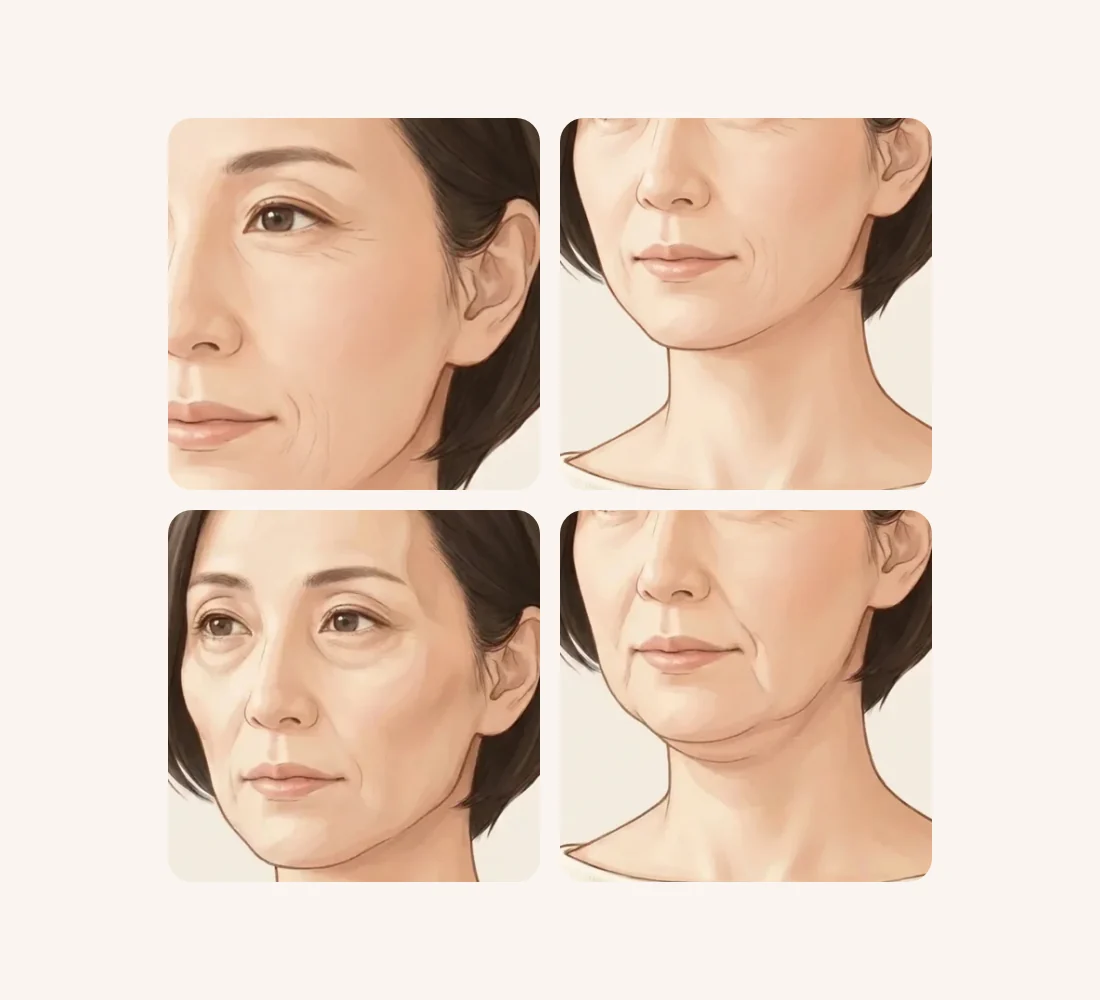
Two faces of the same age can look saggy for very different reasons. Depending on the cause, 10THERMA can be the main treatment or a supporting one.
If your face looks like this
1More fine lines, thinner skin
Warming the dermis with RF to improve firmness tends to fit well
10THERMA
2A jawline that has loosened a little
RF alone, or together with ultrasound that reaches the SMAS
10THERMA · Ulthera
3Hollow temples and cheeks
Filling comes before tightening; RF plays a supporting role
Multi-lifting
4Fat under the chin, deeper sagging
Removing fat or repositioning the SMAS is discussed as well
Multi-lifting · Facelift
- Fine lines and texture: when the main concern is change in the skin itself, such as fine lines around the eyes and cheeks or skin that has become thin and dull, radiofrequency tends to be a good match.
- Mild laxity: a jawline that has loosened slightly can be treated with radiofrequency alone, or planned with ultrasound that reaches the SMAS.
- Volume loss: when the temples and cheeks have hollowed and cast shadows, filling (for example with fat grafting) comes before tightening. Radiofrequency is closer to a supporting role that refines skin texture.
- Fat or deeper sagging: fat under the chin only goes down when it is removed, and tissue that has dropped a long way only goes up when it is repositioned. For when energy-based lifting is not enough, see our guide on when Ulthera or radiofrequency is not enough.
Radiofrequency microneedling, which delivers heat from the tips of fine needles placed into the skin, works differently. It targets scars, pores or deeper dermal layers directly with needles, so it should be thought of separately from 10THERMA, which heats from the surface without needles.
How does a treatment session go?
The usual flow is below. Order and details can differ between clinics and treatment areas.
- After cleansing, the treatment areas are marked out. Many clinics apply numbing cream if you are worried about discomfort.
- A return pad is placed on your body and coupling fluid is spread on the skin.1
- The tip is placed on the skin and one pulse is delivered at a time. With each pulse, cryogen first cools the surface and then radiofrequency flows.2
- The same area is passed over several times, and the energy is adjusted by asking how hot it feels to you.
Step 4 comes from experience. In a survey of 14 physicians reviewing 5,700 monopolar radiofrequency treatments, the original "single pass at high energy" approach gave immediate tightening in 26% of patients, and 45% found it too painful.5 After switching to "lower energy, several passes, with energy guided by heat feedback," immediate tightening was reported in 87% and only 5% found it too painful.5 Because these figures come from a physician survey, they do not carry the same weight as a controlled comparison.
Put simply, enduring as much heat as possible is not the goal. Telling the practitioner straight away when the heat feels too strong also helps keep the treatment safe.
What is recovery like, and what are the risks?
There is no incision, so getting back to daily life is usually easy. Some redness and swelling can appear straight after treatment, and these are described as usually settling within a few hours.2 For skin care and makeup afterwards, follow the instructions given at the clinic.
How changes appear after 10THERMA
- Right afterRedness and warmth, usually settling within hours
- First daysA slight tight feeling as collagen contracts
- Weeks to monthsNew collagen forms gradually as the skin heals
- 6 monthsThe point the eye-area study followed
There are also rare risks worth knowing about.
- Burns and blisters: in the eye-area study, second-degree burns occurred in 0.36% of all pulses (21 of 5,858), and three people had small scars remaining at six months.4 Reviews explain that these mostly happen when settings are too high or the technique is not right.2
- Pain: the heat cannot be avoided entirely, but it can be reduced by adjusting energy and the number of passes.5
- A gap between expectations and results: because the change is subtle, some people feel they "can't tell the difference." Reviews recommend talking about this before treatment.2
There is no fixed number of sessions or fixed duration of effect. Most studies followed people for up to six months after a single treatment.4 How long studies followed each lifting method, and how to think about "how long it lasts," is covered separately in our guide to how long lifting results last.
How we approach it at Bonita Clinic
Treatment options you can discuss in Seoul
At Bonita Clinic near Nonhyeon Station (Line 7, Exit 8, about 100 m on foot), lifting is planned around the cause of sagging rather than a single device. Options you can discuss include:
- 10THERMA radiofrequency for fine lines, texture and the skin's own firmness
- Ulthera focused ultrasound for mildly sagging contours that involve the SMAS
- Multi-lifting, which combines chin liposuction, dissolving threads, stem cell fat grafting and combination laser as needed
- A facelift, when sagging is deep and there is excess skin
Which of these makes sense, alone or together, depends on what is causing your face to look tired or heavy, and is decided after an in-person examination.
Why do the plan and cost differ from person to person?
Two people asking for "10THERMA" can end up with quite different plans. The main factors are below.
What shapes your lifting plan
- Areas to treat (eyes, cheeks, jaw, neck)
- Cause of sagging: skin, volume, fat or SMAS
- Combined with Ulthera or other methods
- Energy level and number of passes
- Pain control
Final plan after an in-person exam
- Treatment areas: eyes only, the lower face, or the whole face and neck changes the scale of treatment.
- Cause of sagging: if volume loss or fat is part of the picture, other methods may be added.
- Combination: whether ultrasound or other treatments are planned alongside.
- Energy and passes: adjusted to your skin thickness and how the heat feels.
- Pain control: whether numbing cream is enough for you.
The final plan, including cost, is explained after your skin has been examined in person.
What can photos show, and what needs an in-person exam?
Photos sent before your visit help us understand your concerns and narrow down options. Some things, however, can only be judged by examining the skin directly.
Photos vs in-person examination
Photos can show
- Fine lines around the eyes and cheeks
- Where the contour looks heavy
- Hollow temples or cheeks
- Overall shape of the jawline
Needs an in-person exam
- How thick or thin the skin is
- How far the skin stretches when pinched
- How much fat sits under the chin
- Whether sagging involves the SMAS
Front and side photos in the same lighting, taken with a neutral expression, are the most useful. Let us know about any lifting, laser, filler or thread treatments you have had, and when.
Planning your visit and recovery
10THERMA does not involve incisions or stitches, and redness usually settles within hours, so treatment does not usually require a long recovery period.2 Because the change builds gradually over months, it is worth remembering that the full effect will mostly appear after you return home. If radiofrequency is combined with other treatments such as fat grafting or liposuction, recovery depends on those treatments instead. Your schedule is planned together at the consultation, based on what is being treated and how you recover.
Frequently asked questions
Are 10THERMA and Thermage the same device?
No. They are different devices made by different companies. In its US FDA submission, 10THERMA named Thermage FLX as its comparison device and listed the same frequency (6.78 MHz), monopolar electrode type and maximum output. Tip design, cooling and treatment settings can still differ between devices, so research on one is not transferred directly to the other.
Exactly how many millimeters will 10THERMA lift?
There is no number that can be promised. In the eye-area study of a device of the same type, 61.5% of eyebrows rose by at least 0.5 mm after one treatment, which is a change measured in fractions of a millimeter. How much your face changes depends on skin thickness, the cause of sagging and how your skin heals with age.
Can I have Ulthera and 10THERMA together?
Because they work on different layers, they are sometimes planned together: ultrasound for contours that have dropped down to the SMAS, and radiofrequency for thinning skin and fine lines. Whether to do them on the same day or separately, and in which order, is decided at the consultation after looking at skin thickness and fat.
Can I have it if I have darker skin or melasma?
Radiofrequency does not aim at pigment such as melanin, so it is described as less affected by skin color than lasers. However, 10THERMA is not a treatment for melasma. If melasma is also a concern, a separate pigment laser plan is made, and we check whether your skin reacts easily to heat.
Can I go back to normal activities straight after?
Most people return to daily life the same day. Redness and warmth usually settle within a few hours. If you notice anything unusual, such as blisters or pain that lasts, let the clinic know right away.
What to prepare before your consultation
- The areas that bother you most (fine lines around the eyes, cheek texture, jawline, under the chin)
- Front and side photos in the same lighting (so sagging and volume can be seen together)
- Any recent lifting, laser, filler or thread treatments, and when you had them
- How painful previous radiofrequency or ultrasound treatments felt for you
Information on lifting devices including Ulthera and 10THERMA is on our Ulthera page, and planning by cause is explained on our Multi-lifting page. For how ultrasound lifting works, see the Ulthera lifting guide; for the limits of energy-based lifting and when surgery is considered, see when Ulthera or radiofrequency is not enough.
References (6)
Sources that support the explanations in this article. Study findings describe general trends and do not guarantee individual results.
- U.S. Food and Drug Administration. 510(k) Premarket Notification K232992: 10THERMA (Tentech Inc.) — Indications for Use and 510(k) Summary. FDA CDRH. 2023;Decision date 2023-12-20.US FDA 510(k) file for 10THERMA: 6.78 MHz monopolar electrode, 400 W maximum output; console, handpiece, single-use tips, return pad, coupling fluid and cryogen cooling; classified in the US as an electrosurgical device for electrocoagulation and hemostasis; Thermage FLX named as the predicate device; cleared on bench testing without clinical studies
- Elsaie ML. Cutaneous remodeling and photorejuvenation using radiofrequency devices. Indian J Dermatol. 2009;54(3):201-205.doi:10.4103/0019-5154.55625Radiofrequency review: heat arises from tissue resistance and is greater in high-resistance tissue such as fat; monopolar devices use a grounding pad, while bipolar heating depth is limited to about half the electrode spacing; cryogen cools the surface; not dependent on pigment; for mild to moderate laxity with potentially modest results; redness and swelling usually settle within hours, and blisters or superficial burns are rare and linked to excessive settings or technique
- Zelickson BD, Kist D, Bernstein E, et al. Histological and ultrastructural evaluation of the effects of a radiofrequency-based nonablative dermal remodeling device: a pilot study. Arch Dermatol. 2004;140(2):204-209.doi:10.1001/archderm.140.2.204Tissue study of a monopolar RF device (ThermaCool TC): collagen fibrils thickened with blurred borders and type I collagen mRNA increased — interpreted as immediate collagen contraction followed by new collagen production during healing
- Fitzpatrick R, Geronemus R, Goldberg D, et al. Multicenter study of noninvasive radiofrequency for periorbital tissue tightening. Lasers Surg Med. 2003;33(4):232-242.doi:10.1002/lsm.1022586 people, one periorbital monopolar RF treatment, followed for 6 months: 83.2% of eye areas improved by at least one wrinkle grade on blinded photos (28.9% by treating physicians), 61.5% of brows lifted at least 0.5 mm, 50% satisfied, second-degree burns in 0.36% of pulses (21 of 5,858), small scars in 3 people at 6 months
- Dover JS, Zelickson B; 14-Physician Multispecialty Consensus Panel. Results of a survey of 5,700 patient monopolar radiofrequency facial skin tightening treatments: assessment of a low-energy multiple-pass technique leading to a clinical end point algorithm. Dermatol Surg. 2007;33(8):900-907.doi:10.1111/j.1524-4725.2007.33191.xSurvey of 14 physicians (5,700 treatments): high-energy single pass — 26% immediate tightening, 45% too painful; lower energy, multiple passes with heat feedback — 87% immediate tightening, 5% too painful; survey data, so lower level of evidence
- Fabi SG. Noninvasive skin tightening: focus on new ultrasound techniques. Clin Cosmet Investig Dermatol. 2015;8:47-52.doi:10.2147/CCID.S69118Focused ultrasound (Ulthera) review: heated points smaller than 1 mm³ up to 5 mm deep (deep dermis, subdermis, SMAS and platysma) with the shallow dermis and epidermis spared; best suited to mild to moderate laxity; combination with other treatments described; one small study found no clear difference in pain compared with RF devices
About this article
This article separates general medical information from Bonita Clinic's own approach. Because the right decision depends on each person's condition, it is not a substitute for a consultation.