KOKorean
 ENEnglish
 JP日本語
 CN中文(简体)
 TW中文(繁體)


Ulthera Shots in Seoul: What the Shot Count Does and Doesn't Tell You, and How Much It Hurts
An Ulthera "shot" is one row of heat points placed under the skin each time the transducer is pressed, and the shot count adds up which areas were treated, at how many depths and how densely. More shots do not mean proportionally more lift, and Ulthera does not replace lost volume or remove excess skin. Pain varies widely by person and area, from around 3 to 4 out of 10 up to the 6 to 7 range even with numbing cream, and tends to be higher along the jawline near bone and with deeper transducers. At Bonita Clinic shots are divided among the areas that have sagged and either numbing cream or sedation is chosen, so if you are considering Ulthera in Seoul, you can send photos and details of past treatments first to see what plan may fit.
Curious about your own case? Ask us online →
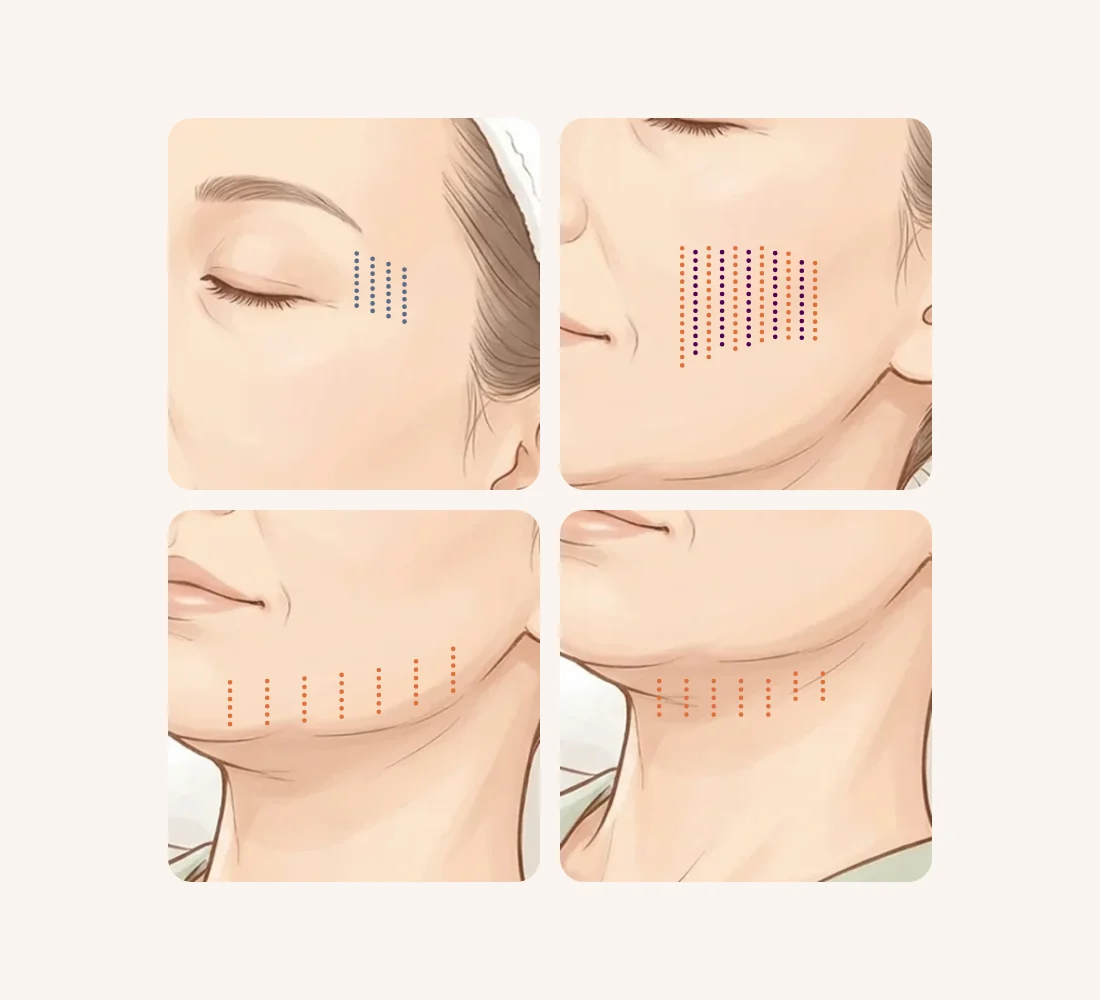
What is a "shot" in Ulthera?
Ulthera is a lifting device that focuses ultrasound at a set depth beneath the skin and creates tiny heat points (very small spots where heat has firmed the tissue). Which kind of sagging it suits, and how much change to expect, is covered in Which sagging does Ulthera suit, and how much can it change?. This article answers the two questions people ask most often before booking: how many shots, and how much it hurts.
When the transducer (the tip of the handpiece that rests on the skin) is pressed once, it places a single row of heat points at an even spacing under the skin. The device is designed so that the heat points sit a consistent 1.0 to 1.5 mm apart.2 Studies call one of these rows a "line". In Korea people usually count them as "shots". So "300 shots" means 300 of these rows.
After one row, the transducer is moved a little to the side and the next row is placed. Rows are laid side by side until an area is covered. Where needed, the same area is treated again with a transducer set to a different depth. Put simply, a shot count combines three things into one number: which areas were treated, how densely, and at how many depths.
How a shot count adds up
How is the number of shots decided?
There is no fixed right number. An expert consensus on Ulthera says that even people who look alike in age and sagging need a plan made for them. The starting point is the ultrasound image: it guides the choice of transducer, depth and the number of rows at each depth.2 In practice, these factors change the count:
- Treatment area: the biggest factor. A full face and neck treatment and a treatment limited to the jawline or eye area are very different in scale.
- Number of depths: combining two depths, for example 4.5 mm (a deep layer that includes the SMAS, the thin sheet covering the facial muscles) and 3.0 mm (a shallower layer), adds rows over the same surface. The consensus review holds that treating only one depth is unlikely to reach the density needed.2
- Degree of sagging: one review describes about 500 to 600 rows for mild laxity over the full face and upper neck, 600 to 700 for moderate laxity, and about 800 for severe laxity.1
- Tissue thickness: the depth of the SMAS varies with weight, body mass index, age, sex and the area being treated.2 The same 4.5 mm transducer may therefore suit different places, and a different number of rows, in different people.
- Sex: Korean doctors who described their experience treating men suggested at least 600 and up to 800 rows for the full face and upper neck.3
How many shots have studies and consensus papers used?
Putting a few published figures side by side shows how wide the range is, even for something described simply as "face lifting".
| Source | Area treated | Rows (shots) reported |
|---|---|---|
| Review1 | Full face and upper neck, by laxity | Mild 500–600 · moderate 600–700 · severe about 800 |
| Consensus review2 | Full face and neck | 800–1,200 considered optimal |
| Korean study cited in the consensus review2 | Facial tightening (4.5 mm) | 100–120 |
| Korean experience in men3 | Male full face and upper neck | At least 600, up to 800 |
| Neck pain study4 | One side of the neck | 45 rows at 4.5 mm + 45 rows at 3.0 mm |
These figures are not a ranking. Each study differs in who was treated, where, at what energy and for what purpose, so they cannot be compared one to one. What they do show is that a shot count on its own says little about what was actually done. It is also worth knowing that the consensus review was supported by the device company and relies largely on expert experience.2
Do more shots mean more lift?
No. It is a common belief that more shots lift more, but there is no evidence that the size of the change rises in step with the shot count. The consensus review links higher-density treatment, meaning rows placed closely at each depth, with better outcomes.2 The point is not the grand total but whether the areas that need it received enough density at the right depth. Six hundred shots spread thinly over the whole face and three hundred concentrated on the jawline and under the chin cannot be compared by the number alone.
Energy matters too. The same review advises setting the energy within what the person can tolerate and, if it becomes uncomfortable, lowering the energy while keeping the row density. It also notes that treatments run only at maximum energy risk being stopped partway through.2 Another review describes treating at the lowest energy setting that still works.1 In other words, turning the energy down to make treatment more bearable is not the same as giving up on the result.
Some sagging does not respond to more shots. Ulthera tightens tissue with heat; it does not replace lost volume or remove excess skin. Burns have been reported when pulses are stacked on the same spot or when the transducer is not in proper contact with the skin.2 That is why the shot count should come after the cause of the sagging has been worked out. If fat or lost volume is part of the cause, Multi Lifting, which combines several methods, is considered as well.
How are shots divided between areas?
Each part of the face differs in size, skin thickness and distance to bone. So even for one person, the number of rows and the depths are planned area by area.
How shots are divided by area
1If the outer eye area has drooped
Fewer rows with a narrow transducer, placed only over bone
Small area
2If the cheek has sagged
A wide surface that takes many rows, sometimes at two depths
4.5 mm · 3.0 mm
3If the jawline has softened
Close to bone, so it often feels sharper; energy and anesthesia are adjusted together
Pain control
4If the area under the chin is loose
Pain scores ran higher here in studies, so the anesthesia plan is set in advance
Pain control
- Cheeks: a wide surface that takes the most rows. One review describes placing 15 vertical rows as one set on each cheek.1
- Eye area: narrower transducers (1.5 mm and 3.0 mm) exist for small areas.2 Around the eyes, treatment is placed only over bone.1
- Jawline and under the chin: sagging shows clearly here, so rows are often concentrated in these areas. They are also where pain scores ran high in studies.1
At Bonita Clinic, too, shots are not spread evenly across the whole face. They are divided among the areas that have actually sagged, and small areas such as the eye area and jawline are treated in separate sections.
How painful is Ulthera?
Many people do find it painful. A review names brief discomfort during the session as the most common adverse effect of this treatment.1 The temperature at each focal point briefly reaches 60 to 70°C, and researchers think heat-sensing nerve receptors are involved in the pain.4 So the pain usually comes in short bursts, each time a row of heat points is made.
On a 0 to 10 scale (0 meaning no pain at all and 10 the worst pain imaginable), the scores vary a lot between studies:
- In one study of 36 people, most scored 3 to 4, but five people (13.8%) scored above 7.1
- A study that measured areas separately found 5.68 for the cheek, 6.09 under the chin and 6.53 under the jaw.1
- In a randomized study on the neck, the side treated with numbing cream alone averaged 6.91 after the 4.5 mm transducer and 5.69 after the 3.0 mm transducer.4
Put simply, a fair number of people rate the pain as moderate or more even with numbing cream on. The same treatment can feel bearable to one person and quite painful to another. The average score across many studies, and the side effects after treatment, are summarised in our Ulthera guide.
Why do some areas hurt more than others?
The same heat point can feel different depending on where it forms and how deep it is. Studies point to three main differences.
The first is distance to bone. Researchers describe discomfort as greater over bony prominences.4 Places like the jawline, where the tissue under the skin is thin and bone lies close beneath it, fall into this group. The second is the depth of the transducer. In two randomized studies, one on the neck and one on the inner arm, scores after the 4.5 mm transducer were higher than after the 3.0 mm transducer: 6.91 versus 5.69 on the neck, and 5.89 versus 5.00 on the arm.45 The third is energy. More energy in each point means more heat, which is why the consensus review recommends lowering the energy to match comfort.2
Where the same heat point tends to hurt more
On top of this, people simply feel pain differently. That is why scores spread widely even for the same area at the same energy.1 If you remember which areas hurt most last time, that helps when planning the next session.
How can the pain be reduced?
There is no single standard regimen.2 Several approaches are combined to suit the person and the area.
Where each way of easing pain works
- Numbing cream: applied to the skin before treatment. In the neck study, a lidocaine and prilocaine cream was left on for 30 minutes under plastic film.4 The cream works near the surface, so it helps most with the shallow 1.5 mm transducer and may do less for the deep ones.1
- Oral pain relief: a review notes that discomfort during treatment can be reduced with oral anti-inflammatory painkillers, and that opioid painkillers were no more effective than these with the deeper transducers.1 Tell us in advance if you have a sensitive stomach or take blood-thinning medicine.
- Sedation: the literature lists several options, from anti-anxiety medicine and nitrous oxide to intravenous sedation.4 Sedation makes pain and tension feel less intense, but you need time afterwards to wake fully and recover.
- Energy adjustment: keeping the row density while lowering the energy.2 It helps to say so straight away if a section feels too uncomfortable.
- Distraction: vibration devices or cold air are sometimes used to take the mind off the pain.3 However, in a randomized study on the inner arm, adding cold air to numbing cream did not change pain scores. The researchers explained that the cooling does not reach the deep layer that the treatment targets.5
| Method | Where it mainly works | What studies found | Good to know |
|---|---|---|---|
| Numbing cream | Near the skin surface | More helpful with shallow transducers1 | Needs time to take effect |
| Oral anti-inflammatory | Throughout the body | Can reduce discomfort1 | Medicines and stomach checked first |
| Sedation | How much pain is felt | Several options in use4 | Time to wake and recover |
| Energy adjustment | Strength of each heat point | Density kept, energy lowered2 | Set together with the row plan |
| Cold air | Skin surface only | No added effect with cream5 | Does not reach the deep points |
Some methods are still at the research stage. In one randomized study, the side that received capsaicin gel (the hot compound in chili peppers) together with numbing cream hurt less, but redness on that side lasted close to two hours on average.4 It is not yet a routine method.
What happens on the day, and how long does it take?
The day usually runs in this order.
On the day of treatment
- 1Consultationcause of sagging, areas, anesthesia
- 2Preparationnumbing cream applied or sedation prepared
- 3Layers on screendepths and row layout confirmed
- 4Treatment by depthpauses or lower energy if needed
- 5Rest, then homeredness and stiffness checked; same-day discharge
Timing depends on the number of shots, the areas and the anesthesia chosen
Time is split between preparing the anesthesia and the treatment itself. Numbing cream needs time on the skin before treatment (30 minutes in the neck study).4 Treatment time depends on the number of shots and the areas. In the study that treated one side of the neck with 90 rows at two depths, each side took about 19 minutes on average.4 A full face, with many more rows, takes correspondingly longer.
Pain affects timing as well. Frequent pauses make the session longer. The consensus review explains that fewer pauses, thanks to less discomfort, also make the treatment more efficient.2 The exact time is given at consultation once the areas and the anesthesia method are settled.
How uncomfortable is it afterwards, and when should you contact the clinic?
During treatment the pain is mostly concentrated in the moments when heat points form. Afterwards, a milder discomfort often remains. At Bonita Clinic, patients are told that temporary redness and slight stiffness may follow straight after treatment. Please avoid hot environments such as saunas and Korean bathhouses (jjimjilbang) for a week.
If numbness or pain continues, do not just put up with it; let the clinic know. Rare side effects and recovery are covered in the side-effects section of our Ulthera guide. How long the effect lasts varies greatly with the degree of sagging and between individuals, so it is discussed at consultation.
How we approach it at Bonita Clinic
Why do Ulthera plans and costs in Seoul differ from person to person?
Bonita Clinic is on the third floor of 565 Gangnam-daero, Seocho-gu, Seoul, about 100 m on foot from Exit 8 of Nonhyeon Station on Line 7. Dr. Kwang-Seop Jung has treated patients at the same location since the clinic opened in 1995.
"An Ulthera treatment" can mean very different things. Treating the jawline alone and treating the full face and neck differ in rows, depths and time, and the anesthesia method also changes the plan.
- Which areas: eye area, cheeks, jawline, under the chin, neck
- Rows needed for each area
- One depth or two
- Numbing cream or sedation
- Other treatments combined on the same visit
Final plan and quote after an in-person exam
Because the number of rows that fits each area is set with the ultrasound image and an examination,2 the final plan and quote are given after you are seen in person. Shot counts quoted elsewhere are hard to compare unless you know the areas and depths behind them.
What can photos show, and what needs an in-person exam?
Photos help decide whether ultrasound lifting is worth discussing and which areas to focus on. They cannot show tissue thickness or how close bone lies under the skin, and both affect the row plan and the pain.
Photos can show
- Which areas sag and how widely
- Differences between the left and right sides
- How the sagging changed (older photos)
Needs an in-person exam
- Skin and fat thickness on ultrasound
- Where bone lies close under the skin
- How many rows each area can take
- Health and medicines that affect anesthesia
Helpful photos are the face from the front, from both sides at 45 degrees and in profile, in even light with the head level. If you have had Ulthera or similar treatments before, add when you had them, the shot count you were told, the anesthesia used and which areas hurt most. You can send us a message with your photos and questions.
How should you plan a visit to Seoul around Ulthera?
What is confirmed in advance is the treatment information: a non-surgical procedure under numbing cream or sedation, same-day discharge and no stitches. If you choose sedation, allow extra time to wake and recover before leaving, and plan not to have anything important straight afterwards. Which areas are treated, whether other treatments are added on the same visit and the overall schedule are planned together with you at consultation.
Temporary redness and slight stiffness are common on the day, and hot environments should be avoided for a week, so it helps to keep the first days of your stay free of saunas and spas. If numbness or pain continues after you return home, contact us or see a local doctor.
Frequently asked questions
Will 600 shots lift exactly twice as much as 300?
No. A shot count adds up the area and depths treated; it is not a measure of how much change you will get. One review describes 500 to 800 rows for the full face and upper neck depending on laxity,1 while a Korean study used 100 to 120 rows on the face.2 Which areas were treated and at how many depths matters more than the total. Asking how many rows are planned for each area, and at which depths, makes plans much easier to compare.
If it hurt less than last time, did it work less?
You cannot assume that. The consensus review recommends lowering energy to match comfort while keeping row density.2 Pain also varies with the anesthesia, how you feel that day, the area and the depth of the transducer.14 Whether the planned areas and depths received enough density matters more than how much it hurt.
With anesthesia, will it not hurt at all?
That is hard to expect. In the neck study, even the side with numbing cream averaged around 6 out of 10.4 Numbing cream works near the surface and helps more at shallow depths.1 If much of the treatment is in deep layers, or you are sensitive to pain, sedation is considered as well. At Bonita Clinic the choice between the two is made after hearing about the treatment area, your health and your experience with earlier treatments.
Can I take a painkiller before I come in?
A review notes that oral anti-inflammatory painkillers can ease discomfort during treatment.1 But they may not suit you depending on your other medicines, your stomach or whether you will have sedation. Rather than taking something on your own, tell us what you take at consultation and follow the advice you are given.
Will ice or cold air make it hurt less?
Cooling the surface has limits. In a randomized study, adding cold air to numbing cream made no difference to pain scores,5 because Ulthera's heat points form deep beneath the skin. Some people still find it a helpful distraction, so it is sometimes used alongside other methods.3
What to prepare before your consultation
- The areas that bother you most: eye area, cheeks, jawline, under the chin, neck
- Previous Ulthera or radiofrequency treatments: when, the shot count if you know it, the anesthesia used and which areas hurt most
- Medicines you take: painkillers, blood thinners, stomach medicine and so on
- Any allergy to numbing cream or medicines
- Whether you are sensitive to pain and whether you would like sedation
Treatment details are on the Ulthera page. For which sagging Ulthera suits and what change to expect, see the Ulthera guide. If fat or lost volume is also part of the cause, see Multi Lifting and the Multi Lifting guide.
References (5)
Sources that support the explanations in this article. Study findings describe general trends and do not guarantee individual results.
- Fabi SG. Noninvasive skin tightening: focus on new ultrasound techniques. Clin Cosmet Investig Dermatol. 2015;8:47-52.doi:10.2147/CCID.S69118Rows by laxity (full face and upper neck: mild 500–600, moderate 600–700, severe about 800), 15 vertical rows per cheek, brief discomfort as the most common adverse effect, pain scores (most 3–4 with 13.8% above 7; cheek 5.68, under chin 6.09, under jaw 6.53), oral anti-inflammatories ease discomfort and opioids were no better with deep transducers, cream helps with 1.5 mm, lowest feasible energy, around the eyes only over bone
- Park JY, Lin F, Suwanchinda A, et al. Customized Treatment Using Microfocused Ultrasound with Visualization for Optimized Patient Outcomes: A Review of Skin-tightening Energy Technologies and a Pan-Asian Adaptation of the Expert Panel's Gold Standard Consensus. J Clin Aesthet Dermatol. 2021;14(5):E70-E79.Industry-supported (Merz) pan-Asian consensus review: heat-point spacing 1.0–1.5 mm, imaging to plan depths and rows per depth, higher density and dual depth, 800–1,200 rows for full face and neck, a Korean study using 100–120 rows, SMAS depth varies, narrow transducers for small areas, lower energy while keeping density, no standard pain regimen, fewer pauses improve efficiency, stacking and poor contact can cause burns
- Park JY, Hong W, Lee KC, et al. Customizing Microfocused Ultrasound With Visualization Treatment for Facial Lifting in Asian Men: Experience and Practical Insights From Korea. J Cosmet Dermatol. 2025;24(6):e70278.doi:10.1111/jocd.70278Korean experience in men: at least 600 and up to 800 rows for the full face and upper neck; individual pain plans with topical or oral analgesics and distraction such as vibration or cold air
- Vachiramon V, Tanratana P, Anuntrangsee T, et al. The role of topical capsaicin gel in pain management during microfocused ultrasound treatment for neck laxity. Skin Res Technol. 2023;29(1):e13240.doi:10.1111/srt.13240Randomized split-neck study (24 people): lidocaine–prilocaine cream for 30 minutes under film, 45 rows each at 4.5 and 3.0 mm, cream-only side 6.91 and 5.69, lower with capsaicin but redness about 112 minutes, about 19 minutes per side, 60–70°C focal heat, more discomfort over bony prominences, list of pain options including sedation
- Vachiramon V, Palakornkitti P, Anuntrangsee T, et al. A comparative study of pain perception during the microfocused ultrasound procedure between topical anesthesia and combined topical anesthesia with forced air cooling. J Cosmet Dermatol. 2023;22(4):1279-1285.doi:10.1111/jocd.15568Randomized study on the inner arm (21 people): adding forced cold air to numbing cream did not change pain scores (cream alone 5.89 after 4.5 mm and 5.00 after 3.0 mm), as cooling does not reach the deep target layer
About this article
This article separates general medical information from Bonita Clinic's own approach. Because the right decision depends on each person's condition, it is not a substitute for a consultation.