KOKorean
 ENEnglish
 JP日本語
 CN中文(简体)
 TW中文(繁體)


Burn Scar Contracture in Seoul: When Is Surgery Considered?
Surgery is usually considered when a burn scar still stops a joint from straightening after steady rehabilitation, everyday movements are blocked, and the scar has matured and softened. Maturing usually takes about a year, but when an eyelid is pulled outward or a neck or hand contracture seriously impairs function, surgery may come earlier. The method depends on the scar's shape: a narrow band can often be lengthened with a Z-plasty or a similar local flap, while a broad, stiff sheet is released and the gap is covered with a skin graft or a flap. Lasers refine the scar's redness, texture and stiffness, and rehabilitation before and after surgery is what keeps the angle that is gained.
Curious about your own case? Ask us online →

Why does a burn scar pull on a joint?
Shallow burns usually heal without much of a scar. Burns that reach deep into the dermis (the thick layer under the surface of the skin), or through the full thickness of the skin, heal differently: the wound draws in from its edges as it closes. This pulling-in is not passive. It is an active process driven by fibroblasts, myofibroblasts (cells that can contract, a little like muscle) and the collagen they lay down.2 It helps a wound get smaller, but the price is that less skin is left than there was before.
The trouble starts when that scar crosses the bending side of a joint. When you straighten an elbow or a knee, lift your chin, or raise your arm overhead, the skin on the bending side has to stretch. If a shrunken scar sits there, it cannot stretch far enough, so the joint stops short of full movement. When a scar limits how far a joint can move like this, it is called a scar contracture, or burn contracture.
A contracture left in place for a long time may not stay a skin problem. A review of burn scars and contractures (a paper that brings earlier research together) explains that in long-standing contractures, muscles and tendons, nerves and blood vessels can shorten as well, and joints can even partly or fully dislocate. In growing children, the bones themselves can be deformed.2 Put simply, a joint that has been held bent for years may not straighten all the way at once, even after the skin is released. That is why planning for a contracture is about two things together: when to operate, and how to protect the joint in the meantime.
Which joints are affected, and how often?
One US regional burn center followed 985 adults admitted with burns between 1993 and 2002 and examined them at discharge. Only four large joints were measured (shoulder, elbow, hip and knee), yet 38.7% (381 people) had a contracture in at least one of them. Those who had contractures had three on average. The shoulder was the most frequently affected (38%), followed by the elbow (34%) and the knee (22%).1 In plain terms, more than one in three people leaving hospital after a major burn could not fully move at least one large joint.
The good news is that most of these contractures were mild (60%) or moderate (32%). They were more likely with longer hospital stays and with larger burned and grafted areas, and the bigger the grafted area, the more severe they tended to be.1 The authors concluded that contractures in more than one in three patients at discharge highlight the importance of therapeutic positioning and intensive therapy during the hospital stay, and called for new and better ways to prevent contractures.1
That study looked only at four large joints. In practice, contractures can form wherever skin folds and unfolds: the front of the neck, the armpit, the elbow, the wrist, the hand and the back of the knee. After burns to the back of the hand, the knuckle joints can become stuck bent backwards.2
What kind of contracture do you have?
Two contractures that limit the same joint can call for different first steps, depending on the shape of the scar. Broadly, there are two patterns.23
- A narrow band: a scar that runs across the joint like a tight cord. Fairly healthy skin often remains on either side of it.
- A broad sheet: the area around the joint is covered by scarred skin, so there is little healthy skin nearby to borrow.
A Japanese review of surgical approaches to burn contractures describes a yardstick that Hudson and colleagues proposed for contractures of the limbs: whether more than half of the joint's normal range of motion is still left. In a milder contracture with more than half remaining, rearranging nearby skin to gain length is considered first. If less than half remains and there is not enough skin nearby, a flap or a skin graft is usually needed.3 This yardstick was set out for the arms and legs, though, not for the neck or face. A flap moves skin together with its own blood supply; a skin graft takes skin from another part of the body and lays it onto the wound.
The scar's shape points to the first options
1A tight, narrow band at the front of the armpit
If the skin beside the band is healthy, a Z-plasty or similar local flap can add length
Z-plasty · local flap
2A broad, stiff scar that makes it hard to lift the chin
The tightest point is released, and the gap is covered with a graft or a flap
Release + graft or flap
3Webbing between the thumb and index finger
Multi-flap variations of the Z-plasty can restore the depth of the web
Z-plasty variants
4A red, raised scar that healed only months ago
While it matures, positioning, splints, exercise and pressure protect the joint
Manage and wait
Webbing between the fingers is a form of narrow band, and here the Z-plasty is often split into several limbs (variations such as the four-flap or five-flap plasty).23 Where skin has been grafted, a new tight band can also appear once the graft matures, along the line where the graft meets the surrounding skin.2
When is surgery considered?
As a rule, a contracture is released once the scar has matured, with its redness faded and the scar soft and supple, which usually takes about a year. Until then, an immature scar bleeds heavily at surgery, and it responds well to therapy and can improve a good deal without an operation.2 How burn scars mature, and how to care for them in the meantime, is covered in detail in our guide to settled burn scars.
With a contracture, how much the wait matters depends on how the gap will be covered. Maturity is especially important when a flap is to be cut from the skin next to the scar, as in a Z-plasty: flaps raised in skin around an inflamed, immature scar can lose their tips (flap necrosis).3 On the other hand, the same review notes that this waiting rule has recently been questioned, and that the waiting period may not be applied as it stands when the gap is planned to be covered with full-thickness skin or a flap.3 Put simply, "about a year" is not a fixed date but a guide that is weighed against the state of the scar and the way it will be covered.
When function is threatened, for example when an eyelid is pulled outward so the eye cannot be protected, or when a neck or hand contracture severely limits daily life, surgery may come before the scar has matured.2
Is it time to think about surgery?
- Still red and firmManage with therapy and pressure, and waitMaturing usually takes about a year
- Mature, over half of limb movement leftLocal flap such as a Z-plastyWhen the skin beside the band is healthy
- Mature, under half of limb movement leftRelease, then cover with a graft or flapCheck whether nearby skin can be used
- Eyelid, neck or hand function badly blockedEarlier surgery considered, even before maturity
It is worth seeking an assessment if any of these apply:
- The angle has not improved for months despite steady therapy and splinting.
- Everyday movements are blocked: reaching overhead, lifting your chin, opening and closing your hand, squatting.
- A tight band has formed along the edge of a skin graft.
- The scar keeps breaking down and does not heal. An unstable scar like this needs a medical examination before any cosmetic treatment.
How does a Z-plasty gain length along a narrow band?
A Z-plasty uses the tight band as the middle stroke of a Z-shaped incision. The incision creates two triangular flaps, and the surgeon swaps their positions. As they trade places, the middle line turns, so the skin gains length along the band and loses an equal amount of width at the sides. In effect, spare skin from the sides is borrowed and added in the direction that was short.
According to a review of the Z-plasty, the classic Z designed with 60-degree angles increases the length of a scar by about 75%, and the many variations are compared against it.4 For example, a 4 cm tight band could in theory lengthen to close to 7 cm.
A few things are worth knowing:
- The 75% figure is calculated from the geometry. How much length is actually gained can vary with how much spare, stretchy skin there is around the band.
- The flaps are made from skin beside the band, so that skin needs to be healthy and the scar mature. Flaps cut within scar tissue risk losing their blood supply.23
- A long band is often treated with several small Zs in a row. Other local flap techniques, such as the W-plasty and the Y-V plasty, are chosen to suit the situation.3
- A new Z-shaped scar line is left behind, but the line that pulled in one direction now changes direction. Besides lengthening a scar, the Z-plasty is also used to realign a scar or make it less conspicuous.4
Our guide to settled burn scars covers the wider options for burn scars that have already matured.
Wide, stiff scars: release, then what covers the gap?
A broad sheet of scar leaves too little spare skin nearby for a Z-plasty to gain enough length. In that case the scar is cut across to release the pull, and the gap that opens up is covered with skin from elsewhere. The burn scar review sets out these principles:2
- The release incision starts across the point of maximum tension, usually opposite the joint line, and goes deep enough to reach unscarred tissue.
- Releasing by incision is generally preferred to cutting the scar out. Excision is kept for things like small depigmented or raised areas and patches that keep breaking down.
- More skin is used than the size of the gap, to allow for the secondary contraction a graft is expected to undergo after surgery.
- Severe, long-standing contractures, in which tendons have shortened too, are not straightened in one go. Full correction may be reached gradually over a couple of weeks with serial splints or traction.
Skin grafts: the thicker, the less they shrink
A split-thickness graft takes the surface layer and part of the dermis; a full-thickness graft takes the whole dermis. The more dermis a graft contains, the less it contracts afterwards.3 Full-thickness grafts contract less than split-thickness grafts and recur less often, but they "take" (survive and attach in their new place) less reliably, and the amount that can be harvested is limited, so they are mainly used for small, cosmetically important areas.23 Split-thickness grafts can cover large areas, but they tend to contract again, with the risk that the contracture returns.3 Skin taken from the groin also tends to darken, which is part of the choice.3
Flaps: moving healthy skin with its own blood supply
A flap moves skin and the tissue beneath it while keeping it connected to its blood supply. Including a perforator (a small vessel that feeds the skin) at the base of the flap makes the transfer more reliable. The Japanese review regards a local flap as the gold standard when normal skin is available next to the contracture, and names a low recurrence rate as its main advantage.3
This has been tested head to head. In a multicenter randomized controlled trial (patients were assigned to one method or the other by chance) run by Dutch burn centers, released contractures were covered either with perforator-based flaps or with full-thickness skin grafts, and the area of the transferred skin was measured over time. The flaps grew to 123% of their original area at 3 months and 142% at 12 months. The full-thickness grafts measured 87% and 92% at the same points. Observer scar scores and color also favored the flaps.5 Put simply, the flaps actually got larger over time, while the grafts stayed slightly smaller than when they were placed.
These results need to be read with care. It was a small trial of 16 flaps and 14 full-thickness grafts,5 and, as the Japanese review points out, scars of the face and scalp were excluded.3 The same review notes that, according to a systematic review (a study that gathers all the relevant research using set methods), it is still unclear which surgical procedure for burn contractures is the most effective.3 In other words, there is evidence in favor of flaps, but there is no single right answer for every site and every person.
A flap also needs healthy skin next to it. After extensive burns, when the surrounding skin is scarred as well, there may be none to use. When a single joint is blocked by a broad sheet and no tissue is available nearby, a free flap (tissue moved from a distant site with its blood vessels reconnected) may be used. A free flap can differ in color, texture and thickness from the skin around it, and leaves another scar where it was taken.3 Tissue expanders, which stretch skin in advance, are used mainly for the neck, chest and scalp, and are considered difficult to use in burned limbs.3
The options side by side
Options for treating a burn contracture
| Option | Mainly fits | Good to know |
|---|---|---|
| Z-plasty, local flap | A narrow band with over half of (limb) movement left | Skin beside the band must be healthy and mature |
| Split-thickness graft | Large areas to cover | Tends to shrink again; recurrence more likely |
| Full-thickness graft | Small, important areas like the face or hand | Shrinks less, but donor skin is limited |
| Perforator or free flap | Healthy tissue available nearby or at a distance | Recurrence lower; scar at the donor site |
| Laser | Redness, texture and stiffness of the scar | If skin is badly short, planned with surgery |
| Rehabilitation | Every stage, before and after surgery | Needs consistency; continues after surgery |
What can lasers do?
An international consensus of 26 experts from 13 countries (recommendations agreed by an expert panel) regards lasers as a first-line therapy for traumatic scars and contractures. It covers vascular lasers for red scars and ablative and non-ablative fractional lasers, which treat the skin in tiny columns of heat, and it gives specific considerations for darker skin types.6 The same consensus also says that more high-quality research is needed.6
Lasers work on the condition of the scar itself: its redness, texture and stiffness. If a broad contracture has left the skin across a joint seriously short, lasers alone may not be able to make up the missing length, so they are often planned in sequence with surgery. At Bonita Clinic, redness, pigmentation and texture left in a burn scar are treated in stages with 2–3 lasers matched to the type.
Why does rehabilitation matter before and after surgery?
Rehabilitation runs through the whole course of contracture care, from before surgery to well after it. Here is what each stage involves:
- While the scar is still red and firm: positioning the joint in a stretched position, splints and exercises protect the angle. Over deep burns, custom pressure garments are worn all day, except when bathing and during massage, for at least 9–12 months. Pressure is described as reducing the number of myofibroblasts in the scar, as well as its redness, thickness and firmness.2
- Right after surgery: the released position is held until the grafted skin is stable, usually about 3 weeks.2
- After that: static or dynamic splints are combined with daily exercises until the joint moves through its full range. Grafted skin is cared for until it no longer tends to contract, usually about a year.2
- The first 6 months: contracture and thick scarring can progress again during this period, so frequent check-ups are recommended.3
Rehabilitation cannot prevent every contracture. One review notes that a contracture can still follow split-thickness skin grafting even when scar management has been carried out vigorously.3 The reverse is also true: length gained by surgery is hard to keep without continuing rehabilitation afterwards. Where and how you will continue rehabilitation after surgery is something to settle at consultation.
What does recovery involve, and what are the limits?
Our treatment page lists local anesthesia or sedation, same-day discharge and stitches for Bonita Clinic's burn scar restoration surgery. This varies from person to person, and if a contracture needs a large graft or a flap, the anesthesia, any hospital stay and how long the area must be held in position may be different, so these are explained after an examination. Recovery time and follow-up visits also depend on the extent of surgery and your condition. Bleeding, infection and inflammation can occur after surgery.
Limits worth knowing before contracture surgery:
- It can tighten again. Split-thickness grafts carry the highest risk of recurrence; flaps and full-thickness grafts carry less.3
- Flap tips can lose their blood supply, or part of a graft may not take.23
- New scars form: the Z-shaped lines, the graft edges, and the places where skin or a flap was taken.3
- Color and texture can differ between the transferred skin and the skin around it.3
- Long-standing contractures may have shortened tendons, nerves and vessels as well.2 Then releasing the skin may not straighten the joint fully at once, and other specialists, such as rehabilitation medicine or hand surgery, may need to be involved.
How we approach it at Bonita Clinic
Bonita Clinic's methods by scar condition
Excision followed directly by suturing works when there is enough slack in the surrounding skin to bring the edges together after the scar is removed. In a broad contracture where the skin across the joint is itself short, the more that is cut out, the larger the area that has to be covered, so excision and suturing alone may not gain the length that is needed.2 That is why the extent of the scar and the surrounding skin are assessed at an examination, to decide whether other methods or other specialists should be part of the plan.
The Z-plasty, skin grafts, perforator flaps and free flaps described in this guide are general methods used to treat contractures. Which method suits your scar, and whether it is a case that needs to be planned together with other specialists, such as a large graft or a major flap, is assessed together at an examination of your joint movement and the surrounding skin.
Treatment options you can discuss in Seoul
Bonita Clinic opened in 1995 and has stayed at the same location since, where Dr. Kwang-Seop Jung, a plastic surgeon board-certified in Brazil, sees patients. For burn scars around joints, the options you can discuss at consultation are those on our treatment page:
- Scar excision with re-suturing for thick, tight burn scars
- Excision sutured along the skin creases for scars with clear borders
- Adipose stem cell regenerative treatment for hard, thin burned skin
- Combined lasers for remaining redness, pigmentation and texture
Which of these fits, in what order, and whether your contracture needs a different kind of reconstruction is decided only after an examination.
Why do the plan and cost differ from person to person?
A single narrow band at the armpit and a broad, stiff scar across the neck and chest are very different projects. What shapes the plan, and therefore the cost, is the scar's pattern and how much needs to be done.
- Narrow band or broad sheet, and how many areas
- How much joint movement is lost
- Excision, fat and stem cell treatment, lasers or a combination
- Anesthesia: local or sedation
- Number of stages and laser sessions
- Earlier grafts and operations
Final plan and quote after an in-person exam
A final estimate is given only after an in-person examination, once the scar's pattern, the methods and the likely number of stages are clear. Photos help narrow down the options, but the scope is set in person.
What can photos show, and what needs an in-person exam?
For a contracture, photos and short videos are a genuinely useful first step, because the limit on movement can be seen when the joint is bent and straightened. What they cannot show is how the skin feels, how far it gives, and what lies beneath it.
Photos can show
- Location, size and color of the scar
- Band or broad sheet
- Rough angle when bent and straightened
- Graft edges and earlier scars
- Change over time (dated photos)
Needs an in-person exam
- Firmness and how far the skin gives
- Healthy skin available nearby
- Joint stiffness beyond the skin
- Tendon, nerve and sensation checks
- Areas that break down or will not heal
Helpful material: photos of the whole scar and a close-up in daylight, plus photos or a short video of the joint fully bent and fully straightened from the same angle. Add the date and cause of the burn, whether you had skin grafts and where, and the therapy, splints and laser treatments you have had. You can send us a message with your photos and a short description of the movements that are limited.
Planning your visit, recovery and follow-up at home
Our treatment page lists local anesthesia or sedation, same-day discharge and stitches for burn scar restoration surgery; whether that applies to your contracture, and how long you would need to stay in Seoul, is decided after an examination. When the stitches come out and how many follow-up visits you need depend on the methods and the extent of surgery, so these are planned with you at consultation.
For a contracture, recovery does not end when the stitches come out. As described above, the released position is usually held while grafted skin stabilizes, and splints and daily exercise then continue for months; grafted skin may need care for about a year.2 Contracture and thick scarring can progress during the first 6 months.3 Before you travel, it is worth arranging how you will continue therapy at home, for example with a local physical or occupational therapist. Taking dated photos of the joint bent and straightened from the same angle makes it easier to compare progress with your consultation photos. If the area becomes increasingly painful, red and hot, or starts to discharge after you return home, see a local doctor promptly.
Treatment cases of burn scars near joints
These cases are from Bonita Clinic's burn and keloid treatment page and show scars close to joints. The photos cannot show whether a contracture was released, or how the joint moved before treatment, so only what is visible is described. Results vary from person to person.
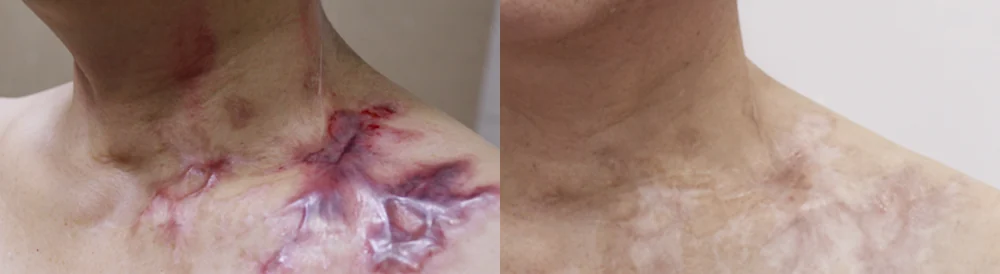
From the side of the neck to the collarbone and front of the shoulder, raised red-purple scars branching out
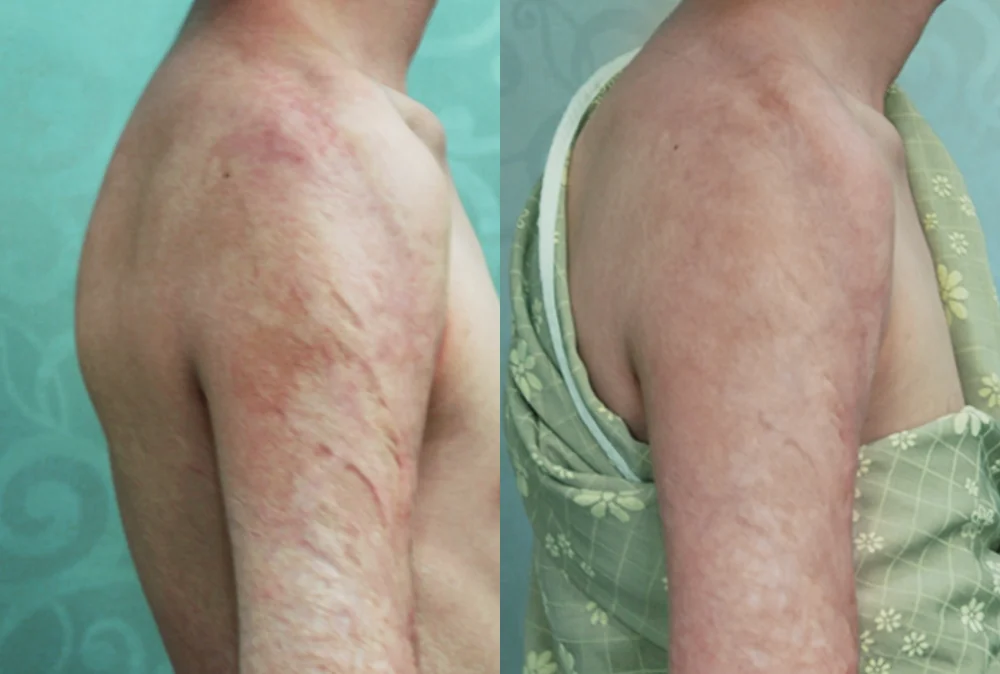
A broad, red, uneven scar from the shoulder down the upper arm
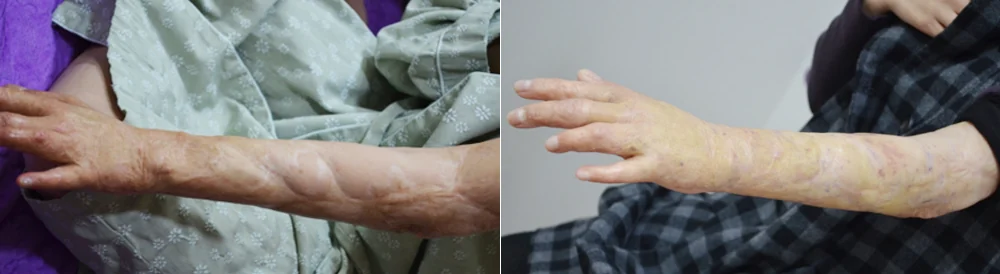
A thick, lumpy raised scar running from the back of the hand along the forearm
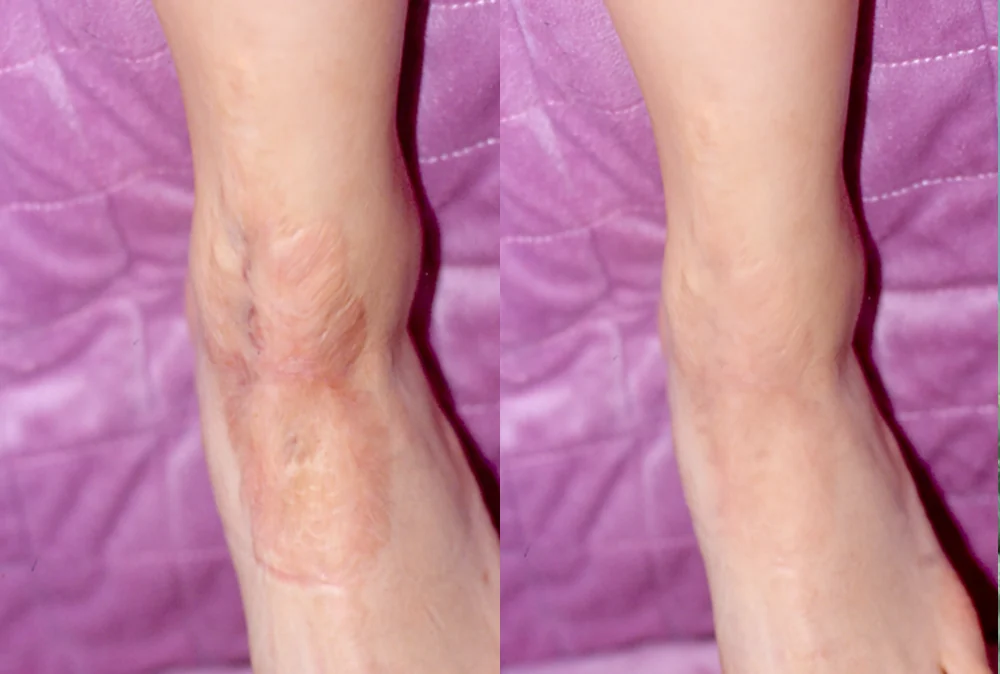
A broad red scar with a clear border on the front of the ankle
* Results vary from person to person. Side effects are possible, so please decide after a thorough consultation with a doctor.
Frequently asked questions
Can stretching and splints alone improve a contracture?
While a scar is still red and firm, positioning, splints, exercise and pressure garments are the foundation of care. Scars at this stage respond well to therapy and can improve a good deal without surgery.2 Even so, in a large study more than one in three patients admitted with major burns had a contracture at discharge.1 If the angle does not improve after the scar matures and everyday movements are blocked, surgery is considered as well.
Can laser treatment alone release the pull?
An international consensus regards lasers as a first-line therapy for traumatic scars and contractures, while also calling for more high-quality research.6 Lasers treat the redness, texture and stiffness of the scar. If the skin across a joint is seriously short, as in a broad contracture, lasers alone may not make up the missing length. The order of laser and surgery is decided after examining the scar's shape and the movement left.
Won't a Z-plasty make the scar longer?
The total length of scar line does increase, because the incision is Z-shaped. In exchange, a scar that pulled along one line is broken into shorter lines running in different directions, so the force no longer concentrates in a single line when the joint straightens. The Z-plasty is used not only to lengthen a scar but also to realign it or make it less conspicuous.4 It is worth asking to see where the new lines would go at consultation.
Can a skin graft shrink again?
Yes. Grafted skin tends to contract a little after it has taken, and thinner grafts with less dermis do so more.3 That is why more graft is used than the size of the gap, and the released position is held until the graft is stable, usually about 3 weeks, before splints and exercise continue.2 In a randomized trial, full-thickness grafts measured 92% of their original area at 12 months.5
How long will I need splints and exercises after surgery?
The general course described in the review is this: the released position is held until the grafted skin is stable, usually about 3 weeks. Splints and daily exercise then continue until the joint moves through its full range, and grafted skin needs care for about a year.2 Contracture and thick scarring can progress during the first 6 months, so frequent follow-up is recommended.3 Actual timing varies with the site, the extent of surgery and the person.
Before your consultation
- When and how you were burned (hot liquid, flame, electrical, chemical), and the treatment you received then (dressings, skin grafts and where)
- Photos of the joint fully bent and fully straightened, taken from the same angle with the date
- The everyday movements that are limited: reaching overhead, lifting your chin, opening and closing your hand, squatting
- Therapy, splints, pressure garments, lasers and operations so far, with approximate dates
- Any areas that keep breaking down or do not heal
- Medicines you take and any medical conditions
Bonita Clinic is on the 3rd floor of 565 Gangnam-daero, Seocho-gu, Seoul, about 100 m on foot from Exit 8 of Nonhyeon Station (Line 7). You can read more on our Burn Scars page. For raised red scars and keloids, see Burn & Keloid Treatment and our guide to keloids and burn scars; to tell keloids from hypertrophic scars, see the keloid vs hypertrophic scar guide. For sunken or depressed scars on the body, see Body Depressed & Incision Scars.
References (6)
Sources that support the explanations in this article. Study findings describe general trends and do not guarantee individual results.
- Schneider JC, Holavanahalli R, Helm P, et al. Contractures in burn injury: defining the problem. J Burn Care Res. 2006;27(4):508-514.doi:10.1097/01.BCR.0000225994.75744.9DProspective study of 985 adult burn patients (abstract): 38.7% had at least one contracture of the shoulder, elbow, hip or knee at discharge, three on average; shoulder 38%, elbow 34%, knee 22%; mostly mild (60%) or moderate (32%); length of stay and the extent of burn and graft were predictors; the authors concluded that this highlights the importance of therapeutic positioning and intensive therapy in hospital and called for better ways to prevent contractures
- Goel A, Shrivastava P. Post-burn scars and scar contractures. Indian J Plast Surg. 2010;43(Suppl):S63-S71.doi:10.4103/0970-0358.70724Review of burn scars and contractures (full text): wound contraction and myofibroblasts, shortening of tendons, nerves and vessels and joint dislocation in long-standing contractures, pressure garments (all day, 9–12 months), why release waits for maturity (about a year) and the exceptions, release at the point of maximum tension, incision rather than excision, generous grafts, full-thickness grafts take less reliably, Z-plasty for linear or webbed contractures, about 3 weeks of positioning then splints and daily exercise, about a year of graft care
- Hayashida K, Akita S. Surgical treatment algorithms for post-burn contractures. Burns Trauma. 2017;5:9.doi:10.1186/s41038-017-0074-zReview of surgical algorithms for burn contractures (full text): contractures can follow split-thickness grafting despite vigorous scar management; per a systematic review, the most effective procedure is unclear; band or sheet of scar; Hudson et al.'s 50% range-of-motion yardstick for limb contractures; Z-plasty variants; flap necrosis in immature scars and the questioned waiting period; more dermis, less contraction; recurrence highest with split-thickness grafts, low with flaps; the randomized trial excluded face and scalp; perforator and free flaps; close follow-up for 6 months
- Hove CR, Williams EF 3rd, Rodgers BJ. Z-plasty: a concise review. Facial Plast Surg. 2001;17(4):289-294.doi:10.1055/s-2001-18828Review of the Z-plasty (abstract): used to lengthen, camouflage or realign a scar; the classic 60-degree Z-plasty increases scar length by 75% and is the reference for its variations
- Stekelenburg CM, Jaspers MEH, Jongen SJM, et al. Perforator-Based Interposition Flaps Perform Better Than Full-Thickness Grafts for the Release of Burn Scar Contractures: A Multicenter Randomized Controlled Trial. Plast Reconstr Surg. 2017;139(2):501e-509e.doi:10.1097/PRS.0000000000002993Dutch multicenter randomized trial (abstract): after burn contracture release, perforator-based flaps (16) versus full-thickness grafts (14); area 123% versus 87% at 3 months and 142% versus 92% at 12 months; observer scar scores and color also favored flaps
- Seago M, Shumaker PR, Spring LK, et al. Laser Treatment of Traumatic Scars and Contractures: 2020 International Consensus Recommendations. Lasers Surg Med. 2020;52(2):96-116.doi:10.1002/lsm.23201International consensus of 26 experts from 13 countries (abstract): lasers are a first-line therapy for traumatic scars and contractures, covering vascular and ablative and non-ablative fractional lasers and darker skin types, with more high-quality research needed
About this article
This article separates general medical information from Bonita Clinic's own approach. Because the right decision depends on each person's condition, it is not a substitute for a consultation.