KOKorean
 ENEnglish
 JP日本語
 CN中文(简体)
 TW中文(繁體)


Hyperpigmentation After Scar Laser in Seoul: Why Skin Darkens and How Long PIH Lasts
If the treated skin turns brown a few weeks after scar laser, it is usually post-inflammatory hyperpigmentation (PIH). Inflammation from the laser's heat stimulates the skin's pigment cells, and it is more common in darker skin, including many Asian skin types. In studies of scar lasers in Asian patients, most cases were mild and cleared in 4 to 5 weeks on average, but pigment that sits deeper in the skin (the dermis) can last much longer. The basics are to avoid sun and irritation, and to reset the energy, density and interval of the next session only after the color settles. If you are planning scar treatment in Seoul, you can send us dated photos of the area to see which approach may fit your case.
Curious about your own case? Ask us online →
What is the darker color that appears after scar laser?
A few weeks after a scar laser session, some people notice that the treated skin looks browner than before. In most cases this is post-inflammatory hyperpigmentation, often shortened to PIH. It means that after inflammation, the skin makes extra melanin (the pigment that gives skin its color), so the area turns brown. The brown marks left behind when acne spots heal are the same kind of change. PIH develops when melanin is overproduced after inflammation, or when the pigment is spread unevenly. It appears more often, and more intensely, in people with darker skin.1
A laser also creates tiny wounds and inflammation in the skin. That is why PIH is described as the most common side effect after laser treatments.2 A 2026 review gathered randomized controlled trials (studies that split patients into groups by chance and compare them) on preventing PIH after laser. It noted that PIH usually shows up most between weeks 4 and 8 after treatment.2 This explains why the skin can look darker several weeks later than it did on the day of the session.
Put simply, the darker color is a mark of the skin reacting to inflammation by making more pigment. It does not mean the scar itself has become deeper or worse. How long it lasts, however, depends on how deep in the skin the pigment sits.
Why does the treated skin turn darker?
Scar lasers use the heat of light to create very thin, column-shaped wounds in the skin. As these columns heal, the texture of the skin is remodeled. Inflammation is part of this process. The greater the injury from the laser, the stronger the inflammatory response and the higher the risk of PIH. Ablative fractional lasers, which remove tiny columns of skin (such as fractional CO2 and erbium lasers), cause PIH more often than non-ablative lasers, which heat the skin without removing it. Higher treatment density, meaning more columns packed into the same area, has also been linked to a higher risk.2
When the skin is inflamed, the body releases a range of signaling substances. These stimulate the pigment cells (melanocytes) at the base of the epidermis, the outermost layer of the skin, to make more melanin.1 The extra melanin is passed on to the surrounding skin cells, and from the outside the skin looks brown.
If the inflammation damages the bottom layer of the epidermis, some melanin can drop down into the dermis (the thicker layer beneath the epidermis). There, scavenger cells called macrophages swallow the pigment and hold on to it.1 Pigment sitting this deep looks blue-gray from the surface.
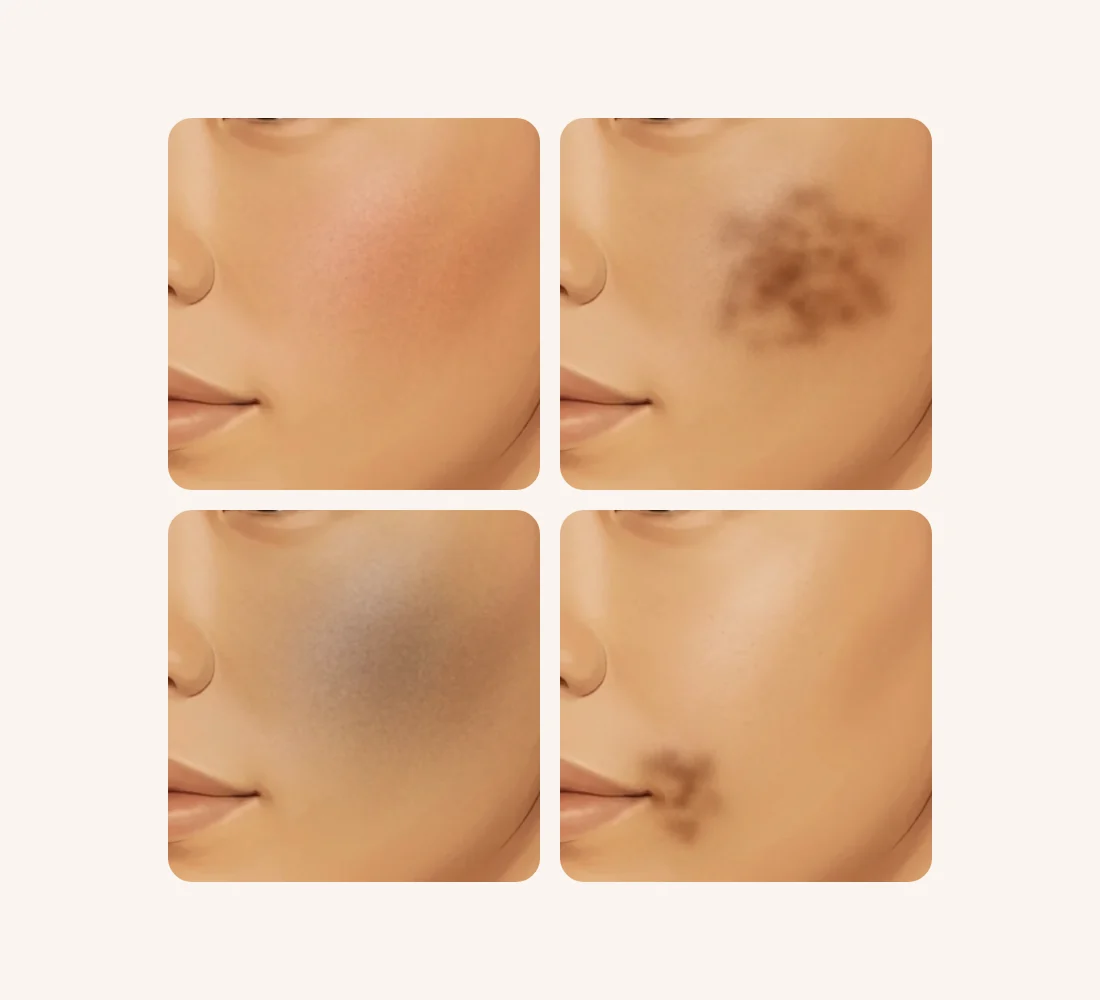
Which kind of color change are you seeing?
Not every color change after laser is hyperpigmentation. When it appeared, what color it is and where it gathers each tell you something different.
Skin color after laser: what kind of change is it?
1The treated area is evenly red
Often a heat reaction; check that it fades day by day
Early reaction
2Weeks later, the area turns patchy brown
Epidermal pigment may have increased; reduce sun exposure and irritation
Epidermal pigment
3A gray tone with blurred edges
Pigment may sit in the dermis; depth is checked in person
Dermal pigment
4Only a small area like the mouth darkened
Heat builds up easily there; settings and cooling are reviewed
Small area
A little more on each card:
- Redness: redness right after laser is a reaction to heat and inflammation, not pigment. What matters is that it eases a little each day.
- Brown patches: if brown appears within the treated area a few weeks later, epidermal PIH is the likely cause. Extra pigment in the epidermis looks tan, brown or dark brown.1
- Blue-gray: pigment in the dermis looks blue-gray. It can last much longer than epidermal pigment, or remain.1
- Around the mouth only: in a study of fractional laser records from Chinese patients, PIH limited to the area around the mouth appeared in patients who were treated without air cooling. The researchers concluded that cooling, to stop heat building up in the tissue, matters especially in small areas like this.5
If a patch appeared somewhere that was not treated, another pigment problem may be involved. Color inside the treated area is not always PIH either. In skin that already had melasma, melasma can become darker after laser, so even color within the treated area is told apart at an examination. Our UltraClear laser guide explains how melasma and fractional laser relate. Either way, the first step is to compare when and where the color appeared with the dates and areas of your laser sessions.
How common is it in Asian skin?
PIH is more common in darker skin. Even within Asian populations, surveys found it more often in groups with darker skin tones.1 Nearly all of the randomized trials in the review above were also carried out in Asia,2 which shows how relevant the problem is for Asian skin.
Three studies of fractional laser in Asian patients give a sense of the numbers. Two looked at acne scar treatment; the third reviewed records of acne scar, skin rejuvenation and pigment treatments together.
| Study | Patients and laser | Hyperpigmentation | Course |
|---|---|---|---|
| Thailand, 2010 | 13 people with skin type IV and depressed acne scars · ablative fractional CO2 laser, 3 sessions about 7 weeks apart | Mild PIH in 92% of patients and 51% of sessions | All cleared in 5 weeks on average3 |
| Thailand, 2021 | 26 people with skin types III–IV and depressed acne scars · 1064-nm picosecond laser with a microlens array, 6 monthly sessions | Mild PIH in about 18% of sessions | All temporary, cleared within 4 weeks on average4 |
| Chinese patients, 2007 | 37 people, 119 sessions · acne scars, skin rejuvenation and pigment treatment · 1540-nm non-ablative fractional laser | Widespread PIH in 7.1% (high energy, low density) vs 12.4% (low energy, high density) | The difference was not statistically significant5 |
"Skin type" in the table refers to the Fitzpatrick scale, which groups skin by how it reacts to the sun. Higher numbers mean darker skin that tans rather than burns. Type IV skin rarely burns and tans easily; it is common among East and Southeast Asian people.
In short, PIH was a common event after fractional laser in Asian skin, and in these studies most cases were mild and cleared within weeks. The studies counted PIH differently, though: some included mild cases while another counted only widespread PIH, and some counted patients while others counted sessions. So the numbers in the table cannot be compared with each other directly. All three studies were also small, so they cannot predict exactly what will happen in your skin.
Can you tell whether your skin is prone to it?
It cannot be predicted precisely, but the factors that raise the risk are known. The same review lists four factors that influence PIH after laser:2
- Skin type: the darker the skin, the higher the risk.
- Ultraviolet exposure: a lot of sun before and after treatment raises the risk.
- Type of laser: ablative lasers cause it more often.
- Amount of inflammation: the stronger the inflammation after treatment, the higher the risk.
You cannot change your skin type, but the others can be managed to some extent through planning and aftercare. If your skin was tanned just before treatment, mention it at consultation. If brown marks lingered after acne or a previous laser, that history also helps in choosing settings.
How long does it take to fade?
In the scar laser studies above, the PIH that developed cleared in 4 to 5 weeks on average.34 Not every case settles that quickly. The review of randomized trials notes that in people with darker skin, PIH can persist for up to a year.2 A broader review of PIH (a paper that summarizes earlier research) explains that untreated epidermal PIH may take months to years to resolve, while dermal PIH may last for a very long time or remain.1
The most useful way to follow the change is a series of dated photos taken in the same light. Looking in the mirror every day, it is hard to notice a difference. Comparing photos from the same angle every two weeks shows whether the color is fading, staying the same or spreading.
Why do energy, density and cooling matter?
Laser settings change the risk of PIH. In fractional lasers, "energy" refers to the strength and depth of each column, and "density" to how closely the columns are packed in a given area.
In the study of Chinese patients above, treatments using higher energy and fewer columns were followed by widespread PIH in 7.1% of cases. Treatments using lower energy and twice as many columns were followed by PIH in 12.4%. This difference was not statistically significant. Even so, the researchers concluded that both density and energy determine the risk, that density may matter more, and that further studies are needed. They also stressed cooling, to stop heat from building up in the tissue.5
Put simply, when the columns are packed closely, heat can spread into the healthy skin between them and increase the inflammation. For skin that pigments easily, this is a reason to consider gentler settings spread over several sessions rather than doing a lot at once.
The evidence on cooling is mixed. In the records of Chinese patients above, PIH around the mouth appeared in patients treated without air cooling, and the researchers concluded that cooling to stop heat building up in the tissue matters.5 On the other hand, the only cooling trial in the 2026 review involved a different laser (a Q-switched laser for facial pigment spots), and the side that received cold air from 30 seconds before, through and after treatment actually developed more PIH.2 The method and timing of cooling, and the type of laser, may change the result, so it is not yet settled which approach is right.
Is sunscreen enough to prevent it?
Ultraviolet light makes PIH darker, which is why daily broad-spectrum sunscreen (protecting against both UVA and UVB) is described as an essential part of treating PIH.1
How much sunscreen prevents PIH from developing in the first place is a point on which studies disagree. The 2026 review ran a network meta-analysis (a calculation that links several trials so that methods never tested head to head can still be compared), and in that calculation sunscreen alone did no better than placebo. No trial compared sunscreen directly with placebo, however; the result is an indirect comparison built from a few small trials. In the included trials, groups using other methods also generally used sunscreen. The authors themselves cautioned that the amount applied, reapplication, SPF and timing may have differed between studies. The same paper also cites another systematic review, of people with darker skin where most cases followed laser, that found sunscreen to be an effective preventive measure.2
In other words, the size of sunscreen's preventive effect is still debated, but it remains the baseline that keeps existing color from getting darker and lasting longer.1 On its own, it is unlikely to prevent every case. Practical sun habits after laser, such as applying sunscreen from the first day, wearing a hat and avoiding the midday sun, are covered in our guide to daily life after laser.
Are there other ways to lower the risk?
Some studies found that medicines that calm inflammation right after laser can reduce PIH. In one Thai trial, 40 people with skin type IV and depressed acne scars had fractional CO2 laser on both sides of the face. On one randomly chosen side, a strong steroid ointment (clobetasol 0.05%) was applied for the first 2 days, followed by petroleum jelly. The other side received petroleum jelly alone for 7 days. PIH developed on 75% of the petroleum-jelly-only sides and on 40% of the steroid sides. The pigmentation on the steroid sides was also lighter and covered a smaller area.6
The review compared 14 trials of this kind:2
| Approach | What studies found | Good to know |
|---|---|---|
| Short course of steroid ointment | Two trials after facial fractional CO2 laser found less PIH26 | A prescription medicine · acne-like bumps in 5% · no benefit in a forearm study2 |
| Tranexamic acid skin injection | One trial of laser for sun spots on the forearms: PIH in 16% (injection) vs 28% (saline)2 | Bruising and stinging at injection sites · only one trial2 |
| Tranexamic acid tablets | One trial of laser for sun spots: no clear reduction2 | Nausea reported in 20%2 |
| Epidermal cooling | The one trial in the review found more PIH with cold air2 | A records study stressed air cooling during treatment5 |
| Lightening cream beforehand | Mixed results2 | No difference when used before CO2 laser in one study2 |
| Sunscreen alone | No better than placebo in an indirect comparison (read with caution) · another review reported benefit2 | Still the baseline that keeps color from deepening12 |
In the review's ranking, tranexamic acid, steroid ointment, cooling and others came out lower than sunscreen alone. Most of these results, however, rest on one or two small trials and indirect calculations, so the range of plausible results (the confidence interval) was very wide. A high rank does not mean a benefit has been confirmed, and the authors themselves warned that the number and size of trials were small, so the ranking should not be taken as definitive.2 All of the medicines listed are chosen by a doctor to suit the skin and the treated area. Using a strong steroid ointment from home on your own for a long time can cause other problems, such as thinning of the skin, so please do not try this yourself.
What should you do now if the color has darkened?
The first step is to avoid irritating the skin further. PIH can be caused or worsened by treatments that irritate the skin.1 Avoid exfoliants, scrubs and rubbing. Our laser treatment page at Bonita Clinic also advises sun protection, avoiding harsh cosmetics and scrubs, generous moisturizing, and avoiding hot baths and saunas after treatment.
How is the color changing now?
- Redness fading day by dayCalm the skin and watchSunscreen and moisturizer
- Brown deepening after a few weeksCheck progress before the next sessionReset energy, density and interval
- Unchanged for months, or grayishHave the depth checked in personTopical medicine or other options
- Pain, heat or oozing increasingContact us without delayRule out infection and other problems
For PIH that has already developed, lightening creams (such as hydroquinone or azelaic acid) used together with sun protection are described as the usual first treatment. These creams work mainly on pigment in the epidermis and respond poorly to deeper pigment. Hydroquinone can irritate the skin when used at high strength for a long time. Long-term use of very high strengths has also been linked to exogenous ochronosis, a side effect in which the skin actually darkens, so the strength and duration should be decided with a doctor.1 When to start a cream and how to apply it are decided after the skin has been examined.
Do not rush the next session. If the color is still deepening, it is safer to wait until it settles and then reset the energy, density and interval. If dermal pigment is suspected, or nothing has changed after several months, the depth of the color and the state of the scar are examined again. Increasing pain, heat or oozing may point to a problem other than pigmentation, so contact us or a local doctor promptly. How sessions are spaced is explained in our guide to scar laser sessions and intervals.
How we approach it at Bonita Clinic
According to Bonita Clinic's treatment information, scar laser is usually done under topical or local anesthesia, and you go home the same day. The anesthesia method, recovery time and follow-up visits depend on the extent of treatment and the individual. If your skin has darkened after a previous laser, please tell us before the next session, along with when and which laser you had. Your skin type and past reactions are key information for choosing settings.
Real treatment cases
These cases are from our acne and pore scar treatment page. They are not photos following PIH after laser; they show cases where the color and texture of scarred skin were both a concern. Results vary from person to person.
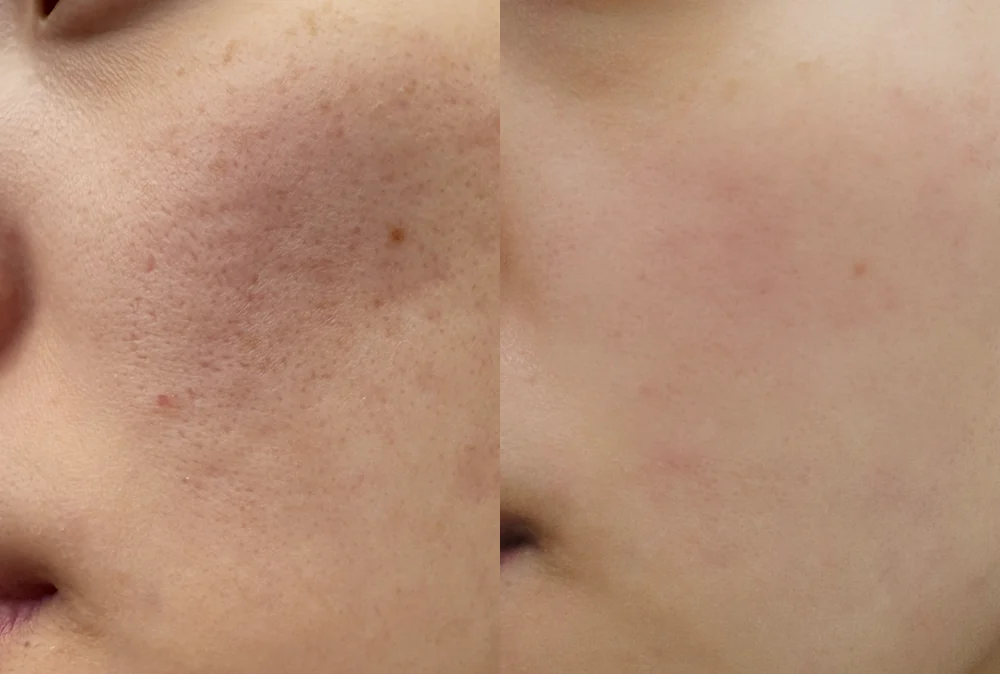
Wide pores in the middle of the cheek, with the surrounding skin looking reddish-brown and dark
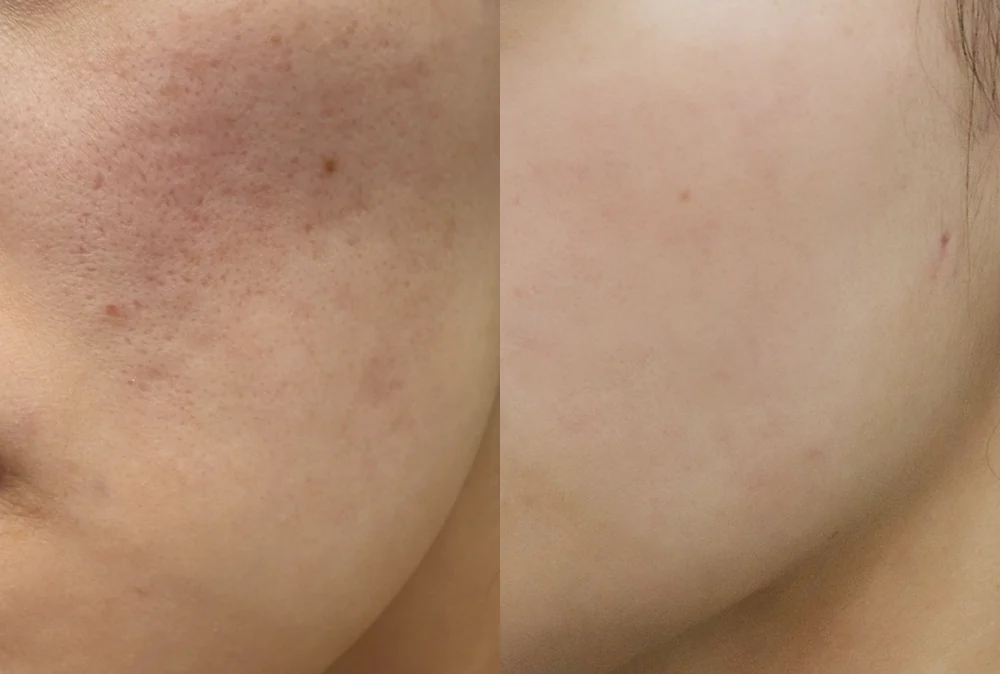
A broad reddish-brown tone over the upper cheek, with small dot-like marks scattered across it
* Results vary from person to person. Side effects are possible, so please decide after a thorough consultation with a doctor.
Treatment options you can discuss in Seoul
Bonita Clinic has treated patients at the same location since opening in 1995, and Dr. Kwang-Seop Jung, a plastic surgeon board-certified in Brazil, sees patients himself. For scars where color and texture are a concern, what you can discuss at consultation is the approach described on our treatment pages:
- An assessment of what is visible now: redness, brown or gray color, texture, and depressions underneath
- Lasers combined by purpose: vascular laser for redness, fractional or CO2 laser for texture and surface irregularities, pico laser for pigment and scar marks, and RF microneedling for scars and pores
- For deep or tethered acne scars, treatments that lift the base (punch techniques and adhesion release) or fill wide depressions (fat grafting) before laser
- Aftercare guidance after each session, with the next session set after checking progress
Which of these you need, if any, is decided only after an examination. If PIH from a previous laser is still settling, the plan may start with a period of watching and protecting the skin.
Why do the plan and the cost differ from person to person?
Two people who both have "dark marks after scar laser" may need quite different plans. What shapes the plan, and therefore the cost, is what remains on the skin and how it needs to be approached.
- What remains: redness, brown or gray color, texture, depressions
- Which lasers are combined, and how many areas
- Number of sessions and the spacing between them
- Gentler settings over more sessions for pigment-prone skin
- Whether depressions need lifting or filling first
- Anesthesia: topical or local
Final plan and quote after an in-person exam
A final estimate is given only after an in-person examination, once the type of color change, its depth and the state of the scar are clear. Photos help narrow down the options, but they cannot settle the plan.
What can photos show, and what needs an in-person exam?
Photos are a good starting point, because color and its pattern show up well on camera. They cannot show how deep the pigment sits or what lies beneath it.
Photos can show
- Color: red, brown or gray, in daylight
- Whether it stays within the treated area
- How it changed, with dated photos
- Scar type that can be seen on the surface
- Areas near the mouth or eyes
Needs an in-person exam
- How deep the pigment sits
- Skin type and how it reacts to sun
- Texture and depressions under the color
- Signs of infection or ongoing inflammation
- Other pigment conditions mixed in
Helpful photos: the whole face from the front and both sides, plus close-ups of the darkened area, taken in daylight without makeup. Photos from before the laser and every couple of weeks since are especially helpful. Note the dates and the names of the lasers you received, if you know them. You can send us a message with your photos and a short description of what changed and when.
Planning laser sessions around a visit to Seoul
PIH tends to show most between weeks 4 and 8 after treatment.2 If you have scar laser during a visit to Seoul, this window usually falls after you are back home. A few points help:
- Protect your skin on the way home and for the following weeks. Ultraviolet light darkens PIH,1 so sunscreen, a hat and avoiding long midday sun exposure matter during travel and sightseeing too.
- Take dated photos. Photos every two weeks, in the same light and from the same angle, make it easier to compare how your skin responded, at your next consultation or with a doctor near you.
- Keep the next session flexible. Whether and when to have another session in Seoul is decided after seeing how your skin reacted, so it is planned together with you rather than fixed in advance.
- Know when to see a local doctor. If pain, heat, swelling or oozing increases instead of settling, see a doctor near you promptly.
How long you stay in Seoul and how many visits you need depend on the treatments chosen, so these are planned with you at consultation. For more on planning the trip itself, see our scar treatment visit planning guide.
Frequently asked questions
Does hyperpigmentation after laser mean my scar got worse?
PIH is a change in skin color. It is different from a change in the depth or shape of the scar. In studies of scar lasers in Asian skin, most cases were mild and cleared in 4 to 5 weeks on average.34 If the color looks grayish or has not changed for several months, though, the pigment may sit deeper, and it is worth an examination.1
Can I prevent it by using a lightening cream before laser?
The results are mixed. In one study, applying a lightening product for 2 weeks before a laser for sun spots reduced PIH. In another, using lightening creams before CO2 laser made no difference compared with no pretreatment.2 It depends on your skin and the laser planned, so bring any products you use to your consultation.
I developed PIH. When can I have the next laser session?
It is safer to wait until you can see the color settling. Higher density (more closely packed columns) has been linked to a higher risk,2 and in the records of Chinese patients the denser setting also had slightly more PIH, although the difference was not statistically significant.5 With this in mind, energy, density and interval are reset for the next session. The timing is decided after examining how your skin has responded.
Can a pico laser clear PIH quickly?
A 2010 review found that studies of lasers used to treat PIH itself were few, mostly case reports. It also pointed out that laser energy aimed at deeper targets can be absorbed by pigment-rich epidermis and cause side effects.1 The usual first steps are to calm the skin, avoid the sun and watch how it changes. Our device list includes a pico laser used for pigment and scar marks, but whether and when to use it is decided after examining the depth of the color and how your skin reacts.
Should I avoid scar laser in summer?
The studies behind this guide did not compare seasons. Ultraviolet light does, however, make PIH darker.1 If you have a beach holiday or long days outdoors planned in the weeks after laser, it is better to schedule treatment around them. Because PIH appears most between weeks 4 and 8,2 plan for that window as well.
What to prepare before your consultation
- The name or type of laser you had, with dates and number of sessions
- When the color started to darken, and dated photos since then (same light, same angle)
- Ointments or cosmetics used after the laser, and any lightening products you use now
- Whether your skin has darkened after acne or a previous laser before, and whether you have been diagnosed with melasma
- Any plans for long periods in the sun in the coming weeks
Bonita Clinic is on the 3rd floor of 565 Gangnam-daero, Seocho-gu, Seoul, about 100 m on foot from Exit 8 of Nonhyeon Station (Line 7). You can read more on our acne and pore scar treatment page, our UltraClear laser page for lasers and aftercare, and our facial surgical scar page for scars after cosmetic surgery. If depressions remain after many laser sessions, see why acne scars may not improve after repeated laser.
References (6)
Sources that support the explanations in this article. Study findings describe general trends and do not guarantee individual results.
- Davis EC, Callender VD. Postinflammatory hyperpigmentation: a review of the epidemiology, clinical features, and treatment options in skin of color. J Clin Aesthet Dermatol. 2010;3(7):20-31.Review (full text): inflammatory mediators stimulate melanocytes to make and pass on more melanin; damage to the basal layer drops pigment into the dermis, where macrophages hold it. Epidermal pigment looks brown, dermal pigment blue-gray. Untreated epidermal PIH may take months to years, dermal PIH may last very long or remain. UV worsens it; daily sunscreen; lightening creams work mainly on epidermal pigment; hydroquinone irritation; irritating treatments can worsen PIH; little evidence for treating PIH with lasers. More common in darker skin
- Wongdama S, Yenyuwadee S, Li JB, et al. Interventions to Prevent Postinflammatory Hyperpigmentation After Laser and Energy-Based Device Treatments: A Systematic Review and Network Meta-Analysis. Lasers Surg Med. 2026;58(3):157-168.doi:10.1002/lsm.70098Systematic review and network meta-analysis of 14 randomized trials, nearly all in Asia (full text): PIH is the most common side effect after laser, peaks at weeks 4–8, and is more frequent with ablative lasers and higher density; risk factors are skin type, UV, laser type and inflammation; sunscreen alone did no better than placebo in an indirect comparison only, while a cited review in skin of color found it effective; higher-ranked methods had very wide intervals; the one cooling trial found more PIH with cold air; PIH can last up to a year in darker skin; few, small trials
- Manuskiatti W, Triwongwaranat D, Varothai S, et al. Efficacy and safety of a carbon-dioxide ablative fractional resurfacing device for treatment of atrophic acne scars in Asians. J Am Acad Dermatol. 2010;63(2):274-283.doi:10.1016/j.jaad.2009.08.051Prospective study (abstract) of 13 people with skin type IV and depressed acne scars, 3 sessions of ablative fractional CO2 laser about 7 weeks apart: mild PIH was the most common side effect, in 92% of patients and 51% of sessions, and cleared in 5 weeks on average
- Manuskiatti W, Punyaratabandhu P, Tantrapornpong P, et al. Objective and Long-Term Evaluation of the Efficacy and Safety of a 1064-nm Picosecond Laser With Fractionated Microlens Array for the Treatment of Atrophic Acne Scar in Asians. Lasers Surg Med. 2021;53(7):899-905.doi:10.1002/lsm.23368Prospective study (abstract) of 26 people with skin types III–IV and depressed acne scars, 6 monthly sessions of 1064-nm picosecond laser with a microlens array: mild PIH in about 18% of sessions, all temporary and cleared within 4 weeks on average
- Chan HH, Manstein D, Yu CS, et al. The prevalence and risk factors of post-inflammatory hyperpigmentation after fractional resurfacing in Asians. Lasers Surg Med. 2007;39(5):381-385.doi:10.1002/lsm.20512Retrospective study with a volunteer arm (abstract), 37 Chinese patients treated for acne scars, skin rejuvenation and pigmentation, 119 sessions of 1540-nm fractional laser: widespread PIH in 7.1% with high energy and low density vs 12.4% with low energy and double density (not statistically significant); localized PIH around the mouth without air cooling; both density and energy matter, density possibly more, further studies needed; cooling matters, especially in small areas
- Cheyasak N, Manuskiatti W, Maneeprasopchoke P, Wanitphakdeedecha R. Topical corticosteroids minimise the risk of postinflammatory hyper-pigmentation after ablative fractional CO2 laser resurfacing in Asians. Acta Derm Venereol. 2015;95(2):201-205.doi:10.2340/00015555-1899Randomized split-face trial (abstract) in 40 people with skin type IV and depressed acne scars after fractional CO2 laser: clobetasol 0.05% ointment for 2 days then petroleum jelly vs petroleum jelly alone for 7 days; PIH 40% vs 75%, with lighter and smaller pigmentation on the steroid side
About this article
This article separates general medical information from Bonita Clinic's own approach. Because the right decision depends on each person's condition, it is not a substitute for a consultation.