KOKorean
 ENEnglish
 JP日本語
 CN中文(简体)
 TW中文(繁體)


Laser Aftercare in Seoul: When Can You Wash, Wear Makeup and Exercise Again?
It depends on the laser, but rinsing with lukewarm water and a gentle moisturizer can usually start on the day of treatment, and sunscreen when you go out from the same day (from the next day after an ablative laser). Makeup and sweaty workouts come back once redness and warmth ease after a laser that only heats the deeper skin, or, after an ablative laser that makes tiny openings in the surface, once crusts and flakes have fallen off and the surface has closed again. Strong products such as scrubs, exfoliating acids and retinoids, as well as saunas and hot baths, come last, and because brown marks were more common in people who spent the early afternoon outdoors, it makes sense to stay out of the midday sun for a few weeks. If small blisters appear in a cluster, if you see pus or yellow crusts, or if pain and redness get worse day by day, contact the clinic right away rather than waiting.
Curious about your own case? Ask us online →
Why does recovery differ so much from one laser to another?
The single biggest factor in how quickly you get back to normal life after a laser is simple: did the laser leave the surface of your skin intact, or did it open it? The outermost layer of skin is called the epidermis. It works like a wall that keeps water, cosmetics, sweat and germs from getting into the skin beneath. If that wall is untouched, washing your face or putting on makeup puts little strain on it. If the laser has made tiny openings in it, there is more to be careful about until it closes again.
A review in the Journal of the American Academy of Dermatology (a paper that gathers and summarizes earlier research) sorts skin-renewal lasers into three broad groups.1
- Non-ablative lasers leave the surface alone and heat only the dermis, the firm layer underneath that gives skin its support.
- Fractional lasers send very fine beams into the skin to create a dense pattern of microscopic heat columns, while the skin between the columns is left untouched.
- Ablative lasers remove the surface over a wide area. The review explains that the roughly two-week recovery and the small but real risk of complications with this approach are what led to non-ablative and fractional lasers being developed.1
Fractional lasers sit in the middle: they tend to change the skin more than non-ablative lasers, and recovery is faster than when the whole surface is removed.1 Put simply, the less a laser disturbs the surface, the sooner you are back to normal, and the more it opens the surface, the more change you can expect, along with more recovery to plan around.
Is the skin surface closed or open?
Fractional lasers themselves come in two kinds. Non-ablative fractional lasers leave only tiny heat marks inside the skin while the surface stays covered. Ablative fractional lasers make real microscopic openings in the surface. After the second kind, the skin is less able to keep out irritants until the surface has re-formed, so for the first few days your routine is mainly about gentle washing, moisturizing and keeping irritation to a minimum.5
Which kind of laser did you have?
Knowing how the laser reached your skin tells you more about recovery than the brand name does. What you see in the mirror afterwards also differs from one type to another.
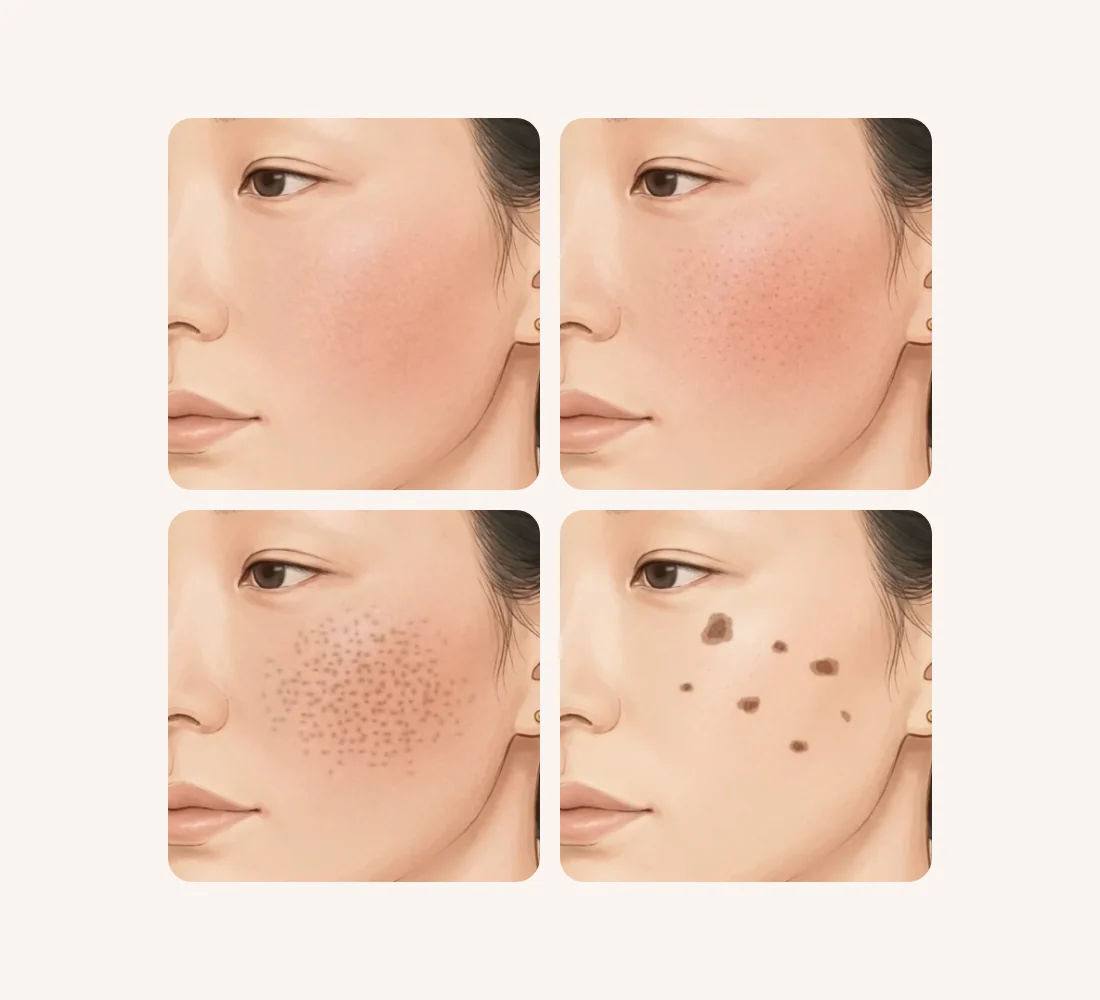
How skin looks after different types of laser
1If the cheek looks evenly red and warm
The surface is intact, so most people carry on as usual once redness and warmth ease
Mediostar
2If you see redness with fine marks
Washing is possible the same day; redness and flaking can last a few days
Sculpio
3If tiny brown crusts sit on red skin
Gentle washing and moisturizer only until the surface closes; leave the crusts alone
UltraClear
4If only the sun spots darken and form thin crusts
Let the crusts fall off on their own and shield the area from midday sun
Here is how this applies to the lasers on our treatment pages:
- Mediostar is a lifting laser that cools the skin surface while heating the deeper skin. Our treatment page explains that temporary redness and warmth usually settle within one to two days.
- Sculpio creates microscopic renewal zones inside the skin without removing the surface. Our treatment page notes that you can wash your face on the day of treatment.
- UltraClear is an ablative fractional laser that uses a 2,910 nm wavelength to resurface the skin in microscopic columns. How long recovery takes depends on the depth and intensity used.
- Pigment lasers concentrate their effect where pigment has gathered, such as sun spots. The spots themselves can look darker for a while, or a thin crust can form and then come off.
At Bonita Clinic, all three of these devices are used as non-surgical treatments with numbing cream. You go home the same day and there are no stitches. Because the power, depth and combination change with your skin condition and your goals, recovery time and follow-up visits vary from person to person. Device-specific research and recovery are covered in our UltraClear guide, Sculpio guide and Mediostar guide. This guide focuses on everyday life after any laser.
In what order do everyday routines come back?
It helps to think in terms of how your skin looks rather than counting days. The usual order is:
- From the day of treatment: rinsing with lukewarm water, a gentle moisturizer, and sunscreen when you go out (after an ablative laser, shade the skin on day one and start sunscreen the next day)
- Once redness and warmth have eased and any crusts or flakes have cleared: makeup, sweaty workouts and swimming
- Last of all: strong products such as scrubs, exfoliating acids and retinoids, and saunas or hot baths
What to restart, and when
How long it takes to reach the second stage is what varies between lasers. After a heating laser it often takes only a day or two. After a laser that opens the surface it takes several days or more, and longer the deeper the treatment. The sections below walk through each step and what the evidence says.
When can you wash your face, and how?
You may have heard that water should not touch your face on the day of a laser treatment. One trial tested exactly this. Researchers in Shanghai divided 30 people with freckles or sun spots (solar lentigines) into two groups. Everyone was treated with a 755 nm alexandrite laser, a laser that targets pigment. One group was told to wash with water, and the other to avoid water. The skin was compared with photos and skin imaging on days 1, 3, 7 and 14 and again at 3 months.2
- Neither group had any serious complications.
- Symptom scores after treatment (on a visual scale) did not differ.
- At 3 months, the reduction in brown spots was similar in both groups.
- Satisfaction was higher in the group that washed with water.2
In other words, at least after a pigment laser, strictly avoiding water made no difference to results or safety. Our Sculpio treatment page also notes that you can wash on the day of treatment.
Lasers that remove part of the surface call for a little more care. A panel of 21 dermatologists and plastic surgeons published a consensus on ablative fractional CO2 lasers, one of the resurfacing lasers with a longer recovery. The panel was built around one company's device, and several members have financial ties to that company, so treat its advice as the experience-based opinion of seasoned doctors rather than fixed rules. Only 19% of the panel allowed a facial cleanser in the first 24 hours, while 62% allowed one from the second or third day.5 If your laser opened the surface, a gentle rinse is enough on day one, and a cleanser can wait until the point you were told.
How to wash is the same whatever the laser:
- Use lukewarm water. Bonita Clinic advises lukewarm rather than hot water for washing after treatment.
- Wash gently with your palms; don't rub, and don't massage the lather into your skin for long.
- Pat dry gently with a clean towel instead of wiping.
- Do not try to wash off crusts or flakes.
Which moisturizer, and how much?
The rule after a laser is "plenty, and gentle." For Mediostar, Sculpio and UltraClear alike, Bonita Clinic advises using enough moisturizer to keep the skin well hydrated.
After a laser that removes part of the surface, the skin is covered more thoroughly for the first few days. The CO2 consensus panel agreed on cold compresses and a petrolatum-based ointment (like plain petroleum jelly) right after treatment. For the first 3 days, 76% recommended this kind of ointment. On days 4 to 7, panelists split between continuing the ointment (57%) and switching to a regular moisturizer (48%).5 Simply put, while the surface is open, an ointment that seals the skin is the base; as it closes, you move back to a simple, gentle moisturizer.
What you apply matters too. The same panel listed lanolin, topical antibiotics, fragrances and preservatives, moisturizers, peeling agents and numbing creams as causes of contact dermatitis (a red, itchy reaction to something applied to the skin) after treatment.5 So the days right after a laser are not the time to try a new product. Choose a simple product you have used before without problems over one that is heavily scented or has a long ingredient list.
Small, pimple-like bumps can also appear after a laser. In a review of 961 non-ablative fractional laser treatments, these acne-like breakouts were the most common complication (1.87%).6 The CO2 panel listed changing the ointment as one way to manage breakouts that persist.5 So use only as much ointment as you need, and if bumps appear, do not squeeze them; let us know which products you are using.
Can you use sunscreen from the first day?
In most cases, yes. Skin is more sensitive to the sun after a laser, and areas that have been inflamed can turn brown. This is called post-inflammatory hyperpigmentation. A Thai research team noted that it is the most common side effect of ablative fractional lasers in Asian patients.3
The same team treated both sides of the face of 30 people with an ablative fractional CO2 laser at the same settings; 26 of them completed every follow-up visit. One side received only petrolatum ointment four times a day for the first week. The other side received the same ointment plus a broad-spectrum sunscreen containing anti-inflammatory ingredients, starting on the morning after treatment.3
- There was no statistically significant difference between the two sides in water loss through the skin surface, which suggests the sunscreen did not get in the way of the healing barrier.
- At the one-week visit, the melanin index (a measure of skin pigment) was lower on the sunscreen side; the abstract reports this difference at one week.3
In this study, sunscreen was started on the morning after treatment. After a laser that removed part of the surface, shade from a hat or parasol comes first on day one, while the skin may still be oozing.
When you are in the sun matters as well. A randomized trial from a Korean university hospital followed 28 patients with 67 sun spots treated with a 532 nm Q-switched laser, a type of pigment laser. In the group that used only a moisturizer, 55.3% of the treated spots developed hyperpigmentation.4 The risk was higher when a lot of redness remained at two weeks. It was also higher with outdoor activity between 1 and 5 pm, with an odds ratio (a measure that compares how likely an outcome is) of 8.10.4 In other words, brown marks were more common in people who spent the early afternoon outdoors. This was an observation in a small study of 28 people, not a test of sun avoidance, but staying out of the midday sun for a few weeks is a sensible precaution.
Bonita Clinic advises applying sunscreen thoroughly whenever you go out after treatment. In practice:
- Apply a generous layer before going out, and reapply if you stay outdoors for a long time.
- Block the sun itself with a wide-brimmed hat or a parasol. While the skin stings or is still oozing, physical shade comes first.
- Cut back on midday outdoor exercise and sightseeing for a few weeks after a laser.
If brown marks do appear, there is no need to panic. The CO2 consensus recommends careful sun avoidance and sunscreen kept up for several months as the basic approach.5
When can you wear makeup again?
We could not find any study that compared makeup start dates directly. So the decision is based on the state of the skin surface:
- Heating lasers: the surface is intact.1 Once redness and warmth have eased and nothing stings, many people start with light makeup. For Mediostar, our treatment page notes that this redness usually settles within one to two days.
- Non-ablative fractional and pico lasers: redness or flaking may last a few days. If makeup lifts off the flakes or stings, wait another day or two.
- Ablative fractional lasers: wait until the tiny crusts and flakes have come off on their own and there is no oozing or stinging. Do not use makeup to cover crusts.
After Sculpio and UltraClear, Bonita Clinic advises avoiding harsh cosmetics and scrubs for one week. When you start makeup again:
- Apply sunscreen first and makeup on top.
- Do not start new products right after treatment; they can cause contact dermatitis.5
- Use clean puffs and brushes.
- Remove makeup without rubbing, with a mild cleanser and a short rinse.
When are workouts, saunas, swimming and alcohol OK?
We could not find studies comparing when to restart exercise either. What is known is that heavy sweating and hot environments send more blood to the face, which can bring back redness and warmth that were settling. The CO2 consensus describes keeping the skin cool and moist while avoiding the sun as the main goal for roughly the first one to two weeks after that treatment.5 Our Sculpio and UltraClear treatment pages also advise avoiding hot baths and saunas.
A sensible order is:
- Light movement with almost no sweating: usually fine if redness and warmth are mild.
- Sweaty workouts, hot yoga, hiking: after redness and warmth have eased, and after an ablative laser, once crusts and flakes have cleared. If you do sweat, rinse with lukewarm water soon afterwards.
- Swimming pools and the sea: wait until the surface has closed. Chlorinated pool water and salt water can irritate open skin, and outdoor swimming adds sun exposure.
- Saunas, Korean bathhouses (jjimjilbang) and hot tubs: last of all. No study has set a timeline for this. Start with short visits once the skin has fully calmed down, and take a break if redness flares again afterwards.
Alcohol is similar. We could not find any study that compared when to start drinking again after a laser, but alcohol, like a sauna, sends more blood to the face and can bring back redness and warmth that were settling. So it is reasonable to wait until redness and warmth have eased, and after an ablative laser, until crusts and flakes have cleared. If your face flares red after drinking, take a break from it for a while.
When can you restart exfoliants, retinoids and brightening products?
Strong skincare comes back last. As mentioned above, Bonita Clinic advises avoiding harsh cosmetics and scrubs for a week after Sculpio and UltraClear. Harsh products commonly include grainy scrubs, exfoliating acids (such as AHA and BHA), retinoids (vitamin A ingredients) and products that sting, such as high-strength vitamin C.
After a deeper resurfacing laser, the wait is longer. In the CO2 consensus, 76% of the panel advised gradually restarting a usual routine, including such active ingredients, between days 8 and 42. Another 24% preferred a more cautious approach of ointment and sunscreen only until four to six weeks.5 Put simply, the more deeply the surface was opened, the longer the wait.
Start brightening ingredients only after talking with your doctor. In the Korean trial above, participants were randomly assigned to start either a prescription brightening combination cream or a plain moisturizer two weeks after treatment. Hyperpigmentation developed in 31.0% of treated spots with the cream versus 55.3% with moisturizer alone,4 and the authors suggested the cream could be considered for higher-risk patients. Prescription ingredients can irritate, so when and how to use them is decided after an examination.
How can you tell a passing reaction from a sign to call?
Redness, swelling and crusting are common after a laser. The CO2 consensus describes all three as expected reactions that are usually short-lived and do not need treatment.5 Our treatment pages also note that temporary redness, swelling or flaking can occur depending on the device, and that pigment changes occasionally occur. The key question is whether things are getting better each day. If they are, keep watching; if they are getting worse, get in touch.
One study shows how often problems occur. A US clinic reviewed 961 non-ablative fractional laser treatments, and 7.6% (73 treatments) were followed by a complication.6
- The most frequent were acne-like breakouts (1.87%) and flare-ups of herpes simplex, the cold sore virus (1.77%).
- Post-inflammatory hyperpigmentation was more frequent in darker skin types.
- All were temporary and did not lead to long-term problems such as scarring.6
These figures come from a laser that does not remove the surface, though. In the ablative CO2 consensus, panelists also named lighter, whitened patches of skin (hypopigmentation) and scarring as less common reactions that can last (47% and 33% of panelists had encountered them).5 These percentages describe how many experts had ever seen each problem, not how often it happens to patients. The same panel regarded crusts lasting more than 5–14 days as a reason for concern, and swelling lasting more than 1–2 weeks as an undesirable reaction (59%).5
Are you seeing any of these after treatment?
- Redness, warmth, mild swelling, fine flakingUsually a passing reactionKeep cool and moisturized; check it eases daily
- Small blisters in a cluster, tingling or stingingContact us right awayCheck for a cold sore virus flare
- Yellow crusts, pus, pain and redness getting worseContact us right awayAn exam to check for infection
- Brown darkening over a few weeksMention it before your next visitSun protection; adjust interval and settings
Contact us right away, without waiting, if:
- Small blisters appear in a cluster, or there is burning, tingling pain (especially around the lips)
- Yellow crusts, pus or oozing increase, or pain, redness and warmth get worse day by day
- Blisters form in the treated area, or the skin turns white or gray
- A strong itch or a hive-like rash spreads after applying a product
- Crusts have not come off after nearly two weeks, or swelling lasts beyond 1–2 weeks
- You have a fever or chills
If you often get cold sores, please tell us before treatment. In the CO2 consensus, 95% of the panel said they use preventive antiviral medicine.5 Brown marks appearing over a few weeks are not an emergency, but they are important for planning the interval and settings of your next session, so please send dated photos.
If you have an important event, when should you book?
If you have a wedding, a photo shoot or a presentation, tell us at consultation. Our treatment pages ask you to mention important plans in advance, and at consultation the device, settings or treatment date are decided together with your schedule in mind.
When planning, allow for two kinds of time:
- Time for redness and flaking to clear: often a day or two after a heating laser; several days or more after a laser that opens the surface.
- Time to watch for pigment changes: in one study, a lot of redness remaining two weeks after treatment was linked to a higher risk of hyperpigmentation.4 Brown marks can appear after the redness has faded, so leave some margin rather than booking right before an event.
Plans with a lot of sun matter too. In the CO2 consensus, 67% of the panel listed a recent sunburn or heavy sun exposure in the preceding weeks as a reason not to treat.5 If a beach holiday or an outdoor event falls just before or after your laser, the timing is planned around it together.
How we approach it at Bonita Clinic
Our laser treatment and aftercare process
- 1Concerns and plansWhat you want to improve, recent treatments, important events
- 2Device and settingsPower, depth and combination for your skin type and response
- 3Aftercare explainedSun protection · moisturizing · less irritation · no temperature extremes
- 4Sessions and intervalA single session, or several spaced out
Bleeding, infection, inflammation and other side effects can occur after any procedure, and recovery differs from person to person. The actual plan is decided after an examination.
Laser options you can discuss in Seoul
Bonita Clinic opened in 1995 and has stayed at the same location since, where Dr. Kwang-Seop Jung, a plastic surgeon board-certified in Brazil, sees patients. For skin concerns treated with lasers, the options you can discuss at consultation are those on our treatment pages:
- UltraClear, an ablative fractional laser for texture, fine lines, pores and tone
- Sculpio, a dual-wavelength laser that works without removing the surface, for tone, pigment, fine lines and pores
- Mediostar, a lifting laser for firmness and facial contour, with contact cooling
- Combinations with other devices, such as ultrasound (HIFU) or radiofrequency, when the cause calls for it
Which device suits you, and whether a single session or a series makes sense, is decided after we examine your skin. If you would like to keep the recovery after your visit short, tell us; that is part of choosing the device and settings.
Why the plan and cost differ from person to person
Two people who both ask for "a laser for texture and tone" can need quite different treatments. The type of laser, how deeply and densely it is used, and how many sessions are needed shape both the recovery and the cost.
- Laser type: heating, non-ablative or ablative
- Depth, density and number of passes
- Area treated: cheeks, full face, neck
- Combination with other devices
- Number of sessions and interval
- Your skin type and pigment history
Final plan and quote after an in-person exam
A final estimate is given only after an in-person examination, once the device, settings and number of sessions are clear. Photos help narrow down the options, but the plan is set in person.
What can photos show, and what needs an in-person exam?
Photos are a useful way to start, because tone, redness and visible spots show up reasonably well in good light. Whether a brown patch is melasma or another kind of pigment, and how your skin reacts, can only be judged in person.
Photos can show
- Overall tone and redness
- Visible spots and their location
- Texture and pores in good light
- How your skin looked after past lasers (dated photos)
Needs an in-person exam
- What kind of pigment a brown patch is
- Skin thickness and sensitivity
- Active acne, cold sores or irritation
- Recent tanning or sunburn
- Which device and settings suit your skin
Helpful photos: the front and both sides of your face in daylight, without makeup or filters, plus close-ups of the areas that concern you. If a previous laser left redness or brown marks, photos from that time are especially useful. You can send us a message with your photos, the treatments you have had and when, and your travel dates.
Planning laser treatment around a trip to Seoul
If you are planning laser treatment during a visit to Seoul, it is worth building these timings into your itinerary. What is confirmed in advance is the treatment information above: a non-surgical treatment with numbing cream, same-day discharge and no stitches. How many sessions you need, the interval between them and how many visits fit into your stay depend on the device and settings, so these are planned with you at consultation.
A few points are specific to visiting Seoul for a laser treatment:
- Leave room for redness and flaking. If you have sightseeing or photos planned, tell us, so the treatment day and settings can be chosen with that in mind.
- Plan sightseeing around the midday sun. In the Korean trial, outdoor activity between 1 and 5 pm was linked to a much higher chance of brown marks after a pigment laser.4 Bring a wide-brimmed hat and sunscreen, and favor indoor plans in the middle of the day for the first few weeks.
- Pack products you already know. Korea is famous for skincare shopping, but the days right after a laser are not the time to try new products, which can cause contact dermatitis.5 A gentle cleanser, a plain moisturizer and a sunscreen you have used before are enough.
- Leave the bathhouse for a later trip. Saunas and jjimjilbang come last in the restart order.
- Tell us about cold sores before booking, so that prevention can be discussed.5
After you return home, keep up sunscreen and shade for the next few weeks. In the Korean trial, a lot of redness remaining at two weeks was linked to a higher risk of brown marks,4 so take photos in the same light every few days and send them if you notice darkening. If you see clustered blisters, pus, or pain and redness that keep getting worse, see a local doctor promptly.
Frequently asked questions
Can I wash my face on the evening after my laser treatment?
In most cases, yes, gently and with lukewarm water. In a randomized trial comparing patients who washed with water after a pigment laser with those who avoided water, results and side effects did not differ, and satisfaction was higher in the washing group.2 After a laser that removes part of the surface, though, cleansers are often started a day or two later.5 Follow the instructions you were given for your device.
Will picking off crusts or flakes speed up healing?
No. Crusts act as a cover while the skin underneath re-forms. Pulling them off early exposes skin that has not finished healing, which can prolong redness or leave a darker mark. The CO2 consensus also lists moisturizing as the way to manage crusting that lasts.5 Keep the area moisturized and let crusts come off on their own.
My skin is still red after several days. Is that normal?
If the redness is fading a little each day, it is usually a passing reaction. Redness tends to last longer the more the surface was opened and the stronger the settings. The CO2 consensus treats redness as an expected reaction and considers extra treatment only when it is prolonged or severe.5 If the redness deepens, or pain, warmth or oozing increase, contact us right away. A Korean study found that a lot of redness remaining at two weeks was linked to a higher risk of hyperpigmentation,4 so please tell us if it is still there by then.
I get cold sores. Can I still have a laser treatment?
Usually yes, but please tell us before treatment. A laser can reawaken the cold sore virus. In the study of 961 non-ablative fractional treatments, it was the second most common complication (1.77%).6 In the CO2 consensus, 95% of the panel said they use preventive antiviral medicine.5 If you have an active cold sore, treatment is postponed until it has healed.
Is sunscreen alone enough for outdoor activities?
Sunscreen is essential, but it is not the whole story. In the Korean study, outdoor activity between 1 and 5 pm after a pigment laser was linked to a much higher chance of hyperpigmentation (odds ratio 8.10).4 For a few weeks after a laser, cut back on midday outdoor activity, use a hat or parasol as well, and reapply sunscreen if you are outside for a long time.
What to prepare before your consultation
- Recent lasers, peels or injectable treatments, with dates, and how long the redness lasted afterwards
- Whether a laser has ever left brown marks, and whether you have been told you have melasma
- Whether you get cold sores often
- Any exfoliants, retinoids or brightening products you use now
- Your travel dates, any important events, and plans for beach holidays or outdoor activities
Bonita Clinic is on the 3rd floor of 565 Gangnam-daero, Seocho-gu, Seoul, about 100 m on foot from Exit 8 of Nonhyeon Station (Line 7). You can read more on our Mediostar, Sculpio and UltraClear pages. If you are having a series of lasers for scars, our guide to scar laser sessions and intervals may also help.
References (6)
Sources that support the explanations in this article. Study findings describe general trends and do not guarantee individual results.
- Alexiades-Armenakas MR, Dover JS, Arndt KA. The spectrum of laser skin resurfacing: nonablative, fractional, and ablative laser resurfacing. J Am Acad Dermatol. 2008;58(5):719-737.doi:10.1016/j.jaad.2008.01.003Review (abstract): non-ablative lasers heat the dermis and preserve the surface, fractional lasers create microscopic columns while sparing the skin between them, and the roughly two-week recovery and complication risk of fully ablative resurfacing led to non-ablative and fractional methods, with fractional in between for effect and recovery
- Han Y, Chang R, Liu L, et al. What is the optimal timing for advising patients to wash the treatment areas after laser therapy? A prospective, assessor-blinded, randomized controlled trial. Clin Exp Dermatol. 2025;50(5):960-967.doi:10.1093/ced/llae525Randomized trial (abstract): 30 people with freckles or sun spots treated with a 755 nm alexandrite laser were assigned to washing with water or avoiding water; no serious complications, no difference in symptom scores or in the reduction of brown spots at 3 months, and higher satisfaction in the washing group
- Wanitphakdeedecha R, Phuardchantuk R, Manuskiatti W. The use of sunscreen starting on the first day after ablative fractional skin resurfacing. J Eur Acad Dermatol Venereol. 2014;28(11):1522-1528.doi:10.1111/jdv.12332Randomized split-face trial (abstract): post-inflammatory hyperpigmentation is the most common side effect of ablative fractional lasers in Asian patients; in 30 patients (26 completed follow-up), adding an anti-inflammatory sunscreen from the morning after treatment lowered the melanin index at one week, with no significant difference in water loss through the skin
- Kang DH, Choi SM, Lee Y, et al. Postoperative risk assessment of post-inflammatory hyperpigmentation and the efficacy of delayed prevention following 532 nm Q-switched Nd:YAG laser treatment of solar lentigines: a randomized controlled study. J Dermatolog Treat. 2024;35(1):2398768.doi:10.1080/09546634.2024.2398768Korean randomized trial (abstract) of 28 patients and 67 sun spots after a 532 nm Q-switched laser, with participants randomly assigned to a prescription combination cream or a moisturizer from two weeks: hyperpigmentation in 55.3% of control lesions vs 31.0% of cream-treated lesions; redness at two weeks (odds ratio 1.32) and outdoor activity from 1 to 5 pm (odds ratio 8.10) were observed risk factors from questionnaires, not a test of sun avoidance
- Levy T, Lerman I, Waibel J, et al. Expert Consensus on Clinical Recommendations for Fractional Ablative CO2 Laser, in Facial Skin Rejuvenation Treatment. Lasers Surg Med. 2025;57(1):15-26.doi:10.1002/lsm.23850Expert consensus of 21 specialists on ablative fractional CO2 lasers (full text): cold compresses and petrolatum right after; cleanser allowed by 19% in the first 24 h and by 62% from days 2-3; ointment or moisturizer on days 4-7; actives restarted between days 8 and 42 (76%) or after 4-6 weeks (24%); redness, swelling and crusting expected; hypopigmentation and scarring seen by 47% and 33%; crusting beyond 5-14 days and swelling beyond 1-2 weeks (59%) as concerns; antiviral prophylaxis (95%); recent heavy sun exposure a contraindication (67%). A single-device panel with industry ties
- Graber EM, Tanzi EL, Alster TS. Side effects and complications of fractional laser photothermolysis: experience with 961 treatments. Dermatol Surg. 2008;34(3):301-305.doi:10.1111/j.1524-4725.2007.34062.xRetrospective review (abstract) of 961 treatments with a 1,550 nm non-ablative fractional laser: complications in 7.6%, most often acne-like eruptions (1.87%) and herpes simplex flares (1.77%); hyperpigmentation more frequent in darker skin; all temporary, with no long-term sequelae such as scarring
About this article
This article separates general medical information from Bonita Clinic's own approach. Because the right decision depends on each person's condition, it is not a substitute for a consultation.