KOKorean
 ENEnglish
 JP日本語
 CN中文(简体)
 TW中文(繁體)


Inflamed Sebaceous Cyst in Seoul: Remove It Now or After It Settles? What Drainage and Antibiotics Can and Cannot Do
An inflamed sebaceous cyst is an epidermoid cyst whose sac has broken or been irritated under the skin, making it red, swollen and painful; in most cases this is a reaction to leaked keratin rather than a bacterial infection. When pus has collected and the lump is soft and tense, a small cut to drain it relieves the pressure, and the long-standing order is to remove the sac once the inflammation has settled. Drainage and antibiotics can ease swelling and pain, but they do not remove the sac, and not every red cyst needs antibiotics. Studies in selected patients have also reported removing the sac right away, even while inflamed, without more complications, so the right order depends on how swollen it is, where it is and your general health. Bonita Clinic does not squeeze cysts but removes the sac as a rule. If you are planning treatment in Seoul, you can send photos of the lump first so its current stage can be seen.
Curious about your own case? Ask us online →
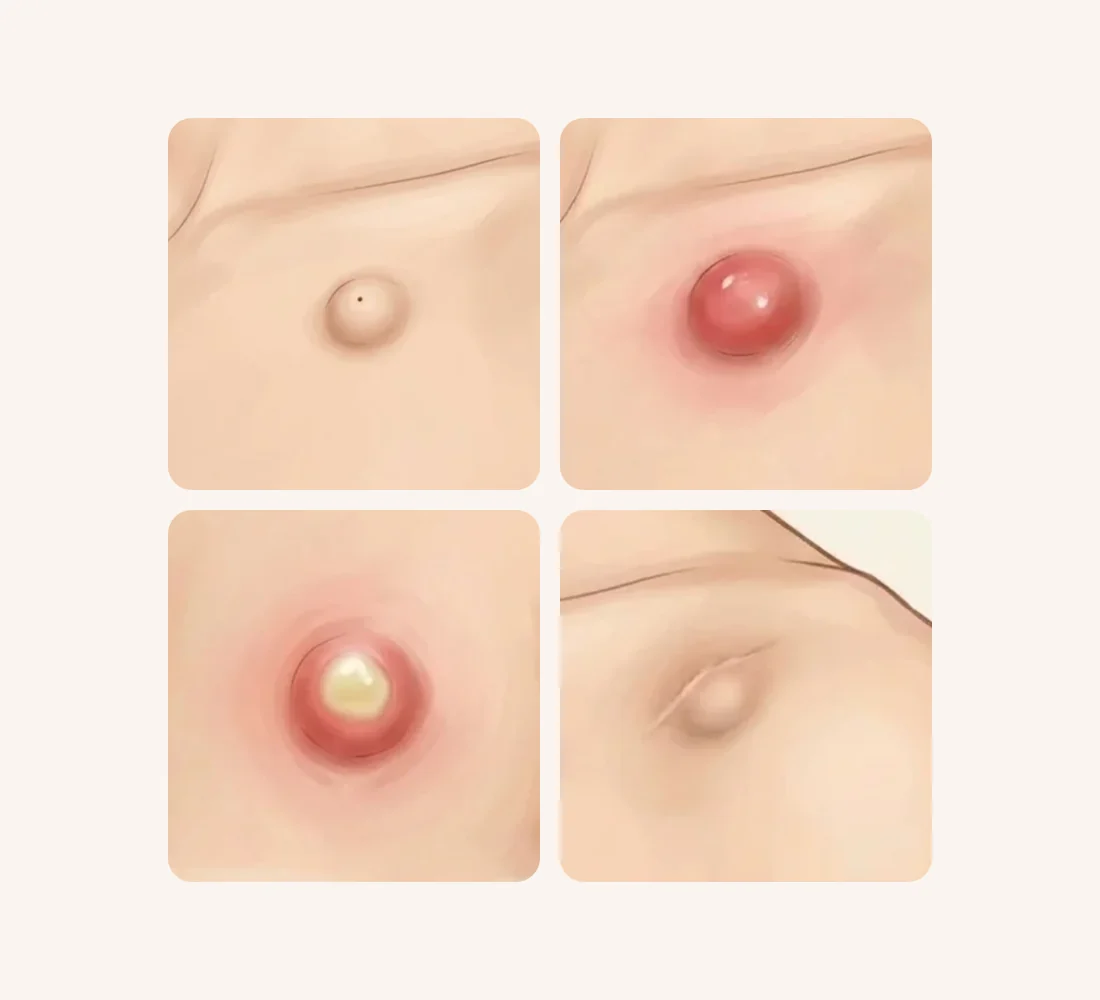
What is happening under the skin when a sebaceous cyst becomes inflamed?
Most lumps that people call "sebaceous cysts" are epidermoid cysts. Under the skin there is a small sac, and the wall of that sac keeps making keratin (the same soft protein that forms the outer skin) and oily material, which builds up inside.3 Most of the time such a cyst simply feels like a soft lump that does not hurt.
Sometimes, though, the lump suddenly turns red, swells, feels warm and hurts when you press it. This is what is meant by an inflamed cyst. The most common trigger is that the sac wall breaks open under the skin. When it does, the keratin inside leaks into the dermis, the thick layer below the surface of the skin. The body sees that keratin as foreign material and reacts strongly. The result is swelling, redness and pain.1
If the inflammation goes on, pus may collect in the middle of the lump, which becomes soft and can look yellow through the skin. Not every inflamed cyst gets that far. Many swell red and firm, then settle over several days to a few weeks.
One point is worth holding on to from the start: even when the inflammation settles, the sac is still there. That is why the same spot tends to swell again, and why scar tissue builds up around the sac with each flare.3
If it is red and swollen, does that mean it is infected?
Not necessarily. Red, hot and sore usually makes people think "infected". Yet the Infectious Diseases Society of America (IDSA) guideline explains the swelling and pus of an inflamed epidermoid cyst as a reaction to the rupture of the cyst wall, rather than an actual infectious process.1 The American Academy of Dermatology likewise states that the overwhelming majority of red, swollen epidermal cysts are inflamed, not infected.2
A study from two Korean hospitals cultured bacteria from 444 cysts as they were removed. Bacteria grew more often from inflamed cysts than from quiet ones, but most of what grew were bacteria that normally live on the skin.5 Put simply, a cyst that has turned red is not automatically an infection that needs antibiotics.
Real infection does happen, of course. In the same study, Staphylococcus aureus was found in some cysts, including strains that resist common antibiotics (MRSA).5 So "probably not infected" is not the same as "fine to ignore". See a doctor without delay if you notice any of the following:
- Fever, chills, or feeling generally unwell1
- Redness spreading well beyond the edge of the lump
- A lump that grows or becomes more painful day by day
- A condition such as diabetes, or medicines that lower your immunity
What comes first, depending on the state of the lump?
Inflamed cysts are not all at the same stage, and the first step depends on where yours is now. The drawings show four states on one person's upper chest.
What to do first, by the state of the lump
1Not swollen or painful
A good time to remove the sac; the incision is easier to keep short
Removal with the sac
2Red, firm, swollen and sore
The inflammation is assessed first, then: settle it, or remove now
Choosing the order
3Soft, with pus showing
Draining the pus may come first. The sac stays behind
Drainage first
4Settled, but a lump remains
That lump is the remaining sac; remove it with its wall and any scar tissue
Removal with the sac
- Not inflamed: This is the most suitable time to remove the sac. The edge of the wall is clear, so the whole wall is easier to take out, and the incision is easier to keep short. How a first removal is done is covered in Sebaceous cysts and lipomas: do they really need to be removed rather than squeezed?
- Red, firm and swollen: Pus has not yet collected in any amount. One way to calm the swelling first is a small injection of corticosteroid directly into the cyst.2 The other choices are to wait for the inflammation to settle and then remove the sac, or in some cases to remove it right away. The difference between these is explained below.
- Soft, with pus showing: When pus has collected and the lump is tense and painful, a small cut to let the pus out (incision and drainage) is the recommended treatment.1 Once the pressure is released, the pain often eases quickly.
- Settled, but a lump remains: That lump is the sac that is left. A quiet period, before it flares again, can be a good time to remove it. Because the area has been inflamed, the scar tissue around it is checked as well.3
What does draining the pus fix, and what does it leave behind?
Incision and drainage means making a small cut and letting out the pus and the leaked keratin. Once that is out, the pressure falls and the pain becomes lighter. The IDSA guideline names incision and drainage as the recommended treatment for inflamed epidermoid cysts,1 and it does not recommend sending the pus for culture in these cysts.1
But drainage puts out the fire; it does not remove what started it. After the pus is out, the sac wall is still in the skin. That is why simple incision and drainage is described as frequently leading to recurrence.3 Over time the remaining wall fills the sac with keratin again, and the same spot can swell once more. Why this happens is covered in detail in Recurrent sebaceous cyst: why does it come back?
In short, drainage is a first step to relieve pain now. Taking out the sac is still to come.
Will antibiotics make the cyst go away?
No, and this is the most common misunderstanding. Antibiotics act on bacteria, so when a real infection is present they can help bring down swelling and fever. They cannot remove the sac wall that keeps making keratin.
On top of that, as described above, many red, swollen cysts are inflamed rather than infected. For this reason the American Academy of Dermatology advises against routinely prescribing antibiotics for inflamed epidermal cysts, and recommends confirming infection first.2 The IDSA guideline also says that whether to add antibiotics to drainage should depend on signs of a whole-body inflammatory response, such as fever or a fast heart rate.1
To put it plainly: when antibiotics are truly needed, they matter. But "it went down after the tablets" does not mean "the cyst is gone". If you can still feel a lump once things have calmed down, the sac is still there.
Can it be removed while it is still inflamed?
The order long regarded as standard has two stages: settle the inflammation first, then remove the sac. An inflamed cyst can be very difficult to remove and close, so it may be better to postpone surgery until the inflammation has settled, which is described as typically taking about a week.3
More recently, removing the sac in one go has been reported in selected cases.
- A hospital in China compared 351 patients with inflamed sebaceous cysts. In 166, the cyst was removed right away and antibiotics were given for five days. In 185, antibiotics and drainage came first, and the cyst was removed one to two months later, once the inflammation had settled.4 The one-stage group had a shorter course of antibiotics, fewer complications and lower costs. The authors added a condition, however: that cases are appropriately selected.4
- Two Korean hospitals removed and closed 444 cysts straight away, whether or not they were inflamed. Antibiotics were not given routinely, only when clinically needed. The overall complication rate was in the range of 2 to 3%, with no meaningful difference between inflamed and non-inflamed cysts.5 The one patient who needed another operation had lowered immunity and an infection with an antibiotic-resistant strain.5
Two stages versus removal in one go
| Approach | What is done | What studies show | Worth knowing |
|---|---|---|---|
| Two stages | Drainage or medicine if needed, then sac removal once settled | The long-standing standard order | More visits; it may flare again while you wait |
| One stage | The sac is removed right away, even while inflamed | In selected patients, complications did not rise | The wall edge is blurred, so removal can be fiddly |
There are limits to keep in mind when reading these results. One study looked back at past records, and for the other it is not clear whether patients were assigned at random. Because surgeons chose whom to operate on, the most severe cysts may have been left out from the start. In other words, this is evidence that some inflamed cysts can be removed right away, not evidence that removing every inflamed cyst at once is better for everyone.
Does removing it while inflamed change the scar or the chance of recurrence?
This is the question people ask most, but studies comparing scar length or recurrence side by side, removal during inflammation versus after it settles, are still few. The Korean study reported complications only and did not report scars or recurrence.5 So what can be said for now is mostly about how things work.
- The edge of the wall: When a cyst is inflamed, the wall and the tissue around it are swollen and fragile, and the boundary is harder to see. The wall tears more easily, so more care is needed not to leave small pieces behind. This is part of why removal and closure are described as difficult at this stage.3
- Scar tissue: A cyst that has been inflamed or has burst develops scar tissue around it. Such a cyst can be hard to remove through a small opening, and a standard excision that includes the scar tissue may be needed.3 Put simply, the incision may end up longer than first planned.
- Flares while you wait: On the other hand, if the cyst swells or bursts again while you wait for it to settle, more scar tissue forms. This is why Bonita Clinic's treatment page notes that squeezing a cyst or leaving it alone lets inflammation develop and the scar grow larger.
So it is hard to say that either "remove now" or "settle first" always gives a smaller scar. It is more realistic to decide by looking together at how swollen it is, how big it is, where it is (the face or the back, for example) and how many times it has flared.
Once it has settled, when and how is it removed?
Inflammation is described as typically settling in about a week.3 In the comparison study above, the two-stage group had their cysts removed one to two months later.4 Rather than a fixed date, the usual reference point is when redness and pain have faded and the edge of the lump can be felt clearly again.
The principle of removal is then the same as for a cyst that was never inflamed: the sac comes out together with its wall. Because the area has been inflamed, a few more things are checked:
- Size and depth of the remaining sac: even a sac that went flat after drainage still has its wall.
- How far scar tissue extends: if scar tissue holding the wall is extensive, it is removed together with the sac.3
- Where earlier drainage cuts are: if the skin has been cut before, the new incision is planned with that mark in mind.
The incision line left after removal settles over time. Scar care after surgery is covered in Scar care after surgery: how long to use silicone gel, tape and sunscreen?
What should you do, and not do, at home?
A swollen, painful lump is tempting to squeeze or pop with a needle. This is not recommended. Squeezing can burst the sac further under the skin, spreading keratin more widely and enlarging the inflammation and the scar. Even if some contents come out, the sac stays where it is.3
- Do not squeeze it or pop it with a needle or fingernails.
- Avoid rubbing it, or pressing on it constantly with tight clothing or a bag strap.
- Do not take leftover antibiotics on your own. Whether it is infected needs checking first.2
- Note the day the swelling started, any day pus came out and any medicines you took, and take photos from the same distance. This helps decide the order of treatment.
- If you have a fever, spreading redness or rapidly worsening pain, see a doctor promptly.1
How we approach it at Bonita Clinic
Settling the swelling with drainage or medicine is only part of the process. Whichever order is chosen, the end point Bonita Clinic works toward is removing the sac with its wall. Telling us what stage the swelling is at, when it started, and whether it has ever been squeezed or drained makes the consultation more accurate. What is possible, the method and the recovery schedule are explained at consultation.
A swollen, painful lump: what state is it in now?
- Fever, redness spreadingSee a doctor promptlyWhole-body signs are checked first
- Soft, pus showingDrainage may come firstThe sac is removed later
- Red and firmSettle first, or remove nowSite, size and health are weighed
- Settled, lump remainsRemove the sac with its wallScar tissue extent is checked
Treatment options you can discuss in Seoul
Bonita Clinic opened in 1995 and has remained in the same place since, with Dr. Kwang-Seop Jung, a Brazilian board-certified plastic surgeon, seeing patients. For sebaceous cysts, our treatment page describes:
- Surgical removal under local anesthesia, with same-day discharge and stitches
- Removal of the cyst together with its sac wall to reduce the cause of recurrence
- Short incisions placed along the skin creases, including on the ears, forehead and neck
- Follow-up of the incision line at our Scar Clinic
Drainage, antibiotics, corticosteroid injection and the timing choices described in this article are general medical information. Whether any of them applies to you is decided after an examination.
Why do the plan and cost differ for an inflamed cyst?
Two inflamed cysts that look similar in a photo can call for different steps. The stage of the inflammation and what has already happened to the lump shape the plan as much as its size does.
- Current stage of inflammation
- Size and depth of the cyst
- Earlier squeezing or drainage
- Scar tissue around the sac
- Site: face, ear, neck, back or chest
- Stitches and follow-up visits
Final plan and quote after seeing you in person
A final estimate is given only after an in-person examination, once the stage of the inflammation, the size of the sac and any surrounding scar tissue are clear.
What can photos show, and what needs an in-person exam?
Photos are very useful for an inflamed cyst, because the redness and size change from day to day. They cannot show whether pus has collected under the skin or how much scar tissue lies around the sac.
Photos can show
- Where the lump is and its visible size
- How red it is and how far the redness spreads
- A yellow head or a dark dot
- Marks from squeezing or drainage
- Change over days (dated photos)
Needs an in-person exam
- Whether pus has collected (soft or firm)
- Depth and how freely it moves
- Scar tissue from earlier flares
- Whether it is a cyst or something else
Helpful photos: the lump from the front and from the side in good daylight, with a ruler or coin beside it for scale, and if possible a photo from before it became swollen. Please add the date the swelling started and any medicines you have taken. You can send us a message with your photos and a short history of the lump.
Planning your visit and recovery
What is confirmed in advance is limited to the treatment information above: removal under local anesthesia, same-day discharge and stitches, with stitch removal and follow-up visits explained after the procedure. How long you should stay in Seoul, and whether you need to return for stitch removal, depend on the site and size of the cyst and on how much scar tissue is removed. These are planned with you at consultation.
Timing matters more with an inflamed cyst. If it is red and swollen when you arrive, the removal may be planned for after the inflammation settles, which typically takes about a week,3 or in some cases it may be removed in one stage.45 So if the lump is currently red or painful, sending photos before you book your trip helps you plan.
After you get home, see a doctor promptly if the wound becomes redder, warmer, more painful or swollen, or starts to leak. If you have a fever with a red, swollen cyst before your trip, have it seen locally first rather than waiting for your visit.1
Real treatment cases
These cases appear on Bonita Clinic's sebaceous cyst and lipoma removal page. Whether the cysts were inflamed at the time cannot be told from the photos, so only the location is described. Results vary from person to person.
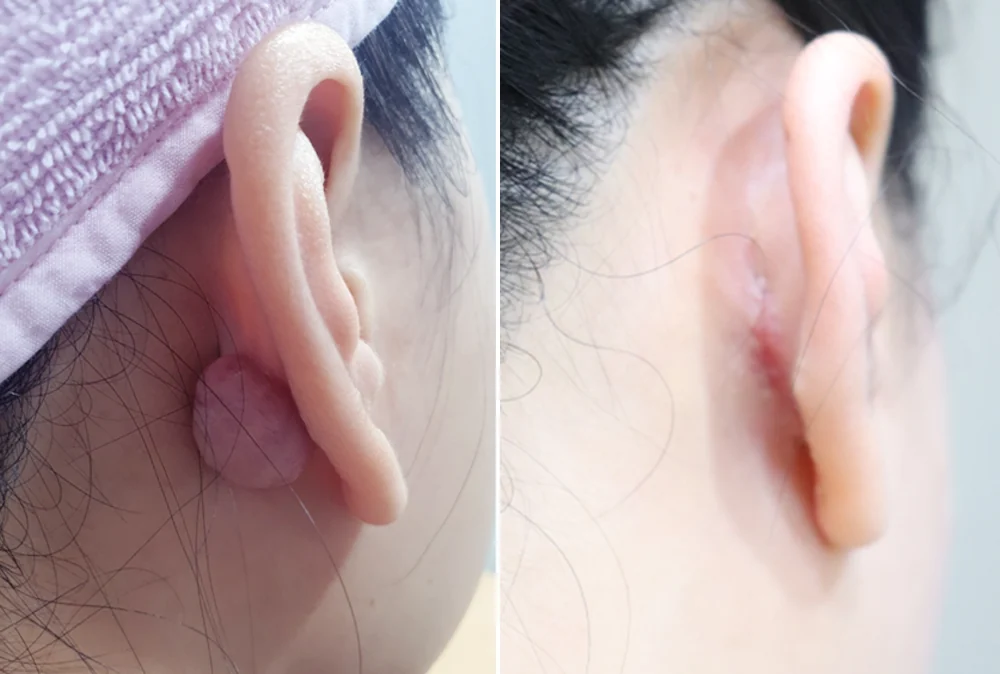
A reddish lump behind the ear
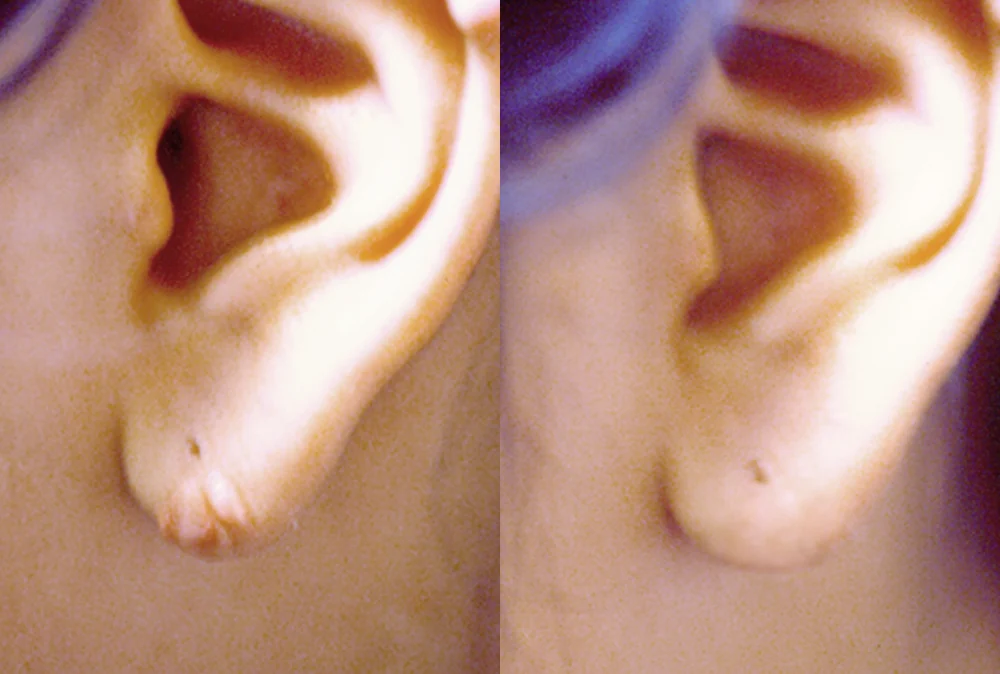
A bulging lump at the tip of the earlobe
* Results vary from person to person. Side effects are possible, so please decide after a thorough consultation with a doctor.
Frequently asked questions
The pus was drained and it went flat. Is it healed?
The pain and swelling have eased, but the sac is very likely still there. Simple drainage is known to lead to recurrence frequently.3 If you can still feel a small lump a few weeks later, it is worth discussing removing the sac while things are quiet.
It settled with antibiotics. Can I leave it now?
If it is small and not bothering you, watching it rather than removing it right away is sometimes an option. But as long as the sac remains it can swell again, and each flare adds scar tissue that can make a later incision longer.3 If it starts to swell again, that is a good time not to put things off.
Does removing it while inflamed exactly mean a bigger scar?
That cannot be said exactly. During inflammation the wall edge is blurred and removal is fiddlier, and scar tissue can make the incision longer.3 On the other hand, if it bursts again while you wait, scar tissue increases. Reports in selected patients found no rise in complications with removal during inflammation,45 but studies directly comparing scar length are still few.
How long should I wait after it settles before removal?
Inflammation is described as typically settling in about a week,3 and in one study removal was done one to two months later.4 Rather than a set date, the decision is based on whether the redness and pain have gone and the edge of the lump is clear again.
Will a corticosteroid injection make the cyst go away?
An injection of corticosteroid into the cyst is described as a way to calm swelling and inflammation.2 It does not take out the sac, so the sac remains after the swelling goes down. This method is not listed on Bonita Clinic's treatment page and is included here as general information.
What to prepare before your consultation
- When the lump first appeared, and the day this swelling started
- Whether it has been squeezed or drained before, and when
- Medicines taken or applied (names of antibiotics or anti-inflammatories if you know them)
- Whether you have had a fever, and how far the redness has spread
- Photos from before it swelled and from now (a ruler or coin beside it helps with size)
- Diabetes, medicines that lower immunity, or a tendency to raised, thick scars
The treatment process is described on our sebaceous cyst and lipoma removal page, and treatment of scars left after removal on our Scar Clinic page. How a quiet cyst is removed is covered in our sebaceous cyst and lipoma guide, and why a removed cyst can come back in our recurrent sebaceous cyst guide. For taking good photos, see How to take photos for an online consultation.
References (5)
Sources that support the explanations in this article. Study findings describe general trends and do not guarantee individual results.
- Stevens DL, Bisno AL, Chambers HF, et al. Practice guidelines for the diagnosis and management of skin and soft tissue infections: 2014 update by the Infectious Diseases Society of America. Clin Infect Dis. 2014;59(2):e10-e52.doi:10.1093/cid/ciu444IDSA skin and soft tissue infection guideline, section on purulent infections (abscesses, furuncles, carbuncles, inflamed epidermoid cysts): incision and drainage is the recommended treatment for inflamed epidermoid cysts (strong, high); Gram stain and culture of pus from inflamed epidermoid cysts are not recommended; adding antibiotics depends on signs of systemic inflammatory response; the inflammation and pus are described as a reaction to rupture of the cyst wall rather than an infectious process
- American Academy of Dermatology. Choosing Wisely: Do not routinely prescribe antibiotics for inflamed epidermal cysts. . 2015.American Academy of Dermatology Choosing Wisely recommendation (second list, 2015): most red, swollen epidermal cysts are inflamed, not infected, so antibiotics should not be prescribed routinely and infection should be confirmed first; appropriate treatments include incision and drainage or corticosteroid injection into the cyst
- Zuber TJ. Minimal excision technique for epidermoid (sebaceous) cysts. Am Fam Physician. 2002;65(7):1409-1412.Review (full text): inflamed cysts can be very difficult to excise and close, so postponing surgery until inflammation subsides (typically one week) may be preferable; it is often unclear whether an inflamed cyst is infected; simple incision and drainage frequently leads to recurrence; previously ruptured or inflamed cysts may have scarring that requires formal excision
- Jun GB, Qi H, Golap C. One-stage excision of inflamed sebaceous cyst versus the conventional method. S Afr J Surg. 2010;48(4):116-118.Comparison of 351 patients (abstract only): 166 had primary excision followed by five days of antibiotics, 185 had antibiotics and drainage with excision one to two months later; one-stage excision reduced antibiotic exposure, morbidity and cost, provided cases were appropriately selected; randomisation, scar and recurrence figures could not be confirmed from the abstract
- Gwak H, Lim ST, Kim SH. Microbiological and clinical outcomes of single-stage minimal excision of inflamed epidermal cysts without routine antibiotic treatments: A dual-center retrospective cohort study. Medicine (Baltimore). 2026;105(19):e48589.doi:10.1097/MD.0000000000048589Two-centre Korean retrospective cohort of 444 cysts (full text): immediate excision and closure regardless of inflammation, antibiotics only when clinically needed; positive cultures were more common in inflamed cysts but mostly skin commensals; overall complications around 2 to 3% with no significant difference by inflammation; the one reoperation was an immunosuppressed patient with MRSA; scar and recurrence were not reported
About this article
This article separates general medical information from Bonita Clinic's own approach. Because the right decision depends on each person's condition, it is not a substitute for a consultation.