KOKorean
 ENEnglish
 JP日本語
 CN中文(简体)
 TW中文(繁體)


Filling Hollows After Filler or Foreign Body Removal in Seoul: What to Use, and When
How a hollow is filled depends on what is causing it. If the volume the material took up has gone, filling with your own fat is usually considered first. If the skin is stuck to the tissue below by fibrous bands (adhesions), those bands need to be released first, or the filled area will not rise evenly. If the skin has also stretched and sagged, lifting is assessed separately once the volume has been restored. The timing depends on whether inflammation and leftover material have been dealt with: some hollows are filled in the same operation, others once the tissue has settled. At Bonita Clinic, whether restoration is needed, and when, is planned from the moment removal is planned. If you are considering treatment in Seoul, you can send photos and what you remember about the injections to see which approach may fit your case.
Curious about your own case? Ask us online →
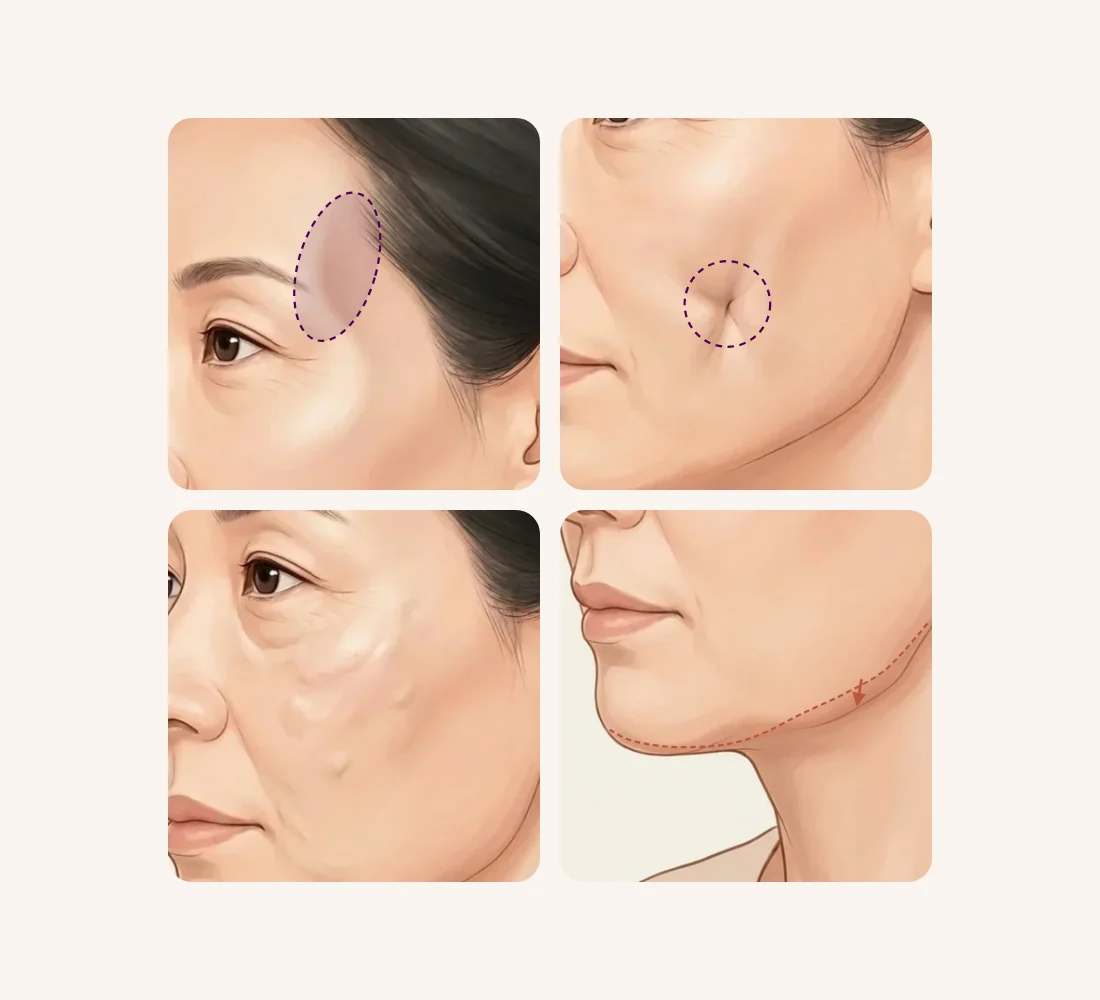
Why does the area sink after filler or foreign material is removed?
When filler, or a substance whose ingredients nobody can name, is taken out of the face, the area often looks hollow afterwards. If the only cause were the volume that has gone, you would simply put back the same amount. In practice, the tissue around the material has usually changed too, often over many years.
The body recognizes injected material as "not mine". It tends to wall it off with a capsule of tough fibrous tissue, which is similar to scar tissue. In a report of 162 women who had injected gel and its surrounding capsule removed from the breast, the capsules that came out were full of inflammatory cells and small nodules.3 In another report, 11 patients had late problems from gel injected into the lips. Every one of them had widespread fibrosis, meaning the tissue had turned tough and firm, and the material was scattered through all three layers of the lip.2
So once the material is out, several changes are usually left behind together:
- An empty space: the volume the material took up is gone, and the skin over it settles down into the gap.
- Adhesions: as the capsule and scar tissue shrink, they hold the skin down to the tissue underneath. The skin looks pulled inward at one point.
- A thinner base: the complications listed for non-absorbable fillers include chronic inflammation, foreign-body granulomas (inflamed lumps that form around the material), migration of the material and lipoatrophy, which means loss of fat.1 If the fat layer underneath has also thinned, the dip can look deeper than the amount of material removed would suggest.
Put simply, a hollow after removal is often not just a hole. It can be a mix of an empty space, bands that pull, and a base that has thinned. Which of these is the biggest part decides how, and in what order, the area is filled.
Skin that was stretched by the material for years can also sag once it loses that support. When lifting should be added for that is covered in our separate guide to lifting after filler and foreign body removal. This guide focuses on what the hollow is filled with, and when.
What kind of hollow is it? Clues you can see in the mirror
The shape of a hollow gives some clues about which change is driving it. Appearance alone cannot settle it, though. At an examination, the area is felt by hand and checked from the inside with ultrasound.
What to look at first, by the shape of the hollow
1A wide, gentle hollow
The lost volume is gauged and filling with your own fat, placed in several layers, is considered
Fat grafting
2One point pulled in, with creases gathering
The fibrous bands holding the skin down are released first, then the area underneath is filled
Adhesion release
3Raised spots mixed with dips
Ultrasound first checks whether it is leftover material or hardened tissue
Check for residue
4A hollow plus a lower jawline
Volume is restored first; the sagging that remains is assessed for lifting
Lifting
When several of these appear in the same face, the order of treatment matters. Leftover material and inflammation are dealt with first, adhesions are released next, volume is then restored, and sagging is looked at last. The reason is simple. While a band is still pulling, filled volume cannot rise evenly at that point. And residue or inflammation left behind can cause trouble again after the area has been filled.1
What is an adhesion, and why release it before filling?
An adhesion is skin that has become stuck to the tissue below by tough fibrous bands. Think of a tent sheet tied to the ground with a cord. As long as the cord pulls, whatever you pack under the sheet, the tied point will not rise much.
Subcision, a technique for depressed scars and wrinkles in which the bands are cut under the skin, works on this principle. A needle with a cutting edge is slipped in through a pinprick, just under the skin. It then cuts the connections that hold the dip down. The report that first described the method gave two reasons why the dip rises. The bands that held it down are released, and new connective tissue (the tissue that links and supports other tissues) forms as the small wound heals.5
Fat grafting can help in the same direction. A meta-analysis (a study that pools the results of many studies and recalculates them) gathered 45 studies of 3,033 patients who had fat moved into scars or fibrotic tissue. Scar stiffness and pliability improved significantly. The authors think that placing fat physically loosens the tissue, and that stem cells in the fat take part in remodeling the area around it. On average, 1.4 procedures were needed to reach the desired result, and minor complications occurred in 4.8% of procedures.6 In other words, one session is not always enough, and some people need another.
At Bonita Clinic this is part of the plan from the removal stage. Where material has clumped and adhered to surrounding tissue, the adhesions are released as it is removed, while limiting tissue damage. Adhesions and fibrotic scar tissue that pull the skin inward are gently released before the filling is planned.
What can the hollow be filled with?
There are several ways to fill or rebuild an empty space. The table separates the methods used in research from the method that Bonita Clinic describes on its treatment pages.
| Method | How it works | Good to know |
|---|---|---|
| Micro-fat grafting | Fat suctioned from elsewhere in your body is placed through a thin cannula as small droplets | Part is absorbed, so a top-up may be needed16 · the filling method Bonita Clinic describes |
| Dermal-fat grafting | A piece of fat with the deeper skin layer (dermis) attached is cut to the shape of the defect | In the study, taken from the groin, which was then stitched closed1 |
| Local fat flap | The fat pad inside the cheek is moved into the space while still attached to its blood supply | A surgical option used together with a deep-plane facelift1 |
| Adhesion release | Cutting the fibrous bands so the skin can rise | Done before filling, or together with fat grafting56 |
| Lifting | Repositions loose skin and soft tissue upward | Does not restore volume · assessed separately when sagging is marked |
Dermal-fat grafts and buccal fat pad flaps are described here as general medical information. The filling method described on Bonita Clinic's treatment pages is fat grafting with your own fat. If a hollow remains after removal, fat is suctioned from an area where it is not needed and grafted into the removal site.
Your own fat is easy to obtain and has long been used to correct volume deficits and asymmetry after filler removal.1 It does not add a new foreign substance, and the act of placing it may also help loosen hardened tissue, which is being studied.6 On the other hand, not all of the moved fat survives. How much tends to remain, and what affects take (the grafted fat settling in and staying alive), is covered in our guide to fat graft survival.
What did a study comparing three filling methods find?
One study compared three ways of filling the defects left after non-absorbable filler is removed. It randomly divided 480 people who had received such filler into three groups of 160. Everyone had the material removed and a deep-plane facelift. The defects were filled in the same operation, and only the filling method differed: micro-fat grafts, dermal-fat grafts or a buccal fat pad flap. Follow-up ran from 6 months to 5 years.1
Across all three methods, the most common problem was an irregular contour noted by the surgeon (17.5%), followed by touch-up surgery (10.6%). Split by method, the differences were large:
- Touch-up surgery: micro-fat 23.1%, dermal-fat 7.5%, buccal fat pad flap 1.3%
- Early infection after surgery: micro-fat 8.1%, dermal-fat 1.9%, buccal fat pad flap 1.9%
- Foreign-body granulomas: micro-fat 10.6%, dermal-fat 6.9%, buccal fat pad flap 5.6%, with no statistically clear difference between the methods.1
The author concluded that, of the three, the buccal fat pad flap had the fewest complications.1 In the fat graft group, close to one person in four had a further procedure. Still, that number alone does not prove fat grafting is a poor choice, because the author points out important limits. The fat was placed on the same day the material came out, onto a bed whose blood supply may have been compromised. Grafted fat survives only when blood vessels reach it. A staged approach that allowed time for the blood supply to recover might therefore have given different results, the author wrote. He also noted that the groups differed in some respects, such as the size of the defects and body weight. And according to the methods, one surgeon performed every operation.1
Because this study combined filling with a major facelift, its numbers cannot be applied directly to everyone. Still, it makes two points clear. First, uneven contours and touch-ups are fairly common when filling areas where material has been removed. Second, the condition of the bed the fat goes into, meaning its blood supply and any inflammation, affects the outcome.
Fill on the same day, or wait until the tissue settles?
There is no single right answer. Both approaches have reasons behind them.
Reasons to fill on the same day
The author of the comparative study chose to remove and rebuild in one operation. He argued that at a later operation, scarring would make safe dissection harder. He also noted that the defect can be seen and corrected right after the material comes out.1 In the report of 162 women who had injected breast gel removed together with its capsule, fat grafting was also done on the same day. But no fat was put into the empty cavity itself. The cavity was closed with a suction drain (a thin tube that draws out fluid), and the fat was spread evenly through the surrounding layers. People with ulceration or infection at the surgical site were excluded from the start.3 Among the 11 patients who had lip gel removed, 8 had fat placed in the same operation. Ten had a satisfying result, while one developed necrosis (death of tissue) of the upper lip.2
Reasons to wait
The main reason is inflammation. Doctors had debated whether long-lasting lumps from injected gel are caused by bacteria or by an immune reaction. One study re-examined tissue from 8 patients whose lumps had grown no bacteria in culture, using special staining. Bacteria were found in 7 of the 8. They were living both in the gel and in the tissue between gel deposits, mostly in clusters. The researchers took this as a sign of a biofilm, a protected community of bacteria.4 So a negative culture does not rule out bacteria in and around the gel.
In the comparative study, too, the 64 people who had had an infection before had more early infections after surgery (9.4% vs 3.1%) and more foreign-body granulomas (15.6% vs 6.5%). The study had also excluded anyone with an infection in the previous 3 months from the start.1
The first question when choosing the timing
Is there inflammation or leftover material at the removal site now?
- Swelling, redness, pus, or a recent infectionSettle the inflammation first, fill once the tissue is stablePeople with past infection had more infections after surgery
- Material is widespread and some will remainWatch how it behaves, then decide on fillingUltrasound locates what remains
- No inflammation, and the confirmed area is clearedSame-day filling can be consideredSame-day filling reported when there was no inflammation or infection
At Bonita Clinic, whether removal and filling continue on the same day, or proceed in stages once inflammation and tissue have settled, is decided after an ultrasound assessment, according to the condition of the skin. Put simply: if the bed is clean and has a good blood supply, the same day can be an option; if there are signs of inflammation, the ground is prepared first and filling comes later.
When does lifting come into the plan?
Filling puts back lost volume, while lifting moves tissue that has dropped back to a higher position, so the two do different jobs. At Bonita Clinic, rather than starting with a strong pull, the lost volume is matched first in a natural way, and only the sagging that remains is then lifted. When and how lifting is added is explained in our guide to lifting after filler and foreign body removal.
What are recovery and the realistic limits?
At Bonita Clinic, foreign body removal is surgery. It is done under sedation combined with local anesthesia, you go home the same day without a hospital stay, and there are stitches. Recovery time and follow-up visits vary with the extent of treatment and your individual condition. At first there is swelling and bruising both where material was removed and where fat was taken, and the contour shows itself as the swelling goes down.
Limits worth knowing
- Part of the grafted fat is absorbed. It is not unusual to reassess the balance once things settle and add a top-up. In the comparative study, 23.1% of the fat graft group had touch-up surgery,1 and studies of fat grafting into scar and fibrotic tissue needed 1.4 procedures on average.6
- The contour can be uneven. This was the most common problem in the comparative study.1
- Leftover material can cause problems again. When material has spread widely through the tissue, removing all of it can be impossible, and some residue has to be accepted.2 In the comparative study, foreign-body granulomas appeared in 7.7% of patients after surgery.1
- Infection can occur. It was more common in people who had had an infection in the area before.1
- Rare but serious complications have been reported. After facial fat grafting, serious complications such as skin necrosis (death of skin tissue), loss of vision and hemiplegia (paralysis of one side of the body) have been reported.1 For areas where vascular problems are more often reported, such as between the brows and the nose, see also our guide to filler removal under the eyes, between the brows and in the nose.
- A scar may remain. At Bonita Clinic, incisions are kept minimal and placed where they show least, and any remaining scar is cared for at our Scar Clinic.
- The skin itself may be thin or red. Restoring volume does not change surface texture and color, which need separate care. At Bonita Clinic, lasers of several wavelengths are combined to match the skin's condition.
- Any surgery, whatever the method, can cause bleeding, inflammation, infection or nerve injury, and recovery and results differ from person to person.
How we approach it at Bonita Clinic
The order we follow
- 1Ultrasound checkLocation, size and progress; inflammation or hardening
- 2RemovalManual or micro-cannula; adhesions released where it has clumped
- 3FillingYour own fat if a hollow remains; timing follows the tissue
- 4Follow-upCombined lasers for marks and texture; residue reassessed
Before any repeat removal, ultrasound checks what remains first
The actual plan is decided after an in-person consultation.
Treatment options you can discuss in Seoul
Bonita Clinic opened in 1995, and Dr. Kwang-Seop Jung, a board-certified plastic surgeon in Brazil, has seen patients at the same location ever since. For a hollow after filler or foreign body removal, these are the parts of our approach you can discuss at consultation:
- Ultrasound to locate remaining material and check the state of the tissue, including inflammation and hardening
- Removal of remaining material, manually or with a micro-cannula, releasing adhesions where it has clumped
- Release of adhesions and fibrotic scar tissue that pull the skin inward
- Filling with your own fat when a hollow remains, with the timing set by the tissue
- Lifting for sagging that remains after volume is restored, and combined lasers for thin or red skin and marks
The dermal-fat grafts and buccal fat pad flaps described above are general medical information, not services listed on our treatment pages. Which steps you need, and whether they happen in one visit or in stages, is decided only after an examination. You can read more on our Eye, Glabella and Nose Revision page, our Forehead, Chin and Cheek Revision page and our Multi-Lifting after Foreign Body Removal page.
Why do the plan and cost differ from person to person?
Two people who both say "the area sank after my filler came out" can need very different treatment. What shapes the plan, and therefore the cost, is what is causing the hollow and how much has to be done.
- Whether material remains, and how far it has spread
- Inflammation that must settle first, or staged treatment
- Adhesions and fibrotic tissue to release
- Amount of fat and the area it is taken from
- Whether lifting or lasers are added
- Anesthesia: sedation with local
Final plan and quote after an in-person exam
A final estimate is given only after an in-person examination, once the extent of removal, the state of the tissue and the number of stages are clear. Photos help narrow down the options; the plan itself is settled at the examination.
What can photos show, and what needs an in-person exam?
Photos are a useful first step, because much of a hollow can be seen from the outside. They cannot show what is happening under the skin.
Photos can show
- Where the hollow is, and its rough size
- Wide hollow, tethered dip or lumpy surface
- Left-right difference at rest and smiling
- Visible redness or marks
- Earlier photos, before the injections
Needs an in-person exam
- Remaining material, located by ultrasound
- Depth and layer of the defect
- Adhesions, felt by hand
- Skin thickness and quality
- Inflammation that must settle first
Helpful photos: front, both profiles and both 45-degree views in even light, plus one with light from above so the dips show. A smiling photo helps too. If you have them, add photos from before the injections and from before any earlier removal. You can send us a message with your photos and what you remember about the injections, even if you do not know the substance.
Planning your visit and recovery
What is confirmed in advance is the treatment information above: surgery under sedation with local anesthesia, same-day discharge, and stitches. How long you should stay in Seoul, when the stitches come out and whether filling is done in the same visit or a later one depend on the condition of the tissue. They are planned together with you at consultation.
If inflammation needs to settle first, or if the volume is to be restored in stages, a second visit may be part of the plan; its timing is set with you according to how the tissue recovers. Expect swelling and bruising at first, at both the removal site and the area where fat was taken. After you return home, contact a doctor promptly if pain, redness, swelling or discharge increases instead of settling. Keeping dated photos taken in the same light makes it easier for any doctor to follow your progress, and for us to judge whether a top-up is needed.
Real treatment cases
These cases are from Bonita Clinic's treatment pages. Results vary from person to person.
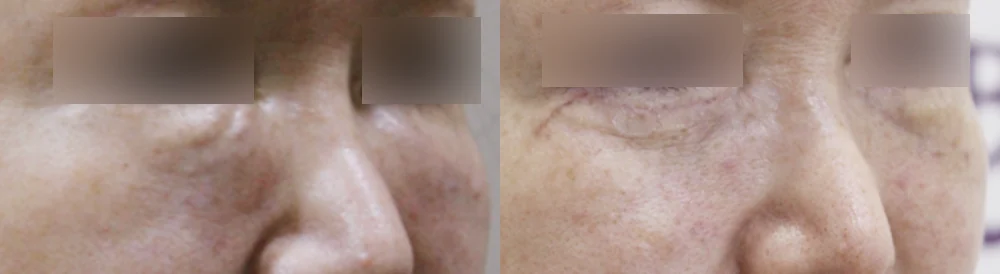
Under the eye and the front of the cheek were uneven and lumpy (angled view)
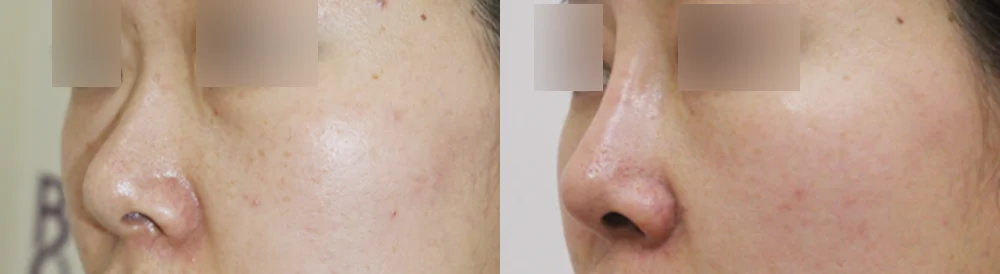
The bridge of the nose and the area beside it had an uneven, wavy contour (angled view)
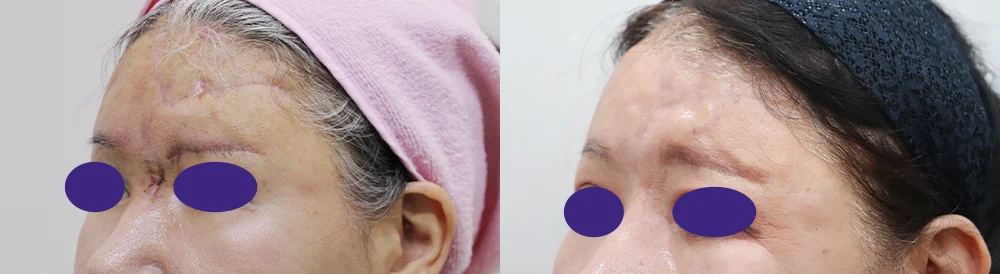
The forehead and glabella had scar marks and an uneven contour (angled view)
* Results vary from person to person. Side effects are possible, so please decide after a thorough consultation with a doctor.
Frequently asked questions
Can the hollow be filled on the same day the material is removed?
It depends on the condition of the area. When there is no inflammation or infection and the confirmed material has been cleared, reports describe filling in the same operation.13 When there is swelling, redness, pus or a recent infection, it is safer to settle the inflammation first and fill once the tissue is stable. At Bonita Clinic, this is decided after an ultrasound assessment, according to the skin's condition.
Can't the hollow simply be filled with filler again?
Rather than refilling straight away, the cause is checked first. Where an area has already gone through inflammation or hardening because of injected material, ultrasound is used first to check for remaining material and the state of the tissue before any other substance is considered. The restoration method described on Bonita Clinic's treatment pages is your own fat. Which approach suits you is decided together at consultation, after the cause and extent of the hollow have been examined.
What if the area sinks again after fat grafting?
Part of the grafted fat is absorbed, and the part that takes stays. In the comparative study, 23.1% of the fat graft group had touch-up surgery,1 and studies of fat grafting into scars and fibrotic tissue needed 1.4 procedures on average.6 At Bonita Clinic, the amount is planned with fat survival in mind, and once it has settled, the balance is reviewed and a top-up is added if needed.
Can the area be filled if a little material remains?
When material has spread widely through the tissue, some may have to be left behind.2 In lumps of polyacrylamide gel, a non-absorbable injectable gel, one study found bacteria even when cultures were negative,4 so whether to fill directly over it is decided with care. At Bonita Clinic, ultrasound checks where remaining material lies and the state of the tissue, and the decision is revisited after watching your progress.
Won't releasing adhesions leave more scarring?
Methods such as subcision release adhesions through a pinprick, cutting the bands under the skin. The new connective tissue that forms as it heals is described as helping to support the dip from below.5 Incisions made to remove material can leave scars. At Bonita Clinic, incisions are kept minimal and placed where they show least, and any remaining scar is cared for at our Scar Clinic.
What to prepare before your consultation
- As much as you remember about when, where and what was injected (you can consult even without knowing the substance)
- If you have already had removal surgery: when, how, and whether you were told some material remains
- Any recent swelling, redness or discharge, and how it was treated
- Whether you smoke (a study of lip gel removal and reconstruction advised special care when treating smokers2)
- Photos from before the injections, and current front, profile and 45-degree photos
- Important dates, such as a wedding or work trip, so that staging can be planned around them
Bonita Clinic is on the 3rd floor of 565 Gangnam-daero, Seocho-gu, Seoul, about 100 m on foot from Exit 8 of Nonhyeon Station (Line 7). For removal by area, see the guide to filler removal under the eyes, between the brows and in the nose and the guide to forehead, chin and cheek filler removal. If your concern is material injected many years ago, see the guide to old silicone and paraffin injections.
References (6)
Sources that support the explanations in this article. Study findings describe general trends and do not guarantee individual results.
- Ghoraba SM. The Outcome of 3 Various Reconstructive Procedures After Permanent Filler Removal and Deep Plane Face Lift. Plast Reconstr Surg Glob Open. 2026;14(1):e7367.doi:10.1097/GOX.0000000000007367Randomized study of 480 people with non-absorbable filler (full text): after removal and a deep-plane facelift, defects filled with micro-fat, dermal-fat or a buccal fat pad flap. Touch-up 23.1%, 7.5%, 1.3%; early infection 8.1%, 1.9%, 1.9%; granulomas 5.6-10.6%, no clear difference; flap had fewest complications. Past infection raised risk; fat placed same day on a bed with possibly poor blood supply; cites hemiplegia, skin necrosis and vision loss after facial fat grafting
- Kästner S, Gonser P, Paprottka F, Kaye KO. Removal of Polyacrylamide Gel (Aquamid®) from the Lip as a Solution for Late-Onset Complications: Our 8-Year Experience. Aesthetic Plast Surg. 2018;42(3):791-797.doi:10.1007/s00266-018-1114-1Case series of 11 patients with late complications of polyacrylamide gel in the lips (abstract): widespread fibrosis in all, material in all three lip layers; 8 had immediate fat grafting; 10 satisfying results and 1 upper lip necrosis; residue in the mucosa had to be accepted
- Gao Q, Zhai P, Qi J, et al. Breast Augmentation with Autologous Fat Grafting Immediately after Removal of Polyacrylamide Hydrogel and Fibrotic Capsule in 162 Patients. Breast Care (Basel). 2022;17(4):377-384.doi:10.1159/000522616Retrospective report of 162 women (full text): breast gel and its inflamed fibrous capsule removed with same-day fat grafting; capsules held inflammatory cells and giant-cell nodules; no fat put into the empty cavity, which was closed with suction drainage, and fat spread through surrounding layers; ulceration or infection excluded. A breast study, not the face
- Bjarnsholt T, Tolker-Nielsen T, Givskov M, et al. Detection of bacteria by fluorescence in situ hybridization in culture-negative soft tissue filler lesions. Dermatol Surg. 2009;35 Suppl 2:1620-1624.doi:10.1111/j.1524-4725.2009.01313.xTissue study (abstract): in 7 of 8 culture-negative polyacrylamide gel lumps, bacteria were found in the gel and the tissue between it, mostly in clusters, suggesting a biofilm. Supports the point that bacteria may be present in and around the gel even when cultures are negative
- Orentreich DS, Orentreich N. Subcutaneous incisionless (subcision) surgery for the correction of depressed scars and wrinkles. Dermatol Surg. 1995;21(6):543-549.doi:10.1111/j.1524-4725.1995.tb00259.xOriginal description of subcision (abstract): cutting fibrous connections under the skin through a pinprick lifts depressions by release and by new connective tissue formed during healing. The basis for releasing adhesions first
- Krastev TK, Schop SJ, Hommes J, et al. Autologous fat transfer to treat fibrosis and scar-related conditions: A systematic review and meta-analysis. J Plast Reconstr Aesthet Surg. 2020;73(11):2033-2048.doi:10.1016/j.bjps.2020.08.023Meta-analysis of 45 studies, 3,033 patients (abstract): fat grafting into scars and fibrosis improved stiffness and pliability; mechanical release and stem-cell-mediated remodeling are thought to be the mechanisms; 1.4 procedures on average; minor complications 4.8%. Not a study of foreign body removal sites themselves
About this article
This article separates general medical information from Bonita Clinic's own approach. Because the right decision depends on each person's condition, it is not a substitute for a consultation.