KOKorean
 ENEnglish
 JP日本語
 CN中文(简体)
 TW中文(繁體)


Fat Grafting in Seoul: How Much of the Grafted Fat Survives?
Not all of the fat that is grafted survives; part of it is absorbed by the body. Pooled studies report that on average about 47% remained in the face (26–83% across studies) and about 53% in breasts without implants, but the figures change a great deal with how, when and where they were measured, so no one can fix your result in advance. Grafted fat survives by picking up a blood supply from its edges, which is why the basic principle is to place it in thin, spread-out portions rather than pooling a large amount in one spot. At Bonita Clinic we set the volume with the expected absorption in mind, and decide whether a touch-up graft is needed once the result has settled. If you are planning fat grafting in Seoul, you can send us photos first to see which approach may fit your case.
Curious about your own case? Ask us online →

What does "graft take" mean, and why doesn't all the fat survive?
Fat grafting (also called fat transfer or lipofilling) moves fat from one part of your body to another. The fat is first removed by liposuction, prepared, and then injected where volume is needed. When it is moved, the fat is cut off from its original blood vessels. No vessels are reconnected; only the tissue is transferred. So the grafted fat has to pick up a new blood supply in its new home before it can survive.
Fat that survives and settles in is said to have "taken." The share of the injected volume that remains is often called the "survival rate," "take" or "retention rate." Fat that does not survive is mostly absorbed by the body.
What happens inside a fat graft has been studied closely in the laboratory. A research group in Japan first cultured human fat tissue. Of all the cells in it, fat cells were the least able to cope without blood flow, while adipose stem cells survived for up to 3 days.1 Adipose stem cells are cells inside fat tissue that can make new fat cells. The group then transplanted fat tissue in mice and examined it day by day. Most of the fat cells began to die from the first day after grafting. Only some of the fat cells lying within 300 micrometers, that is 0.3 mm, of the tissue edge survived.1 Put simply, only a very thin outer rim, which oxygen and nutrients can seep into from the surrounding tissue, gets through the first few days.
The same study described three zones, from the outside of a graft to its center:1
- Surviving zone (outermost): the fat cells survive as they are.
- Regenerating zone (further in): the fat cells die, but adipose stem cells survive and replace the dead cells with new fat cells.
- Necrotic zone (center): both fat cells and stem cells die. "Necrosis" simply means tissue death.
What happens inside grafted fat over the first few months?
The same researchers then followed grafted fat for three months, again in mice.2
- Week 1: apart from the outermost surviving zone, all of the original fat cells had died.
- Weeks 1 to 4: small new fat cells appeared in the second (regenerating) zone from the first week, and were most numerous at week 4.
- After week 2: in the very center (the necrotic zone), no new fat cells formed, and many inflammatory cells gathered.
- Week 12: the formation of new fat cells was complete, but the areas that had not regenerated were still being cleared up.
Oil droplets released by dead fat cells were absorbed very slowly. The researchers suggested that these droplets also hold the space open until new fat cells fill it. In the end, each grafted fat cell met one of three fates. It survived intact, it was replaced by a new fat cell, or it was replaced by scar tissue or an oil cyst (a small pocket of oil).2
These findings come from mice, so the timeline in people may not be the same. Still, they show clearly that what you see right after grafting is not the final result. In other words, the first few months after fat grafting are a period in which the grafted fat is being "rebuilt" in its new place. Early swelling also adds to the volume, so the result is not judged by how full the area looks straight after the procedure.
How much grafted fat survives, according to research?
For people, there are studies that pool results by body area. Please keep in mind that the figures below are averages across many studies, not a prediction for one person.
Face
A meta-analysis gathered 27 studies with 1,011 people in which the volume remaining after facial fat grafting was measured objectively.3 A meta-analysis is a study that combines the results of many studies and recalculates them together. The share remaining varied from 26% to 83% between studies, with follow-up of 3 to 24 months. The pooled average was 47%, with a 95% confidence interval of 41% to 53%.3 A confidence interval is the range in which the true average most likely lies.
Put simply, if you placed 10 parts of fat in the face, on average close to 5 remained across the studies. But in some studies it was about 3, and in others about 8. Complications were reported in 2.8% of all patients in this analysis.3
Breast
A 2026 meta-analysis pooled 47 studies with 4,425 people who had fat grafted into the native breast, meaning a breast without an implant. It included breast augmentation, and fat added to the untreated side to match a reconstructed breast. On average, 53.26% of the grafted fat remained per breast (95% confidence interval 46.32% to 60.20%).4 The authors were clear that the results varied greatly between studies.4
Buttocks
Few studies have measured directly how much fat remains in the buttocks. The measurement studies we know of, and their limits, are covered separately in our buttock fat grafting guide.
Share of injected fat remaining · study averages
It would be a mistake to line up the face and breast figures and conclude that one area "holds fat better." The people studied, the volumes injected and the measuring methods all differ. What the two numbers say together is that a good part of grafted fat can be absorbed, and that how much varies widely between people and conditions.
Why do survival numbers differ so much between studies?
A "survival rate of X%" is not a fixed property of a procedure. The facial meta-analysis above found that the method used to measure volume had a significant influence on the retention rate reported. Its authors concluded that the exact percentage of facial fat that will be retained cannot currently be predicted.3 There are four main reasons the numbers differ:
- How it is measured: tools such as 3D imaging, CT and MRI, and the way volume is calculated from them, differ between studies, and the reported numbers differ accordingly.3
- When it is measured: a measurement at a few months and one at one or two years are not the same. As in the animal studies, the first months are a time of ongoing change in the tissue.2
- Area and volume: a small volume in the face and a large volume in the breast or buttocks are very different conditions.
- Patient and technique: the state of the receiving tissue, how the fat is processed and how it is injected all vary between studies.
Which studies are pooled also changes the range. Another systematic review, of 18 studies of facial fat grafting, reported that 13% to 68% of the fat remained, with differences between facial areas; we describe it in our guide to fat grafting for a protruding mouth.
So whenever you hear a survival figure, it helps to ask four questions. Which body area does it refer to? How was the volume measured? How many months after surgery was it measured? How many people were measured? A figure without these answers is hard to compare with any other. In short, a survival rate is less a score for a clinic than a measurement that comes with conditions attached.
What affects how much fat survives?
One basic principle governs graft take: how close the grafted fat is to a blood supply, and how quickly it gets one. Here are the conditions that influence it.
One large deposit, or many thin threads?
In the experiments above, the fat cells that made it through the first days were only those within 0.3 mm of the edge.1 So if the same amount is placed as one large lump, its center ends up too far from the edge. If it is spread in many thin threads instead, most of the fat lies close to the surrounding tissue.
A paper on the principles of large-volume fat grafting to the breast explains the same point. When a large volume is injected into a tight space, the pressure inside the tissue rises. That squeezes the capillaries (the tiniest blood vessels) and reduces blood flow. Crowded fat droplets also merge into "lakes," so less of the graft is in contact with the receiving tissue. Oxygen then has further to travel to reach the center, and the center dies before new vessels can grow in.5 That means injecting more is not the same as keeping more.
How much room the receiving site has
The receiving site matters too. The same paper explains that these problems with tight spaces have long limited how much fat can be grafted into small breasts.5 Where the skin and tissue have little give, there is a limit to how much can be placed in one session. That is why areas where tissue is firm, such as scarred skin or a site of earlier surgery, are assessed with that in mind.
How the fat is processed
Liposuction fat contains oil, blood and the fluid used during suction. So before injection it is prepared to keep only usable fat. There are several ways to do this: centrifugation (spinning to separate layers), letting it settle (decantation), washing and filtering, among others.
A systematic review gathered 24 studies with 2,413 patients that compared these processing methods.6 A systematic review collects all relevant studies by a set method and assesses them together.
- In the breast, long-term volume retention did not differ significantly between processing methods.6
- In the head and neck, more volume was retained with stem cell enrichment (64.8% to 95%) and with commercial devices (41.2%) than with centrifugation (31.8% to 76%).6 The ranges overlap, however, so these figures alone do not settle which method is better.
- The authors concluded that washing and filtering gave better long-term outcomes than centrifugation or decantation. They also noted that studies reported their results in different ways, and that there is still no agreement on which method is optimal.6
In other words, the way fat is handled may affect the result, but the evidence is not strong enough to name one method as clearly better. The evidence on grafting fat together with stem cells, including a recent meta-analysis, is covered in our hip and pelvic fat grafting guide.
A first graft or a repeat graft?
In the facial meta-analysis, retention tended to be better with secondary (repeat) fat grafting.3 The authors called it a trend, so it is not a firm conclusion. And because the receiving tissue differs from person to person, results vary even when the same method is used.
Your own health: smoking and weight changes
Your own condition also plays a part. Smoking is linked to wound-healing complications after surgery, so it helps to plan when to stop well before the procedure; our guide to medicines and smoking before surgery explains the timing. And if your weight rises or falls a lot while the graft is settling, it becomes hard to compare the remaining volume with the start. That is why it helps to tell us at consultation whether you smoke, how your weight has changed recently and what you plan for your weight.
Face, breast, buttocks, scars: what is checked first in each area?
The principle of graft take is the same everywhere, but the volume injected and the conditions at the receiving site differ by area. So what is checked first differs a little too.
What is checked first in each area
1If the cheeks look hollow
Small amounts are placed in thin threads across several layers
Facial fat grafting
2If a larger volume is needed, as in the breast
Fat is spread widely rather than pooled, and lumps are watched for
Breast fat grafting
3If the area is wide, like the buttocks or hips
Available donor fat and room at the site set the range
Buttock fat grafting
4If a scar has left a firm dent
The scar is assessed too; small amounts are added in stages
Depressed scars
- Face: hollow areas such as the forehead, cheeks and temples take relatively small volumes. The skin is thin in places and the face moves a great deal, so small amounts are spread in thin threads across several layers. When hollows around the mouth make it look more prominent, see our guide to fat grafting for a protruding mouth.
- Breast: larger volumes are needed, so fat can easily end up pooled in one place. Whether lumps (fat necrosis) form, and how the breast will look on later screening images, are part of the planning.4
- Buttocks and hips: a large volume goes over a wide area. How much fat can be moved, and how much room the receiving site has, decide how far the shape can change. The depth at which fat is placed and the safety recommendations are covered in our Brazilian butt lift guide.
- Depressed scars: scar tissue is firm and has little give. So the scar itself is assessed, and small amounts are added in stages while the progress is watched. For deep dents that laser alone has not improved, our guide to depressed facial scars may also help.
What happens to fat that does not survive?
Most fat that does not survive is slowly absorbed. Some, however, can remain in another form. In the animal studies above, areas that failed to regenerate ended up as scar tissue or oil cysts.2 In people, these changes can show up as lumps you can feel under the skin.
| What | What it is like | How often it was reported |
|---|---|---|
| Fat necrosis | Fat that did not survive, felt as a firm lump | 4.66% per person in native-breast studies4 · 0–58.4% across studies in a processing review6 |
| Palpable cyst (e.g. oil cyst) | Liquefied fat or other contents collected in a thin capsule, felt as a lump | 0–20% across studies6 |
| Surgical-site infection | Redness, warmth, pain or pus | 0–8% across studies6 |
| Later biopsy | A small tissue sample taken to check what a lump is | 5.55% in native-breast studies4 |
The authors of the processing review noted that complications were reported in very different ways between studies.6 So the 0–58.4% range for fat necrosis cannot be compared directly from one study to another. Please read the numbers in this table as "reported within this range" rather than as exact risks.
Put simply, in many cases grafted fat is either absorbed or settles in. Fat that has been pooled in one place, however, can remain as a lump. If you have had fat grafted to the breast, always tell the team at your breast screening; it helps them interpret what they see on the images. If a lump appears or grows, or becomes red or painful, have it checked by a doctor.
Rare but serious risks, separate from graft take
Apart from graft take, there is a rare but serious risk: grafted fat entering a blood vessel and blocking it.
- Face: a systematic review of blindness after cosmetic facial injections found 32 patients, and in 15 of them it followed fat injection. The authors advised small needles or blunt microcannulas, and low-pressure injection of the smallest possible amounts.7
- Buttocks: after buttock fat grafting, fat embolism has been reported, in which fat travels through the veins and blocks the vessels of the lungs, sometimes fatally. It was reported more often by surgeons who injected deep into the muscle, and the task force advised against deep muscle injection.8
The precautions for the face are covered in our guide to fat grafting for a protruding mouth, and injection depth and the safety recommendations for the buttocks in our Brazilian butt lift guide.
When is a second fat grafting session considered?
It is worth knowing from the start that one session may not be the end. In the native-breast studies, 11.83% of patients had further fat grafting.4 The authors stressed that patients should be counseled in advance about likely volume loss and the possible need for several sessions to reach a satisfying result.4 In the facial meta-analysis, repeat grafting also tended to retain more.3
When is it decided?
Right after grafting there is swelling, and regeneration is still under way inside the fat. In the animal studies, the tissue was still changing at around week 12.2 Human studies, too, measured the remaining volume from a few months up to two years after surgery.3 So whether a second session is needed is judged not right after the first graft, but from the shape once these changes have settled.
Why not inject much more the first time?
It may seem logical to inject far more at the start to make up for what will be absorbed, but the principle works the other way. Overfilling a tight space raises the pressure and makes droplets merge, so the center is more likely to die.5 That is why fat is placed only in the amount the receiving site can take. Adding more later, only where it fell short, fits how grafts survive.
What is checked before a second session
- The volume and shape that remain, and the balance between left and right
- Whether any lumps can be felt
- Where fat can be harvested again, and how much (areas already treated by liposuction may have less to give)
- The change you would still like, and your schedule
How a second session is decided
- 1First graftVolume set with expected loss in mind, placed in small portions
- 2Watch recoveryWhile swelling settles and the tissue remodels
- 3Check what remainsVolume, left–right balance, any lumps
- 4Only if neededDiscuss a further graft for the areas that fell short
How we approach it at Bonita Clinic
Buttock fat grafting is performed as surgery under sedation or general anesthesia, with same-day discharge and stitches. Fat grafting for a protruding mouth is performed under sedation with local anesthesia, with same-day discharge; stitches are only at the fat harvest site. When fat grafting is combined with a face lift or scar treatment, the anesthesia and stay follow the guidance for that procedure. Recovery time and the number of follow-up visits depend on the extent of treatment and on each person.
Fat grafting options you can discuss in Seoul
Bonita Clinic has treated patients at the same location since opening in 1995, where Dr. Kwang-Seop Jung, a board-certified plastic surgeon (Brazil), sees patients. For fat grafting, what you can discuss at consultation in Seoul is what is described on our treatment pages:
- Buttock fat grafting, planned around the line from the waist through the hips to the thighs
- Brazilian Layered Hip-up and 7:10 pelvic contouring, in which fat is built up in layers, with adipose stem cells added
- Stem cell fat grafting for hollow forehead and cheeks, as part of multi-lifting or a face lift
- Fat grafting for a protruding mouth, filling the hollows that make the mouth look prominent
- Fat grafting alongside treatment of deep depressed scars, such as chickenpox, smallpox and cleft lip scars
- Revision breast surgery: after the implant and capsule are removed, volume may be restored with your own fat and adipose stem cells. The breast figures above come from breasts without implants, so they cannot simply be applied here.
Which of these suits you, and whether fat grafting is needed at all, is decided only after an examination.
Why do the plan and cost differ from person to person?
Two people who both want "fat grafting" can need quite different procedures. What shapes the plan, and therefore the cost, is where fat is added, how much, and what it is combined with.
- Which areas are filled, and how much volume
- Where the fat is taken from, and how much is available
- Whether adipose stem cells are separated and added
- Anesthesia: sedation or general, or sedation with local
- Liposuction contouring or lifting done at the same time
- Previous liposuction, fat grafting or fillers
Final plan and quote after an in-person exam
A final estimate is given only after an in-person examination, once the areas, the volume and any combined procedures are clear. If a second session is needed later, it is planned separately, based on how the first graft has settled.
What can photos show, and what needs an in-person exam?
Photos are a good place to start, because hollows and proportions show well in pictures. They cannot show how much fat you have to spare, how much room the tissue has or what can be felt under the skin.
Photos can show
- Where the hollows or flat areas are
- Left–right differences
- Overall body proportions
- Possible donor areas with spare fat
- Dents or scars from earlier procedures
Needs an in-person exam
- How much fat can really be harvested
- How much room the skin and tissue allow
- Lumps or oil cysts from earlier grafts
- How firm a scar is underneath
- Medical history and medicines
Helpful photos: for the face, the front and both 45-degree and side views in even light, without heavy makeup; for the body, the front, both sides and the back, standing relaxed in plain underwear against a plain wall. If you have had fat grafting or liposuction before, photos from before that procedure and the approximate date are very useful. You can send us a message with your photos and a short note on which areas you want to fill or reduce.
Planning your visit, your recovery and a possible second session
What is confirmed in advance is the treatment information above. How long you should stay in Seoul, when stitches at the harvest site are checked and how many follow-up visits you need all depend on the areas treated and the extent of the procedure. These are planned together with you at consultation.
Some points are specific to fat grafting:
- The early look is not the result. Swelling adds volume at first, and the grafted fat keeps remodeling for months.2 Try not to judge the outcome in the first weeks, or by photos taken while still swollen.
- A second session would be a separate decision. If one is considered, it is decided after the changes have settled,34 so it would usually mean a later visit rather than part of the same trip. It helps to know this when you plan.
- Body fat grafting and long journeys. After liposuction and fat grafting to the body, sitting for long periods and clot risk deserve attention. Our guide to flying after liposuction and fat grafting explains what to consider; the timing for you is discussed at consultation.
- Keep a record. Photos of the treated areas taken every few weeks in the same light and pose make it easier for any doctor to follow how the graft settles.
After you return home, see a doctor promptly if pain, redness, warmth or swelling increases instead of settling, if you develop a fever, or if a lump appears or grows. If fat was grafted to the breast, tell the team at your next breast screening.
Real treatment cases
These are patients who had fat grafting at Bonita Clinic. Results vary from person to person, and the survival rate cannot be read from photos alone.
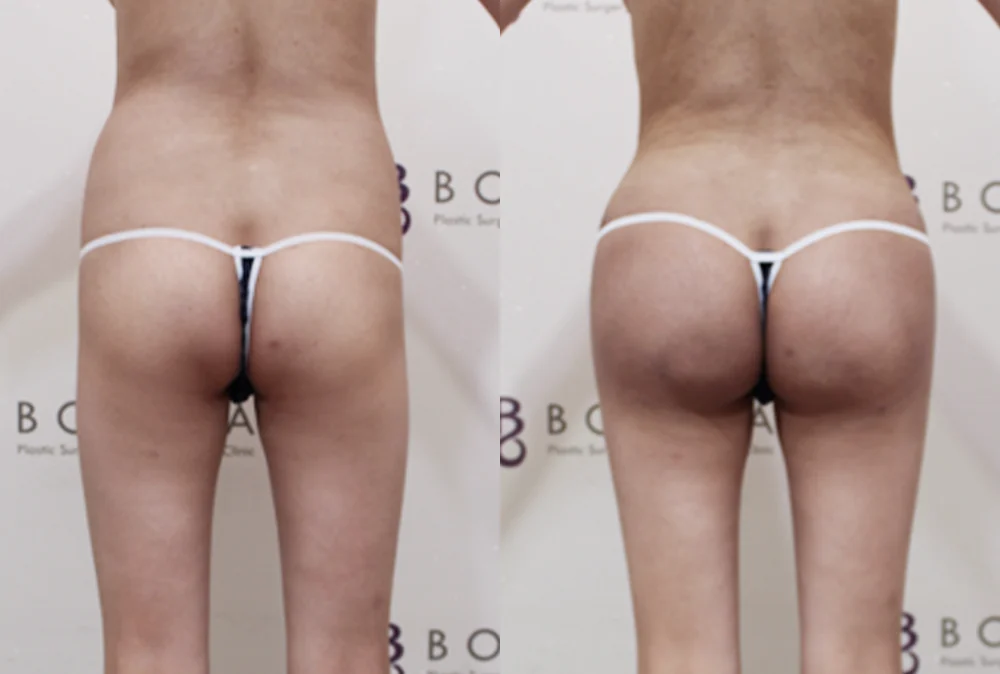
The line from the waist through the buttocks to the thighs, seen from behind
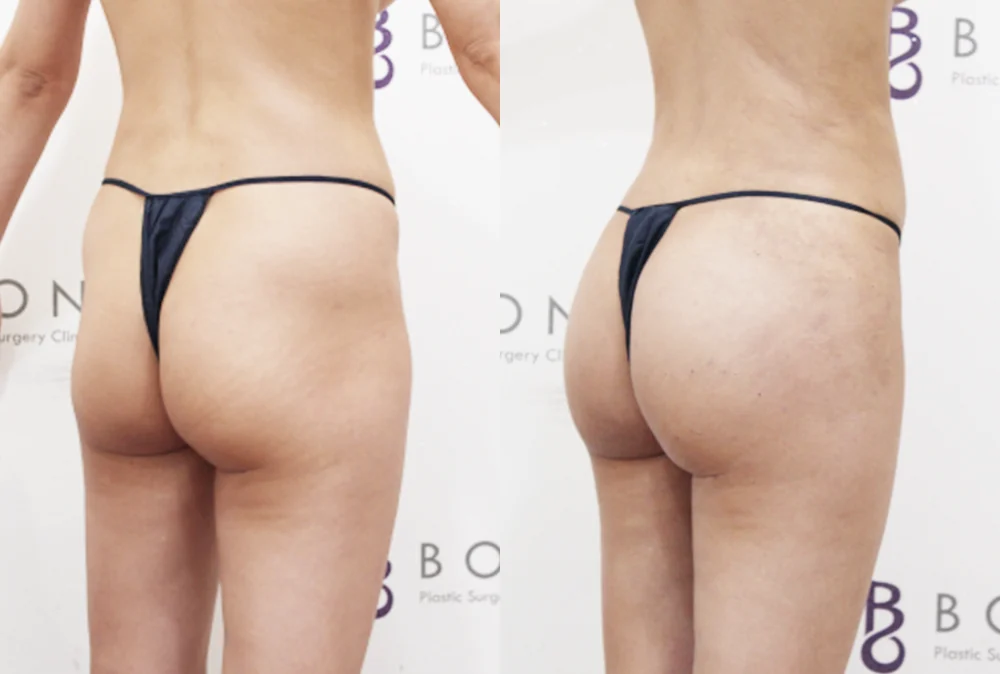
The curve from the waist to the buttocks, seen from a back angle
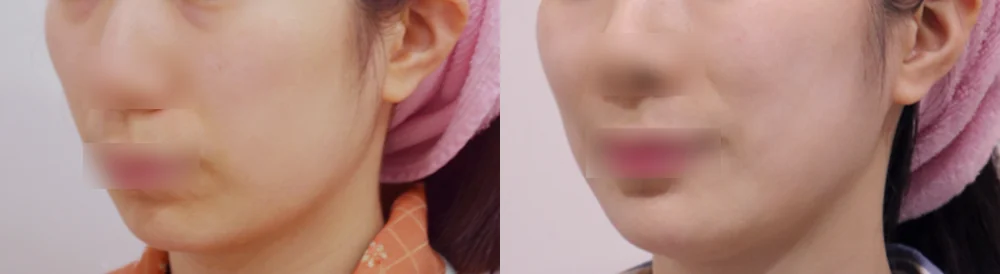
The area around the mouth and chin, seen from an angle
* Results vary from person to person. Side effects are possible, so please decide after a thorough consultation with a doctor.
Frequently asked questions
Does a clinic with a higher quoted survival rate give better results?
The number alone cannot tell you. Even in a review of facial fat grafting studies, the reported retention differed widely depending on how volume was measured.3 Ask which area was measured, with what method, how many months after surgery and in how many people. No one can fix an individual survival rate before the procedure.
Wouldn't injecting more at the start mean less loss?
Injecting more does not mean keeping more. Packing a large volume into a tight space raises the pressure, reduces blood flow and makes droplets merge, so the center is more likely to die.5 Dead fat can then be felt as a lump. Placing what the site can take, and adding more later only if needed, fits how grafts survive.
Do stem cells make more of the fat survive?
In the head and neck, more fat was retained in studies that added adipose stem cells.6 But methods varied between studies, so this is not a firm conclusion. At Bonita Clinic we may graft adipose stem cells together with your own fat in the buttocks, hips and hollow areas of the face, and even then some of the fat may be absorbed. The related meta-analysis is summarized in our hip and pelvic fat grafting guide.
Will I definitely need a second session?
Not necessarily. In the native-breast studies, 11.83% of patients had further fat grafting.4 If the shape that remains is within what you wanted, nothing more is added. Whether to add more is decided at consultation, from the shape once swelling has gone and the tissue has settled, the balance between sides and how much fat can still be harvested.
I can feel a lump where fat was grafted. Is that normal?
Fat that did not survive can remain as a firm lump (fat necrosis) or an oil cyst.24 What a lump is cannot be decided by touch alone. If it is new or growing, or becomes red or painful, have it checked by a doctor. If it is in the breast, mention the fat grafting at your breast screening.
What to prepare before your consultation
- Which areas you would like to fill and which you would like to reduce (possible donor areas)
- Any previous liposuction, fat grafting or fillers, with approximate dates and photos from before, if you have them
- Recent weight changes and any plans to gain or lose weight
- Medicines you take and whether you smoke (see our guide to medicines and smoking before surgery)
- Your travel dates, and any important events while swelling settles and the graft is being followed
Bonita Clinic is on the 3rd floor of 565 Gangnam-daero, Seocho-gu, Seoul, about 100 m on foot from Exit 8 of Nonhyeon Station (Line 7). For area-specific details, see our buttock fat grafting guide, hip and pelvic fat grafting guide and guide to fat grafting for a protruding mouth.
References (8)
Sources that support the explanations in this article. Study findings describe general trends and do not guarantee individual results.
- Eto H, Kato H, Suga H, et al. The fate of adipocytes after nonvascularized fat grafting: evidence of early death and replacement of adipocytes. Plast Reconstr Surg. 2012;129(5):1081-1092.doi:10.1097/PRS.0b013e31824a2b19Animal and laboratory study (abstract): fat cells are the most vulnerable to lost blood flow while adipose stem cells survive up to 3 days; most grafted fat cells began to die from day 1 and only some within 300 µm of the edge survived; three zones from edge to center: surviving, regenerating and necrotic
- Kato H, Mineda K, Eto H, et al. Degeneration, regeneration, and cicatrization after fat grafting: dynamic total tissue remodeling during the first 3 months. Plast Reconstr Surg. 2014;133(3):303e-313e.doi:10.1097/PRS.0000000000000066Mouse study over 3 months (abstract): all fat cells outside the surviving zone had died by week 1; new fat cells in the regenerating zone appeared at week 1 and peaked at week 4; no regeneration and inflammatory cells in the necrotic center after week 2; new fat formation was complete by week 12 while clearing continued; fates were survival, replacement or scar/oil cyst
- Lv Q, Li X, Qi Y, et al. Volume Retention After Facial Fat Grafting and Relevant Factors: A Systematic Review and Meta-analysis. Aesthetic Plast Surg. 2021;45(2):506-520.doi:10.1007/s00266-020-01612-6Meta-analysis (abstract) of 27 studies and 1,011 patients after facial fat grafting: objectively measured retention ranged from 26% to 83% (3–24 months), pooled 47% (95% CI 41–53%); the measuring method significantly influenced reported retention; a trend to better retention with secondary grafting; complications in 2.8%; exact retention cannot be predicted
- Giannas E, Fritsch AM, Jeon H, et al. Fat survival following autologous fat transfer to the native breast: A systematic review and meta-analysis. J Plast Reconstr Aesthet Surg. 2026;115:146-156.doi:10.1016/j.bjps.2026.02.017Meta-analysis (abstract) of 47 studies and 4,425 participants with fat grafted to the native breast: fat uptake 53.26% per breast (95% CI 46.32–60.20, very high heterogeneity), fat necrosis 4.66% per participant, further fat grafting 11.83%, later biopsy 5.55%; counsel patients about volume loss and possible multiple sessions
- Khouri RK, Rigotti G, Cardoso E, et al. Megavolume autologous fat transfer: part I. Theory and principles. Plast Reconstr Surg. 2014;133(3):550-557.doi:10.1097/01.prs.0000438044.06387.2aPrinciples paper (abstract): grafting large volumes into a tight space raises tissue pressure and reduces capillary flow, and crowded droplets merge with less contact with the recipient tissue, so the center dies before new vessels form; this has limited the volume that small breasts can receive
- Langridge BJ, Jasionowska S, Khan H, et al. Achieving optimal clinical outcomes in autologous fat grafting: A systematic review of processing techniques. J Plast Reconstr Aesthet Surg. 2023;81:9-25.doi:10.1016/j.bjps.2023.01.003Systematic review (abstract) of 24 studies and 2,413 patients comparing processing methods: no agreement on the optimal method; complications reported variably (palpable cysts 0–20%, infection 0–8%, fat necrosis 0–58.4%); no long-term retention difference in the breast; in the head and neck, stem cell enrichment 64.8–95%, commercial devices 41.2%, centrifugation 31.8–76%; washing and filtering judged better than centrifugation or decantation
- Lazzeri D, Agostini T, Figus M, et al. Blindness following cosmetic injections of the face. Plast Reconstr Surg. 2012;129(4):995-1012.doi:10.1097/PRS.0b013e3182442363Systematic review (abstract) of blindness after cosmetic facial injections: 32 patients in 29 articles, 15 after fat injection; precautions against embolism into the ophthalmic artery (small needles or blunt microcannulas, low pressure, the smallest possible amount, a limited total volume)
- Mofid MM, Teitelbaum S, Suissa D, et al. Report on Mortality from Gluteal Fat Grafting: Recommendations from the ASERF Task Force. Aesthet Surg J. 2017;37(7):796-806.doi:10.1093/asj/sjx004ASERF task force report (abstract; survey of 692 surgeons, 198,857 cases): 32 fatal and 103 nonfatal pulmonary fat emboli; significantly higher incidence among surgeons injecting into the deep muscle; recommends avoiding deep muscle injection, cannulas under 4 mm and pointing the cannula downward
About this article
This article separates general medical information from Bonita Clinic's own approach. Because the right decision depends on each person's condition, it is not a substitute for a consultation.