KOKorean
 ENEnglish
 JP日本語
 CN中文(简体)
 TW中文(繁體)


Facial Asymmetry in Seoul: What Should Be Checked First for Each Cause?
With facial asymmetry, the first step is to find which layer differs. A shifted jaw or uneven bite needs a dental and jaw assessment first, and sudden one-sided weakness needs a medical check for a nerve problem. Soft-tissue loss or sagging, tethering scars and old filler are treated at the cause first, then volume and balance are restored. Bonita Clinic treats soft-tissue differences with fat grafting and Multi Lifting, and scar- or filler-related asymmetry with asymmetry reconstruction; the aim is a smaller, less noticeable difference, not identical sides.
Curious about your own case? Ask us online →

Is a slightly uneven face normal?
Yes. No one's face is exactly the same on both sides. Mild asymmetry is very common, and most of the time neither the person nor the people around them notice it.1 In studies of orthodontic patients in several countries, the share with asymmetry that could be seen by eye ranged from about 12% to 37%, depending on the study. Measured on X-rays, however, more than half of people showed a left–right difference.1 In other words, more than half of faces differ when measured, but only some of them look uneven.
So how big does a difference have to be before people notice? A systematic review (a study that gathers all the relevant research by a set method and re-examines it) pooled experiments in which face photos were changed step by step and shown to viewers. It found that each part of the face has its own threshold. People began to notice a difference of about 2 mm in eyelid height at rest, 3 mm at the corner of the mouth, 3.5 mm in brow height, 4 mm of nose tip shift and 6 mm of chin shift.3
The same review found that once a difference passes a certain threshold for intervention, the wish for surgery does not rise gradually but climbs steeply.3 Small differences around the eyes and mouth are easy to see, while the chin has to move quite a lot before anyone notices. That is why the goal of asymmetry treatment is not ruler-straight symmetry. It is to reduce a difference that has become noticeable, so the face reads as natural again.
Which layer of the face does asymmetry come from?
Doctors usually describe facial asymmetry as dental, skeletal, muscular or functional. "Functional" means a problem with movement, such as the jaw sliding to one side as the mouth closes. The causes are grouped as present from birth, acquired through injury or illness, or developing during growth without a clear reason.1
In this guide we use five groups that are easier to picture in the mirror:
- Bone: the shape of the jaw and cheekbones, and the way the upper and lower teeth meet (the bite)
- Muscle and nerve: the size of the chewing muscles and the strength of the facial nerve that powers expressions
- Soft tissue: the volume and sagging of the fat and skin that cover the bone
- Scars: places where skin from an old injury or operation has stuck down to the tissue underneath (an adhesion)
- Foreign material: filler or injected material of unknown content that has stayed in the face or clumped
From the outside it is often hard to tell which layer is responsible. One study, for example, found that the tilt of the mouth corners reflected a bigger difference in the soft tissue than in the bone underneath. When bone measurements and the visible face do not match, the soft tissue has to be considered as well.1 It is also common for one person to have two or three causes at once.
What do the different causes look like?
"One side looks different" can mean very different things, and what is checked first depends on where and how the face differs. The drawings below show the same face with only one part changed each time.
If your face looks like this
1The chin and lower jaw sit to one side
Bone may be the cause, so the bite and the jaw are examined first
Bone · specialist first
2Only one cheek looks hollow or saggy
The volume difference is measured and fat grafting or lifting is considered
Soft tissue
3A scar is sunken and pulls the skin
The adhesion is released and the scar refined before balance is restored
Scar
4You can feel lumps where you once had injections
Ultrasound first shows where the material is and how far it has spread
Foreign material
Of the four cards, the first is mainly a bone problem; the other three are soft-tissue, scar and foreign-material problems. The sections below go through each cause in turn: what signs to look for and how it is checked.
When is bone the cause, and what are the signs?
Skeletal asymmetry shows most often in the lower face, especially at the chin. A US university study looked at 1,460 patients seen at a clinic for jaw and facial deformities. In 34%, the asymmetry was visible on examination. Among those patients the chin was off-center in 74%, the middle of the face (mainly the nose) was involved in 36% and the upper face in only 5%. In 41% the plane on which the teeth meet was tilted to one side.2 Put simply, about one in three people who came in for jaw or bite problems had visible asymmetry, and most of it showed at the chin.
These signs point toward a bone problem:1
- The line between the upper front teeth does not match the middle of the face
- The plane where the teeth meet tilts to one side
- Only the back teeth on one side touch first, or the jaw slides sideways as you close
- From the front, the jaw angles sit at different heights or the jawline is longer on one side
The assessment starts with what bothers you and what you hope to change, followed by front photos and an examination inside the mouth, and then imaging. To see the bones in three dimensions, CT, especially the cone-beam CT used in dentistry, is described as the most recommended option.1 Treatment depends on age, cause and how large the difference is. It ranges from orthodontic treatment to orthognathic surgery, which moves the jawbones into a new position.1
When the jaw keeps shifting to one side
If the jaw keeps turning to one side after you have finished growing, have it examined rather than waiting. A typical example is condylar hyperplasia, a condition in which the end of the lower jawbone that forms the jaw joint (the condyle) overgrows on one side. A German clinical guideline describes it as starting in puberty or adulthood and usually progressing until about age 27. The shape of the face and the bite change gradually. About a third of patients do not notice it themselves, and it is often mistaken for other kinds of asymmetry.4
The guideline recommends an examination and a panoramic X-ray first, followed, once the condition is confirmed, by a nuclear medicine scan (SPECT) that shows whether the bone is still active. Treatment is mainly surgical, by removing part of the condyle or by orthognathic surgery, and the authors note that most evidence comes from studies with few patients.4 Filling such a progressive asymmetry with filler or fat first would only hide the outside while the cause carries on. That is why the jaw is checked first.
What if a muscle or the facial nerve is involved?
Asymmetry can also come from muscles that differ in size or strength between the two sides.1 It has been suggested that always chewing on one side or always sleeping on one side shapes the face, but these ideas remain controversial.1
The facial nerve needs checking more urgently. If, over a few days, one side of your forehead stops wrinkling, your eye will not close fully and one corner of your mouth no longer lifts when you smile, the facial nerve may be weak or paralyzed. The American Academy of Otolaryngology–Head and Neck Surgery guideline says that sudden one-sided facial weakness should first be examined to rule out other identifiable causes. For Bell's palsy, the form with no known cause, it recommends oral steroids within 72 hours of the first symptoms for patients aged 16 and over, and protecting the eye if it does not close. If recovery is incomplete after three months, it advises reassessment or referral to a facial nerve specialist.5
So a face that has suddenly drooped needs a medical examination before any cosmetic consultation. In particular, if one corner of your mouth drops suddenly, over minutes to hours, it may be a stroke even if your forehead still moves. Call emergency services or go to an emergency department straight away, even without weakness in an arm or leg or slurred speech.
How is soft-tissue asymmetry different?
Soft tissue means the skin, fat and fascia (the thin sheets wrapping muscles) that lie over the bone. Asymmetry in this layer usually looks like one of these:
- One cheek or temple looks hollow and shadowed
- The jawline or the corner of the mouth sags more on one side
- After earlier fat grafting or other treatments, the two sides have settled differently
Rarely, a disease in which the tissue under the skin slowly shrinks on one side of the face (progressive hemifacial atrophy, also called Parry–Romberg syndrome) is the cause.1 In that case, the relevant specialist, such as a dermatologist, first checks whether the condition is still active, and any remaining volume difference is discussed afterwards.
Soft-tissue asymmetry can often be treated without moving bone. Volume is added on the hollow side, and the heavier or saggier side is lifted or lightened. At Bonita Clinic, when soft tissue alone differs, without scars or foreign material, we treat it with Multi Lifting, which combines only what you need from jaw liposuction, dissolvable threads, stem cell fat grafting and combined lasers. We measure the volume difference between the two sides and transfer your own fat to make up that difference. Fat that hangs below the jawline is removed through a fine cannula (a thin tube), without a surgical incision line. Part of any transferred fat is absorbed while the part that takes hold remains. So we decide the amount with that in mind and top it up if needed. Our guide to fat graft survival looks at the research on how much fat stays.
Why are scars and foreign material dealt with first?
Scars: skin held down from below
When a scar from an injury or an operation sticks to the tissue underneath (an adhesion), that spot cannot move along with the surrounding skin. At rest it may look like a small dent, but when you smile or talk the tethered spot stays put and the difference between the two sides grows. If you fill or lift the face with that scar left as it is, the scar can stand out even more. At Bonita Clinic, we first release the adhesion so the skin can move, fill the dents and narrow scars that have widened, and only then rebalance the face. The order of scar treatment and lifting is explained in our guide to scar treatment and lifting.
Foreign material: what clumps or stays behind over time
Filler and injected material of unknown content can cause problems years later. A lump formed by the body's reaction to injected material is called a foreign-body granuloma. These lumps are uncommon, reported in anywhere from 1 in 100 to 1 in 5,000 patients. They appear months to years after the injection, at all the injected sites at the same time. Non-degradable materials do not cause them more often, but when they do, the lumps tend to be more prominent and to last longer if not treated properly.6 This means that even an injection from long ago can later form lumps that make the contour uneven and the two sides look different.
Some people have already had material removed elsewhere, yet their face is now lumpy and uneven. Where the material came out, the area can sink; where some material or an adhesion remains, the skin can bulge or pull. At Bonita Clinic, we first use ultrasound to see which layer the material is in and how far it has spread, and remove it. We then release the adhesions and hardened scar tissue pulling the skin inward, and restore the lost volume afterwards. Material that has spread widely can be hard to remove completely in one go, and the area can sink once it is removed, so treatment is sometimes done in stages. Our guides on old silicone and paraffin injections and on lifting after filler removal cover these steps in more detail.
How does the first check differ by cause?
Each cause has its own starting point. The table sums it up.
What is checked first for each cause
| Cause | Typical clue | First check |
|---|---|---|
| Bone | Shifted chin, teeth meet unevenly | Mouth exam, X-ray or CT |
| Muscle, nerve | Sudden one-sided weakness, eye will not close | Exam to rule out other causes |
| Soft tissue | One hollow cheek, one side sags | Compare volume and sagging |
| Scar | Dented spot that pulls on smiling | Check adhesion and scar state |
| Foreign material | Lumps you can feel, past injections | Ultrasound: where and how far |
The table shows how different the starting points are, which is why the cause comes first even when two faces look similarly uneven. Comparing your face at rest and while smiling or talking gives many clues. If the difference is already large at rest, a difference in bone or volume is more likely. If it grows mainly when you smile, a tethering scar or a muscle or nerve problem is also considered.
What does Bonita Clinic treat, and what needs another specialist first?
Bonita Clinic treats soft-tissue volume differences and sagging with Multi Lifting, including fat grafting, and asymmetry caused by scars or foreign material with asymmetry reconstruction. Asymmetry reconstruction restores facial balance after scars or foreign material have been treated. It has two treatment pages: Multi Lifting after Scar Removal and Multi Lifting after Filler Removal.
Where to start
Treated at Bonita Clinic
- Hollow or sagging cheek (Multi Lifting, fat grafting)
- Tethered or widened scars
- Filler or foreign-material lumps
- Unevenness after earlier removal
Assessed by a specialist first
- Jaw, cheekbone or bite differences
- Jaw asymmetry that keeps progressing
- Sudden facial paralysis
Orthognathic surgery to reposition the jaw and treatment of facial nerve paralysis are not among the treatments on Bonita Clinic's treatment pages. If one of these causes is suspected, the right order is to see an orthodontist or an oral and maxillofacial surgeon, or a doctor for the nerve problem, first. Even with a skeletal asymmetry, the soft tissue or a scar on top can make the difference look bigger. In that case you can discuss the remaining soft-tissue difference with us after the bone has been assessed.
If the middle of the face looks off because the nose is crooked, the nose itself may be the issue. In the study above, 36% of people with asymmetry had a difference in the midface, mainly at the nose.2 A crooked nose is covered on our Crooked Nose Rhinoplasty page and in the crooked nose surgery guide; uneven nostrils after cleft lip repair are covered on the Cleft Lip Nose Rhinoplasty page.
How we approach it at Bonita Clinic
The order we follow
- 1Find the causeWhich layer differs: front, profile, expression
- 2Clear firstRelease scar adhesions, remove material with ultrasound
- 3Volume firstMeasure the difference, graft fat
- 4Lift what remainsJaw liposuction, dissolving threads, laser
- 5Check balanceAt rest and smiling, side by side
Only the steps you need are chosen. Any difference left after healing can be fine-tuned
Whether removal and lifting are done on the same day or in stages, once inflammation and tissue have settled, is decided after ultrasound and an assessment of your skin. At Bonita Clinic, this is classed as a non-surgical procedure performed under sedation with local anesthesia, and you go home the same day. Stitches are needed only if fat grafting is done. Recovery time and the number of follow-up visits depend on the extent of treatment and on you. Any procedure can cause side effects such as bleeding, infection, inflammation or swelling. Transferred fat can be partly absorbed or settle unevenly (see our guide to fat graft survival), and results vary from person to person.
Treatment options you can discuss in Seoul
Bonita Clinic has been in the same location since opening in 1995, where Dr. Kwang-Seop Jung, a board-certified plastic surgeon (Brazil), sees patients. For facial asymmetry, what you can discuss at consultation is the approach on our asymmetry reconstruction and Multi Lifting pages:
- Releasing tethered scars, filling dents and narrowing widened scars
- Finding and removing filler or foreign material with ultrasound, and releasing the adhesions it has left
- Restoring the volume difference between the two sides with your own fat and fat-derived stem cells
- Refining fat below the jawline with a fine cannula, dissolving threads and combined lasers for what remains
If the bite, the jawbone or the facial nerve seems to be involved, that assessment comes first. It is often simplest to have it done at home before you plan a trip. Which steps you need is decided only after an in-person examination.
Why do the plan and cost differ from person to person?
Two people who both say "one side of my face looks different" may need quite different treatment. What shapes the plan, and therefore the cost, is which layer is involved and how much needs to be done.
- Which layer: soft tissue, scar or foreign material
- Whether remaining material must be removed first
- Areas and amount of fat grafting
- Which lifting steps: jaw liposuction, threads, laser
- One session or staged treatment
- Inflammation or an earlier removal that must settle
Final plan and quote after an in-person exam
A final estimate is given only after an in-person examination, once the cause and the extent of treatment are clear. Photos help narrow down the options; the extent of treatment is settled at the examination.
What can photos show, and what needs an in-person exam?
Photos are a useful first step, because much of asymmetry is about how the two sides compare at rest and in motion. But they cannot show what lies under the skin.
Photos can show
- Which side differs, at rest and smiling
- Where a scar or lump sits
- Hollows and sagging in even light
- Chin and midline in a straight front photo
- How the face has changed (older photos)
Needs an in-person exam
- Whether the bone or bite is involved
- How firmly a scar is tethered
- Whether material remains (ultrasound)
- Skin thickness and fat available to graft
- Nerve and muscle movement, watched live
Helpful photos: a straight front view with your head level, both 45-degree views and both profiles, all at rest, plus a front view while smiling broadly and one with your mouth wide open. Take them in even light without heavy makeup. Older photos from before the difference appeared, or from before earlier treatments, help a great deal. You can send us a message with your photos and a short note on what bothers you and when it started.
Planning your visit and recovery
What is confirmed in advance is the treatment information above: a non-surgical procedure under sedation with local anesthesia, same-day discharge, and stitches only when fat grafting is done. How long you should stay in Seoul, whether everything can be done in one session and how many follow-up visits you need depend on the extent of treatment. For example, whether material must be removed first and given time to settle makes a difference. So these points are planned together with you at consultation.
Swelling and bruising are expected at first, and the balance between the two sides becomes clearer as they go down. Because part of the transferred fat is absorbed, the final balance is judged once the fat and lifting have settled. Any small remaining difference can be fine-tuned at that point, so it is worth discussing at consultation how a later check fits into your plans. After you return home, contact a doctor promptly if pain, redness, swelling or warmth increases instead of settling. Dated front photos at rest and smiling make it easier for any doctor to follow your progress.
Real treatment cases
These cases are from the facial asymmetry section of our patient reviews. Results vary from person to person.
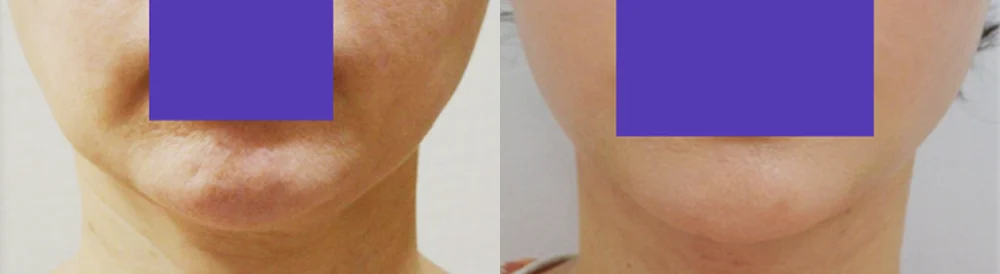
The chin and jawline area looked lumpy and the contour uneven (front view)
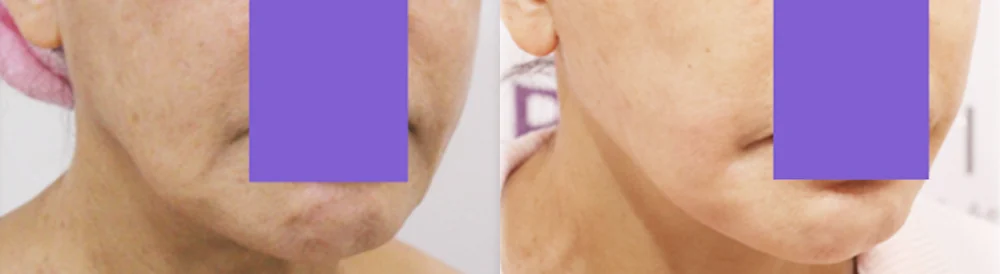
The contour below the chin looked lumpy (angled view)
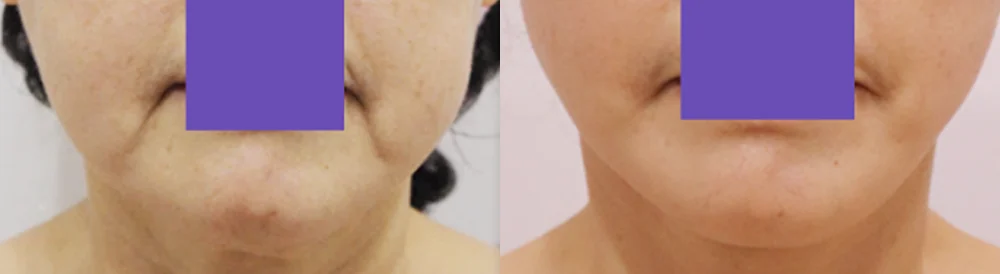
Both sides of the mouth bulged and the jaw contour was uneven (front view)
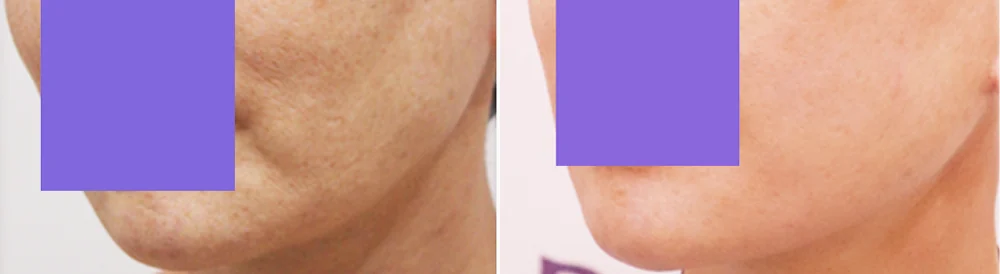
The skin of the lower cheek looked dented and uneven (angled view)
* Results vary from person to person. Side effects are possible, so please decide after a thorough consultation with a doctor.
Frequently asked questions
How much asymmetry is worth treating?
There is no fixed number. In research, other people began to notice a difference at about 2 mm for the eyelids, 3 mm for the corners of the mouth and 6 mm for the chin.3 In practice, where the difference sits, whether it grows when you smile and how much it bothers you in daily life matter more. At consultation we look at your face at rest and smiling, and start by finding the cause.
Is it from chewing on one side or sleeping on my front?
It has been suggested that such habits affect the shape of the face, but the idea remains controversial.1 Rather than blaming a habit, the first step is to find which layer differs: bone, muscle, soft tissue, scar or foreign material. If your bite has changed or your jaw joint is uncomfortable, see a dentist first.
I am in my twenties and my jaw seems to be shifting to one side. What should I do?
If your jaw keeps becoming more uneven after you have stopped growing, a bone cause such as condylar hyperplasia, in which the bone at the head of the jaw joint overgrows on one side, needs to be ruled out. This condition can progress until about age 27 and is often mistaken for other kinds of asymmetry.4 Before covering it with filler or fat, have an orthodontist or an oral and maxillofacial surgeon examine it.
Can fat grafting make both sides exactly the same?
That cannot be promised. Faces are naturally a little different on each side, and part of the transferred fat is absorbed. At Bonita Clinic, we measure the volume difference and fill it, decide the amount with absorption in mind and, once things have settled, fine-tune any difference that remains.
One corner of my mouth has suddenly dropped and my eye won't close properly.
One-sided drooping that appears over a few days may be a facial nerve problem, so a medical examination comes before any cosmetic consultation. The guideline recommends ruling out other causes first and, for Bell's palsy (when no cause is found), oral steroids within 72 hours of the first symptoms for patients aged 16 and over.5 If it came on suddenly, over minutes to hours, it may be a stroke even if your forehead still moves, so call emergency services or go to an emergency department straight away, even without arm or leg weakness or slurred speech.
Before your consultation
- When the difference first appeared, and whether it is getting worse or came on suddenly
- Older photos: from your teens or twenties, and from before any procedures or surgery
- Whether your bite has changed, and whether your jaw joint clicks or hurts
- What caused any scar, when, and what scar treatment you have had
- Where and when you had fillers or injections and what was used, if you know, plus records of any removal done elsewhere
- Front, 45-degree and profile photos, plus photos smiling broadly and with your mouth wide open
Bonita Clinic is on the 3rd floor of 565 Gangnam-daero, Seocho-gu, Seoul, about 100 m on foot from Exit 8 of Nonhyeon Station (Line 7). You can read more on our Multi Lifting after Scar Removal and Multi Lifting after Filler Removal pages. If sagging and hollows without scars or fillers are your main concern, see Multi Lifting and our Multi-Lifting guide; for treating a sunken facial scar itself, see the guide to depressed facial scars.
References (6)
Sources that support the explanations in this article. Study findings describe general trends and do not guarantee individual results.
- Thiesen G, Gribel BF, Freitas MP. Facial asymmetry: a current review. Dental Press J Orthod. 2015;20(6):110-125.doi:10.1590/2177-6709.20.6.110-125.sarReview (full text): mild facial asymmetry is common and usually goes unnoticed (clinically visible in 12–37%, 23% and 21% of orthodontic patients in different countries, over 50% on radiographs); dental, skeletal, muscular and functional types; congenital, acquired and developmental causes including hemifacial atrophy; lower-face deviation is most frequent; history, photos, intraoral exam and CBCT; soft tissue can be more asymmetric than bone at the mouth corners; one-sided chewing and sleeping habits remain controversial hypotheses
- Severt TR, Proffit WR. The prevalence of facial asymmetry in the dentofacial deformities population at the University of North Carolina. Int J Adult Orthodon Orthognath Surg. 1997;12(3):171-176.Retrospective survey (abstract) of 1,460 patients at a dentofacial deformity clinic (jaw shape or bite problems): 34% had clinically apparent asymmetry; among them the chin was involved in 74%, the midface (mainly the nose) in 36% and the upper face in 5%; the occlusal plane was canted in 41%
- Wang TT, Wessels L, Hussain G, Merten S. Discriminative Thresholds in Facial Asymmetry: A Review of the Literature. Aesthet Surg J. 2017;37(4):375-385.doi:10.1093/asj/sjw271Systematic review (abstract) of perception studies: asymmetry starts to be noticed at about 2 mm for eyelid position at rest, 3 mm for the mouth corner, 3.5 mm for the brow, 4 mm for nasal tip deviation and 6 mm for chin deviation; beyond the intervention threshold, the wish for surgery rises exponentially rather than linearly
- Riechmann M, Gellrich NC, Kress B, et al. Clinical Practice Guideline: Condylar Hyperplasia of the Mandible—Diagnosis and Treatment. Dtsch Arztebl Int. 2024;121(24):816-823.doi:10.3238/arztebl.m2024.0210German clinical practice guideline (systematic review plus Delphi consensus, full text): condylar hyperplasia causes progressive one-sided jaw asymmetry and bite changes from puberty or adulthood, usually up to about age 27; about a third of patients do not notice it; misdiagnosis is common; examination and panoramic X-ray, then SPECT; treatment is mainly surgical; evidence is mostly level 4–5
- Baugh RF, Basura GJ, Ishii LE, et al. Clinical practice guideline: Bell's palsy. Otolaryngol Head Neck Surg. 2013;149(3 Suppl):S1-S27.doi:10.1177/0194599813505967American Academy of Otolaryngology clinical practice guideline (abstract): sudden one-sided facial weakness needs history and examination to exclude other causes; oral steroids within 72 hours for patients 16 and older with Bell's palsy; eye protection if the eye does not close; reassessment or referral for new neurological or eye symptoms or incomplete recovery at 3 months
- Lemperle G, Gauthier-Hazan N, Wolters M, et al. Foreign body granulomas after all injectable dermal fillers: part 1. Possible causes. Plast Reconstr Surg. 2009;123(6):1842-1863.doi:10.1097/PRS.0b013e31818236d7Review (abstract) of foreign-body granulomas after dermal fillers: a rare complication (1% to 0.02%) appearing months to years after injection at all injected sites at the same time; non-degradable materials do not cause them more often, but their lumps are more pronounced and last longer if not treated properly
About this article
This article separates general medical information from Bonita Clinic's own approach. Because the right decision depends on each person's condition, it is not a substitute for a consultation.