KOKorean
 ENEnglish
 JP日本語
 CN中文(简体)
 TW中文(繁體)

Breast Augmentation Recovery in Seoul: When Can You Shower, Exercise and Return to Daily Life?
Daily life after breast augmentation comes back in stages: walking around the house is possible from the day of surgery, and showering is generally considered safe from 48 hours after surgery. Soaking the wound in a bath or pool, and exercise that works the chest muscles hard, wait until a check-up confirms the wound has healed. A randomized trial found that starting exercise one week after surgery did not increase complications, but when you restart depends on the extent of surgery and how the wound is healing. At Bonita Clinic, surgery is done without general anesthesia with same-day discharge, and one to two months of breast massage is not required.
Curious about your own case? Ask us online →

What does recovery after breast augmentation look like, step by step?
Daily life after breast surgery does not come back all at once; it widens in stages. This guide is written mainly for recovery after breast augmentation with implants and after revision surgery in which an implant is replaced. If an implant is removed and the breast is refilled with your own fat, the area where fat was taken also needs its own recovery care.
One thing is worth knowing first: there is surprisingly little research comparing when it is safe to do what. The authors of a 2022 randomized controlled trial (a study that assigns participants to groups by chance, like drawing lots) noted that scientific data on exercise after breast augmentation are limited. Advice to avoid activity ranges from a few weeks to a few months.1 So rather than memorizing a single date, it is more accurate to think of recovery as stages you move through as your body heals.
Broadly, the stages look like this:
- Day of surgery: go home and rest, walk slowly around the house, and start with light tasks such as eating and washing your face.
- After 48 hours: a UK clinical guideline recommends telling patients that they may shower safely 48 hours after surgery.4
- Until the stitches come out: widen your everyday activity as swelling and the feeling of tightness ease.
- Once the wound has healed: soaking the wound in a bath, pool or sauna, and exercise that works the chest muscles hard, wait until the wound has been checked.
- Over several months: as swelling goes down, the breast shape gradually settles.
At Bonita Clinic, implants are placed through a small endoscopic incision, surgery is done without general anesthesia, and you go home the same day. There are stitches, and both the recovery period and the visit schedule depend on the extent of surgery and your individual condition.
When and how can you return to everyday tasks?
The four questions patients ask most during recovery are gathered below. Each one is explained in detail in the sections that follow.
Everyday tasks during recovery
1When you want to shower
Considered safe from 48 hours after surgery; baths, pools and saunas wait until the wound has healed
Showering
2When you need to lift your arms overhead
Widen the range little by little, guided by pulling and pain, and watch an armpit incision
Using your arms
3When you want to exercise again
Walk early; sweaty workouts and chest exercises are timed at a check-up
Exercise
4When you are choosing a bra
A front-closure wireless bra is easy to put on; keep underwires off a fold incision
Bras
When can you shower after breast augmentation?
The surgical site infection guideline of the UK's National Institute for Health and Care Excellence (NICE) recommends advising patients that they may shower safely 48 hours after surgery.4 The same guideline recommends that clinical staff use sterile saline (sterile salt water) when they clean the wound during the first 48 hours. It also recommends that patients be told how to care for the wound after discharge, how to recognize an infection, and whom to contact if they are worried.4 The showering recommendation was set in 2008 and has been kept unchanged since.
It helps to separate "showering" from "soaking":
- Showering: water runs briefly over the wound and away.
- Soaking: the wound stays under water or in strong heat for a long time — a bath, a swimming pool, the sea, a sauna or a hot spa.
Showering is considered safe from 48 hours. Soaking, however, should wait until the stitches are out and a check-up confirms that the wound has fully closed. Put simply: rinsing comes early, soaking comes later.
When you shower:
- Follow your clinic's instructions on whether to remove the tape or dressing (wound cover) or to leave it on while you wash.
- Do not scrub the wound. Afterwards, pat it dry gently with a clean towel.
- Keep the first shower short and lukewarm. You may feel lightheaded while taking painkillers or standing for long, so it is safer to shower when someone else is at home.
- If raising your arms over your head is hard, lean back to wash your hair as you would at a hair salon, or ask someone to help.
How much can you use your arms, and when?
Your arms and chest are more closely linked than you might think. The large chest muscle (pectoralis major) starts from the breastbone and collarbone and attaches to the top of the upper arm bone. It works whenever you bring your arms forward, push something or lift. If the implant sits under this muscle, forceful arm movements put load on the operated area. If the incision was made in the armpit, raising your arm high can pull on that spot.
There is no evidence, though, that keeping your arms completely still is better. The randomized trial mentioned above did not test arm use on its own, but women who started an exercise program one week after surgery did not have more complications.1 So a realistic approach to using your arms is "widen the range little by little, guided by pulling and pain" rather than "stop everything."
In order, it looks like this:
- At first, do tasks that keep your elbows close to your body: eating, washing your face, using your phone.
- As the pulling eases, add tasks that use your arms up to shoulder height, such as drying your hair or changing clothes.
- Reaching high overhead, lifting heavy things such as shopping bags or a child, and pushing hard are added after the wound has been checked.
A few preparations make daily life easier:
- Have tops and bras that open at the front, so you can dress without raising your arms overhead.
- Before surgery, move things you use often onto shelves between waist and chest height.
- If you often need to lift a young child, arrange help for the recovery period in advance.
If pain suddenly gets worse or one breast swells noticeably while you are moving, stop and tell the clinic. These signs are summarized again below under "Which symptoms should you report right away?"
When can you exercise again?
It is easiest to think of exercise in three groups: light movement such as walking, workouts that make you sweat and breathe hard, and exercises that work the chest muscles hard.
Walking starts early
Walking slowly around the house is something you can do from the day of surgery. In a large US study of about 129,000 people who had cosmetic surgery, the rate of venous blood clots (clots in a vein) within 30 days of breast surgery was 0.01%, about 1 in 10,000. It rose to 0.21% after body procedures on the trunk or limbs and to 0.28% when body and breast surgery were combined. Combined procedures in general had a higher rate (0.20%) than single procedures (0.04%).5 So clots are uncommon after breast surgery alone. If another procedure such as liposuction was done at the same time, clots are more likely, so it is even more worthwhile to get up and walk often.
A randomized trial of exercise from one week
A study published in 2022 in the journal of the American Society of Plastic Surgeons randomly divided women having a first breast augmentation at one private practice into two groups. One group followed the usual activity restrictions; the other started exercising one week after surgery. Among the 225 women in the final analysis, the results were:1
- Complications: 7.5% in the restricted group and 6.9% in the exercise group, with no difference.
- Scars: scar scores at 12 months were similar, 29.9 and 29.6.
- Satisfaction: on a questionnaire answered by the patients themselves (BREAST-Q), satisfaction with the outcome was 83.4 in the exercise group, higher than 66.3 in the restricted group.
The authors concluded that early exercise after a first breast augmentation did not increase complications or reoperations and did not reduce scar quality after one year.1
This does not mean "any exercise is fine after one week." Keep these points in mind:
- It is one study from a single practice.
- The exercise group followed a supervised program (aerobic or strength training, three times a week for 12 weeks), and the restricted group avoided exercise for 12 weeks.7 Exercising on your own may not be the same.
- Participants could not help knowing which group they were in. Satisfaction was self-reported, so the experience of exercising itself may have influenced the answers.
- Results may differ with the surgical technique, implant size and where the implant was placed.
In plain terms, the study is a good reason to rethink the idea that only long rest is safe. Your own exercise plan, however, should be based on how your own wound is healing.
Chest-muscle exercises come last
Exercises that work the chest muscles and arms hard — push-ups, bench presses, pull-ups, heavy weights, freestyle swimming — belong at the very end of recovery. What needs checking before you restart depends on whether the implant sits under the muscle and where the incision was made. For running and other exercise in which the breasts move a lot, start at a light intensity once you have a supportive sports bra.
Which bra should you wear after breast surgery, and for how long?
Wrapping the breasts with a bra or band after surgery to press on them is called compression. A 2023 review (a paper that gathers earlier studies) of the evidence for compression after plastic surgery summarized the breast research like this:2
- In a 2001 trial that randomized 130 women having breast augmentation, foam compression applied after surgery and removed the next morning made no difference to hematoma (a pocket of collected blood), bruising, hardening or infection. Of the women who had compression, 39% found it uncomfortable.2
- In a 2023 trial of 201 women after breast cancer surgery, among those who still had pain at three weeks, pain scores were lower with a compression bra than with a soft bra (2.0 vs 2.7 on a numeric pain scale).2
- The review concluded that compression after breast surgery may help reduce pain, but there is no evidence that it speeds recovery or prevents complications. That does not mean it should not be used; the benefit and the discomfort should be weighed together with your surgeon.2
In other words, a bra after surgery is closer to "a tool that supports you comfortably" than "the tighter the better." When choosing one:
- A wireless bra that opens at the front lets you dress without lifting your arms high, which is easier early on.
- If it is so tight that breathing feels restricted, if it cuts into the skin along one line, or if it rubs, check the size and shape again.
- If the incision is in the breast fold, keep underwires from pressing or rubbing on it. When you can return to underwired bras is decided at a check-up, based on how the wound and shape have settled.
- When you go back to exercise, have a sports bra that limits movement.
Do you need breast massage after implants?
At Bonita Clinic, one to two months of breast massage after surgery is not required.
Breast massage has long been recommended to prevent capsular contracture, in which the thin layer of tissue the body forms around an implant (the capsule) thickens and tightens, making the breast firm or changing its shape. The evidence for massage, however, is weak. A literature review that searched studies from 1975 to 2017 found only four eligible studies (587 patients). Massage started two days to two weeks after surgery, twice a day for two to five minutes per breast. The average contracture rate was 31% with massage and 40% without.3 In the largest study (453 patients), however, contracture was actually 35% with massage and 30% without.3
Those numbers are hard to take at face value. Methods and results varied so much between studies that they could not be compared statistically, and all four studies were from 1976 to 1990. The implants studied then (smooth-surfaced gel implants, double-lumen implants and others) may differ from those used today.3 The authors concluded that current data do not support massage to prevent capsular contracture, and that studies with a standardized method are needed.3
There is also an experience report that stressed compression. Its authors recommended pressing the breasts by hand, wearing a compression bra and sleeping face down for three months, and reported that none of about 1,000 implants then needed surgery for contracture. Because it was not a properly designed comparative study, its conclusion was judged hard to rely on.2
In short, massage is not proven well enough to be a required recovery task. Unless your surgeon has advised it for your particular implant or condition, avoid kneading the breasts firmly before the wound has healed. Capsular contracture and how it is treated are covered in our breast implant guide.
When can you change your sleeping position, drive and go back to work?
Sleeping position
At first, lying on your back so nothing presses on the breasts is most comfortable. A pillow behind your back to raise your upper body a little makes it easier to lie down and get up. Advice on when you may sleep on your front varies widely between surgeons; as in the report above, some surgeons even recommended sleeping face down.2 So it is closer to each clinic's practice than to a rule set by evidence. Follow the instructions of the clinic that operated on you.
Driving
Do not drive while taking painkillers that can make you drowsy. You can start to think about driving when turning the wheel fully, braking suddenly and the seatbelt pressing on your chest no longer hurt or pull. Always wear your seatbelt, during recovery too.
Work
How long you need off depends on your job — whether it is desk work, or involves lifting heavy things or using your arms a lot. If you tell us about your work and schedule at consultation, it is easier to plan recovery around them.
Can you fly after breast augmentation?
After breast surgery alone, blood clots are uncommon, but there is no fixed date that suits everyone: when you can fly is decided at a check-up based on the extent of surgery and your own risk factors. The main concern on a long journey is a blood clot in the leg veins after sitting for hours. In the US study above, venous clots within 30 days of breast surgery were rare, at 0.01%. The risk was higher with body procedures, with several procedures at once, with a higher body mass index (weight relative to height) and with older age.5
The British Association of Aesthetic Plastic Surgeons (BAAPS), in its guidance for patients travelling for surgery, considers that total travel time of around four hours already affects risk. During travel it advises an aisle seat, plenty of fluids, moving about during the flight, and anti-embolism (clot-prevention) stockings.6 This guidance is expert opinion rather than the result of a study.
The same guidance names people who need particular attention: those with a personal or family history of clots, a body mass index over 30, age over 40, or who take oral hormone therapy or the contraceptive pill.6 For breast surgery, one practical point matters too: lifting a carry-on bag into the overhead bin means raising your arms and lifting weight at the same time. Check your bag in, or ask the cabin crew or a companion for help.
Which symptoms should you report right away?
Most discomfort during recovery eases a little each day. Some changes, however, should never be waited out.
If you notice this
After surgery, if you notice…
- Sudden breathlessness, chest pain worse on breathing in, coughing blood, or one swollen, painful calfEmergency care right awayPossible blood clot
- One breast swelling quickly, hard and painfulCall your surgeon's clinic nowBlood may have collected
- A red, hot, swollen wound, fever or pusContact your surgeon's clinicPossible infection
- Swelling and bruising on both sides easing dailyCheck at your scheduled visitCommon during recovery
- If one breast swells quickly, becomes hard and painful, or bruising spreads fast, blood may have collected. Call the clinic that operated on you right away.
- If the skin around the wound is hot, red, swollen and painful, it may be a sign of infection. In more serious cases there is fever, the wound edges separate, or pus collects deeper down.4 Contact the clinic right away in this case too.
- If you suddenly become breathless, have chest pain that is sharp when you breathe in, cough up blood, or one calf is swollen and painful, it may be a sign of a blood clot. Do not wait: go to an emergency department or the nearest hospital.
- If both sides are similarly swollen and bruised and it eases a little every day, that is common during recovery. It is checked at your scheduled visit.
A breast that swells or hardens years after surgery is a different matter from recovery. Those changes and regular check-ups are explained in our breast implant guide and breast revision guide.
How we approach recovery at Bonita Clinic
Surgery and recovery at Bonita Clinic
- 1ConsultationBody shape and goals; implant size and incision site
- 2SurgerySmall endoscopic incision, no general anesthesia
- 3Same-day dischargeRecovery starts at home; there are stitches
- 4Recovery and check-upsVisits set by extent and condition; massage not required
What is possible, the method and the recovery schedule are explained at an in-person consultation.
Breast surgery options you can discuss in Seoul
Bonita Clinic has treated patients at the same location since opening in 1995, where Dr. Kwang-Seop Jung, a board-certified plastic surgeon (Brazil), sees patients himself. For breast surgery and recovery, what you can discuss at consultation is the approach described on our treatment pages:
- Breast augmentation with implants through a small endoscopic incision, without general anesthesia, with same-day discharge
- Implant replacement for contracture, rupture, position change or size, with the capsule treated at the same time
- Implant removal followed by refilling with your own fat and stem cells
- Choosing a size your tissue can support, based on tissue laxity, breast base width, body type and the look you want
See our Safe Breast Augmentation page and Breast Revision page for details. Which approach suits you is decided only after an examination.
Why do the plan and cost differ from person to person?
Two people who both say "breast augmentation" can need quite different operations, and quite different recovery. What shapes the plan, and therefore the cost, is the type of surgery, what has to be done to any existing implant, and your tissue.
- First augmentation, or revision of an earlier implant
- Implant replacement with capsule treatment
- Removal and refilling with your own fat and stem cells
- Implant type and size
- Incision site: armpit, areola or breast fold
- Previous breast surgery or injections
Final plan and quote after an in-person exam
A final estimate is given only after an in-person examination, once the method, the implant and the extent of surgery are clear. Photos help narrow down the options before you travel; the details are settled at the examination.
What can photos show, and what needs an in-person exam?
Photos are a good way to start, because size, shape and symmetry are visible. They cannot show how thick the tissue is, how far the skin stretches, or what is happening around an existing implant.
Photos can show
- Breast size and shape, front and side
- Left–right difference
- Existing scars and where they are
- Visible changes after earlier surgery
- Chest width and body proportions
Needs an in-person exam
- Tissue thickness and skin stretch
- Breast base width and fold position
- Firmness around an existing implant
- Implant condition (imaging if needed)
- Medical history and clot risk
Helpful photos: front, both sides and both 45-degree views, from the neck down without your face, standing straight with your arms relaxed, against a plain wall in even light, with the camera at chest height. If you have had breast surgery before, the approximate date and any implant details you have are useful. You can send us a message with your photos and a short note on what you would like to change and when you plan to travel.
Planning your stay in Seoul and your recovery back home
If you are planning breast surgery in Seoul, you can tell us your travel dates at consultation so the recovery stages and your flight home are planned together. What is confirmed in advance is the treatment information above: surgery without general anesthesia, same-day discharge, and stitches. How long you should stay in Seoul and how many follow-up visits you need depend on the extent of surgery, so they are planned together with you at consultation.
International guidance can help you think about timing. The BAAPS guidance divides operations into three groups by anesthesia and length rather than by name; which group an operation falls into depends on its length and extent, and yours is discussed at consultation. For travel of around four hours or more, it suggests that patients in its second group (general anesthesia up to three hours, or longer local anesthetic procedures) be in the destination country at least 72 hours before surgery and for one to two weeks after. For its third group (longer operations, several sites, or a higher clot risk) it suggests one week before and two to four weeks after.6 It also recommends that suture removal be booked before discharge, that the operating surgeon review you at least once before you fly home, and that follow-up continue by phone or video after you return, with checks at one to two weeks and between six weeks and six months.6 This is a UK society's expert opinion, not a schedule we promise; your own plan is made at consultation.
A few points make the trip home easier:
- Before you leave Seoul: make sure you know your wound-care steps, which bra to wear, and what you may and may not lift.
- On the plane: take an aisle seat, drink water and walk when you safely can.6 Do not lift your bag into the overhead bin yourself.
- At home: keep dated photos of the breasts and incisions taken in the same light, and keep the details of your surgery and implant, so any doctor can follow your progress.
- If something changes: contact a doctor promptly if pain, redness, swelling or one-sided enlargement increases instead of settling; for sudden breathlessness, chest pain that worsens when you breathe in, coughing blood or a painful swollen calf, seek emergency care at once.
For more on caring for yourself after you return, see our guide to aftercare at home after surgery in Korea.
Real treatment cases
These cases are from our Safe Breast Augmentation page. Results vary from person to person.
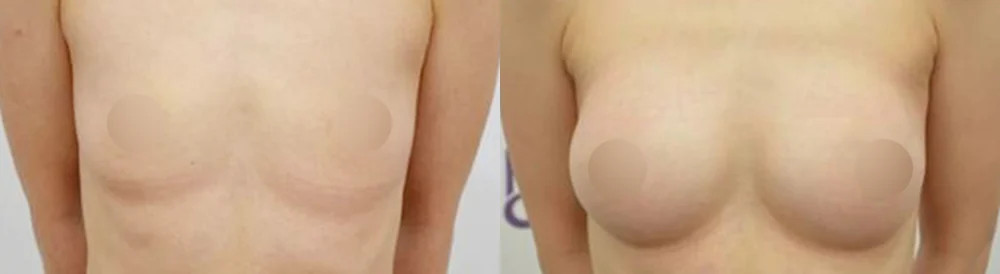
Small, flat breast volume (front view)
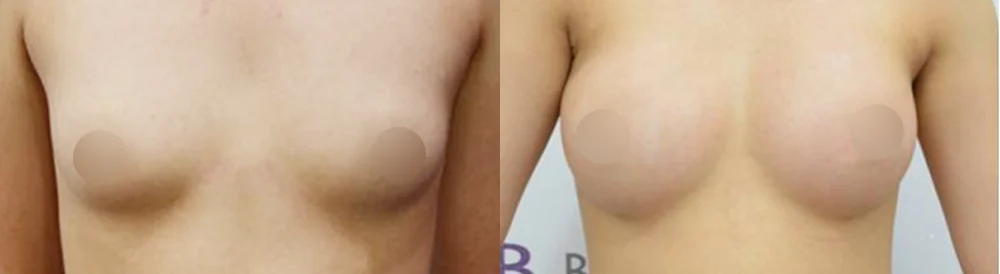
Small breast volume (front view)
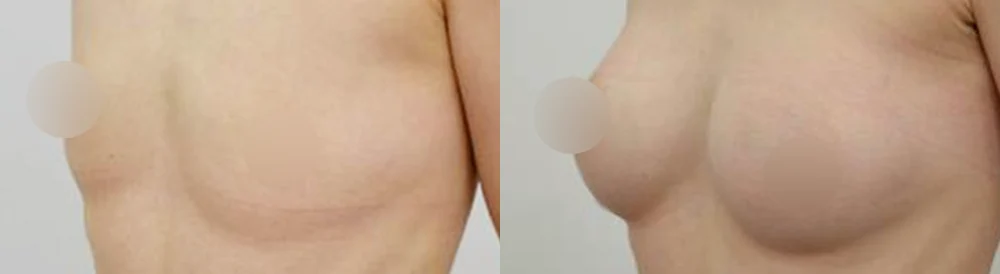
Small breast volume (angled view)
* Results vary from person to person. Side effects are possible, so please decide after a thorough consultation with a doctor.
Frequently asked questions
Can I go back to work the day after surgery?
It depends on your job, your pain and your medication. Breast surgery at Bonita Clinic is done without general anesthesia and you go home the same day, but being able to go home is not the same as being ready to work. You may need longer if you are taking painkillers that make you drowsy, or if your job involves lifting or heavy arm use. Tell us about your work and schedule at consultation so recovery can be planned around it.
When can I wash my own hair?
A clinical guideline says showering is fine from 48 hours after surgery.4 Washing your own hair, though, means raising your arms overhead, which may pull at first. Until then, lean back to wash it as at a salon or ask for help, and switch to doing it yourself once raising your arms no longer pulls.
When can I go back to the gym?
A randomized trial found that women who started exercise one week after surgery did not have more complications.1 It is a single study of a supervised program, however,7 and the exercise people actually do varies a lot. Start with walking and light lower-body exercise that uses the chest less, and leave chest exercises such as push-ups and bench presses until the wound has been checked.
Will skipping massage make capsular contracture more likely?
There is no clear evidence for that. Only four studies have looked at massage and contracture, all of them old, and the authors concluded that current data do not support massage.3 Contracture can occur with or without massage, so what matters is seeing a doctor if the breast becomes firm or changes shape, and keeping up regular check-ups.
When can I use a sauna, hot spring or swimming pool?
Soaking the wound in water or strong heat for a long time starts later than showering. It is wiser to wait until the stitches are out and a check-up confirms the wound has fully closed. Swimming also works the arms and chest muscles hard, so both the wound and the muscles are considered before you restart.
What to prepare before your consultation
- Your job, how much time off you can take, and any important dates after surgery
- The exercise you usually do, how often, and when you would like to restart
- Your travel dates and flight plans, including the length of the flight home
- Whether you need to lift a child or do heavy arm work at home
- Clot-related factors: the contraceptive pill or hormone therapy, smoking, any previous blood clot
- Medicines and supplements you take, and any previous breast surgery
Bonita Clinic is on the 3rd floor of 565 Gangnam-daero, Seocho-gu, Seoul, about 100 m on foot from Exit 8 of Nonhyeon Station (Line 7). For the types and known risks of implants, see our breast implant guide; for scar care once the wound has healed, see our guide to scar care after surgery.
References (7)
Sources that support the explanations in this article. Study findings describe general trends and do not guarantee individual results.
- Basile FV, Oliveira TS. Exercise after Breast Augmentation: A Randomized Controlled Trial. Plast Reconstr Surg. 2022;149(1):18e-24e.doi:10.1097/PRS.0000000000008676Randomized trial (abstract) at one private practice: women having a first breast augmentation were assigned to standard restrictions or exercise from 1 week (225 analyzed); complications 7.5% vs 6.9% (no difference), scar scores at 12 months 29.9 vs 29.6, patient-reported satisfaction (BREAST-Q) 66.3 vs 83.4; early exercise did not increase complications or reoperations. The abstract notes limited data and advice ranging from weeks to months, and does not detail the exercise
- Ormseth BH, Livermore NR, Schoenbrunner AR, Janis JE. The Use of Postoperative Compression Garments in Plastic Surgery—Necessary or Not? A Practical Review. Plast Reconstr Surg Glob Open. 2023;11(9):e5293.doi:10.1097/GOX.0000000000005293Practical review (full text) of postoperative compression: in a 130-patient breast augmentation trial, overnight foam compression made no difference to hematoma, bruising, induration or infection and 39% reported discomfort; in a 201-patient breast cancer surgery trial, compression bras lowered pain scores among those still in pain at 3 weeks (2.0 vs 2.7); an experience report of compression and prone sleeping was not a properly designed study; compression may reduce pain but has not been shown to speed recovery or prevent complications
- Sood A, Xue EY, Sangiovanni C, et al. Breast Massage, Implant Displacement, and Prevention of Capsular Contracture After Breast Augmentation With Implants: A Review of the Literature. Eplasty. 2017;17:e41.Literature review (full text) of massage after breast augmentation: 4 eligible studies (587 patients, published 1976–1990); massage began 2 days to 2 weeks after surgery, twice daily, 2–5 minutes per breast; contracture averaged 31% with massage vs 40% without, with results too varied for statistics; current data do not support massage to prevent capsular contracture
- National Institute for Health and Care Excellence (NICE). Surgical site infections: prevention and treatment. NICE guideline NG125. 2019;Recommendations 1.1.2-1.1.3, 1.4.2-1.4.3; published 2019-04-.UK NICE surgical site infection guideline (web page): advise patients they may shower safely 48 hours after surgery (recommendation set in 2008), sterile saline for wound cleansing up to 48 hours, information on wound care, recognizing infection and whom to contact; definition of surgical site infection (heat, redness, pain, swelling, fever, wound separation, deep abscess)
- Winocour J, Gupta V, Kaoutzanis C, et al. Venous Thromboembolism in the Cosmetic Patient: Analysis of 129,007 Patients. Aesthet Surg J. 2017;37(3):337-349.doi:10.1093/asj/sjw173Prospective cohort (abstract) from a US insurance database, 129,007 cosmetic surgery patients: venous thromboembolism within 30 days 0.09%; breast 0.01%, face 0.01%, body 0.21%, body and breast 0.28%; combined procedures 0.20% vs single 0.04%; risk factors were body procedures, combined procedures, BMI and age
- British Association of Aesthetic Plastic Surgeons (BAAPS). BAAPS Cosmetic Tourism Guidelines. . 2023;September 2023 v1.BAAPS guidance for patients travelling for surgery (full document, expert opinion): aisle seat, fluids, moving during the flight and anti-embolism stockings; total travel of around 4 hours affects risk; suggested stays by group (group 2: at least 72 hours before and 1–2 weeks after; group 3: 1 week before and 2–4 weeks after); higher-risk patients; suture removal booked before discharge, review by the operating surgeon before flying home, phone or video follow-up and checks at 1–2 weeks and 6 weeks to 6 months
- Wolters Kluwer Health: Lippincott. Early exercise shows benefits for women after breast augmentation. . 2021;Press release, 22 December 2021 (distributed via Newswise).Press release (web page) from the publisher of the journal that carried the randomized trial in source 1: the exercise groups began supervised aerobic or strength training three times a week for 12 weeks from one week after surgery, the control group was advised to avoid exercise for 12 weeks, and 75 patients per group completed the study; supports the point that the trial tested a supervised program
About this article
This article separates general medical information from Bonita Clinic's own approach. Because the right decision depends on each person's condition, it is not a substitute for a consultation.